Home » Competition » Recent Articles:

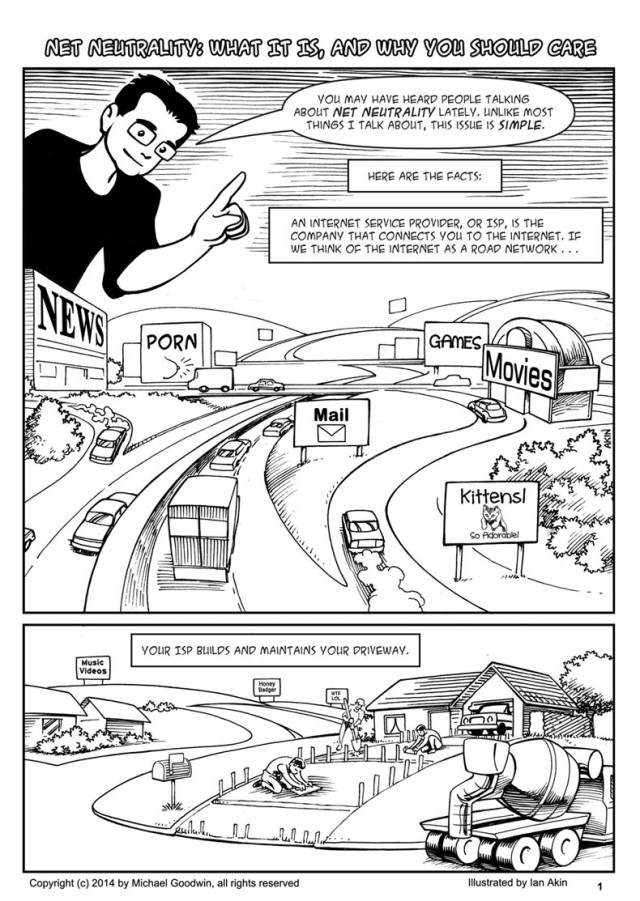
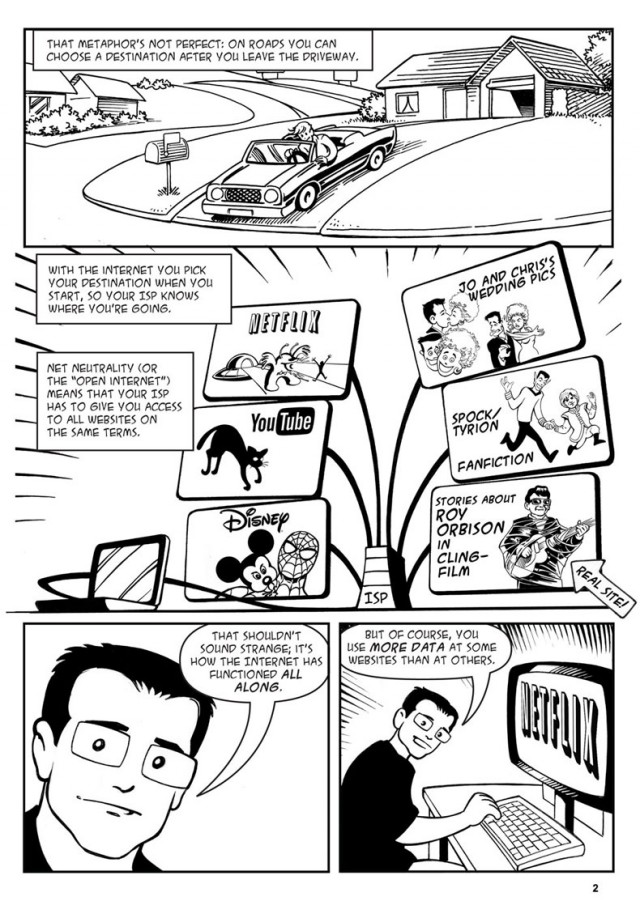
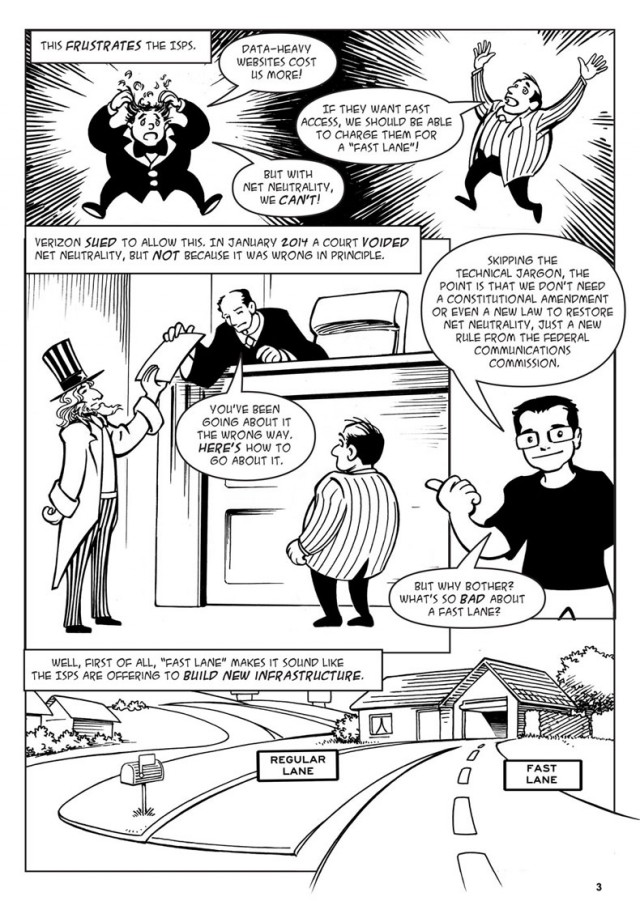
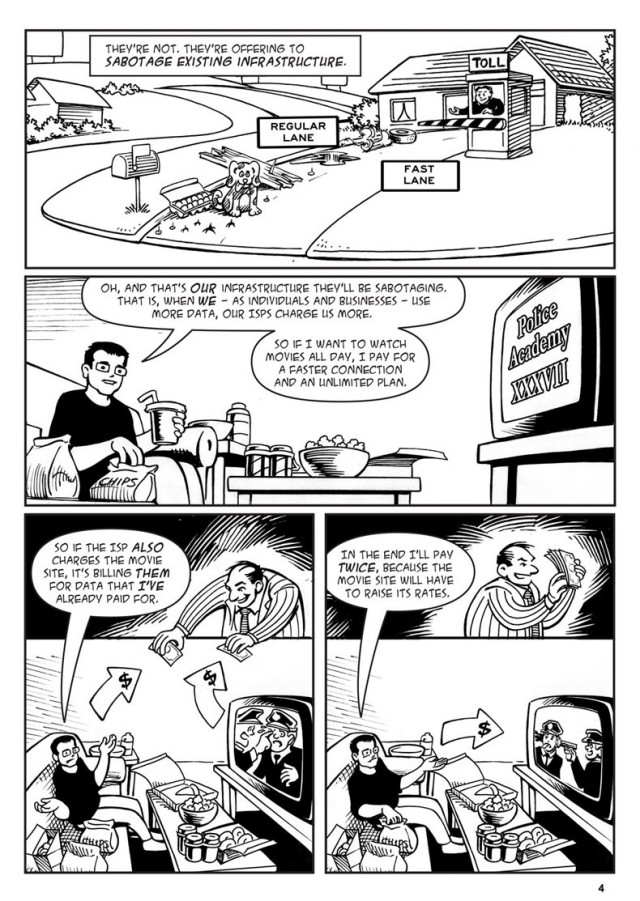
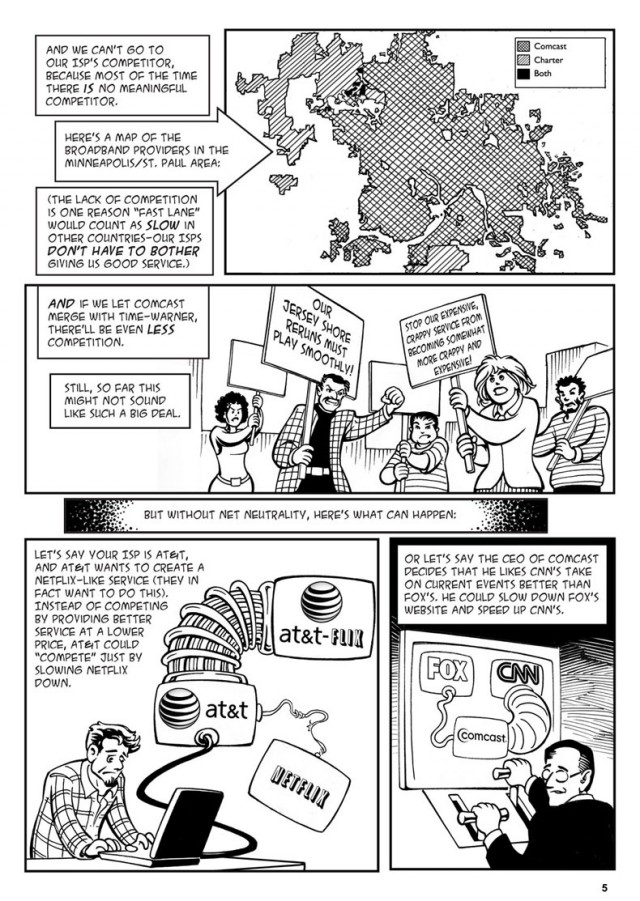
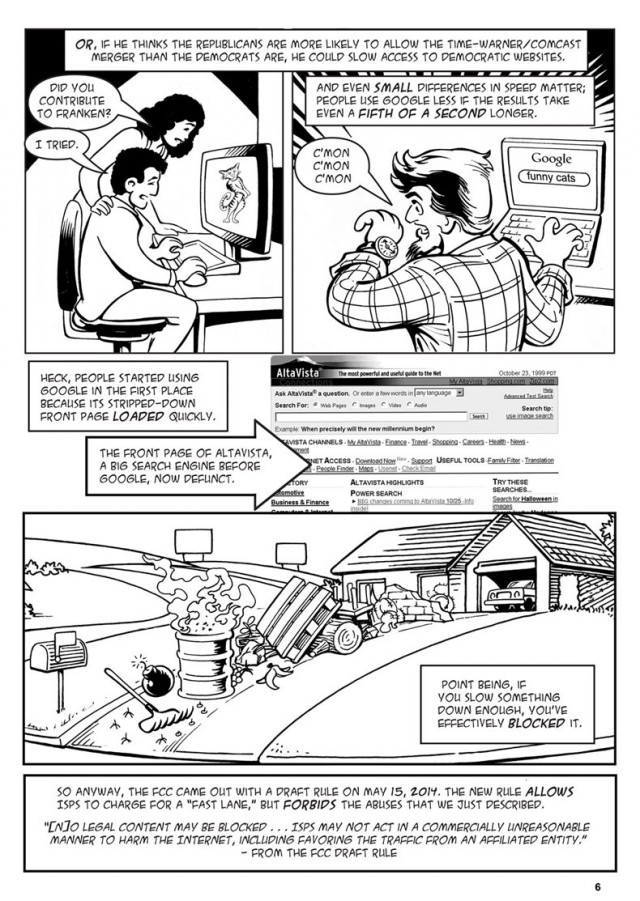
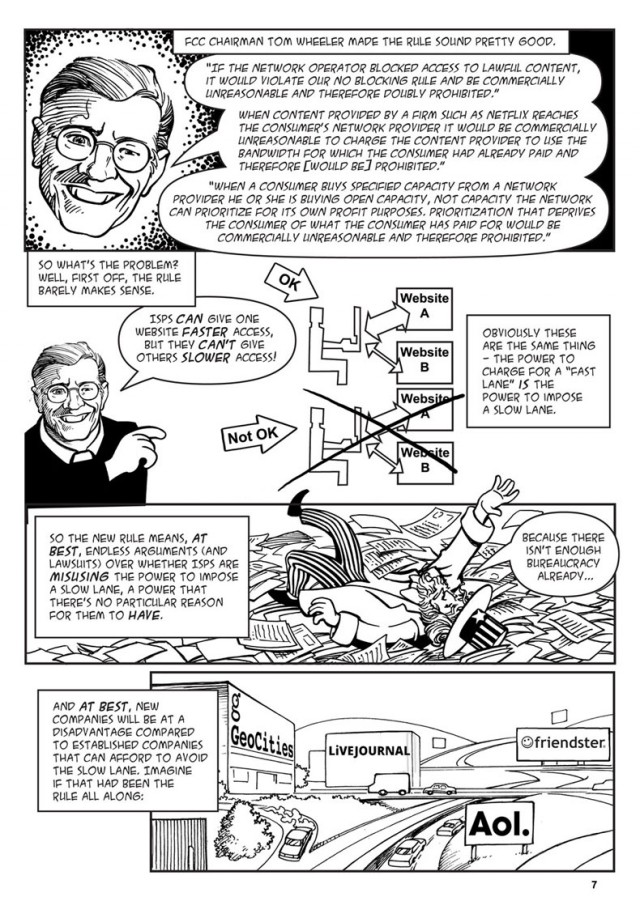
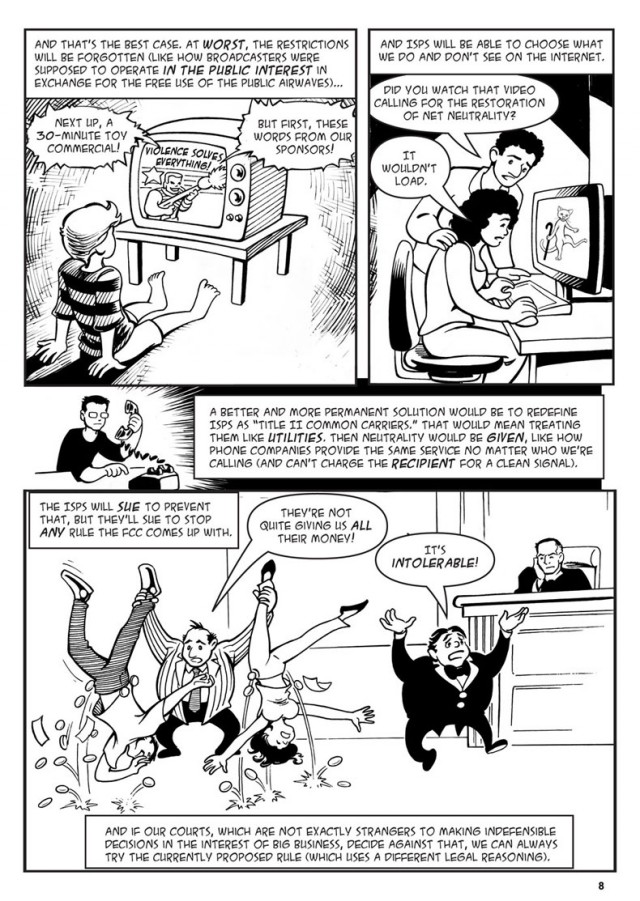
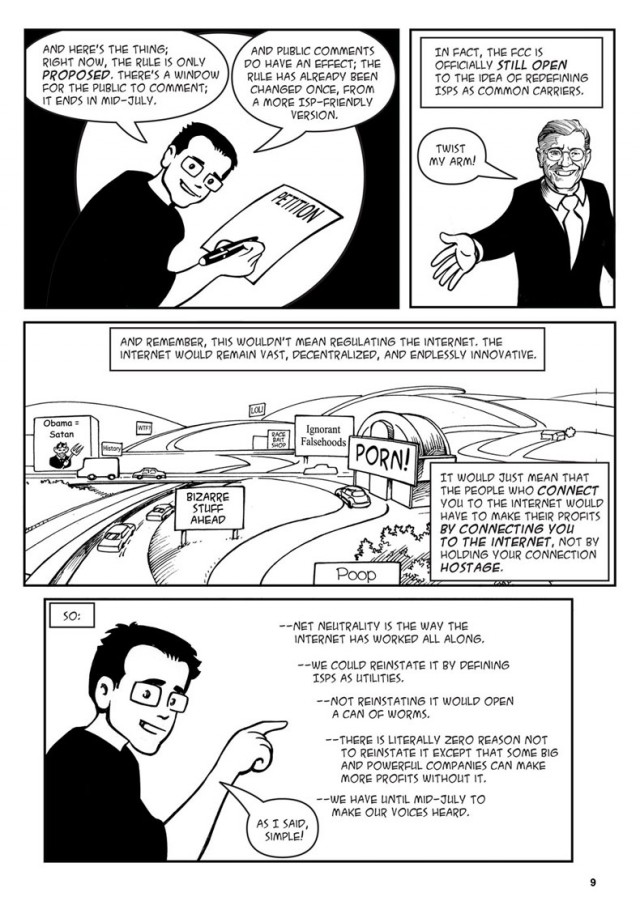
Net Neutrality Explained (for Those Who Hate Our Usual Long-Winded Articles)

For the benefit of those accustomed to content designed to appeal to the web’s short attention span and for those who loathe reading our usual epic-length articles, here’s a primer on Net Neutrality you can read without worrying there will be a test.

It’s one of the most important concepts of a free and open Internet, yet it has a name that evokes yawns from those who don’t understand it.

Thanks to Boing Boing for bringing it all together.

NetNeutralityPage15NetNeutralityPage22NetNeutralityPage32NetNeutralityPage42NetNeutralityPage52NetNeutralityPage62NetNeutralityPage72NetNeutralityPage82NetNeutralityPage92

Antitrust Us: Is ComVerizablAsT&TWCDirecTV Really Best for American Broadband?

Phillip Dampier July 2, 2014 Astroturf, AT&T, Broadband "Shortage", Broadband Speed, Comcast/Xfinity, Competition, Consumer News, Data Caps, DirecTV, Editorial & Site News, Net Neutrality, Public Policy & Gov't, Rural Broadband, Video Comments Off on Antitrust Us: Is ComVerizablAsT&TWCDirecTV Really Best for American Broadband?
Bad enough

Bad enough

A big company needs a big name, and so what if you can’t say it out loud, so long as your check reaches the cable cartel on time to avoid those inconvenient late fees.

The shock waves of the $45 billion dollar proposed merger of Comcast and Time Warner Cable (not to mention AT&T and DirecTV) have reached as far as Great Britain where appalled editorial writers in the British press are pondering whether Washington has lost its mind or just its integrity… or a combination of both, by actually contemplating the unthinkable rebirth of the American Robber Baron.

Only instead of railroads powering America’s early 20th century economy, today its broadband. Overseas, broadband is plentiful, fast, and cheap. Back home, cable operators are hard at work in a comfortable monopoly/duopoly working on excuses to justify Internet rationing with usage caps, outrageous equipment rental fees, rate hikes, and usage billing for a product about as cheap to offer as a phone call on one of those unlimited calling plans you probably already have.

From The Economist:

“On “OUTLAW”, a drama that aired on NBC, a Supreme Court justice leaves the bench to join a law firm. In real life he might have begun working for Comcast, America’s largest cable company, which owns NBC. Many of Washington’s top brass are on Comcast’s payroll, including Margaret Attwell Baker, a former commissioner of the Federal Communications Commission (FCC), America’s telecoms regulator, who in government had helped approve Comcast’s takeover of NBCUniversal in 2011. Even Barack Obama has Comcast ties. “I have been here so much, the only thing I haven’t done in this house is have seder dinner,” he quipped at a fundraiser hosted last year at the home of David Cohen, Comcast’s chief lobbyist.

“It helps to have influential friends, especially if you are seeking to expand your grip on America’s pay-TV and broadband markets.

“[…] The deal would create a Goliath far more fearsome than the latest ride at the Universal Studios theme park (also Comcast-owned). Comcast has said it would forfeit 3m subscribers, but even with that concession the combination of the two firms would have around 30m—more than 30% of all TV subscribers and around 33% of broadband customers. In the cable market alone (ie, not counting suppliers of satellite services such as DirecTV), Comcast has as much as 55% of all TV and broadband subscribers.

Worse

Worse

“Comcast will argue that its share of customers in any individual market is not increasing. That is true only because cable companies decided years ago not to compete head-to-head, and divided the country among themselves. More than three-quarters of households have no choice other than their local cable monopoly for high-speed, high-capacity internet.

“For consumers the deal would mean the union of two companies that are already reviled for their poor customer service and high prices. Greater size will fix neither problem. Mr Cohen has said, “We’re certainly not promising that customer bills are going to go down or even that they’re going to increase less rapidly.” Between 1995 and 2012 the average price of a cable subscription increased at a compound annual rate of more than 6%.”

Before blaming it all on President Obama’s close relationship with Comcast’s top executives, it was the Republicans in Washington that set this tragic monopolistic farce into motion. Michael Powell, President George W. Bush’s idea of the best man in America to protect the public interest at the FCC, represented the American people about as well as ‘Heckuva Job Brownie.’ Instead of promoting competition, Powell used his time to beef-up his résumé for a very cushy post-government job heading America’s top cable lobby – the National Cable & Telecommunications Association. Attwell-Baker was even more shameless, departing the FCC for her sweet new executive digs at Comcast just a short time after enthusiastically voting in favor of its NBCUniversal merger deal.
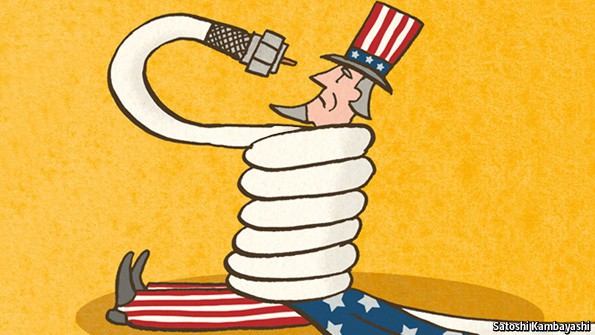
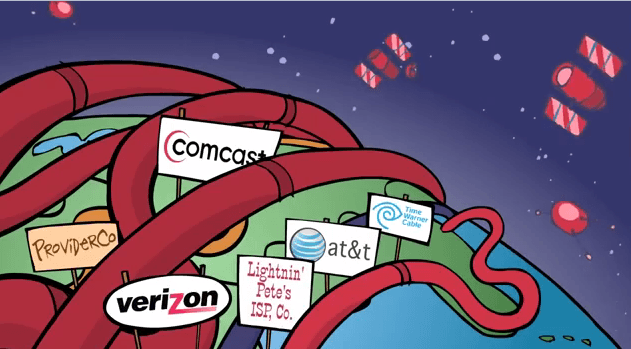
snakePowell and others made certain that Internet Service Providers would not be classified as “common carriers,” which would require them to rent their broadband pipes at a reasonable wholesale rate to competitors. The industry and their well-compensated friends in the House and Senate argued such a status would destroy investment in broadband expansion and innovation. Instead it destroyed the family budget as prices for mediocre service in uncompetitive markets soared. Today, consumers in common carrier countries including France and Britain pay a fraction of what Americans do for Internet access, and get faster speeds as well.

Letting Comcast grow even larger, The Economist argues, will allow one company to dominate not just your Internet experience, but also the content consumers access and at what speed.

“There is plenty for Mr Obama and Mr Cohen to discuss at their next dinner,” concludes the magazine. “But better yet, officials could keep their distance from Comcast, and reject a merger that would reduce competition, provide no benefit to consumers and sap the incentive to innovate.”

Considering the enormous sums of money Comcast has shown a willingness to spend on winning over supporters for its business agenda, restraint on the part of Washington will need voter vigilance, much the same way calling out non-profits who gush over Comcast while quietly cashing their contribution checks must also be fully exposed to regulators who will ultimately decide the fate of the merger.

[flv]http://www.phillipdampier.com/video/Antitrust Us.mp4[/flv]

Antitrust Us: Cartoonist Mark Fiore takes on the corporate idea that merging cable companies together creates more competition. (1:50)


Comcast’s Gain, Our Pain: New Yorkers Flood PSC With Comments Opposing Merger Deal

Phillip Dampier June 30, 2014 Broadband Speed, Comcast/Xfinity, Competition, Consumer News, Net Neutrality, Public Policy & Gov't, Rural Broadband, Video Comments Off on Comcast’s Gain, Our Pain: New Yorkers Flood PSC With Comments Opposing Merger Deal

Nearly 2,000 New York residents and counting have urged the state Public Service Commission to reject the proposed merger of Time Warner Cable and Comcast.

A review of the comments finds little interest in compromise and setting conditions in return for merger approval. Those commenting overwhelmingly want nothing to do with Comcast even if the company agrees to broaden its Internet Essentials program for the poor or agrees to continue voluntarily supporting Net Neutrality principles.

comcast no

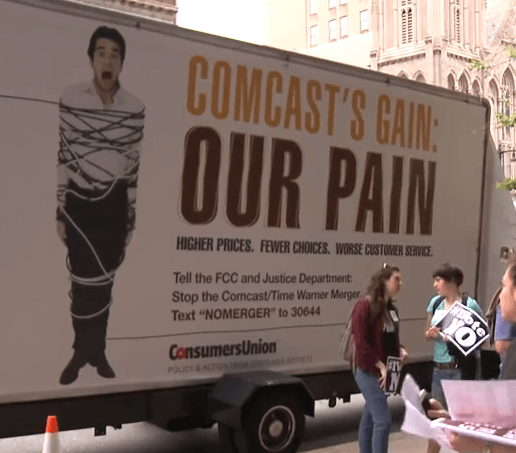
Consumers Union stormed the streets of Philadelphia during Comcast’s annual shareholder meeting to protest its merger deal with Time Warner Cable.

“There are ample examples of the rottenness of Comcast,” wrote I. VanKeuren from Wallkill. “It seems to me that instead of holding hearings on a possible merger of these two bad companies, the PSC should be investigating why Comcast has been so bad for so long.”

VanKeuren is hardly alone in his thinking.

A new survey from the Consumer Reports National Research Center found scant support for the merger among Americans.

The survey found 56% of Americans oppose the merger, and only 11% of respondents were in favor of it, with the rest either undecided or resigned to the belief it is out of their hands.

Cable companies rank among the least trusted organizations that most Americans do business with, so it’s not surprising that the people are concerned. Seventy-four percent of the public says they believe that prices will rise if the merger goes through, and two-thirds say that Comcast will have less incentive to improve customer service. The study, which drew on a nationally representative pool of 1,573 people, was conducted on behalf of the Consumers Union, the policy and advocacy arm of Consumer Reports.

“Most Americans don’t have time to follow complicated corporate mergers but this deal has definitely captured the public’s attention,” Delara Derakhshani, policy counsel for Consumers Union, said. “Consumers are tired of rising monthly bills and lousy customer service for cable and Internet and have little faith that this mega merger will make things any better.”  The new Comcast would control more than two-thirds of all cable television subscribers in the country, and nearly 40 percent of the high-speed Internet market.

Those statistics and past experiences dealing with Comcast have New York consumers like VanKeuren concerned.

“If […] the PSC approves this merger, then the PSC itself should [itself] be investigated with a complete reorganization as its goal,” said VanKeuren.

[flv]http://www.phillipdampier.com/video/No ComcastTime Warner Mega Merger 5-23-14.mp4[/flv]

Consumers Union protested outside of Comcast’s annual meeting in Philadelphia in opposition to its proposed merger with Time Warner Cable. (1:48)

Comcast Using Ethically Disgraced Ralph Reed to Advise on Time Warner Cable Merger

That "paragon of virtue" Ralph Reed is helping Comcast with their merger problems.

That “paragon of virtue” Ralph Reed is helping Comcast with their merger problems. (Image: Mark Fiore)

The owner of left-leaning MSNBC has engaged a religious conservative activist to handle consulting work on Capitol Hill for a cable company so hated, even ardent pro-business conservative Republicans are holding their noses contemplating a merger that would make Comcast even larger.

Ralph Reed has tried to keep his head down during his 8-10 year “association” with Comcast, whose executives make regular major contributions to Democratic Party candidates and play golf with President Barack Obama.

Reed’s ethically challenged past has made him notorious in Washington, and many well-connected lobbyists avoid publicly associating with the man who helped the disgraced lobbyist Ralph Abramoff rip off Native Americans for $100 million. Even worse, while Abramoff and Reed were working to rob various tribes blind in Mississippi, Alabama, and Louisiana,  the next mission would be protecting off-shore sweatshops in the Northern Mariana Islands, a U.S. possession that lacks American labor law protections. Workers were paid less than half the American minimum wage, had their movements restricted, were sexually exploited, and churned out products for corporations that could still claim they were proudly “Made in the U.S.A.”

Both men kept it ‘klassy with a k’ with respect to their paying clients. Abramoff routinely called  tribal leaders “monkeys” and Reed wanted to use his new found expertise in corporate lobbying to enrich himself. Reed sent e-mail to Abramoff recommending himself as a corporate lobbying asset, because of his ability to mobilize hundreds of thousands of religious conservative households through an extensive network of politically active pastors willing to use religion to advance the agendas of his corporate clients.

“I need to start humping in corporate accounts,” Reed wrote Abramoff, noting he could quickly create anti-gambling astroturf groups morally opposed to allowing new gambling ventures on religious grounds. In reality, his opposition was actually designed to protect Abramoff’s existing clients — Native American tribal casinos — from facing new competition.

comcast twcReed is theoretically trying to promote the Comcast merger with skeptical political and religious conservatives who have heard loud complaints from constituents about the cable company. But one of Reed’s self-proclaimed selling points is that he prefers to move in the shadows.
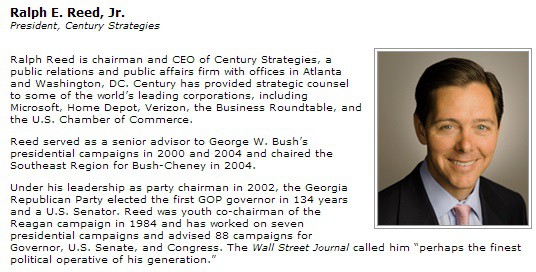

“I want to be invisible. I do guerrilla warfare,” Mr. Reed told a Virginia newspaper in 1991. “I paint my face and travel at night. You don’t know it’s over until you’re in a body bag.”

Had Reed kept a lower profile, his association with Comcast might have never seen the light of day.

“It’s widely known because Ralph’s been on conference calls,” one insider said. “It has been at least eight years; it’s been some time.”

Century Strategies, the Atlanta-based firm Reed owns, has been on retainer with Comcast for eight or 10 years, the source said.

ralph reed bio

Unfortunately for Comcast, Reed has appeared at one too many microphones lately, spouting off at various conservative functions including the annual Faith & Freedom Coalition, where he loudly compared the Supreme Court’s decision in favor of same-sex marriage as a historical mistake as explosive as the 1857 Dred Scott decision. That was the one where the court ruled that all blacks — slaves as well as free — were not and could never become citizens of the United States. How could I have missed the similarities!

Comcast didn’t respond to a request for comment about its reported engagement of Reed’s company. Century Strategies also didn’t respond to a request for comment from the Washington Blade, which exposed the Reed-Comcast link, to confirm the reports.

Much of what constitutes official paid lobbying vs. an informal conversation is just part of the murky world of Beltway lobbying. So far, Reed has not filed as an official lobbyist.

France’s Bouygues Telecom Announces 1Gbps Fiber, TV, Phone Package for $35/Month

Phillip Dampier June 26, 2014 Broadband Speed, Competition, Consumer News 1 Comment

173x116_Logo-BT_WSCustomers of Paris-based Bouygues Telecom in some of France’s largest cities will soon have access to 400Mbps fiber to the home broadband (with an upgrade to 1Gbps later this year), as well as a television and phone package that combined will cost $35.43 a month.
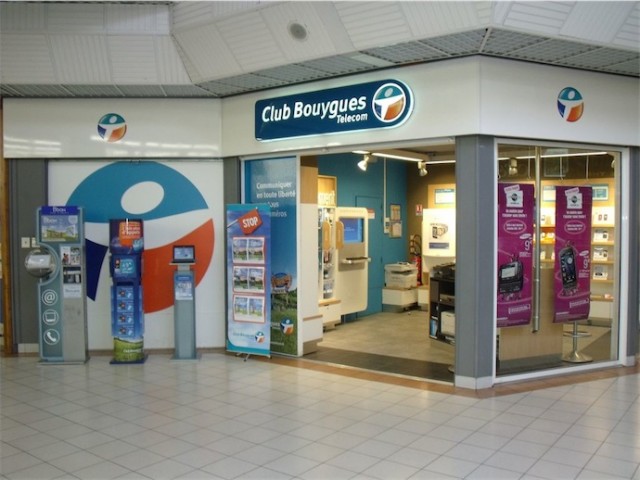
The company’s new fiber offer commences June 30 and comes as a result of fierce competition for the French broadband customer.

Bbox Sensation Fiber is available from both fiber to the home and fiber to the building connections throughout urban areas in France, including Paris, Lyon, Marseille, Nice, Toulouse and Bordeaux.

Fiber continues to gradually replace older copper-base wire networks in France. But unlike in North America, European telephone companies believe their future isn’t only in selling wireless. Upgrading those networks to fiber to the home service allow companies to sell bundled packages of phone, wireless, television and broadband Internet access.

Bouygues Telecom’s fiber to the home network now reaches 3.3 million French homes with more to come. Its older fiber to the neighborhood network reaches another 5 million customers.

Customers who sign up for the fiber to the home service by the end of August will get two months free

Here are the details:

macgpic-1402559468-29638698693873-sc-opBbox Sensation Fiber (first phase) includes:

Internet

  • 400Mbps service with upgrade to 1Gbps by the end of this year;
  • 50GB cloud storage

Television

  • Up to 170 TV channels, including 29 HD channels
  • DVR with 300GB storage
  • Bbox Video on Demand: Thousands of multilingual titles available in HD and DTS
  • Bbox Games: Over 50 multiplayer video games accessible on the network at any one time
  • Multi-Screen: Watch on portable devices

Telephone

  • Unlimited calls to mobiles in France and the French commonwealth, U.S.A., Canada, China, Singapore and South Korea;
  • Unlimited calls to fixed landlines in 120 countries.

Availability

This fiber offer available in Paris, Lyon, Villeurbanne, Marseille, Toulouse, Nice, Bordeaux, Issy les Moulineaux, Boulogne Billancourt, Courbevoie, Aubervilliers, Charenton le Pont, Saint Maurice, Alfortville, Maisons Alfort, Neuilly sur Seine, Puteaux, Chatillon Montrouge Vanves Malakoff, Levallois-Perret, Cergy Saint-Cloud, Garches, Palaiseau, Antony, Clamart, Rueil Malmaison, and Sèvres.

Search This Site:

Contributions:

Recent Comments:

Your Account:

Stop the Cap!