Home » Competition » Recent Articles:

Approving Comcast-Time Warner Cable Merger Opens the Door for Massive Cable Consolidation

Liberty Global logo 2012Although Charter Communications did not succeed in its bid to assume control of Time Warner Cable, it isn’t crying about its loss to Comcast either.

Greg Maffei, president and CEO of Liberty Media Corp., which has very close ties to John Malone, former cable magnate, says if the merger between Comcast and Time Warner Cable is approved, it will start a race to merge the rest of the cable industry into just a handful of cable operators serving almost the entire country.

Comcast’s argument is that since it does not compete with Time Warner Cable, there are no antitrust or anti-competitive reasons why it should not be allowed to buy Time Warner Cable. If state and federal regulators believe that, nothing precludes a company like Charter (Liberty has an ownership interest in the cable company) snapping up every other cable operator in the country. In fact, Charter has signaled consolidation is precisely its intention, alerting investors it intends to play a very aggressive role in mergers and acquisitions once it sees what regulators feel about the Comcast-Time Warner deal.

Likely targets for Charter include:

  • Atlantic Broadband
  • CableONE
  • Cablevision
  • Mediacom
  • Midcontinent Communications

Cox remains privately held and Bright House Networks is tied up in contractual obligations with Time Warner Cable.

[flv]http://www.phillipdampier.com/video/Bloomberg Maffei Charter Is Logical Acquirer of Cable Assets 8-6-14.flv[/flv]

Greg Maffei, president and chief executive officer of Liberty Media Corp., talks about the outlook for Charter Communications Inc. and the cable industry. Speaking with Betty Liu on Bloomberg Television’s “In the Loop,” Maffei also discusses the decision by Rupert Murdoch’s 21st Century Fox Inc. to withdraw its $75 billion takeover bid for Time Warner Inc. (5:40)

Cloudy Days for Bright House Networks Ahead? Comcast-Time Warner Merger Complicates Volume Discounts

(Original image: Musée McCord Museum - Re-envisioned by Stop the Cap!)

(Original image: Musée McCord Museum) — (Re-envisioned by Stop the Cap!)

Bright House Networks customers could face much higher cable television bills and a decline in technology upgrades thanks to a merger deal between two companies that should theoretically have no impact on them.

Bright House Networks has been an odd duck among cable companies since it was created from cobbled-together systems originally owned by Vision Cable, Cable Vision, TelePrompTer, Group W, Paragon and others. In the 1990s and early 2000s, Time Warner effectively ran the cable systems still owned by the Newhouse family. After the AOL-Time Warner merger, Advance/Newhouse decided to take back control of the management and operations of its cable systems, relaunching them under the Bright House Networks brand.

While the Newhouse family continues to assert its ownership and control of Bright House, it is highly dependent on Time Warner Cable to handle cable programming negotiations and broadband technology. That is why Bright House customers were sold “Road Runner” broadband service for many years – a brand familiar to any Time Warner customer. To this day, programming blackouts that affect Time Warner cable TV viewers usually also impact those subscribing to Bright House. Time Warner Cable also retains a minority ownership interest in Bright House.

Although the company is well-known in Indianapolis, Birmingham, suburban Detroit and Bakersfield, its presence is most recognized in central Florida, where it serves customers in Orlando, Daytona Beach, Lakeland, Tampa Bay, and many points in-between.

Despite the fact Bright House serves more than two million customers and is the sixth largest cable company in the country, it is small potatoes to major programmers like Comcast-NBCUniversal, Viacom, Disney, and others. All the best discounts go to satellite television providers and giant cable operators like Comcast and Time Warner Cable. Smaller operators pay substantially more.

That is where the merger between Comcast and Time Warner Cable comes in.

brighthouse1The federal government is likely to count Bright House’s 2.2 million customers as part of the Time Warner Cable family, at least as far as control of cable programming pricing is concerned. Despite Comcast’s voluntary commitment to keep its national share of the cable TV business under 30 percent with the merger of Time Warner, Comcast hasn’t taken seriously counting  the customers of the uninvited cousin – Bright House.

Logistically and legally, Comcast would assume control of Time Warner Cable’s interest in Bright House if the merger is approved by state and federal regulators. That may be too much for regulators to swallow.

Because Bright House is insignificant to Comcast and Time Warner Cable’s marriage plans, Comcast could end up terminating the arrangement, which even Bright House acknowledged would put it “at risk of losing the material benefits such agreements provide, include possibly raising costs for its customers and hampering its ability to compete effectively—a result that would certainly not be in the public interest.”

The Newhouse family has evidently seen the writing on the wall, hiring Wall Street investment bank UBS to advise whether it makes sense to sell. If Bright House does decide to hang out a “for sale” sign, Time Warner Cable has the right to bid first. But by that time, if things go according to plan, it might be Comcast ultimately swallowing up yet another large cable system.

Frontier Communications Promises Gigabit Broadband Will Be Available… to Almost Nobody

Frontier's "High Speed" Fantasies

Frontier’s “High Speed” Fiber Fantasies

Frontier Communications has jumped on the gigabit broadband promises bandwagon with an announcement to investors the company will make available 1,000Mbps broadband speeds available later this year to a small handful of customers.

“I want to note that nearly 10% of our households are served through a fiber to the home architecture,” said Frontier’s chief operating officer Dan McCarthy. “Over the next several quarters we will introduce expanded speed offerings in select markets including 50-100Mbps services. Some residential areas will also be able to purchase up to 1Gbps broadband service. We are excited to bring these new products to market and look forward to making these choices available to our customers.”

Most of Frontier’s fiber customers are part of the FiOS fiber to the home infrastructure Frontier adopted from Verizon in Fort Wayne, Ind., and in parts of Oregon and Washington. The rest of Frontier customers accessing service over fiber are in a few new housing developments and some multi-dwelling units. The majority of customers continue to be served by copper-based facilities.

Despite the speed challenges imposed by distance-sensitive DSL over copper networks, Frontier customers crave faster speeds and more than one-third of Frontier’s sales in the last quarter have come from speed upgrades. As of this month, 54% of Frontier households can receive 20Mbps or greater speed, 75% can get 12Mbps and 83% can get 6Mbps. Here at Stop the Cap! headquarters, little has changed since 2009, with maximum available Frontier DSL speeds in this Rochester, N.Y. suburban neighborhood still maxing out at a less-impressive 3.1Mbps.

Frontier’s plans for the next three months include a growing number of partnerships with third-party equipment manufacturers and software companies, as well as integrating former AT&T service areas in Connecticut into the Frontier family:

Sale of AT&T Connecticut Assets to Frontier Communications Wins Approval from State Attorney General

frontier frankConnecticut’s Attorney General has announced a deal with Frontier Communications to approve its acquisition of AT&T’s wired assets in the state. The office asked for and got a three-year rate freeze on basic residential telephone rates and a commitment to keep selling standalone broadband at or below Frontier’s current rates. Low-income military veterans would receive basic broadband service for $19.99 per month, a substantial discount off the regular price of $34.99. The first month of service is free.

Frontier will make $500,000 in donations annually to various Connecticut charities, give $512,500 to the University of Connecticut basketball teams, and commit $75,000 to sponsor the Connecticut Open tennis tournament in New Haven.

The phone company has also committed to invest $64 million on network upgrades between 2015-2017, primarily to expand DSL broadband and U-verse service. The company also must undertake to inspect the wireline network it is buying from AT&T and replace deteriorating infrastructure including lines and telephone poles as needed.

Frontier announced it was buying AT&T’s wired assets in December for $2 billion. AT&T will continue to own and operate its wireless network assets in the state. Connecticut was home to AT&T’s only significant landline presence in the northeast. The Southern New England Telephone Company of Connecticut was originally bought by SBC Communications for $4.4 billion in 1998. After SBC purchased AT&T, the telephone company changed its name to AT&T Connecticut. Its primary competitor is Cablevision Industries, which also serves eastern New York and parts of New Jersey. AT&T has aggressively deployed its U-verse platform in Connecticut. Frontier will continue to run and expand U-verse in the state.

Frontier Services and Partnerships Expand

  • Customers may have already received marketing for Frontier’s Emergency Phone, a $4.99/mo landline that can only reach 911. Frontier CEO Maggie Wilderotter told investors that global climate change has made weather patterns more unpredictable, making the reliability and resiliency of traditional landlines a “true life line” in the event of an emergency knocking out Voice over IP lines or cell phone service;
  • Frontier Texting, powered by Zipwhip, allows customers send and receive text messages using their existing landline numbers. The service appears most popular with business customers, with more 800 signed up so far;
  • Frontier third-party technical and security support offers a large range of computer security, home automation, and support services for both hardware and software. Frontier added the Nest thermostat during this quarter, as well as tech support for Intuit QuickBooks and Dropcam remote video monitoring.

Wilderotter Flip-Flops on Gigabit Broadband: You Don’t Need a Gig

Less than three weeks ago, Wilderotter told the Pacific Northwest readers of The Oregonian they didn’t need gigabit broadband speeds:

“Today it’s about the hype, because Google has hyped the gig,” said Wilderotter, in Portland this week for a meeting of her company’s board. She said Google is pitching something that’s beyond the capacity of many devices, with very few services that could take advantage of such speeds, and confusing customers in the process.

“We have to take the mystery and the technology out of the experience for the user because it’s a bit disrespectful to speak a language our customers don’t understand,” said Wilderotter, in Portland this week for a meeting of her company’s board.

Frontier’s pitch: Better prices for more modest speeds. For most people, Wilderotter said, 10 to 12 megabits per second will be perfectly adequate for at least the next couple years. She said Frontier is upgrading its networks in rural communities where it doesn’t offer FiOS to meet that benchmark.

Now that Frontier proposes to offer those speeds, company officials are excited they will be available. Customers shouldn’t be. Most won’t have access for some time to come, if ever.


NYS Assembly Leader Joe Morelle Plagiarizes Comcast Testimony in Letter to Regulators

New York State Assembly Leader Joe Morelle (D-Rochester) plagiarized large sections of a Comcast press release and the Congressional testimony of Comcast’s executive vice president David Cohen in a letter sent to the New York Public Service Commission endorsing the cable company’s bid to merge with Time Warner Cable.

Morelle evidently ignored or was unaware of his constituents’ overwhelming opposition to the merger deal and seemed unfazed about Comcast’s long record of dreadful customer service, constant rate increases, and the company’s plan to reimplement usage limits on consumer broadband accounts. Morelle simply cut and pasted Comcast’s own words in his letter about the merger, as we illustrate below:


morelleN.Y. State Assembly Leader Joe Morelle: “The combination of Comcast and Time Warner Cable will create a world-class communications, media and technology company to help meet the increasing consumer demand for advanced digital services on multiple devices in homes, workplaces and on-the-go.”

cohenDavid Cohen, executive vice-president, Comcast: “The combination of Comcast and TWC will create a world-class communications, media, and technology company to help meet the insatiable consumer demand for advanced digital services on multiple devices in homes, workplaces, and on-the-go.”

 

morelleJoe Morelle: “Comcast has a proven record of investing in new technologies, facilities and customer support to provide the best in broadband Internet access, video and digital voice services.”

cohenDavid Cohen: “Comcast has a proven record of investing in new technologies, facilities, and customer support to provide the best in broadband Internet access, video, and digital voice services.”


morelleJoe Morelle: “Similarly, TWC has made significant strides in offering a diverse array of video, broadband, and voice services to its customers.”

cohenDavid Cohen: “Similarly, TWC has made significant strides in offering a diverse array of video, broadband, and voice services to its customers.”


morelleJoe Morelle: “Combining the two companies’ complementary strengths will accelerate the deployment of next-generation broadband Internet, video and voice services across the new company’s footprint.”

cohenDavid Cohen: “Combining the two companies’ complementary strengths will accelerate the deployment of next-generation broadband Internet, video, and voice services across the new company’s footprint.”


morelleJoe Morelle: “Residential customers will benefit from technological innovations including a superior video experience, higher broadband speeds and the fastest in-home Wi-Fi, while also generating significant cost savings and other efficiencies.”

comcastComcast Press Release: “Through this merger, more American consumers will benefit from technological innovations, including a superior video experience, higher broadband speeds, and the fastest in-home Wi-Fi. The transaction also will generate significant cost savings and other efficiencies.”
 

morelleJoe Morelle: “In just two-and-a-half years, over 350,000 families, representing approximately 1.4 million low-income consumers, have been connected to the Internet thanks to this program. This proposed merger would extend this vital program to many more low-income households in New York by providing access to it in certain areas of the state currently only served by Time Warner.

cohenDavid Cohen: “In just two and a half years, over 300,000 families, representing some 1.2 million low-income consumers, have been connected to the transformative power of the Internet thanks to this program. The transaction will extend this vital program to millions more Americans in the areas currently served by TWC.”

Verizon Wireless Closing Unlimited Data Plan Upgrade Loopholes; The Latest Party Ends 8/24

610px-Verizon-Wireless-Logo_svgVerizon Wireless is closing several loopholes that customers have used to acquire new subsidized, on-contract smartphones and keep their unlimited data plans intact for an extra two years.


Since Verizon Wireless stopped enrolling customers in unlimited use data plans in 2012, current customers have been able to hang on to their unlimited use plans with the understanding they will not be entitled to subsidized upgrades or new lines with unlimited data. Despite that, Verizon still aggressively pursues unlimited data customers at almost every contact encouraging them to ditch their unlimited plan in favor of much more profitable Family Share plans, which feature usage-based billing tiers that customers will need to regularly upgrade to stay ahead of increasing data usage trends.

A study from Consumer Intelligence Research Partners showing Verizon has successfully convinced all but 22% of their customers to dump their unlimited plans. Those still hanging on guard their unmetered plans zealously. Some have even managed to find loopholes that let them keep unlimited data while getting subsidized device upgrades. But Verizon has caught on and is slowly closing the loopholes, increasing restrictions on unlimited data plan customers.

The Loopholes

One of the newer loopholes is a type of subsidized upgrade through Best Buy. A number of careful steps are required to win the upgrade without changing your data plan, and there are several side effects explained exhaustively on the Slickdeals website. If you try, read the instructions very carefully or you could lose your unlimited plan. The upgrade has been successful for many who have kept their unlimited packages, signed a new two-year contract exempting them from Verizon Wireless’ 4G speed throttle, and getting a new device at a subsidized discount. it won’t be easy to tell when this loophole is closed, and you might have to fight to win back your unlimited data package if it is removed from your account.

Another loophole involves shifting upgrades around on your current family plan. As different family members become eligible for device upgrades, it is possible to an upgrade to an existing number with an unlimited data plan without losing that feature. This is the most popular loophole at the moment and the one Verizon Wireless wants to kill the most.

"Tina, bring me the axe!"

“Tina, bring me the axe!”

Verizon Takes the Axe to Loopholes, Discounts, and Finance Plans for Unlimited Data Customers

Verizon has declared a virtual war on their grandfathered unlimited data plan customers, and has gradually tightened the noose:

  1. Verizon Wireless will begin throttling 4G/LTE speeds of off-contract, unlimited data plan customers deemed heavy users who consume more than 4.7GB of data per month beginning this fall;
  2. On July 13, Verizon Wireless quietly terminated its Device Payment Plan for unlimited data customers seeking to finance the cost of an unsubsidized device upgrade over 12-20 months. Instead, customers must enroll in Verizon Edge to get a phone with little cash upfront and monthly payments. One of the conditions of the Edge program is forfeiting your unlimited data plan;
  3. Verizon will no longer allow customers with unlimited data plans to transfer an available device upgrade from another line on the account to get a subsidized device upgrade while keeping their unlimited data plan.

In the past, some customers who love upgrading devices a lot either grabbed other family members’ device upgrade offers or opened up extra lines on the account. For each additional $9.99 a month basic line, a customer could qualify for a new subsidized device with a two-year contract, initially attaching a basic 2GB $30/month data plan they can immediately drop when the phone is switched to a line with unlimited data. Some customers have even maintained two or three unused phantom lines just so they can upgrade their phone every 10 months or so.

Beginning Aug. 24, Verizon will close that loophole by forcing customers to keep a data package associated with every subsidized device on their account for the length of the contract. This means customers must pay at least $30 for a 2GB data package, plus the usual $9.99 a month fee for service over the next two years for each line with a smartphone attached, regardless of what number it gets associated with.

According to information received by Droid Life, Verizon believes that when it “gives customers a discount on the retail price of a smartphone, we expect them to pay for data services and keep the smartphone activated for two years. This change closes the loopholes which allowed customers to activate/upgrade a smartphone and immediately revert back to a basic phone, resulting in a discontinued smartphone with no associated data plan.”

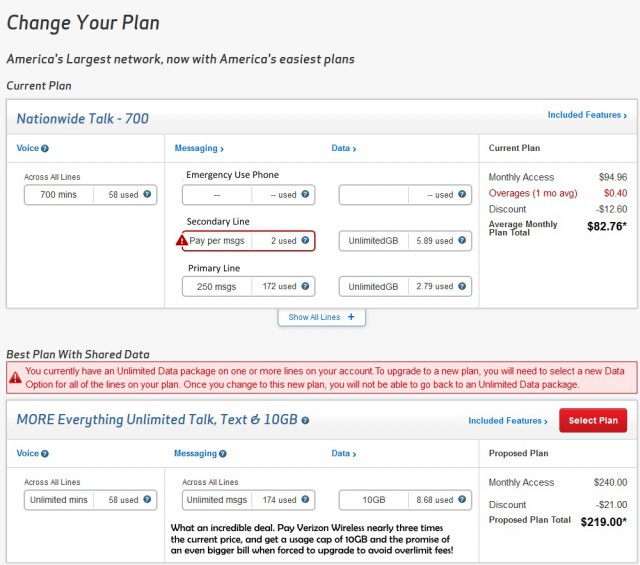
This may explain why Verizon Wireless is so gung-ho about getting me to switch to their "money-saving" Family Share Plan. In fact, it's a Family Theft plan -- nearly three times more expensive with a data cap that will force even more upgrades at a higher cost in the future.

Here’s an offer I’d like to refuse: This may explain why Verizon Wireless is so gung-ho about getting customers to switch to their “money-saving” Family Share Plan. In fact, it’s a Family Theft plan — nearly three times more expensive with a data cap that will force even more upgrades at a higher cost in the future.

Search This Site:

Contributions:

Recent Comments:

Your Account:

Stop the Cap!