


Home » Competition » Recent Articles:

52 Mayors Pledge Allegiance to Comcast’s Merger Deal; Is Yours on the List?

mayorsMore than 50 mayors of towns and cities large and small regurgitated Comcast-provided talking points in a joint letter submitted to the FCC in support of the Comcast-Time Warner Cable merger:

The combination of these two American companies will bring benefits to every affected city. Cities joining the Comcast service area will benefit from increased network investment, faster Internet speeds, improved video options and leading community development programs to help us tackle important community challenges like the digital divide. Existing Comcast markets will enjoy the benefits of a company with the scale and scope to invest in innovation and deliver products and services on a regional basis.

For us, the most significant aspect of the proposed transaction is its capacity to propel new investment in infrastructure in Time Warner markets that will enhance video and Internet service in our communities. Comcast has pledged to invest hundreds of millions of dollars a year speeding up and improving the combined company’s networks.

We also view positively the apparent response to this development from other companies that provide similar services. Since the Comcast Time Warner Cable transaction was proposed, Google has announced plans to expand its high-speed Fiber service to 34 new communities, AT&T has announced plans to expand its 1 gigabit U-Verse service to 100 new municipalities including 21 large cities, and Sprint’s corporate parent has proposed to build a 200 Mbps wireless network for the US.

In addition to being terribly misleading, parts of the letter are factually inaccurate. The letter’s text was taken almost entirely from Comcast’s own talking points released to the media and disclosed to the Securities and Exchange Commission.

Buffalo Mayor Byron Brown 2012: Time Warner Cable is naughty. 2014: Time Warner Cable is nice.

Buffalo Mayor Byron Brown
2012: Time Warner Cable is naughty.
2014: Time Warner Cable is nice.

Remarkably, Buffalo Mayor Byron Brown managed a complete flip-flop on his views of Time Warner Cable. In 2012, he co-signed a letter accusing Comcast and Time Warner Cable of anticompetitive behavior, runaway rate increases, and a growing digital divide. He was speaking about Comcast and Time Warner Cable’s  decision to partner with Verizon Wireless to jointly market products to their customers:

“We are deeply worried that the anti-competitive partnership between Verizon Wireless, the nation’s largest wireless provider, and four of the leading cable companies will have a negative impact on economic development and job creation in our cities, leading to higher prices, fewer service options, and a growing digital divide, “ the letter reads. “As you review the Verizon Wireless/cable transaction, we strongly urge you to examine the impact of this transaction on competition and consumer choice, and ensure that our communities are not left behind.”

This year, despite the fact both Comcast and Time Warner Cable still have their cross-marketing agreement with Verizon and both cable operators have raised prices, Brown joined the other mayors heaping praise on both cable companies:

Time Warner Cable has been a responsible corporate citizen whose efforts will only be enhanced by joining forces with Comcast’s community investment programs. Comcast has established itself as an industry leader and exemplary community partner who invests in its local communities and works hand in hand with local governments on critical social challenges like the digital divide.

Except when it is not.

Matthew Keys, who comments on journalism and social media, notes the Comcast merger has little to do with broadband expansion at other companies:

But the mayors failed to note that Sprint’s pledge of a faster wireless data network was predicated on a merger with rival T-Mobile, which fell through earlier this month. In addition, AT&T’s 1-Gigabit Internet service is likely being offered as an incentive for the FCC to approve its own proposed merger with Comcast competitor DirecTV; the Internet service is offered to residents in a handful of cities at a whopping $100 a month, nearly triple what the company sells it’s basic broadband Internet service for. And while the mayors assert that Google is expanding its Fiber service to more than 30 areas, they fail to note that Google is in preliminary talks with those communities and that the rollout may never happen.

If any providers inspired a broadband speed Renaissance, it was Google Fiber and a handful of gigabit community-owned fiber networks like EPB in Chattanooga, all demonstrating fast speeds and affordable pricing can go hand in hand when your primary interest is serving customers, not shoveling money at shareholders.

Customers who happen to live in the cities below might want to fill the email boxes and melt down the phone lines of these mayors who have demonstrated a willingness to throw their constituents under the bus (Matthew Keys did an exceptional job collecting their contact information).

Feel free to share our fact-based testimony with the mayors and let them know you don’t appreciate the fact they are spending taxpayer time and money advocating for a multi-billion dollar cable merger the majority of Americans oppose. Then remind them if this merger succeeds, you will think of them every time you have a problem with your cable service, when your bill increases, and when you discover Comcast has rationed your use of the Internet with a compulsory usage allowance. Because these problems always come fast and furious with Comcast, let them know you will have no trouble recalling their role in bringing Comcast to town when you go and vote.

Mayor Name
City
State
E-mail
Phone Number
William Bell Birmingham Alabama [email protected] (205) 254-2283
Tom Tait Anaheim California [email protected] (714) 765-5247
Kathleen DeRosa Cathedral City California [email protected] (760) 770-0340
Harry Price Fairfield California [email protected] (707) 428-7400
Acquanetta Warren Fontana California [email protected] (909) 350-7600
Jeffrey Gee Redwood City California [email protected] (650) 780-7597
Steve Hogan Aurora Colorado [email protected] (303) 739-7015
Marc Williams Arvada Colorado [email protected] (303) 424-4486
Richard McLean Brighton Colorado [email protected] (303) 655-2266
Michael Hancock Denver Colorado [email protected] (303) 331-3872
Pedro Segarra Hartford Connecticut [email protected] (860) 757-9500
Cindy Lerner Pinecrest Florida [email protected] (305) 234-2121
Joy Cooper Hallandale Beach Florida [email protected] (954) 457-1318
Alvin Brown Jacksonville Florida [email protected] (904) 630-1776
George Vallejo N. Miami Beach Florida [email protected] (305) 948-2986
John Marks Tallahassee Florida [email protected] (850) 891-2000
Tomas Regalado Miami Florida [email protected] (305) 250-5300
Lori Moseley Miramar Florida [email protected] (954) 602-3142
Buddy Dyer Orlando Florida [email protected] (407) 246-2221
Frank Ortis Pembroke Pines Florida [email protected] (954) 435-6505
Michael Boehm Lenexa Kansas [email protected] (913) 477-7550
Michael Copeland Olathe Kansas [email protected] (913) 971-8500
Kevin Dumas Attleboro Massachusetts [email protected] (508) 223-2222
Gary Christenson Malden Massachusetts [email protected] (781) 397-7000
Michael McGlynn Medford Massachusetts [email protected] (781) 393-2409
Daniel Rizzo Revere Massachusetts [email protected] (781) 286-8111
Albert Kelly Bridgeton New Jersey [email protected] (856)-455-3230
Dana Redd Camden New Jersey [email protected] (856) 757-7200
Frank Nolan Highlands New Jersey [email protected] (732) 872-1224
David DelVecchio Lambert New Jersey [email protected] (609) 397-0110
Gary Passanante Somerdale New Jersey [email protected] (856) 783-6320
Thomas Kelaher Toms River New Jersey [email protected] (732) 341-1000
Eric Jackson Trenton New Jersey [email protected] (609) 989-3030
Richard Berry Albuquerque New Mexico [email protected] (505) 768-3000
Ken Miyagishima Las Cruces New Mexico [email protected] (575) 541-2067
Byron Brown Buffalo New York [email protected] (716) 851-4890
Ernest D. Davis Mount Vernon New York [email protected] (914) 665-2300
Lou Odgen Tualatin Oregon [email protected] (503) 691-3011
Joseph DiGirolamo Bensalem Pennsylvania [email protected] (215) 633-3603
Eric Papenfuse Harrisburg Pennsylvania [email protected] (717) 255-3040
Rick Gray Lancaster Pennsylvania [email protected] (717) 291-4701
Robert A. McMahon Media Pennsylvania [email protected] (610) 566-5210
Michael Nutter Philadelphia Pennsylvania [email protected] (215) 686-2181
C. Kim Bracey York Pennsylvania [email protected] (717) 849-2221
Joseph Riley Charleston South Carolina [email protected] (843) 577-6970
Stephen Benjamin Columbia South Carolina [email protected] (803) 545-3075
Lee Leffingwell Austin Texas [email protected] (512) 974-2250
Beth Van Duyne Irving Texas [email protected] (972) 721-2410
Allen Owen Missouri City Texas [email protected] (281) 403-8500
Leonard Scarcella Stafford Texas [email protected] (281) 261-3900
Matthew Doyle Texas City Texas [email protected] (409) 643-5902

This article updated 8/28 to reflect that Pedro Segarra is the mayor of Hartford, Conn., not Hartford, Colo.

Stop the Cap!’s Reply Comments to NY PSC Staff Recommendations on Comcast Merger

Phillip Dampier August 26, 2014 Broadband Speed, Comcast/Xfinity, Competition, Consumer News, Data Caps, Editorial & Site News, Public Policy & Gov't Comments Off on Stop the Cap!’s Reply Comments to NY PSC Staff Recommendations on Comcast Merger

[Ed. Note: New York’s DPS and PSC in this instance are synonymous.]

psctestStop the Cap! agrees with the DPS staff’s conclusion that the petitioners (Comcast and Time Warner Cable) have failed to meet their burden of demonstrating that the transaction is in the public interest for New York residents.
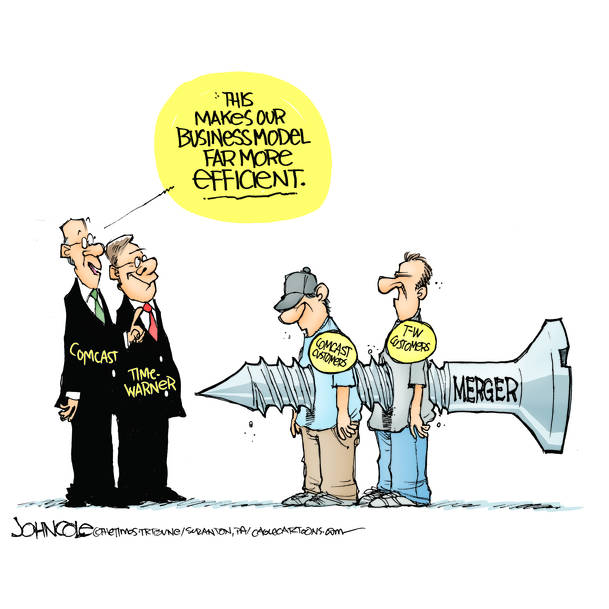
However, we are concerned that the proposed mitigation strategies suggested by DPS staff are insufficient to remedy this. We also challenge some of the assigned values placed on Comcast’s “benefits” to produce a net positive for New Yorkers because the DPS staff is relying on incomplete information in assigning values and not accounting for additional costs that will be incurred by Comcast customers.

comcast-time-warner-mergerFirst, the Commission must be aware that previous attempts to impose behavioral remedies on these types of mergers to generate net positive benefits have traditionally failed to protect consumers after the merger deals are approved. Professor John E. Kwoka, Jr., in his study, “Does Merger Control Work? A Retrospective on U.S. Enforcement Actions and Merger Outcomes,” [2] found numerous examples of mitigation strategies and conditional approvals that ultimately failed to protect ratepayers from the effects of a concentrated marketplace. Few businesses in New York are as concentrated as this state’s cable companies.[3]
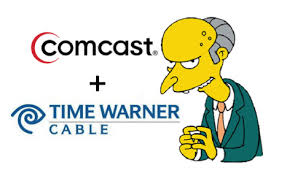
Second, the DPS staff’s proposal that Comcast provide at least $303.5 million in incremental benefits to New York residents over the next ten years to realize our state’s share of benefits from the proposed transaction ignores Comcast’s ability to recapture those benefits through relentless rate increases, well in excess of the cost of providing the service.

The DPS staff has also elected to rely on the Federal Communications Commission to mandate conditions to mitigate potential risks of vertical market power. That is unwise and effectively forfeits the authority given to the Commission by the New York State legislature to protect the public interest of New York residents. The FCC does not have that responsibility.

Specific Objections and Concerns Regarding DPS Staff Recommendations to Create Public Benefits

  1. Investment

The staff has recommended that the combined entity must demonstrate a commitment to make new investments or invest beyond Time Warner’s current capital investment budgets.

The problem with this formula is that ordinary planned investments as part of creating new revenue-generating opportunities can be claimed as “extra investments” for the benefit of New Yorkers, despite the fact those investments would have been made with or without an agreement compelling the investment. It also ignores the impact New York cable subscribers care about the most – their rising monthly bill.

Comcast blames those rate increases partly on the cost of increased investment. In Portland, Ore. Comcast spokeswoman Theressa Dulaney blamed annual rate hikes partly on precisely the type of investments the DPS staff declares would be a net benefit to New Yorkers.

“We continue making investments in our network and next-generation technology to make enhancements customers want and value, including faster Internet speeds, more multiplatform video and better customer service,” Dulaney said in a written statement.[4]

Comcast has asserted it will increase capital spending to improve service for Time Warner Cable customers, but continues to ignore the fact Time Warner Cable’s own upgrade program meets or surpasses Comcast’s own menu of services often at a lower cost. New Yorkers will not benefit if Comcast’s investments yield only incrementally better technology, but at a significantly higher cost and a worse customer service experience. The Commission should at a minimum establish Time Warner Cable’s Maxx service and pricing as a benchmark when comparing the products and services of the two companies and demand Comcast do better.

  1. Cable television “enhancements”

burnsThe DPS staff is correct to express skepticism about the relative benefits of Comcast’s expanded TV offerings, but then proceeds to declare the expanded programming an “incremental benefit for New York customers.”

While the DPS staff seems willing to grant Comcast credit for service improvements, it seems to lack a willingness to “deduct points” when Comcast’s improvements come at a significantly higher price and does not consider the implications of Comcast’s current market testing of broadband usage control measures like data caps/thresholds will have on Time Warner Cable customers.

The DPS staff must take care not to assign a dollar amount of an incremental benefit in Comcast’s column, but not be willing to deduct or transfer those dollars back to the column representing New York residents faced with higher prices, service restrictions, or dramatically worse customer service.

For example, Comcast’s touted television enhancements promise what Americans have said they absolutely do not want – a bigger cable TV package and a growing cable television bill. According to the Washington Post, in 2012 U.S. cable subscribers got a record average of 189 channels in prepackaged bundles but watched only 17 of those channels.[5] And the appetite to view more channels, even when offered vastly more television content, hasn’t changed much in years. In five years, cable companies added 60 more channels for the typical subscriber, but viewers haven’t increased their consumption of new content. They have consistently watched an average of 17 channels.

But their cable television bill has dramatically increased. In Oregon, Comcast cable customers paid $41.55 a month for Comcast’s “Digital Starter” package in 2004. In 2013, the price increased to $70.49.[6]

Cohen

Cohen

A-la-carte cable television is definitely not on the menu, despite consumer interest in paying only for the channels one wishes to receive.

As we noted in our previous filing[7], there are a range of other costs the DPS staff is not counting in its calculations:

  • A transition to all-digital cable television imposes added consumer costs from required set top boxes or ancillary digital boxes that can manage Comcast’s encrypted television lineup. These costs start at $25 a year in additional outlet fees per connected television, or $75 if an average household’s three television sets are connected to cable;
  • Comcast’s much-heralded X1 set top platform, a hallmark of its filing with New York regulators, includes an upgrade fee of up to $99 for the equipment – more than the cost of an entire month of cable television service;
  • Comcast’s current market trials of “usage thresholds” which place an allowance on how much a subscriber can use the Internet before overlimit fees are charged applies to XFINITY on-demand video when a tablet, phone, or home computer is used to watch. Although Comcast’s online viewing options may be more plentiful, customers in these market trial areas have discovered a double-edged sword when online viewing erodes away their monthly Internet usage allowance.

Unfortunately, none of these additional costs or limits that could or are likely to be incurred by New York subscribers are accounted for in the DPS staff recommendations.

  1. Enhanced Wi-Fi Hotspot Deployment

DPS staff seems unaware the vast majority of Comcast’s Wi-Fi hotspot deployments come from Comcast residential customers sharing their Comcast-supplied network device with other Comcast customers. Comcast charges $8-9 a month to lease its wireless gateway that provisions an extra Wi-Fi signal available to guest users. But customers carry almost all of the costs –indefinite lease charges, installation, ongoing power use, and any potential security lapses.[8]

  1. DPS Staff Wrongly Offers Consumer Benefit Credits to Comcast for Improving Customer Service

poor serviceWe strongly disagree with the DPS staff proposal to credit an overall consumer value of $50 million in return for Comcast’s commitment to improve its perennially terrible customer service rating.


Comcast’s well-documented poor customer service record alone should be sufficient to demonstrate this merger in not in the public interest of New York. Crediting $50 million in consumer value if Comcast agrees to adhere to a customer service standard any company should meet as a normal cost of doing business is unacceptable.

Under the new Public Service Law, it is Comcast alone that must demonstrate its proposal is in the public interest. The DPS staff has determined it has not met that burden. This is an unfortunate example of DPS staff showing a willingness to tolerate Comcast’s current unacceptable customer service performance and transfer a portion of the consumer benefit credit New Yorkers should enjoy as a result of the merger just to cajole Comcast to meet minimal customer service standards sometime in the future.

Comcast should arrive in New York demonstrating a solid record of customer service before being granted approval of this transaction. It is not in the public interest to subject (even if temporarily) New York residents to an even worse customer service experience than they currently receive from Time Warner Cable. We are concerned about the appearance that DPS staff is offering mitigation strategies to Comcast to help it squeeze past a public interest test it has currently failed in their view.

The DPS staff has also provided no details about its proposed public benefit program. Since customers are the ones that will suffer as a result of bad customer service, any funds captured by New York from Comcast should be rebated in full to New York customers, not for any other purpose.

Comcast executives have made two public statements that should also be weighed carefully in any recommendations to the Public Service Commission:

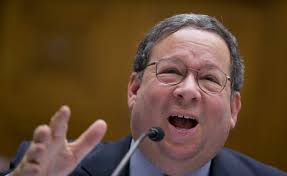
  • Comcast executive vice president David Cohen has predicted usage allowances will be imposed on all Comcast customers within five years.[9]
  • “We’re certainly not promising that customer bills are going to go down or even increase less rapidly.”[10] Comcast executive vice president David Cohen

[1] http://documents.dps.ny.gov/public/Common/ViewDoc.aspx?DocRefId={0A5EAC88-6AB7-4F79-862C-B6C6B6D2E4ED}

[2] John E. Kwoka, Jr. and Diana L. Moss, “Behavioral Merger Remedies: Evaluation and Implications for

Antitrust Enforcement,” at 22, available at

http://antitrustinstitute.org/sites/default/files/AAI_wp_behavioral%20remedies_final.pdf

[3] John E. Kwoka, Jr., “Does Merger Control Work? A Retrospective on U.S. Enforcement Actions and Merger Outcomes,” 78 Antitrust L.J 619 (2013)

[4] http://www.oregonlive.com/silicon-forest/index.ssf/2013/08/comcast_cable_tv_rates_going_u.html

[5] http://www.washingtonpost.com/blogs/the-switch/wp/2014/05/07/cables-forced-bundles-are-getting-fatter-but-no-one-is-watching-more-channels/

[6] http://www.oregonlive.com/silicon-forest/index.ssf/2013/08/comcast_cable_tv_rates_going_u.html

[7] http://documents.dps.ny.gov/public/Common/ViewDoc.aspx?DocRefId={C6D8225D-7E82-4756-A715-AF9CC6CB76A5}

[8] https://arstechnica.com/information-technology/2014/06/comcast-raises-your-electric-bill-by-turning-router-into-a-public-hotspot/

[9]https://techcrunch.com/2014/05/14/comcast-wants-to-put-data-caps-on-all-customers-within-5-years/

[10] https://arstechnica.com/tech-policy/2014/02/comcast-no-promise-that-prices-will-go-down-or-even-increase-less-rapidly/

Framily Values: Sprint’s Dan Hesse Out, What T-Mobile Merger? and Major Layoffs Ahead

Phillip Dampier August 20, 2014 Broadband Speed, Competition, Consumer News, Public Policy & Gov't, Sprint, Video, Wireless Broadband Comments Off on Framily Values: Sprint’s Dan Hesse Out, What T-Mobile Merger? and Major Layoffs Ahead
Out: Hesse

Out: Hesse

Sprint CEO Dan Hesse has left the building. He won’t be the last.

Hesse was appointed to lead Sprint in December 2007 after the catastrophic mess created when Sprint and Nextel merged. Now he’s gone because of his catastrophic failure to convince regulators a merger with T-Mobile USA made sense.

Brightstar Corporation CEO Marcelo Claure, appointed to Sprint’s board of directors by Softbank Mobile CEO Masayoshi Son earlier this year, is now in charge, and his commitment to save Sprint isn’t much different from what Hesse promised almost seven years earlier.

“The strategy is simple,” Mr. Claure said in an interview Monday. “We have to get back in the game.”

On a company-wide town hall call on Thursday, Claure outlined his three priorities: cut prices, improve the network, and decrease operational costs. Priority number one, price reductions, which have already started.

In: Claure

In: Claure

Claure blasted Sprint’s current pricing models, which he admitted were out of line considering how bad Sprint’s network is these days. He also trashed Sprint’s upgrade efforts, calling the “rip and replace” method of upgrading individual cell sites too slow, admitted social media networks were loaded with negative comments about Sprint’s performance, and that absolutely nobody understood the company’s most recent marketing attempt – a talking hamster selling Sprint’s Framily plan.

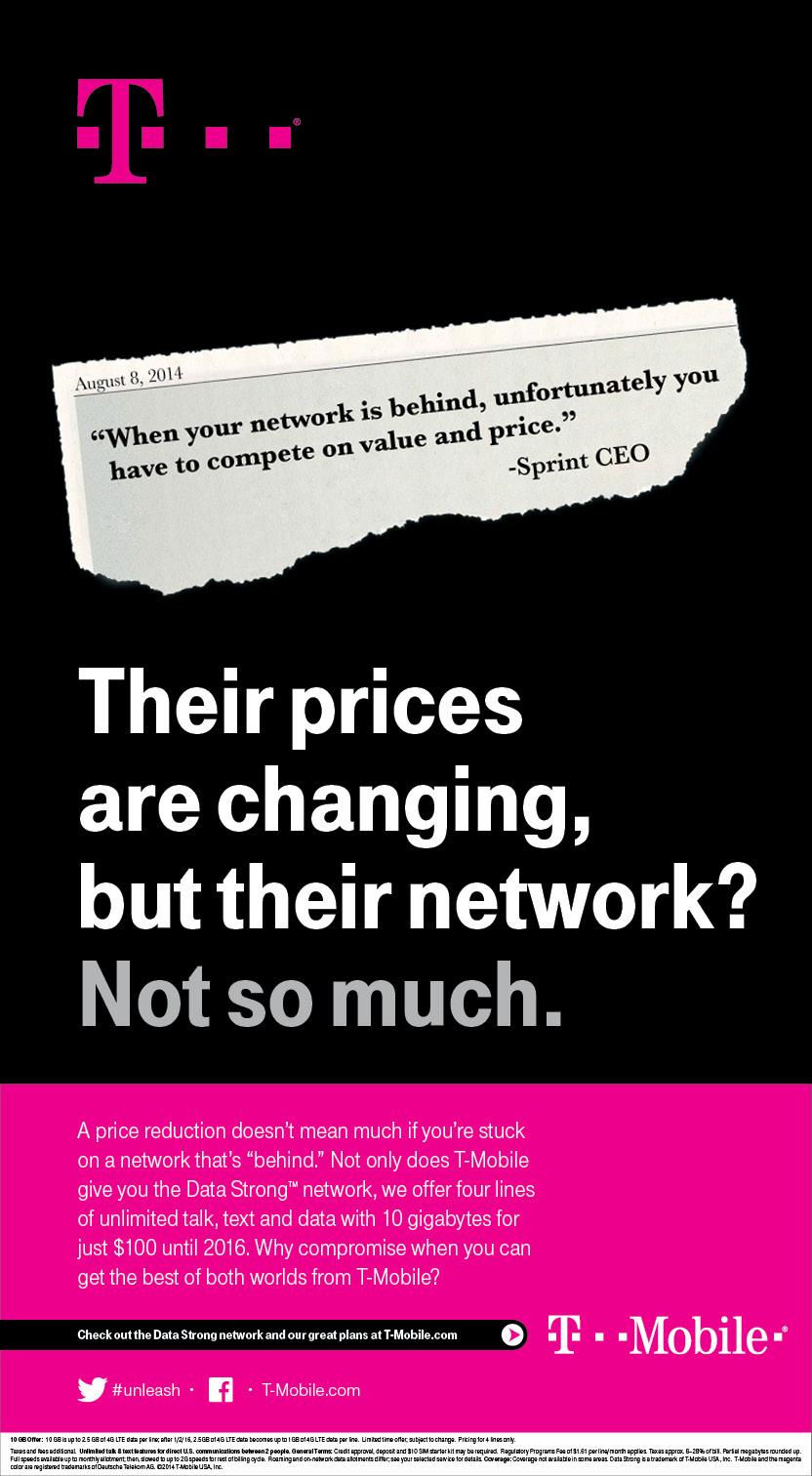
“We’re going to change our plans to make sure they are simple and attractive and make sure every customer in America thinks twice about signing up to a competitor,” he said. “When you have a great network, you don’t have to compete on price. When your network is behind, unfortunately you have to compete on value and price.”

Sprint’s network isn’t just behind, it’s downright prehistoric in places. Its 3G network borders on unusable in large cities, WiMAX is on life support, and Sprint’s 4G LTE network expansion is taking so long, by the time it is finished, LTE might be considered passé.  Hesse had avoided a more aggressive timetable to protect Sprint’s share price from the precipitous drop that would come from an upgrade spending spree.

Those days are over.

Claure warned the changes for Sprint would not just include price cuts and upgrades. It will also mean major job cuts, although Claure would not specify exactly how many Sprint employees were headed for the unemployment office. Unlimited data may also be headed for the door – Claure would not commit to retaining the unlimited use wireless data plans Sprint has been known for under Hesse’s leadership. Kansas City officials are also worried Sprint’s new executive team wants to move the company headquarters west, likely to California.

sprintnextelMasayoshi Son and Claure both agree that U.S. regulators were no fans of Sprint either — sending clear and unambiguous warnings that continued efforts to merge Sprint with T-Mobile USA were futile. So a proposed merger between the two companies is off. T-Mobile USA CEO John Legere wasted no time piling on, advising Sprint customers in tweets to #SprintLikeHell to another wireless carrier (preferably his).

Some predictable grumbling from Wall Street has also been heard over Claure’s plans to disrupt the comfortable profits earned by American wireless companies.

“Expect capital spending to rise,” says analyst firm Moffett Nathanson in a research note. “They will also have to cut their service prices, which are simply are too high relative to competitors.”

With a dramatic cut in prices, Sprint’s financials will look “ugly” in the coming quarters.

[flv]http://www.phillipdampier.com/video/Bloomberg Here is Why Sprint Stopped Talks With T-Mobile 8-6-14.flv[/flv]

Sprint ended talks to acquire T-Mobile US a person with knowledge of the matter said, as regulatory concerns outweighed the potential benefits of combining the third- and fourth-largest U.S. wireless carries. Bloomberg’s Alex Sherman reports on “Market Makers.” (4:07)

[flv]http://www.phillipdampier.com/video/Bloomberg Sprint Faces Tough Road Running Business 8-6-14.flv[/flv]

Craig Moffett, founder of MoffettNathanson LLC, talks about reports of Sprint Corp.’s decision to end talks to acquire T-Mobile US Inc. due to regulatory concerns. Moffett speaks with Tom Keene and Brendan Greeley on Bloomberg Television’s “Surveillance.” (3:25)

[flv]http://www.phillipdampier.com/video/Bloomberg Sprints Dropped T-Mobile Bid Adds Options Ergen 8-7-14.flv[/flv]

Dish Network Chairman Charlie Ergen said Sprint’s decision to drop its bid for T-Mobile US has opened up more options for his satellite-TV carrier as it looks for ways to expand into the wireless business. Alex Sherman reports on “In The Loop.” (4:01)

[flv]http://www.phillipdampier.com/video/Bloomberg Sprint CEO Right Man for Right Company 8-11-14.flv[/flv]

Patterson Advisory Group Chairman and CEO Jim Patterson and Bloomberg Intelligence Telecom Analyst John Butler discuss challenges facing Sprint’s new CEO Marcelo Claure. Patterson and Butler speak on “In The Loop.” (5:47)

[flv]http://www.phillipdampier.com/video/Bloomberg Is Sprints New CEO up to the Challenges He Faces 8-11-14.flv[/flv]

Bill Ho, principal analyst at 556 Ventures, and Bloomberg Intelligence’s John Butler discuss expectations for Sprint’s new Chief Executive Officer Marcello Claure and look at the challenges he faces as the head of the nation’s number three wireless company. They speak on “Market Makers.” (6:56)

The Talking Hamster is Dead: Sprint Kills Its Framily Plan, Unveils Cheaper Shared Data

Phillip Dampier August 20, 2014 Broadband Speed, Competition, Consumer News, Sprint, Wireless Broadband Comments Off on The Talking Hamster is Dead: Sprint Kills Its Framily Plan, Unveils Cheaper Shared Data
frobinson

The Frobinson Family

Sprint’s Framily Plan swims with the fishes starting this Friday.

Ex-CEO Dan Hesse’s latest (and last) attempt to get creative with a talking hamster selling cell service was a fantastic flop.

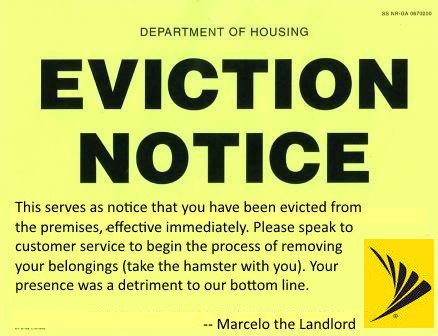
“There’s no longer going to be Framily as of this Friday,” incoming CEO Marcelo Claure said to employees, who oohed and applauded the forthcoming eviction of the eclectic Frobinson family.

Framily was the closest Sprint came to a desperate multi-level marketing scheme that turns customers into irritating recruiters hassling friends, family, and strangers to join their wireless plan for bigger discounts.

Framily began earlier this year offering four lines for $160 a month with 1GB of data each. Unlimited data was a $20 add-on.

T-Mobile’s John Legere mocked the plan from day one and more importantly obliterated its savings by undercutting it with T-Mobile’s Simple Choice plan ($100 a month for four lines and 2.5GB of data on a much faster network.)

evictionEven worse, if you were convinced to sign up for Framily and another member of your “extended family tree” decided Sprint’s network disruptions and performance were no longer worth the trouble, every other family member’s bill increased when they defected — talk about an awkward moment with friends and family.
“It’s quite the confusing plan to sign up and more confusing when people drop off,” said Roger Entner, founder of Recon Analytics. He noted Sprint’s network disruptions from the extensive upgrade effort had sent some customers packing.

“If Sprint doesn’t work for them, your price goes up. So you get penalized for Sprint’s network,” Entner said.

Out with the Frobinson Framily, in with Sprint’s Family Share Pack.

Starting Friday, the Sprint Family Share Pack will offer considerably more data for that $160 a month. At that price, Family Share offers four lines and 20GB of data, compared to 10GB of data for the same price from AT&T or Verizon. Really big families will appreciate Sprint’s support for up to 10 lines on one account. Existing customers won’t appreciate the fact Sprint won’t offer existing customers any promotions or discounts.

A kick-off offer promises even lower prices if you don’t mind sharing data. For $100, a family of four can share 20GB of data and unlimited talk/text through the end of 2015. As an added bonus, customers will get an extra 2GB per line for up to 10 lines. (The $100 offer is available Aug. 22 – Sept. 30, 2014 only when customers switch to Sprint. It includes $15 a month in line access charges waived through 2015. Valid only on 20GB or higher data allowance plans.)

For example:

Sprint Family Share Pack  Limited-Time Promotion
Price # of lines Data Additional 2GB per line Total Data for # of lines
$100 4 20GB 2GB x 4 lines 28GB
$100 10 20GB 2GB x 10 lines 40GB

Sprint Family Share Pack – How it Works

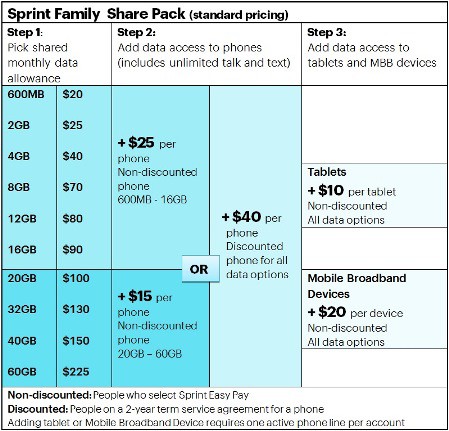
Customers can build their own plan in three steps as shown below.  First, choose the data allowance. Second, add up to 10 lines of data access with unlimited talk and text while on the Sprint Network.  Third, include your tablet devices for $10 per month per line and mobile broadband devices for $20 per month per line. There is no early termination fee and no annual service contract with non-discounted phones.

Sprint Family  Share Pack High Res2
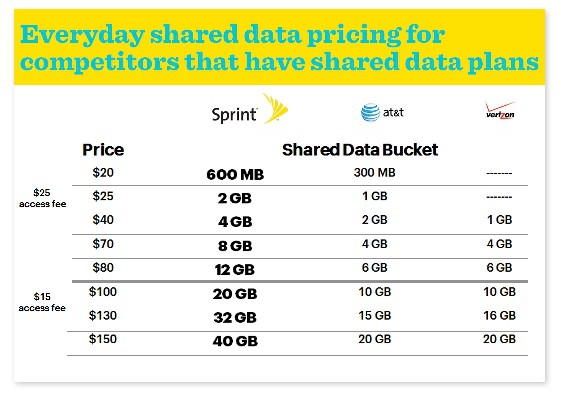
Everyday pricing for competitors that have shared data plans:
Competitors-Shared-Pricing-Data-Plans2Limited-time Promotion for Customers Switching to Sprint Family Share Pack
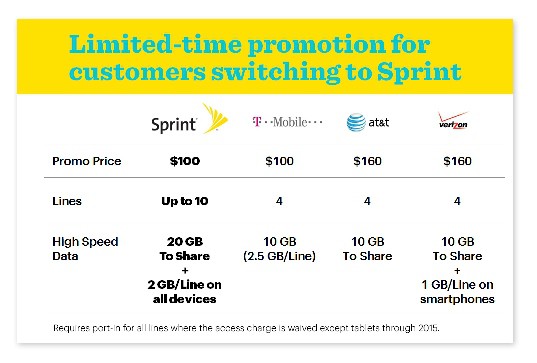
For a limited time, customers who bring their number and activate on the Sprint Family Share Pack can receive a Visa Prepaid Card up to $350 to compensate for early termination fees charged by their current carrier. This switching offer will be available at Sprint stores and Sprint Telesales.

With the limited-time promotion, Sprint is waiving the data access charge for handsets, tablets and mobile broadband devices on 20GB or higher data allowances for up to 10 lines. To qualify for the offer customers must switch their number from another carrier to Sprint.   All devices must be purchased through Sprint Easy Pay. Existing customers do not qualify.

Limited-Offer-Switch-to-Sprint42

Sprint’s New Plans: Putting Lipstick on a Pig and Enraging Your Soon-to-Be Ex-Customers

Phillip Dampier August 20, 2014 Broadband Speed, Competition, Consumer News, Editorial & Site News, Sprint, T-Mobile, Wireless Broadband Comments Off on Sprint’s New Plans: Putting Lipstick on a Pig and Enraging Your Soon-to-Be Ex-Customers

tmobileIf this is the best Sprint’s Marcelo Claure can do, Softbank needs to keep shopping for another CEO.

Claure’s decision to deep-six the appallingly stupid Framily Plan was a no-brainer. Sprint’s own customer service agents barely understood the multi-level marketing scheme it actually was, and I never saw much value in alienating friends and family by cajoling them to use the atrociously bad Sprint network. Neither did Sprint employees who loudly cheered its upcoming demise.

Even Claure trashed Sprint’s network performance and upgrade program as glacier-slow and highly disruptive to customers who find nearby cell sites here today, gone tomorrow, and maybe back again someday when network upgrades have been finished. Unlike AT&T or Verizon where a cell tower outage might cut a few bars of signal strength, when a Sprint cell tower drops, it’s roaming time. It is not uncommon for residents along Lake Ontario’s shorelines in the United States to find their phones preferring to roam on Canadian networks (especially Rogers) to avoid Sprint.

Claure’s commitment to cut prices while cruelly excluding your current customer base from getting any of those savings is a sure-fire way to accelerate their departure… mostly to T-Mobile. John Legere is waiting with open arms.

Sprint doesn’t need to just cut prices, it needs to butcher them, and fast. Sprint’s loyal customers have been promised a lot since the company unveiled its Network Vision upgrade plan during the French Revolution of 1789. The Bastille might still be standing today had Sprint slapped a working 4G LTE antenna on top of it. But alas, let them suffer with Sprint 3G, declared Dan Hesse, on a network so bad that throttled customers in heavy-use prison actually saw their speeds rise. Some customers in western New York simply turn Sprint 3G data off to save the battery.

When Sprint 4G LTE finally did arrive in western New York (illogically first in rural communities like the stiflingly-dull town of Dansville), many barely noticed because Sprint’s backhaul connection between the cell tower and Sprint’s data network often stayed the same — congested and slow.

Although T-Mobile’s coverage is not that different from Sprint, its network upgrades are.

T-Mobile CEO John Legere has confidently pushed Sprint around over its newest plan, but if it does start to eat into T-Mobile’s business, Legere will no doubt respond with some new plans of his own. For current Sprint customers, T-Mobile is definitely the upgrade Sprint has promised for at least five years, and should be considered at contract renewal time. But current Verizon and AT&T customers paying Cadillac pricing should not be expected to switch to Sprint after recalling dropped calls in a store, home or in an emergency on Sprint’s less robust network. They are very unlikely to change carriers no matter what shade of lipstick Sprint applies to its plans.

Claure has the right idea — slash prices and actually deliver on promises of a better network going forward, but those commitments deserve to apply to both existing and new customers. So far Claure has managed to inflict only superficial wounds. The price cuts must go much deeper to attract business from customers of the larger carriers willing to compromise for the right price and upgrades have to be real and delivered immediately.

Sprint still doesn’t understand it cannot charge Honda Accord prices on a Chevy Spark network. Until they do, T-Mobile is likely to continue taking them to school.


Search This Site:

Contributions:

Recent Comments:

Your Account:

Stop the Cap!