Home » Competition » Recent Articles:

Alaska’s GCI Boosts Speeds But Leaves Its Caps and Overlimit Fees Intact

redAlaska-based GCI has rolled out a free upgrade for customers in Anchorage, Fairbanks, Juneau, Ketchikan, Mat-Su Valley, and Sitka that delivers broadband speeds up to 250/10Mbps.

GCI’s re:D broadband used to max out at 200Mbps, but thanks to channel bonding on the cable system, download speeds will be upgraded to 250Mbps in re:D service areas by the end of this year.

But getting 250Mbps broadband is not cheap in Alaska. The service is priced at $174.99 a month when part of a service bundle. Broadband-only customers also pay a $11.99 monthly access fee. Both come with 24-month contracts at that price. Customers who don’t want to be tied down can choose month-to-month service for $5 more per month.

At those prices, one might hope GCI would drop its usage cap, but customers can forget it. A 500GB monthly usage cap applies, with overlimit fees up to $30/GB on some plans.

GCI also announced it would deliver 1Gbps next year over a fiber to the home network under construction in Anchorage, promising “no limits with what you can do with broadband” without mentioning whether it planned usage limits for its fiber service as well.
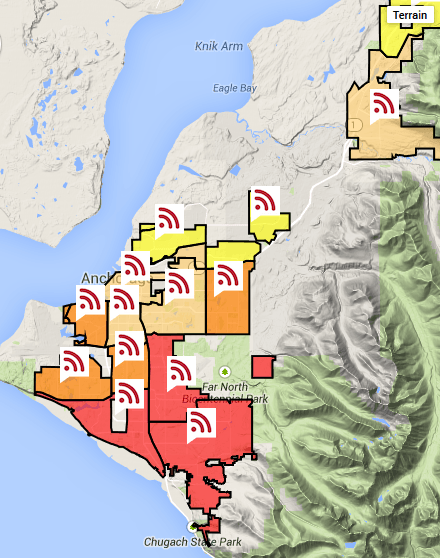
GCI is asking customers to vote support for their neighborhoods getting fiber upgrades. The more red this map of Anchorage shows, the more customers who have shown support for fiber broadband.

GCI is asking customers to vote support for their neighborhoods getting fiber upgrades. The more red sections of this map of Anchorage shows, the more customers who have shown support for fiber broadband.

For most GCI customers, however, broadband will continue to arrive over the company’s HFC coaxial cable network. To better manage speeds, the company’s DOCSIS 3 platform is bonding eight cable channels, but in re:D areas the company bonds up to 24 cable channels, with plans to increase to 32 channels.

acs logoThe speed increases come after its competitor Alaska Communications announced speed increases of its own. ACS sells unlimited access broadband service at speeds up to 50Mbps. ACS has beefed up its copper infrastructure to support faster Internet speeds, starting with 15Mbps introduced across the state in May. Now customers in Anchorage can subscribe to faster tiers including 30 and 50Mbps.

“Alaskans asked for faster Home Internet, and we’ve responded with these increased speeds, delivered with great customer service and without overage charges,” said ACS president and CEO Anand Vadapalli. “In addition to faster download speeds, customers choosing our product get the highest upload speeds that are so important for sharing videos and gaming.”

ACS has found its unlimited broadband offering attractive to customers who don’t want to worry about GCI’s overlimit fees. ACS also claims its customers get broadband over a dedicated line, not shared infrastructure like GCI, resulting in no speed slowdowns at peak usage times.
UN: U.S. Broadband Ranking Slips Again; Now 19th Place in Penetration, 24th in Wired Connections

Phillip Dampier September 23, 2014 Broadband Speed, Canada, Competition, Consumer News, Editorial & Site News, Public Policy & Gov't, Wireless Broadband Comments Off on UN: U.S. Broadband Ranking Slips Again; Now 19th Place in Penetration, 24th in Wired Connections

All of the top-10 broadband rankings for accessibility, affordability, speed, and subscription rates have been awarded to countries in Europe and Asia, while the United States continues to fall further behind.

This week, the UN Broadband Commission issued its annual report on broadband and had little to say about developments in North America, where providers have maintained the status quo of delaying upgrades, raising prices, and limiting usage. As a result, other countries are rapidly outpacing North America, preparing the infrastructure to support the 21st century digital economy while officials in the U.S.A. and Canada cater primarily to the interests of large incumbent cable and telephone companies.

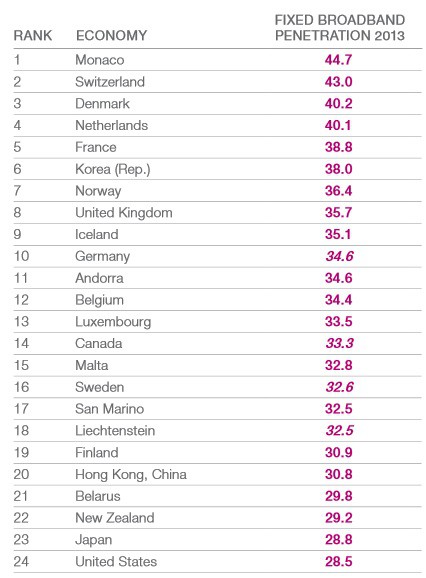
The United States has fallen from 20th to 24th place in wired broadband subscriptions, per capita. Virtually every country in western Europe now beats the United States, as does Hong Kong, Belarus, and New Zealand. Canada scored better, taking 14th place.

fixed broadband penetration 2013

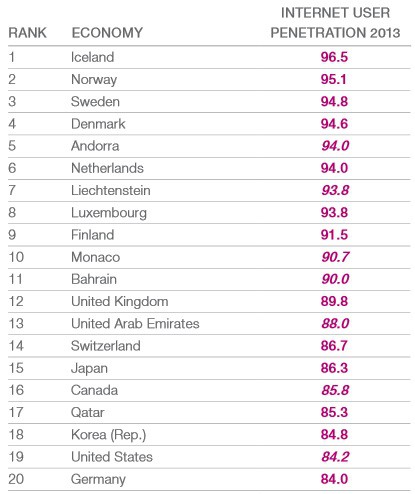
Only managing a meager 19th place, only 84.2% of Americans are online. Iceland has 96.5% of their population on the Internet, closely followed by the other northern European nations of Norway, Sweden and Denmark. Also scoring superior to the United States: Andorra, Bahrain, Qatar, and the United Arab Emirates. Canada did better than its southern neighbor as well, coming in at number 16.

percentage using the internet

With big profits to be made in wireless, large wireless phone companies like Verizon Wireless and AT&T helped the U.S. achieve its best rating — 10th place in wireless. But the countries that exceeded the United States did much better (Canada was not rated this year.)

With the arguable exception of wireless, the United States is no longer a world leader in broadband and continues a slow but steady decline in rankings as other countries leapfrog over the U.S.

At least 140 countries now have a National Broadband Plan in place, most maintaining stronger oversight over telecommunications infrastructure than the largely unregulated U.S. broadband marketplace. After reviewing broadband performance across most UN member states, the Broadband Commission for Digital Development recognized several traits common in countries where broadband has been particularly successful:

Competition is essential to promote enhanced broadband. A monopoly or duopoly (usually a telephone company and cable or wireless operator) is not enough to promote healthy broadband advancements. At least three, near-equal competitors are required to achieve the best upgrades and price competition. The presence of smaller competitors or those charging considerably different pricing had little effect on competition.

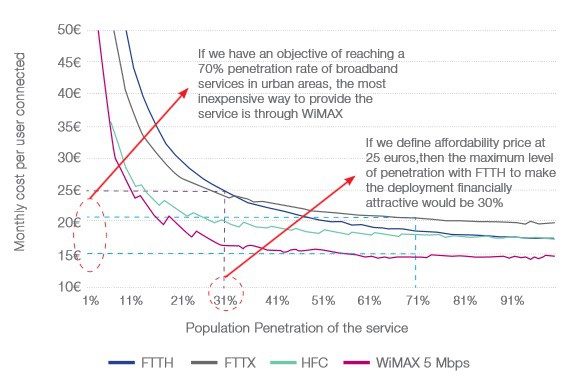
Countries with the best speeds have national policies promoting the installation of fiber optic technology, at least in multi-dwelling units and new developments. Although the cost of fiber and its installation can amount to as much as 80% of a broadband expansion project, many countries have been successful compelling competing providers to share a single fiber optic network (and its costs) to make the investment more affordable. In terms of ultra-high-speed broadband, there are still not many consumer apps and services that need Gigabit speeds, but such services are on their way. Experience shows that technology typically moves faster than most people anticipate – so countries and operators need to start planning now for the imminent broadband world.

technology cost

A coherent regulatory foundation that emphasizes competition over regulation was the most effective policy. But regulatory frameworks must guarantee a level playing field among competitors and strong oversight to make sure competitors play fair. Regulation is not keeping pace with the changes in the market – Internet players offering equivalent voice and messaging services are, by and large, subject to relatively limited requirements (including consumer protection, privacy, interoperability, security, emergency calls, lawful intercept of customer data, universal service). Asymmetric regulation has resulted in an uneven competitive landscape for services. Governments and policy-makers need to review and update their regulatory frameworks to take into account evolving models of regulation.

Telecommunication and broadband access providers need to explore business arrangements with Internet content providers that will accelerate global investment in broadband infrastructure, to the mutual benefit of all, including end-consumers. Internet companies and Internet content providers need to contribute to investment in broadband infrastructure by debating interconnection issues and agreeing fees/revenue shares with other operators and broadband providers.

That last issue is now being hotly debated in the United States, where providers are seeking compensation from streaming video providers like Netflix, which now account for a substantial amount of Internet traffic.

Singapore’s Cutthroat Gigabit Broadband Price War Shows Real Competition Saves Consumers $

Phillip Dampier September 23, 2014 Broadband Speed, Competition, Consumer News, Data Caps, Online Video Comments Off on Singapore’s Cutthroat Gigabit Broadband Price War Shows Real Competition Saves Consumers $

bnr_reg_1gbpsThree competing telephone companies in Singapore have launched an all-out price war on gigabit fiber to the home Internet access that shows what real competition can do for broadband pricing.
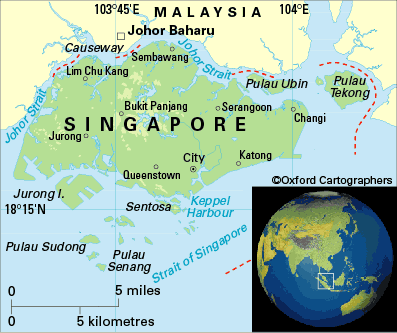
Last week, M1 took a butcher knife to its monthly rate for 1Gbps service that used to cost $101.75 a month. Today, anyone can order service price-locked for 24 months at a promotional price of $38.65 a month — less than what most cable companies in the United States charge for 10Mbps service. It is the cheapest gigabit plan in Singapore and when the promotion ends, the price may or may not increase to $78 a month. Competitive pressure in Singapore may make M1’s post-promotional price untenable.

Competition is the reason M1 may not be able to raise prices. MyRepublic slashed the price for gigabit service to just under $40 a month in January.

SingaporeSingapore’s largest phone company, SingTel, has its own unlimited gigabit offering for $55.13 a month, a price the company is now re-evaluating.

“We’re happy to see Singapore move towards the 1Gbps standard,” a MyRepublic spokesman said, noting it has no immediate plans to further lower its rates. But it has sweetened its offer by throwing in a free smartphone for every customer signing up for 1Gbps service.

With broadband prices so low, providers are now switching to beefing up extras to entice customers. SingTel promises customers they will never encounter traffic shaping that might cut their broadband speeds when networks get congested. It also offers a 25 percent discount on a virtual private network (VPN) add-on, a common feature used in Singapore to get past geographical restrictions on video streaming. VPN users in Singapore rely on the service to reach Hulu, Netflix and other North American video services that only allow domestic audiences to watch.

A fourth competitor – StarHub – is late to the gigabit battle and is presently working on a revamped offer to be introduced by October. StarHub’s original gigabit broadband offer was expensive at more than $400 a month. That plan has been discontinued.

Wall Street and other trading centers are not happy that falling prices have sliced into telecom profits. Average revenue per user (ARPU) collected by Singapore’s ISPs have dropped 15-20 percent since MyRepublic launched the price war. Investors are being warned that profits will be affected by the robust competition. In Singapore, broadband prices are falling, but so are the costs to provide the service. In North America, it is a much different picture, where a lack of competition has allowed providers to increase prices, constrict usage, and avoid dramatic speed upgrades, even though wholesale broadband costs in North America are among the cheapest in the world.

Fiber to the Press Release: Atlantic Broadband Announces 1Gbps in Miami… (For 40 Homes)

Phillip Dampier September 18, 2014 Atlantic Broadband, Broadband Speed, Competition, Consumer News Comments Off on Fiber to the Press Release: Atlantic Broadband Announces 1Gbps in Miami… (For 40 Homes)

atlanticMore people will read this story than Atlantic Broadband has current customers for its 1Gbps broadband project in Miami.

“Atlantic Broadband is proud to be the first company to deliver 1 Gigabit Internet service to its customers here in the Miami Beach area,” said David Keefe, Atlantic Broadband’s senior vice president and general manager of the South Florida region. “While other companies are talking about what they will be doing, Atlantic Broadband moved forward and started offering this service in one of its communities. We look forward to extending access to our Gigabit Internet service to other properties and communities within our Miami footprint.”

Although Mr. Keefe isn’t being modest, his company’s gigabit broadband coverage area certainly is.

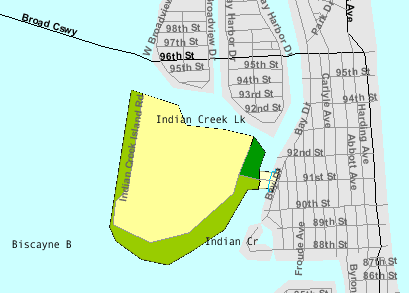
At present, the company serves just 40 properties with the super high-speed broadband service in high-income Indian Creek Village — the 8th richest community in the United States.

The tiny village of Indian Creek is made up of 40 properties and is the 8th richest community in the U.S.A.

The tiny village of Indian Creek, in the Miami-Dade area, is made up of 40 properties and is the 8th richest community in the U.S.A.

Designed to appeal to residents who can spare no expense, the Atlantic Broadband package also includes more than 350 TV channels powered by TiVo, integrated access to Netflix, and unlimited phone service for up to four lines.

An Atlantic Broadband spokesperson wouldn’t reveal the price of the package, and admitted customers cannot choose standalone broadband-only service.

“The needs of Indian Creek Village were unique so custom service packages were created that include all of Atlantic Broadband’s TV services, Gigabit Internet and four phone lines,” a spokeswoman told Multichannel News. “Currently, there is not a published a standalone price for Gigabit Internet.”

Residents in the wealthy enclave include Victoria’s Secret model Adriana Lima, Spanish singer Julio Iglesias, his son Enrique Iglesias, Robert Diener, co-founder of Hotels.com, Edward Lampert, hedge fund billionaire and owner of what is left of Kmart and Sears, Don Shula, retired football coach, Charles Bartlett Johnson, mutual fund billionaire, billionaire investor Carl Icahn and former Philadelphia Eagles owner and billionaire art collector Norman Braman.

Other famous residents both past and present have included Beyoncé and Jay-Z, pro golfer Raymond Floyd, coach Rick Pitino, U.S. Senator George Smathers, Sheik Mohammed al Fassi, television host Don Francisco, co-founder of Calvin Klein Barry Schwartz, radio magnate Raul Alarcon, coal and oil executive, heiress and philanthropist Suzie Linden, Arthur I. Appleton, President of Appleton Electric Company and founder of the Appleton Museum of Art and Bridlewood Farm, and his wife Martha O’Driscoll a former Hollywood actress.

Atlantic Broadband has not ripped out classic cable infrastructure for its less-well-to-do customers outside of the village in the Miami-Dade area and relies on RF over Glass technology for its network extensions. That allows the company to keep its legacy equipment in place while giving some residents access to fiber and others traditional coaxial cable.

Atlantic serves an island of customers in the Miami Beach area, but most of Miami gets its cable service from Comcast. Competitor AT&T has promised fiber upgrades and gigabit speeds for its own customers in the Hialeah, Hollywood, Homestead, Opa-Locka, and Pompano Beach areas, but no time frame has been announced for the upgrade.

Atlantic Broadband will have one advantage over AT&T U-verse. It does not have usage caps.

Atlantic Broadband serves around 230,000 residential and business subs in western Pennsylvania, Miami Beach, Maryland/Delaware, and Aiken, S.C. It is owned by Cogeco Cable of Canada.

Behind the Bulletproof Glass: More Misadventures at Comcast’s Customer Service Center

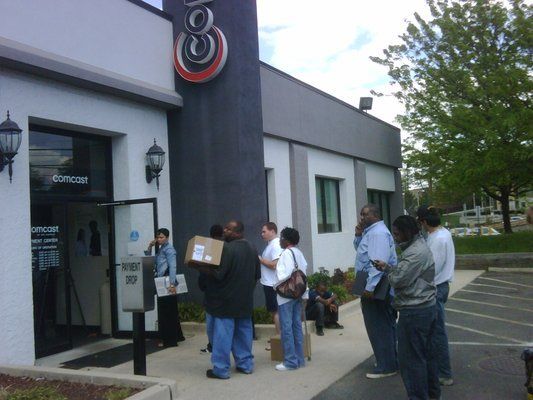
Marco S. was so frustrated by the line running outside of his local Comcast store, he snapped this photo. At least the weather was nice.

Marco S. was so frustrated by the line running outside his local Comcast store, he snapped this photo. At least the weather was nice.

Comcast customer Timothy Lee made a grave error in judgment. He decided to return his Comcast-owned cable modem to a Comcast customer service center… on a Saturday!

Long-time Comcast customers know only too well a Saturday visit to Comcast represents a major outing, with long lines that often extend outside and up to an hour or more waiting time.

Lee compared his visit to waiting in line at the post office, but that’s not really true except during the holidays — the post office is better organized and usually lacks the heavy-duty bulletproof glass and surly attitudes that separate Comcast’s “customer service agents” from their unhappy customers.

Predictably, Lee waited more than 30 minutes before his number was up.

Lee’s predicament is all too familiar. His only choice for high-speed Internet access is Comcast, and the cable company knows it. So just like your local Department of Motor Vehicles, there is no harm done if Comcast opens a customer service center with 10 available windows staffed by only two employees, one happily munching on pretzels ignoring the concert-length line during his 20-minute break.

Time Warner Cable’s service centers are not much better, although they usually have fewer windows to keep customers from getting their hopes up. Comcast’s bulletproof glass is also not in evidence at TWC locations, although the burly bank-like security guard is very apparent at some centers in sketchy neighborhoods. Time Warner Cable also offers seating, but visit wealthier suburban locations when possible, where comfortable couches replace the nasty hard benches or plastic furniture often found downtown.

Comcast was instantly ready to offer up the usual excuses:

Your recent visit to our Washington D.C. service center is certainly not the experience we want anyone to have. We’ve been working on  a multi-year project to revamp the hundreds of service centers we have around the country to better serve customers.  As part of that project, we will be remodeling the Michigan Avenue location and will open another service center in the District in early 2015.  We’re also introducing more options for customers to manage their accounts, including a new program we’re starting to roll out with The UPS Store to make them an authorized Comcast equipment return location.

It’s always better at Comcast sometime in the yet-to-be-determined future. Until then, suffer.

Search This Site:

Contributions:

Recent Comments:

Your Account:

Stop the Cap!