As expected, Redbox Instant by Verizon will stop operations on Tuesday (Oct. 7) after failing to attract enough interest from customers in the Netflix-dominated online video marketplace.
IMPORTANT SERVICE SHUTDOWN NOTICE
Thank you for being a part of Redbox Instant by Verizon. Please be aware that the service will be shut down on Tuesday, October 7, 2014, at 11:59 p.m. Pacific Time.
Information on applicable refunds will be emailed to current customers and posted here on October 10. In the meantime, you may continue to stream movies and use your Redbox kiosk credits until Tuesday, October 7 at 11:59 p.m. Pacific Time.
We apologize for any inconvenience and we thank you for the opportunity to entertain you.
Sincerely,
The Redbox Instant by Verizon Team
Customers that purchased digital copies of movies Redbox Instant offered for sale may not be able to retrieve them from Verizon’s digital storage locker after the service shuts down, but the company says it is “exploring options” for those affected.
“The service is shutting down because it was not as successful as we hoped it would be. We apologize for any inconvenience and we thank you for giving us the opportunity to entertain you,” the company said as part of its shutdown notice.
Paying customers will receive a refund for one month of service and have just 24 hours to redeem any Redbox kiosk rental vouchers included with their subscription.
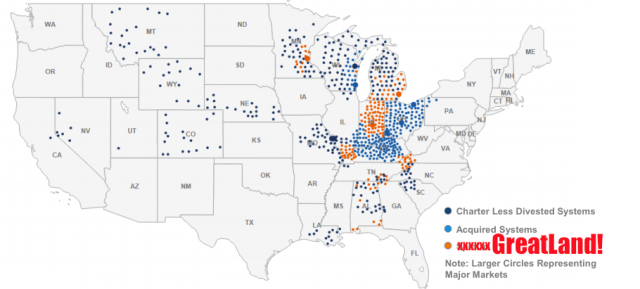
The merger of Comcast and Time Warner Cable includes castoffs that will be served by a completely unknown spinoff – GreatLand Connections, that nobody can speak with and does not have a website.
At least 2.5 million Comcast customers in cities like Detroit and Minneapolis could soon find their service switched to a new provider that doesn’t have a website, doesn’t answer questions, and won’t give detailed information to municipal officials about its plans, pricing, or service obligations.
GreatLand Connections is the dumping ground for communities Comcast no longer wants to serve, including cities in Alabama, Indiana, Kentucky, Michigan, Minnesota, Tennessee and Wisconsin.
Formerly known as “SpinCo” for the benefit of Wall Street investment banks advising Comcast, the new cable company has been created primarily to help Comcast convince regulators to approve its merger with Time Warner Cable. Comcast believes supersizing itself with Time Warner Cable will win a pass with the FCC by self-limiting its potential television market share. The deal is also structured to dump a large amount of debt on the brand new cable company, allowing Comcast to avoid a significant tax bill.
GreatLand will, for all intents and purposes, be Charter Cable under a different name. Charter will act as the “management company,” which means it will be in charge of most consumer-facing operations.
Beyond that, almost nothing is known about the new cable company, except that it will open its doors laden with $7.8 billion in debt, according to a securities filing. That is equal to five times EBITDA, or earnings before interest, taxes, depreciation and amortization. In comparison, Comcast is 1.99 times EBITDA and Time Warner Cable is 3.07 times EBITDA, making the new cable company highly leveraged above industry averages. Charter Cable, which declared bankruptcy in 2009, is loaded down it debt itself, as it continues to acquire other cable operators.
Finances for the new company appear to be “less-than-middling,” according to MoffettNathanson analyst Craig Moffett, in a note to investors.
Because cable operators face little serious competition, the chances of any significant cable company liquidating in bankruptcy is close to zero, but a heavily indebted company may be very conservative about spending money on employees and operations. It may also leverage its market position and raise prices to demonstrate it can repay those obligations.
With many customers having only one choice for High Speed Internet access above 15-25Mbps — the cable company — the arrival of GreatLand concerns many municipalities facing deadlines to approve a transfer of franchise agreements from Comcast to the new entity.
Jodie Miller, executive director of the Northern Dakota County Cable Communications Commission in suburban Minneapolis said it was impossible to find anyone to talk to at GreatLand. The commission needs to sign off on franchise transfers by mid-December, but nobody can reach GreatLand and the company has no track record of service anywhere in the country.
“We’re not even saying it’s unqualified,” she told Businessweek. “We’re saying we don’t really have information.”
Coon Rapids, Minn. has put franchise renewal negotiations on hold. Michael Bradley, a municipal cable TV attorney and the city’s longtime cable counsel said the deadline has been extended from Oct. 15 to Dec. 15.
“It’s a challenge,” he said. “No one knows who we can deal with locally. Nothing is certain yet and discussions are on hold.”
“We don’t have the answers we need,” added Ron Styka, an elected trustee with responsibility for cable-service oversight in Meridian Township, Michigan, a town served by Comcast about 80 miles west of Detroit.
“Answers have been inadequate at best and mostly not forthcoming,” echoed David Osberg, city administrator of Eagan, Minn. in a filing to the Federal Communications Commission.”It’s not clear whether GreatLand will be financially qualified.”
Eagan has had problems with Comcast in the past, and does not want new ones with GreatLand, especially with broadband service, which is vital to an effort to attract technology jobs to the community.
Rumors abound of the imminent death of Redbox Instant.
Comcast’s Streampix and Verizon’s Redbox Instant have not lived up to the expectations of their respective owners and the two Netflix-like services have quietly been partly decommissioned or have stopped accepting new customers altogether.
But truth be told, neither service made a competitive dent in Netflix, either because they were poorly marketed or found no audience. Comcast denies it is even trying to compete against Netflix. But it did admit in a regulatory filing Streampix found very few takers at its $4.99/month asking price.
“Though Comcast sought to create excitement around Streampix by offering the online version through a unique online site and app, and offered Streampix to a small number of XFINITY broadband-only customers in one region, these attracted minimal interest,” Comcast wrote.
Streampix will be a shadow of its former self, continuing on mostly in name-only.
“Going forward, Streampix will simply be part of the XFINITY TV app and website like other video-on-demand offerings,” said Comcast in the filing. The Google Play and Apple App stores seem to confirm as much when customers looking for the Streampix app instead find: “Streampix has moved to XFINITY TV Go. Comcast customers with Streampix should download XFINITY TV Go to view Streampix content.”
Comcast launched Streampix in February 2012 as a streaming-only offering, but added download capability in late 2013.
When customers balked at paying Comcast another $5 a month for the streaming add-on, Comcast began giving it away to customers who subscribed to multiple premium channels or high value triple play packages as part of ongoing promotions.
Comcast’s XFINITY Streampix admittedly didn’t draw much interest from customers.
Critics of Comcast’s merger with Time Warner Cable suspect Comcast’s real intention was to launch the service to markets outside of its service area to compete for premium over-the-top video customers without cannibalizing its cable television revenue. With the merger under scrutiny at the state and federal levels, some suspect Streampix’s public demotion is a maneuver to protect the deal from a potential political liability over Comcast’s growing dominance in the cable and broadband business.
The troubles with Verizon’s Redbox Instant service go well beyond the realm of public policy debates. Since launching in mid-2013, the service has attracted only minor interest from the public. Critics contend a marketing deal with Redbox was wrong from the start. Redbox’s success comes from renting DVDs from kiosks, not competing with Netflix. Verizon hoped a promotional tie-in offering online viewers up to four free DVD rentals a month from Redbox kiosks would bring the two services closer together. Redbox Instant also rented current movie titles on a pay-per-view basis, and hoped it could convince kiosk users disappointed with out of stock DVDs or otherwise poor pickings to go online and stream a pay-per-view video instead.
But customers would have to be psychic looking for something to stream – Redbox does not publish online movie availability on its kiosk-service website. Unsurprisingly, kiosk users have stayed loyal to renting movies through the kiosk and online viewers usually won’t bother renting a DVD from a kiosk, even with a voucher.
Free trials of Redbox Instant service brought an underwhelming number of customers converting to paid subscriptions. That might be attributed to the heavy overlap of titles available from Redbox Instant and competitors Netflix and Amazon.com, making three services redundant for many. Although Redbox’s parent has invested $70 million in the service, it is dwarfed by the massive content acquisition budgets available to its larger competitors.
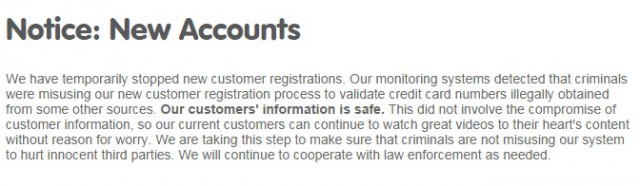
It would take a larger subscriber base to change that for the better, but Redbox Instant seems intent on sabotaging its success, still refusing to enroll new customers three months after a security breach. It seems Redbox Instant’s website was an excellent resource for credit card thieves to verify if stolen card numbers were still valid. Current customers are still able to use the service, but reportedly cannot update or change their credit card information, meaning they will lose service if their credit card expires or the credit card number changes.
A notice on Redbox Instant’s website prevents new users from enrolling.
Company executives have told investors they are not happy with Redbox Instant’s subscriber numbers. Not allowing new customers to sign up while gradually losing old ones because of an expired credit card could go a long way to explain this. Redbox’s parent company previously warned it has the right to pull out of the venture if the numbers don’t improve, and they won’t if the website remains locked down.
When Roettgers asked Redbox and Verizon to comment on a reddit rumor that the service was to close down on Oct. 1, the only reply was “no comment.” Roettgers believes that is telling, because no company would want such a false rumor to spread unchallenged. With Oct. 1 less than 24-hours away, we won’t have long to wait to see what happens next.
Roettgers would not be surprised to see Redbox Instant downsize itself with an end to its subscription video plan and move forward exclusively as a paid, video-on-demand service. It already powers Verizon’s On Demand video store. Having a traditional television partner like Verizon FiOS TV could help Redbox survive in an already crowded marketplace of online, on-demand video stores like iTunes, Google Play, Vudu, Amazon, and others.
In a larger context, the industry’s belief in “if we build it, they will come,” appears to be untrue, especially cable and telephone company efforts developing their TV Everywhere platforms. Content and viewing limitations that confine online viewing largely to the home, a barrage of online video advertising, subscription fees, and the lack of quality content have all hurt efforts to deliver a good user experience that can promote customer loyalty. Nothing now or on the horizon appears to be anything like a Netflix-killer app.
[flv]http://www.phillipdampier.com/video/Bloomberg Bibb Says Comcast Has Little Confidence in Streampix 2-21-12.mp4[/flv]
Two years ago, Porter Bibb, managing partner at Mediatech Capital Partners, panned the then-new XFINITY Streampix service for streaming the same television shows and movies customers can already see on Netflix and other services. From Bloomberg Television’s “Bloomberg West,” originally aired Feb. 21, 2012. (4:30)
The arrival of Netflix north of the American border has sparked a potential video revolution in Canada that some fear could renew “an erosion” of Canadian culture and self-identity as the streaming video service floods the country with American-made television and movies. But anxiety also prevails on the upper floors of some of Canada’s biggest telecom companies, worried their business models are about to be challenged like never before.
Two weeks ago, the country saw a remarkable Canadian Radio-television and Telecommunications Commission (CRTC) hearing featuring a Netflix executive obviously not used to being grilled by the often-curt regulators. When it was all over, Netflix refused to comply with a CRTC order for information about Netflix’s Canadian customers.
Earlier today, the CRTC’s secretary general, John Traversy, declared that because of the lack of cooperation from Netflix, all of their testimony “will be removed from the public record of this proceeding on October 2, 2014.” That includes their oral arguments.
“As a result, the hearing panel will reach its conclusions based on the remaining evidence on the record. There are a variety of perspectives on the impact of Internet broadcasting in Canada, and the panel will rely on those that are on the public record to make its findings,” Mr. Traversy wrote in a nod to Canada’s own telecom companies.
Not since late 1990’s Heritage Minister Sheila Copps, who defended Canadian content with her support of a law that restricted foreign magazines from infiltrating across the border, had a government official seemed willing to take matters beyond the government’s own policy.
CRTC chairman Jean-Pierre Blais threw down the gauntlet when Netflix hesitated about releasing its Canadian subscriber and Canadian content statistics to the regulator. Mr. Blais wanted to know exactly how many Canadians are Netflix subscribers and how much of what they are watching on the service originates in Canada.
With hearings underway in Ottawa, bigger questions are being raised about the CRTC’s authority in the digital age. Doug Dirks from CBC Radio’s The Homestretch talks with Michael Geist at the University of Ottawa. Sept. 19, 2014 (8:40) You must remain on this page to hear the clip, or you can download the clip and listen later.
Netflix has operated below regulatory radar since it first launched service in Canada four years ago. The CRTC left the American company with an impression it had the right to regulate Netflix, but chose not to at this time. The CRTC of 2010 was knee-deep in media consolidation issues and did not want to spend a lot of time on an American service that most Canadians watched by using proxy servers and virtual private networks to bypass geographic content restrictions. But now that an estimated 30% of English-speaking Canada subscribes to Netflix, it is threatening to turn the country’s cozy and well-consolidated media industry on its head.
Ask most of the corporate players involved and they will declare this is a fight about Canada’s identity. After all, broadcasters have been compelled for years to live under content laws that require a certain percentage of television and radio content to originate inside Canada. Without such regulations, enforced by the CRTC among others, Canada would be overwhelmed by all-things-Americans. Some believe that without protection, Canadian viewers will only watch and listen to American television and music at the cost of Canadian productions and artists.
[flv]http://www.phillipdampier.com/video/BNN Netflix vs the CRTC 9-22-14.flv[/flv]
Kevin O’Leary, Chairman, O’Leary Financial Group is furious with regulators for butting into Netflix’s online video business and threatening its presence in Canada is an effort to protect incumbent business models. From BNN-Canada. (8:45)
A viewer watches Netflix’s Corie Wright testify before the CRTC. (Image: Sean Kilpatrick, The Canadian Press)
But behind the culture war is a question of money – billions of dollars in fact. Giant media companies like Rogers, Shaw, and Bell feel threatened by the presence of Netflix, which can take away viewers and change a media landscape that has not faced the kind of wholesale deregulation that has taken place in the United States since the Reagan Administration.
Before Netflix, the big Canadian networks didn’t object too strongly to the content regulations. After all, CRTC rules helped establish the Canadian Media Fund which partly pays for domestic TV and movie productions. Canada’s telephone and satellite companies also have to contribute, and they collectively added $266 million to the pot in 2013, mostly collected from their customers in the form of higher bills. Netflix doesn’t receive money from the fund and has indicated it doesn’t need or want the government’s help to create Canadian content.
“It is not in the interest of consumers to have new media subsidize old media or to have new entrants subsidize incumbents,” added Netflix’s Corie Wright. “Netflix believes that regulatory intervention online is unnecessary and could have consequences that are inconsistent with the interests of consumers,” Wright said, adding viewers should have the ability “to vote with their dollars and eyeballs to shape the media marketplace.”
That is not exactly what the CRTC wanted to hear, and Wright was off the Christmas card list for good when she directly rebuffed Mr. Blais’ requests for Netflix’s data on its Canadian customers. Wright implied the data would somehow make its way out of the CRTC’s offices and end up in the hands of the Canadian-owned broadcast and cable competitors that know many at the CRTC on a first name basis.
Does Netflix pose a threat to Canadian culture? Matt Galloway spoke with John Doyle, the Globe & Mail’s television critic, on the Sept. 22nd edition of CBC Radio’s Metro Morning show. Sept. 22, 2014 (8:31) You must remain on this page to hear the clip, or you can download the clip and listen later.
Mr. Blais, obviously not used to requests being questioned, repeated demands for Netflix’s subscriber data to be turned over by the following Monday and if Netflix did not comply, he would revoke Netflix’s current exemption from Canadian content rules and bring down the hammer of regulation on the streaming service.
Blais
The deadline came and went and last week Netflix defiantly refused to comply with the CRTC’s order. A Netflix official said that while the company has responded to a number of CRTC requests, it was not “in a position to produce the confidential and competitively sensitive information, but added it was always prepared to work constructively with the commission.”
Now things are very much up in the air. Many Canadians question why the CRTC believes it has the right to regulate Internet content when it operates largely as a broadcast regulator. Public opinion seems to be swayed against the CRTC and towards Netflix. Canadian producers and writers are concerned their jobs are at risk, Canadian media conglomerates fear their comfortable and predictable future is threatened if consumers decide to spend more time with Netflix and less time with them. All of this debate occurring within the context of a discussion about forcing pay television companies to offer slimmed down basic cable packages and implement a-la-carte — pay only for the channels you want — is enough to give media executives heartburn.
To underscore the point much of this debate involves money, American TV network executives also turned up at the CRTC arguing for regulations that would compensate American TV stations for providing “free” programming on Canadian airwaves, cable, and satellite — retransmission consent across the border.
Netflix does not seem too worried it is in trouble in either Ottawa or in the halls of CRTC headquarters at Les Terrasses de la Chaudière in Gatineau, Québec, just across the Ottawa River. Prime Minister Stephen Harper and Heritage Minister Shelly Glover have made it clear they have zero interest in taxing or regulating Netflix. Even if they were, the Canada-U.S. free trade agreement may make regulating Netflix a practical impossibility, especially if the U.S. decides to retaliate.
[flv]http://www.phillipdampier.com/video/Canadian Press CRTC vs Netflix 9-19-14.mp4[/flv]
Dwayne Winseck, Carleton School of Journalism and Communication, defended the role the CRTC is mandated to play by Canada’s telecommunications laws. (1:41)
The staff of the New York Public Service Commission has requested extra time for consideration of Comcast’s application to assume control of Time Warner Cable’s operations in New York State.
“Pursuant to a request from Department of Public Service staff in the above-referenced matter, Comcast Corporation and Time Warner Cable Inc. agree to action by the Public Service Commission on the Joint Petition at the November 13, 2014 Commission Session, with a final order being issued no later than November 19, 2014,” says a filing published late this afternoon by the Commission.
The merger was to be on the agenda for approval or rejection at a meeting in early October. New York public interest groups are continuing to mount opposition campaigns against the merger. Many feel the proposal has not been given enough attention and the public remains largely unaware of their ability to take part in discussions about the proposal.
Update: 9/29/14:
Public Service spokesperson James Denn sent this statement to City Newspaper on Monday:
“The Comcast proceeding, affecting 2.2 million cable customers in New York and representing an approximate New York transaction value of $3 billion, has led to an intense stakeholder focus producing nearly 3,000 public comments, making it one of the most active proceedings in commission history. Given the depth and breadth of the public record and the importance of the issues presented, the commission has accepted the extension of the period for review so that it may consider the matter more fully at its November 13 session.”
Be Sure to Read Part One: Astroturf Overload — Broadband for America = One Giant Industry Front Group for an important introduction to what this super-sized industry front group is all about. Members of Broadband for America Red: A company or group actively engaging in anti-consumer lobbying, opposes Net Neutrality, supports Internet Overcharging, belongs to […]
Astroturf: One of the underhanded tactics increasingly being used by telecom companies is “Astroturf lobbying” – creating front groups that try to mimic true grassroots, but that are all about corporate money, not citizen power. Astroturf lobbying is hardly a new approach. Senator Lloyd Bentsen is credited with coining the term in the 1980s to […]
Hong Kong remains bullish on broadband. Despite the economic downturn, City Telecom continues to invest millions in constructing one of Hong Kong’s largest fiber optic broadband networks, providing fiber to the home connections to residents. City Telecom’s HK Broadband service relies on an all-fiber optic network, and has been dubbed “the Verizon FiOS of Hong […]
BendBroadband, a small provider serving central Oregon, breathlessly announced the imminent launch of new higher speed broadband service for its customers after completing an upgrade to DOCSIS 3. Along with the launch announcement came a new logo of a sprinting dog the company attaches its new tagline to: “We’re the local dog. We better be […]
Stop the Cap! reader Rick has been educating me about some of the new-found aggression by Shaw Communications, one of western Canada’s largest telecommunications companies, in expanding its business reach across Canada. Woe to those who get in the way. Novus Entertainment is already familiar with this story. As Stop the Cap! reported previously, Shaw […]
The Canadian Radio-television Telecommunications Commission, the Canadian equivalent of the Federal Communications Commission in Washington, may be forced to consider American broadband policy before defining Net Neutrality and its role in Canadian broadband, according to an article published today in The Globe & Mail. [FCC Chairman Julius Genachowski’s] proposal – to codify and enforce some […]
In March 2000, two cable magnates sat down for the cable industry equivalent of My Dinner With Andre. Fine wine, beautiful table linens, an exquisite meal, and a Monopoly board with pieces swapped back and forth representing hundreds of thousands of Canadian consumers. Ted Rogers and Jim Shaw drew a line on the western Ontario […]
Just like FairPoint Communications, the Towering Inferno of phone companies haunting New England, Frontier Communications is making a whole lot of promises to state regulators and consumers, if they’ll only support the deal to transfer ownership of phone service from Verizon to them. This time, Frontier is issuing a self-serving press release touting their investment […]
I see it took all of five minutes for George Ou and his friends at Digital Society to be swayed by the tunnel vision myopia of last week’s latest effort to justify Internet Overcharging schemes. Until recently, I’ve always rationalized my distain for smaller usage caps by ignoring the fact that I’m being subsidized by […]
In 2007, we took our first major trip away from western New York in 20 years and spent two weeks an hour away from Calgary, Alberta. After two weeks in Kananaskis Country, Banff, Calgary, and other spots all over southern Alberta, we came away with the Good, the Bad, and the Ugly: The Good Alberta […]
A federal appeals court in Washington has struck down, for a second time, a rulemaking by the Federal Communications Commission to limit the size of the nation’s largest cable operators to 30% of the nation’s pay television marketplace, calling the rule “arbitrary and capricious.” The 30% rule, designed to keep no single company from controlling […]
Less than half of Americans surveyed by PC Magazine report they are very satisfied with the broadband speed delivered by their Internet service provider. PC Magazine released a comprehensive study this month on speed, provider satisfaction, and consumer opinions about the state of broadband in their community. The publisher sampled more than 17,000 participants, checking […]


 Subscribe
 With many customers having only one choice for High Speed Internet access above 15-25Mbps — the cable company — the arrival of GreatLand concerns many municipalities facing deadlines to approve a transfer of franchise agreements from Comcast to the new entity.
 The arrival of Netflix north of the American border has sparked a potential video revolution in Canada that some fear could renew “an erosion” of Canadian culture and self-identity as the streaming video service floods the country with American-made television and movies. But anxiety also prevails on the upper floors of some of Canada’s biggest telecom companies, worried their business models are about to be challenged like never before.