

Home » Competition » Recent Articles:

Comcast Prepares to Launch All-Out Attack on C Spire’s Irritating Competition in Mississippi

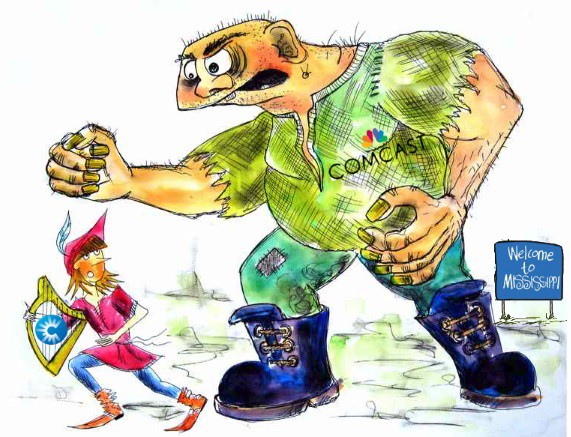
comcast crushThe sleepy deep south isn’t often a battleground for an all-out broadband competition war, but Ridgeland, Miss.-based C Spire, a regional cell phone company with fiber broadband aspirations, has gotten too big for its britches and Comcast is preparing to demonstrate its size and resources can run even a home state provider into the ground.

C Spire is building a statewide fiber-to-the-home network, city by city, on its pre-existing fiber backbone which extends to C Spire’s cell towers across the Magnolia State. As the fiber network expands, talk of doing something in a “Mississippi Minute” will be a thing of the past as C Spire prepares to deliver gigabit broadband speeds far in excess of what competitors like Comcast, AT&T and Cable One are prepared to offer.

Communities already on the construction list include: Batesville, Clinton, Corinth, Hattiesburg, Horn Lake, McComb, Quitman, Ridgeland and Starkville.

But C Spire’s network caught the attention of Comcast earlier this month when it announced Jackson, the state capital, was going to get fiber service.

C Spire is following Google Fiber’s model, attempting to get enough residents in a neighborhood to pre-register with a refundable $10 deposit. Online pre-registration for the service began in Jackson last month, and several hundred residents applied even before the fiber network expansion was announced, ready to tell Comcast to take a hike.

Jackson neighborhoods that reach sign-up levels set by C Spire will be the first to get the new generation of fiber services, the company says.

“Gigabit infrastructure can create a new economic reality for the city of Jackson,” Duane O’Neill, president & CEO of the 2,100-member Greater Jackson Chamber Partnership, told the Mississippi Business Journal. “In the handful of U.S. cities where this infrastructure is deployed and widely available, it has generated thousands of jobs, millions of dollars of new investment, boosted home values and improved the overall quality of life.”
c spire fiberC Spire’s plans could cost Comcast a significant number of cable customers across Mississippi, and it isn’t taking that lightly.

Departing from its usual tradition of focusing new technology on large northeastern cities, Comcast will begin saturating Jackson with its Wi-Fi hotspot service, starting with 200 public hotspots slated for launch before the end of this year. The company only had a handful of Wi-Fi hotspots in Jackson before. Jackson will also get significant cable service upgrades, including the introduction of a new “smart home” service, a cloud-based service integrating Comcast’s cable, Internet, and home-security.

Comcast says it has plans to turn Jackson into a “truly connected city,” and if that means competitively disconnecting C Spire from its nascent fiber customer base, all the better.“This is the kind of threat that would frighten competitors,” said industry observer Jeff Kagan. “Comcast can be a heavy-duty competitor when they want to be. So why is Jackson and other Mississippi cities getting this kind of attention from Comcast and C Spire? I think it’s a matter of competition and C Spire’s aggressive move in the state of Mississippi played a role in the Comcast decision to turn up the heat.”

Kagan also expects Comcast will cut prices to undercut C Spire. That would be consistent with Comcast’s customer retention policies that dramatically lower rates for customers threatening to leave. Rate-cutting will benefit consumers, but if Comcast engages in below-cost predatory pricing, those savings will be short-lived.

“It’s starting to look like that old nursery rhyme, Jack and the Beanstalk,” said Kagan. “Watch out Jack, the Giant is waking up.”

If that battle becomes cut-throat, C Spire’s fiber aspirations may end up nothing more than pipe dreams if the company retreats, deciding it cannot survive in a battle with Comcast, the Giant of all cable companies.

Rogers Snaps Up Another Independent Cable Company; Hamilton-based Source Cable

Phillip Dampier October 27, 2014 Canada, Competition, Consumer News, Data Caps, Rogers Comments Off on Rogers Snaps Up Another Independent Cable Company; Hamilton-based Source Cable

source-cableRogers Communications will acquire Hamilton, Ont.-area independent Source Cable in a quiet $160-million deal.
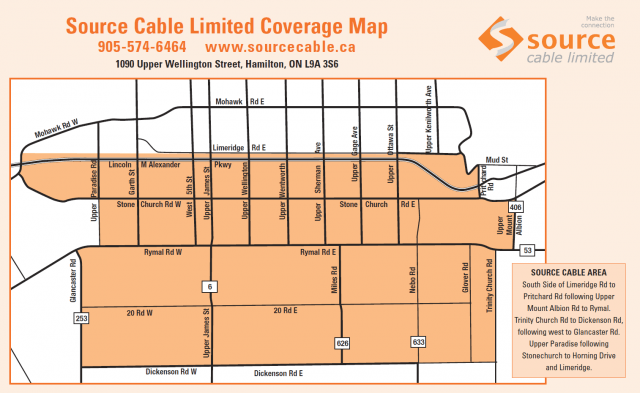
The transaction was first noticed in Rogers’ quarterly financial report to shareholders, noting that Source Cable provides cable, broadband, and phone service to only a part of the city of Hamilton. Rogers already provides service next to Source Cable’s service area so a transition to Rogers should pose few issues for eastern Canada’s biggest cable operator. The rest of greater Hamilton will continue to be served by Cogeco and Rogers in their respective service areas.

“We’re really excited about purchasing Source Cable,” said Kevin Spafford, Rogers Communications spokesperson. “We view this acquisition as a growth opportunity because the company is well run; the footprint is adjacent to our existing cable systems; they have really good penetration of cable TV and Internet services, and there is potential for new customers as the unbuilt part of the area develops.”

Subscribers are less enthusiastic.

The cable company has always been responsive to its customers and willing to pioneer new technology before larger providers like Rogers.

Source Cable customers may win some extra ethnic language programming now seen on Rogers, but will likely experience a major downgrade in how they deal with their cable provider. Source customers will eventually be exposed to Rogers’ much lower-rated customer service. Broadband customers are also likely to lose their unlimited Internet service, forced to select from Rogers’ usage-capped plans.

Source Cable was started by former city alderman Jim Campbell in 1974. Campbell died two years ago.

Source Cable's service coverage area is limited to a number of blocks in parts of Hamilton, Ont.

Source Cable’s service coverage area is limited to a number of blocks in parts of Hamilton, Ont.


Tesco Grocery Chain Offers 16Mbps Broadband to UK Residents Free for a Year (After Line Rental)

Phillip Dampier October 27, 2014 Broadband Speed, Competition, Consumer News, Tesco (UK) Comments Off on Tesco Grocery Chain Offers 16Mbps Broadband to UK Residents Free for a Year (After Line Rental)

tesco broadbandOne of the largest grocery chains in the United Kingdom is giving away free unlimited 16Mbps broadband for a year, including a free wireless router, as long as customers cover the usual monthly line rental fees.

The service is offered without a voice dialing plan, which means customers will pay for any voice minutes they use, except when those calls are to or from Tesco Homephone customers. Internet customers also receive a free year of Tesco Internet Security and UK-based phone support. The optional phone service also includes Caller ID, Caller ID blocking, and Directory Inquiries.

In fact, Tesco’s offer will actually be a money-maker for customers who already have home phone service because Tesco also includes Clubcard points on every bill, which can be redeemed on purchases made at the chain.

After 12 months, the price reverts to Tesco’s current standard offering: 16Mbps for $9.68 a month.

Tesco’s line rental charge, required on all landlines and DSL service costs $24.83 a month.

In comparison, CenturyLink charges $39.95 a month for 10Mbps service for a year before the price increases. But customers will pay considerably more than that, as that price does not include taxes, fees, and surcharges, including a Carrier Universal Service charge, National Access Fee surcharge, a one-time, High-Speed Internet activation fee, and state and local fees that vary by area and certain in-state surcharges. A monthly modem rental fee also applies.


Sprint Realizes Not Everyone Wants a $200 Cell Phone Bill: Announces $20, 1GB Family Data Plan

Phillip Dampier October 23, 2014 Competition, Consumer News, Data Caps, Sprint, Wireless Broadband 1 Comment

budgetIf your family budget cannot handle a $200 monthly cell phone bill from AT&T or Verizon and you can keep your data usage to around 1GB, Sprint has a deal for you.
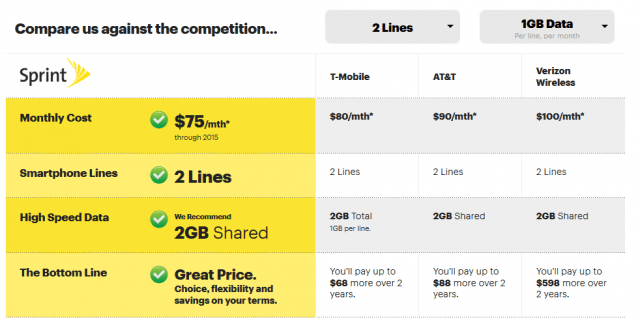
On Wednesday, Sprint unveiled a low-end family data plan offering 1GB of data for $20 a month, an improvement over the 600MB data option Sprint used to offer. It’s also a better deal than the 500MB $20 buys you on Verizon’s network or the piddling 300MB AT&T delivers on its budget plan.

“This entry-level sharable data allowance reinforces Sprint’s commitment to offering customers the best value in wireless,” said Marcelo Claure, Sprint CEO. “We’re offering customers a choice – whether they need a small amount of data or are a high-end data user.”

Customers can build their own plan in three steps. First, choose the shared data allowance. For 1GB, it’s $20 per month for up to 10 lines. Second, add data access for phones with unlimited talk and text while on the Sprint network. The data access charge for non-discounted phones is $25 per month per line for 1GB through 16GB. Third, add your tablet devices for $10 per month per line and mobile broadband devices for $20 per month per line. There is no early termination fee and no annual service contract with non-discounted phones.

In addition, when customers switch their number to Sprint, a family with up to 10 lines can get 20GB of shared data and unlimited talk and text for only $100 a month through 2015.

This chart reflects a 2GB shared data plan for two lines that amounts to $75 a month before taxes, fees and surcharges.

This chart reflects a 2GB shared data plan for two lines that amounts to $75 a month before taxes, fees and surcharges.

Since wireless carriers discovered reports of a spectrum crisis were vastly exaggerated, they have fallen all over each other with “double your data” promotions and other allowance boosters. Sprint’s family plans allow customers to divide up an inexpensive data plan across all phones on the account. If you spend most of your time on Wi-Fi or share an account with parents or grandparents not accustomed to using much data, Sprint’s plan may deliver enough data to satisfy.

Sprint has hemorrhaged its high-end customers for several quarters, mostly because its 3G data service is barely usable and its new 4G LTE network has rolled out at the typical speed of a glacier and its performance has not always impressed. Sprint has cut prices and is trying to find a stable niche among budget-conscious postpaid customers unwilling to pay AT&T and Verizon’s asking price but are willing to tolerate reduced coverage in favor of a better price. Sprint and T-Mobile are both competing for these customers. Verizon says it cannot be bothered being seen as a discount carrier, and AT&T is committed to keeping its average revenue per customer numbers growing.

Half of AT&T’s Customers Are Paying $100 for 10GB Data; Unlimited Customers Still Throttled After 3-5GB

Phillip Dampier October 23, 2014 AT&T, Broadband "Shortage", Broadband Speed, Competition, Consumer News, Data Caps, Public Policy & Gov't, Wireless Broadband Comments Off on Half of AT&T’s Customers Are Paying $100 for 10GB Data; Unlimited Customers Still Throttled After 3-5GB
Speed bump

Speed bump

More than half of AT&T’s wireless customers are paying at least $100 a month for 10GB or more of wireless data on AT&T’s Mobile Share Plans at the same time AT&T continues to throttle its legacy unlimited data customers who use more than 3GB of data on its 3G network or 5GB of data on its 4G LTE network.

AT&T claimed in 2012 it implemented its “fair usage policy” for unlimited customers to assure all could receive reasonable service during peak usage times when cell towers become congested.

AT&T also blames “a serious wireless spectrum crunch” for the speed throttling, implying access to more spectrum could help ease the problem. But there is a much faster way to overcome AT&T’s “spectrum crunch:” agree to pay them more money by ditching that $30 unlimited plan for a tiered plan.

John Stephens, AT&T’s chief financial officer, told investors Wednesday that nothing boosts revenue more than pushing customers into usage-cappped data plans that customers are regularly forced to upgrade.

“On the ARPU (average revenue per user/customer) story, I think the biggest issue with the improvement is people buying the bigger [data] buckets and buying – upping plans,” said Stephens. “We had over 50% of the customer base at the 10GB or bigger plans.”

Stephens added that AT&T benefited from customers upgrading to 4G LTE devices that are handled more efficiently by AT&T’s mobile data network.

Increased usage and upgraded data plans delivered a 20% increase in data billings over the last quarter.

Since 2012 AT&T has paid out more than $50 billion to shareholders through dividends and share buybacks. The company benefited from nearly $20 billion a year in free cash flow and asset sales over the last two years and is expected to repeat those numbers this year. Consolidated revenue at AT&T grew to $33 billion, up $800 million since the same time last year.

Miraculously, despite the “alarming spectrum crunch,” AT&T found more than enough spectrum to award its best customers with a “double data” promotion that turns a 15GB data plan into a 30GB plan, a 20GB plan to 40GB, a 30GB plan to 60GB, a 40GB plan to 80GB, or a 50GB plan to 100GB. Importantly, AT&T boasts its double data promotion won’t “explode” — their language for “expire” — on customers until their contract ends.

Lowering the bar on "unlimited use" customers.

Lowering the bar on “unlimited use” customers.

“Those exploding offers — customers hate those offers,” said AT&T Mobility CEO Ralph de la Vega at a recent investor conference. “Unless they change their mind, we won’t offer those kinds of promotions.”

But de la Vega doesn’t mind leaving the company’s most loyal legacy customers in the penalty box if they cling to their grandfathered unlimited data plans. The throttles stay and the allowances have remained unchanged since first announced, despite the bountiful spectrum obviously ready and available to serve AT&T’s deluxe customers. Unlimited customers are regularly reminded they can easily avoid the throttle — just abandon that unlimited data plan. According to Stephens, more than 80% of AT&T’s customers already have.

The excuses for wireless speed throttles and killing off unlimited data plans at AT&T and Verizon Wireless don’t seem to wash with FCC chairman Thomas Wheeler, who demanded Verizon offer the “rationale for treating customers differently based on the type of data plan to which they subscribe, rather than network architecture or technological factors,” after it announced it was planning speed throttles for its remaining unlimited data plan customers. Verizon canceled the plan after Wheeler began scrutinizing it, but the throttles are still in place at AT&T.

AT&T’s 10GB Mobile Share Plan starts with a $100 data plan. Customers also pay:

  • $10 a month for each auto-based smart-locator;
  • $10 a month for each tablet, camera or game device;
  • $15 a month for each basic phone;
  • $20 a month for each wireless home phone replacement;
  • $20 a month for each connected Internet device;
  • $40 a month for each connected smartphone.

A family of four with four smartphones, a tablet, and AT&T’s wireless home phone replacement would be billed $290 a month before at least $39 in taxes, fees, and surcharges — well north of $300 a month for most.

Search This Site:

Contributions:

Recent Comments:

Your Account:

Stop the Cap!
