


Home » Competition » Recent Articles:

Competition Finally Starts Hurting Verizon Wireless; Holiday Margin Pressure and Higher Disconnects

Phillip Dampier December 8, 2014 Competition, Consumer News, Verizon, Wireless Broadband 1 Comment

Christmas Stocking with chunks of coal laying on a green textured backgroundFor years Verizon Wireless has charged some of the highest prices in the wireless industry because it could. But those days may finally be coming to an end as the company admits it is seeing an increase in customer disconnects, and the company announced it will spend more on subscriber promotions to win back old customers and attract new ones.

Verizon Wireless executives have repeatedly stressed they can charge ‘Cadillac prices on a Cadillac network’ that has traditionally outperformed the competition in coverage, 4G data, and customer service. But customers may be telling the carrier “enough as enough” as a growing number are attracted to offers of dramatically lower pricing from Sprint and T-Mobile.

In a statement issued to shareholders, Verizon Wireless reports it is not on track to have a completely Merry Christmas:

As the company is accelerating the upgrades of high-quality customers to 4G, total retail postpaid disconnects are trending higher both sequentially and year over year in this highly competitive and promotion-filled fourth quarter.

The company expects that the fourth-quarter impacts of its promotional offers, together with the strong customer volumes this quarter, will put short-term pressure on its wireless segment EBITDA and EBITDA service margin (non-GAAP, based on earnings before interest, taxes, depreciation and amortization) as well as its consolidated EBITDA margin (non-GAAP) and earnings per share.

Despite the growing number of customers leaving Verizon for more affordable alternatives, those remaining are willing to pay even higher prices upgrading to the latest smartphones and tablets equipped to take advantage of Verizon’s 4G LTE network. Customers are gradually moving away basic cell phones and towards smartphones and tablets.

Customers are also increasingly willing to abandon the upgrade subsidy in favor of early upgrades and device payment plans. Verizon reports almost one-quarter of customers are now enrolled in its Verizon Edge smartphone program, which budgets the cost of a new phone in installments charged to a cell phone bill. Just three months ago, Verizon had only enrolled 12% of its customers in the upgrade program.

Cuomo: 100% of New York State Should Have Access to 100Mbps Broadband by 2018

ny broadbandNew York Gov. Andrew Cuomo has set a goal that every resident of New York State should have access to at least 100Mbps broadband no later than 2018.
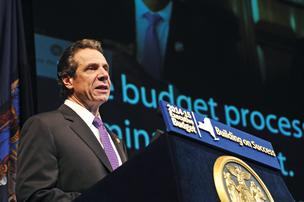
The governor will kick off his latest broadband expansion effort with the launch of his $500 million broadband expansion program, dubbed the New New York Broadband Fund, a follow-up to the state’s $70 million public-private effort to expand broadband that began in 2012.

Much of the money awarded in the 2012 broadband expansion effort went to Wireless Internet Service Providers, institutional broadband networks, middle-mile fiber projects not accessible to the public, and emergency service network upgrades. Another $5.2 million was awarded to Time Warner Cable to expand broadband service to 4,114 households in the Capital, Central, Finger Lakes, Mid-Hudson, Mohawk Valley, NYC, North Country, Southern Tier and Western regions of New York State. In June, many of the top funding recipients also received honors from the governor’s office in the first annual New York State Broadband Champion Awards.

Gov. Cuomo

Gov. Cuomo

Despite the money, the 2012 effort did not make a significant dent in the pervasive problem of broadband availability in upstate New York.

While Gov. Cuomo is committed to a target speed of 100Mbps within the next four years, more than one million New York households still cannot access broadband that achieves the state minimum — 6.5Mbps. That includes 113,000 businesses.

The governor’s solution is to subsidize private businesses with more tax dollars to resolve the broadband problem, with a significant part of the next round of funding likely to reach more institutional and public safety networks off-limits to the public, middle mile network expansion that can build state-of-the-art fiber rings that do not connect to end users, and an even bigger amount handed to Time Warner Cable (or Comcast if the state approves a merger with Time Warner Cable) and rural phone companies like Frontier Communications. Much of the money awarded to last mile providers like cable and phone companies will placate those that have stubbornly refused to expand further into rural areas unless taxpayers pick up some of the expense.

“In some of these areas, there’s just not a business case for these [service] providers to build out,” said David Salway, director of the New York State Broadband Program office. “The cost far exceeds what the revenue might be for that area.”

An unintended consequence of the broadband funding effort could be taxpayers subsidizing the establishment of for-profit monopolies in rural corners of the state. Although Salway told Capital NY he wanted to make sure New Yorkers had a choice, he clarified he was referring to a choice in technology, not service providers.

twcGreenThat must come as a relief for Verizon. The state’s largest phone company has petitioned state officials in the past for a gradual mothballing of New York’s rural landline network in favor of switching customers to wireless voice and broadband over Verizon’s cellular network. Theoretically, taxpayers could end up subsidizing the demise of rural New York landlines and DSL if Verizon seeks money from the rural broadband fund to expand its wireless tower network in rural New York. Time Warner Cable almost certainly will also seek more funding, probably in excess of the average $1,264 paid to the cable company for each of the 4,114 additional connections it agreed to complete during an earlier round of funding.

While rural broadband remains an important issue in New York, the merger of Comcast and Time Warner Cable is on the front burner and Salway, like the governor, had little to say. But Salway did offer that he did not believe the merger “would reduce [access] as much as further our goal” for expansion.

Guidelines for grant recipients are expected to become available just after the governor’s State of the State presentation in January, with ground-breaking on projects likely to start by mid-summer of 2015.

AT&T, Verizon Break Out The Campaign Contribution Checkbooks Early, Sending $ to the Newly-Elected

Big Telecom is already trying to buy incoming members of Congress with lavish campaign contributions.

Big Telecom is already trying to buy incoming members of Congress with lavish campaign contributions.

Before constituents have a chance to make an impression on Capitol Hill’s incoming freshmen class, AT&T and Verizon have rushed significant campaign contributions to more than two dozen newly elected members of Congress.

Politico reports AT&T has cut checks to 31 new members of the House and Senate, Verizon sent 28 checks, and Comcast donated to 22 winners in the fall elections. Most of the money went to incoming Republicans who will control both the House and Senate starting in January.

All three companies are seeking allies in the fight against Net Neutrality and for a wholesale rewriting of the Communications Act, the nation’s most important telecom-related legislation.

Congressional observers predict revisiting the Communications Act would be a lobbyist bonanza, with potentially billions flowing into congressional coffers to win further industry deregulation. The last major overhaul in 1996 transformed broadcasting, allowing a handful of corporations to own the majority of radio and television stations and allowing large phone and cable companies to govern themselves with respect to broadband and competition. Cable and broadband prices soared as a result, while the number of competitors dropped due to industry consolidation.

The telecom companies are well ahead of technology players like Microsoft and Google, that have collectively sent contributions to fewer than a half-dozen incoming members and are barely active in Washington in comparison to the biggest phone and cable companies.

Amazon.com Slashes Price of Fire TV: $69 for Cyber Monday is $30 Off Regular Price

Phillip Dampier December 1, 2014 Competition, Consumer News, Online Video Comments Off on Amazon.com Slashes Price of Fire TV: $69 for Cyber Monday is $30 Off Regular Price

Amazon’s entry into the online video streaming set-top box market is getting a price chop for Cyber Monday, discounted by $30 for today only.

An out the door price of $69 plus applicable tax will get you connectivity between your home broadband connection and your television, and is particularly useful for Amazon Prime customers seeking access to Prime Instant Video. Amazon Fire TV uniquely uses voice search — at least for Amazon.com’s own video content, and supports Netflix, Hulu Plus, and a variety of other online video resources. Built in Wi-Fi also allows for remote control. The box can be managed through the Fire TV Remote App for your mobile device. The app includes voice search, simple navigation, and a keyboard for easy text entry—no more hunting and pecking. The app is supported on many Android phones and tablets, Fire Phone, and Fire HDX & Fire HD tablets with microphones.

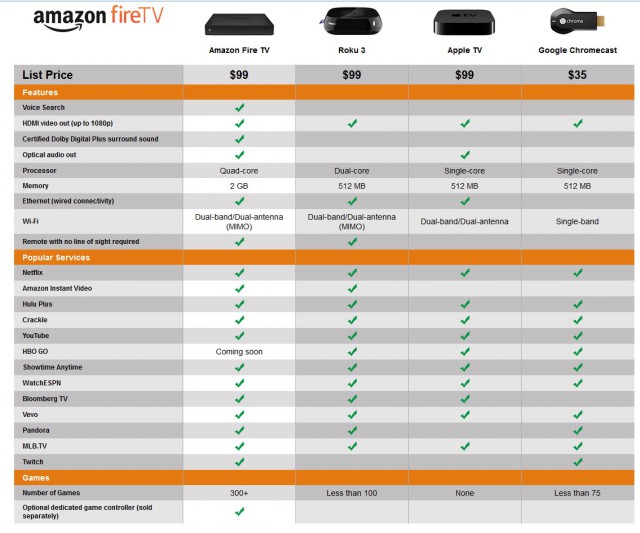
Amazon’s video set-top box fiercely competes with Roku, Apple TV, and Chromecast.

fire tv compare

This Amazon-provided comparison chart is weighed in favor of Amazon’s device, but does offer useful specs.

Google Fiber Prices Announced in Austin: No Surprises – 5/1Mbps Free, 1Gbps $70/Month

google fiberAustin residents will receive Google Fiber service under three rate plans: $70 for 1,000/1,000Mbps or 5/1Mbps at no charge after paying a $300 construction fee. A package including television costs $130 a month.

Google Fiber announced its prices this week in anticipation of a December launch in the capital city of Texas. But Google Fiber will arrive with at least two competitors beating them to the gigabit space: Grande Communications and AT&T.

Austin is the first city in the country to have three concurrent gigabit providers. Only Time Warner Cable has elected to sit out the city’s gigabit broadband fight. Google Fiber is expected to face stiffer competition in Austin than in Kansas City and Provo, where it also operates gigabit fiber networks. AT&T U-verse with GigaPower matches Google’s $70 price and San Marcos-based Grande Communications beats it, charging $64.99 for its 1,000Mbps service.

Google is sweetening the deal by converting the former home of a children’s museum into a “Fiber Space,” a community center at 201 Colorado Street – hosting concerts, community meetings, and clubs, in addition to showcasing Google’s fiber network.

As with AT&T’s gigabit U-verse upgrade, only a limited number of residents in Austin will initially be able to get the new fiber service. Google is initially lighting up areas in south and southeastern Austin. For some, the wait to eventually sign up could take up to several years as Google slowly builds out its network in the city of 885,000 people.

Search This Site:

Contributions:

Recent Comments:

Your Account:

Stop the Cap!