Home » Competition » Recent Articles:

Missouri Representative Introduces Community Broadband Ban Bill to Protect AT&T, CenturyLink

Rep. Rocky Miller (R-Lake Ozark)

Rep. Rocky Miller (R-Lake Ozark)

A Missouri state representative with a track record of supporting AT&T and other telecommunications companies has introduced a bill that would effectively prohibit community broadband competition in a bid to protect incumbent phone and cable companies.

Rep. Rocky Miller’s (R-Lake Ozark) House Bill 437 would strictly prohibit the construction of public broadband networks in any part of Missouri served by a private provider, regardless of the quality of service available or its cost, without a referendum that includes a mandated question observers consider slanted in favor of existing providers.

HB437 would banish community broadband networks as early as September unless services were already up and running. The bill would effectively stop any public broadband network intending to compete against an existing phone or cable company within the boundaries of a city, town, or village offering any level of broadband service. It would also require communities to schedule a referendum on any project budgeted above $100,000, and includes ballot language that implies public broadband projects would duplicate existing services, even if a private provider offers substantially slower broadband at a considerably higher price. (Emphasis below is ours):

“Shall [Anytown] offer [broadband], despite such service being currently offered within Anytown by x private businesses at an estimated cost of (insert cost estimate) to Anytown over the following five-year period?”

Miller’s proposal would also require voters to approve a specific and detailed “revenue stream” for public broadband projects and if the referendum fails to garner majority support, would prohibit the idea from coming up for a second vote until after two years have passed, allowing cable and phone companies to plan future countermeasures.

yay attThe proposed bill also carefully protects existing providers from pressure to upgrade their networks.

Miller’s bill defines “substantially similar” in a way that would treat DSL service as functionally equivalent to gigabit broadband as both could be “used for the same purpose as the good or service it is being compared to, irrespective of how the good or service is delivered.”

In other words, if you can reach Rep. Miller’s campaign website on a CenturyLink 1.5Mbps DSL connection and over a co-op gigabit fiber to the home connection, that means they are functionally equivalent in the eyes of Miller’s bill. Residents voting in a referendum would be asked if it is worthwhile constructing fiber to the home service when CenturyLink is offering substantially similar DSL.

Among the telecom companies that had no trouble connecting to Rep. Miller to hand him campaign contributions: AT&T, CenturyLink, Comcast, and Charter Communications

The Coalition for Local Internet Choice was unhappy to see yet another state bill introduced designed to limit competition and take away the right of local communities to plan their own broadband future.

“The state of Missouri is the latest legislature to attempt to erect barriers to the deployment of broadband networks that are critical to the future of its local economies and the nation, via House Bill 437,” said a statement released by the group. “High-bandwidth communications networks are the electricity of the 21st century and no community should be stymied or hampered in its efforts to deploy new future-proof communications infrastructure for its citizens – either by itself or with willing private partners.”
cell_towerThe group urged the Missouri legislature to reject the bill.

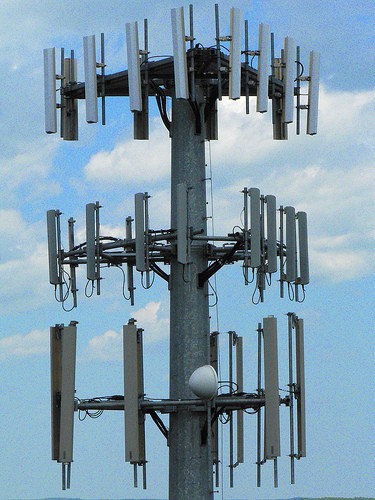
In 2013, Miller hit the ground running in his freshman year to achieve his campaign pledge of “getting the government out of the way of economic development.” In the Missouri state legislature, Miller strongly supported AT&T’s other state legislative priority: deregulation of cell tower placement. Miller traveled around Missouri promoting HB650, an AT&T inspired bill that would strip away local oversight powers of cell sites.

The issue became a hot topic, particularly in rural and scenic areas of Missouri, where local officials complained the bill would allow haphazard placement of cell towers within their communities.

“[The] bill inhibits a city’s ability to regulate cell towers as we have in the past,” Osage Beach city attorney Ed Rucker said. “The process we have in place has worked, and has worked well.”

Had HB650 become law, Osage Beach residents would today be surrounded by six new cell towers around the city, with little say in where they ended up. The bill Miller supported would have also eliminated a requirement that providers repair, replace, or remove damaged or abandoned cell towers, potentially leaving local taxpayers to pick up the tab.

Miller claimed the legislation would allow expansion of wireless broadband across rural Missouri and remove objectionable fees. HB650 would limit municipal fees to $500 for co-locating an antenna on a pre-existing tower and $1,500 for an application to build a new tower. Local communities complained those limits were below their costs to research the impact and placement of cell towers.

“That cost is an inhibitor to broadband,” Miller countered. “It’s beginning to look like the fees are an impediment to the expansion of broadband.”

Miller did not mention AT&T’s interest in cell tower expansion is also connected to its plan to retire rural landline service in favor of its wireless network, saving the company billions while earning billions more in new revenue from selling wireless landline replacement service over its more costly wireless network. The cell tower bill was eventually caught up in a legal dispute after a court ruled the broader bill that included the cell tower deregulation language was unconstitutional on a procedural matter.

Still Waiting for FiOS in New York City? Your Landlord Might Be to Blame… Or Verizon

Phillip Dampier January 13, 2015 Competition, Consumer News, Public Policy & Gov't, Verizon 3 Comments

keep outVerizon Communications has stepped up efforts in New York City to get intransigent landlords to let the company into their buildings to bring FiOS fiber optics to tenants, even as some property managers accuse Verizon of ignoring earlier requests to get the service.
On at least 13 occasions in December, Verizon has filed petitions with the New York Public Service Commission requesting help to gain entry to a total of 476 buildings in the city after claiming to receive either no response from building management or active resistance to Verizon bringing FiOS to their tenants.

In an effort to stay compliant with its franchise agreement with the City of New York, Alyson Siegal, area manager for FiOS Franchise Assurance – New York City, has written a lot of letters lately:

Dear Property Owner/Manager:

I have been advised by Verizon New York Inc.’s (“Verizon”) NYC FiOS Real Estate Department of the difficulty Verizon has encountered in attempting to install and/or attach its FiOS facilities at [your property].

Our records indicate that you have not responded to our previous correspondence, that you have conditioned Verizon’s access on unreasonable terms and conditions or that you have denied Verizon access to the Property. The purpose of this letter is to restate our need to gain access to your Property.

By way of background, Verizon is attempting to gain access to your building because we have received a request for FiOS service(s) from a tenant(s) in your building and/or a resident(s) on your block, and our access to your Property is necessary to provide cable television services to those tenants and/or residents. We are very excited about the opportunity to provide world-class voice, data and video services to you and the area residents using a fiber based network to deliver these services at unprecedented speeds and capacities. Your cooperation in allowing Verizon access to your Property will enable your tenants and/or other residents on your block to receive the services they want in a timely manner.

Building owners don't want a repeat of this kind of FiOS installation.

Building owners don’t want a repeat of this kind of FiOS installation.

In a few earlier cases, some landlords refused entry without special financial compensation or gifts like free service for life. Others have unilaterally decided their tenants are happy enough being served by Time Warner Cable and don’t need a competitor. But a significant number claim the problem is with Verizon itself.

Hamdi Nezaj, who owns several buildings in Bronx, last summer refused entry to workers seeking to install FiOS, complaining Verizon performed shoddy work.

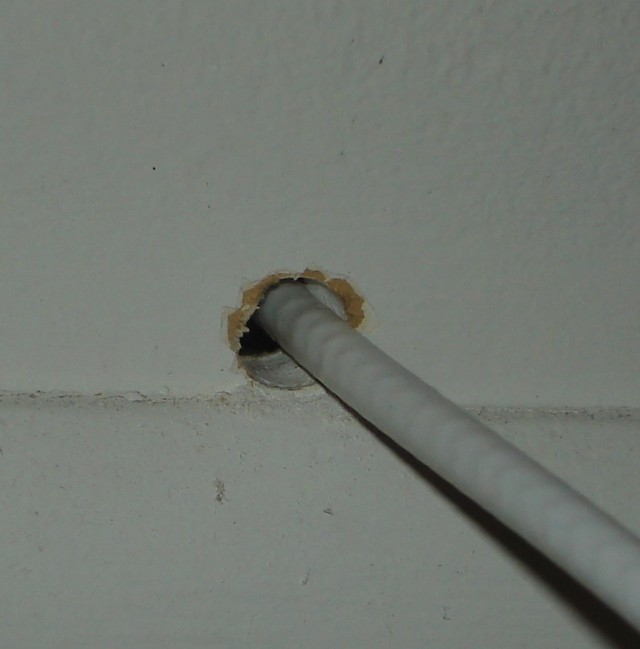
“On three properties that I own, the installation of FiOS was done recklessly,” complained Nezaj. “They never came back to fix the holes that were drilled, fix the boxes they installed and put molding on their respective wires. I am not interested once again in having Verizon drill holes and butcher my buildings.”

Several building owners responded to Verizon’s complaints indicating the phone company itself was responsible for dropping the ball on FiOS installation and were stunned the company was resorting to legal tactics to force entry.

Arthur Leeds from Leeds Associates LLC reports one of his properties has been waiting for Verizon to install FiOS since April 2014.

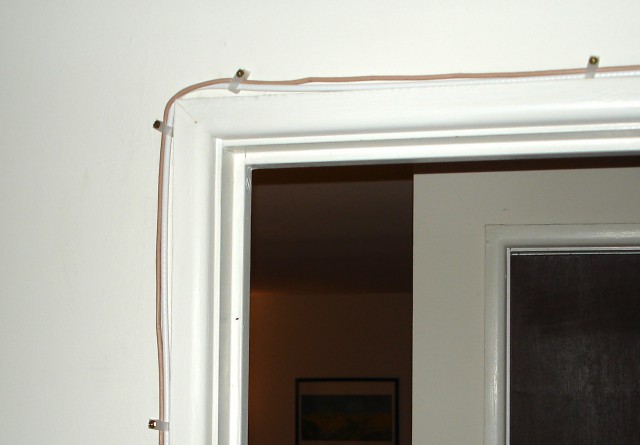
This customer found Verizon installing its FiOS cables up and down his doorways.

This customer found Verizon installing its FiOS cables up and down his doorways.

“We have responded every time we were asked for access most specifically to Thomas Miller, the FiOS franchise manager in NYC, and to Alyson Seigal (sic) another Verizon manager either by phone or via certified mail but all of our responses to them were ignored,” wrote Leeds. “Further we are well aware of the law and are certainly interested in supplying our tenants with alternatives to RCN and Time Warner Cable. However we do have a right to know how and with what materials Verizon intends to install their equipment in our building, [a request that] seems to stall any response on your part or that of your contractors.”

Amy Ward, an attorney representing the interests of 200 East 87”’ Street Associates, LP, has Leeds beat. She told the PSC Verizon first sought to install FiOS in the building in 2012, but Verizon kept stalling. When Verizon formally sought permission yet again in September 2014, a building representative asked for a delay because of “multiple intrusive projects occurring at and planned for the property.” No response to that request was forthcoming from Verizon until the December demand for entry was received.

Brian Loftman, property manager of the @The Aspen New York, wrote the PSC he was not happy to hear from Verizon’s legal team either.

Many building owners want Verizon to install crown molding that can effectively hide cables.

Many building owners want Verizon to install crown molding like this that can effectively hide cables.

“I am appalled that Mr. Richard C. Fipphen, assistant general counsel for Verizon has contacted you stating that we have not complied with their request to give access to the property,” wrote Loftman.

Loftman included a copy of correspondence he sent to Ms. Siegal, claiming she is impossible to reach.

“I am writing to you because after several attempts to reach you via phone at 888 364 3467 it has been impossible,” wrote Loftman. “I find it hard to believe that you being in the telecommunications business that even your voicemail is full and I cannot leave a message on the number you provided us to contact your office.”

Loftman also questioned Siegal’s claims that Verizon has “world-class voice, data, and video services.”

“Has it improved since the last time our phones were out or the DSL went down for almost a week?” he asked.

Loftman’s previous experience with Verizon’s installation crews was not a positive one. He only learned after signing up for the service at another building he manages that Verizon intended to use visible basic plastic molding throughout the building’s hallways to hide FiOS wiring. Other property managers shared aesthetic objections to Verizon’s plans, requesting wiring be installed behind more visually attractive crown molding or run through ceiling ducts.

Part of New York State’s Public Service law covers the installation of cable television facilities, which also covers Verizon FiOS:

§228. Landlord-tenant relationship

1. No landlord shall:

(a) interfere with the installation of cable television facilities upon his property or premises, except that a landlord may require:

(1) that the installation of cable television facilities conform to such reasonable conditions are necessary to protect the safety, functioning and appearance of the premises, and the convenience and well being of other tenants;
(2) that the cable television company or the tenant or a combination thereof bear the entire cost of the installation, operation or removal of such facilities; and
(3) that the cable television company agree to indemnify the landlord for any damage caused by the installation, operation or removal of such facilities.

§898.1 Prohibition

Except as provided in section 898.2 of this Part, no landlord shall demand or accept any payment from any cable television company in exchange for permitting cable television service or facilities on or within said landlord’s property or premises.

§898.2 Just Compensation

Every landlord shall be entitled to the payment of just compensation for property taken by a cable television company for the installation of cable television service or facilities. The amount of just compensation shall be determined by the commission in accordance with section 228 (1)(b) of the Public Service Law upon application by the landlord pursuant to section 898.5 of this Part.

Time Warner Cable/Comcast Deal Approval Delayed (Again) in N.Y.

Phillip Dampier January 13, 2015 Comcast/Xfinity, Competition, Consumer News, Public Policy & Gov't Comments Off on Time Warner Cable/Comcast Deal Approval Delayed (Again) in N.Y.

The New York State Public Service Commission has once again delayed final action on Comcast’s request to acquire Time Warner Cable systems operating in the state.

The further delay was accepted by Comcast and Time Warner Cable, citing a request from the staff of the PSC.

The next scheduled date for action is at the Commission Session scheduled for Jan. 22, with a final order issued no later than Jan. 27, 2015.


Illinois’ ‘Free AT&T from Regulation and Responsibility’ Bill Returns in 2015

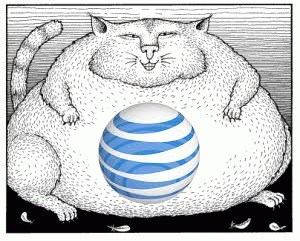
Nobody raises phone rates after deregulation like AT&T.

Nobody raises phone rates after deregulation like AT&T.

AT&T’s bill to maximize profits and minimize responsibility to its customers is back for consideration in the Illinois state legislature.

The Illinois Telecom Act is up for review in the spring and AT&T’s team of lobbyists are gearing up to advocate killing off AT&T’s legal obligation to provide low-cost, reliable landline service to any resident that wants service. AT&T says the measure is a reasonable response to the ongoing decline in its landline customer base, but rural and fixed-income residents fear the phone company will walk away from areas deemed unprofitable to serve and force customers to expensive wireless phone alternatives.

Areas in central and southern Illinois are served by a variety of rural phone companies including AT&T and Frontier Communications. Northeast Illinois is the home of metropolitan Chicago, where businesses depend on reliable phone service and the urban poor and senior residents depend on predictably affordable basic landline service.

The state still has as least 1.3 million residential landline customers paying rates starting at $3 a month for basic “Lifeline” service in Chicago to $9.50 a month for rural flat rate service with a limited local calling area. Cell service costs several times more than AT&T’s basic landline rates and signal quality is often challenged in rural areas. In large sections of Illinois where AT&T has elected not to bring its U-verse fiber to the neighborhood service, customers with basic voice calling and DSL broadband service could find themselves eventually disconnected and forced to switch to AT&T’s wireless residential service.

fat cat attAT&T’s Wireless Home Internet plan charges $60/month for 10GB of Internet use, $90/month for 20GB, and $120/month for 30GB. The overlimit fee is $10 per gigabyte. Telephone service is extra.

Customers will need smartphones or hotspot equipment to reach AT&T’s wireless services. Although often discounted or free for those who sign two-year contracts, credit-challenged customers will be required to pay a steep deposit or buy equipment outright.

“Smartphones are wonderful technology but they don’t come cheap and anybody who has traveled across Illinois knows they’re not always reliable,” David Kolata, executive director of Citizens Utility Board, said at a recent news conference. “Traditional home phone service is the most affordable, reliable option for millions of people and we shouldn’t take away that choice.”

The Federal Communications Commission is currently allowing AT&T to experiment with discontinuing landline service in parts of Alabama and Florida. Customers in urban areas are switched to AT&T’s U-verse service, those in rural areas are switched to cell service. Both services are unregulated. If AT&T can sell the Illinois legislature on abandoning its need to serve as a “carrier of last resort,” the company will have the unilateral right to disconnect service, set rates at will, and be under few, if any, customer service obligations.

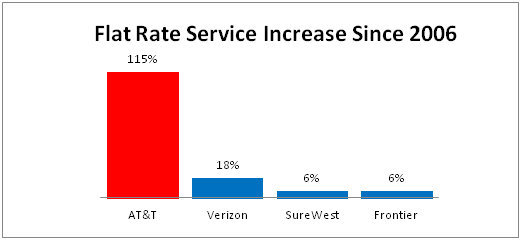
In states where AT&T won the near-total deregulation it now seeks in Illinois, phone rates quickly soared. In California, AT&T flat rate calling shot up 115% between 2006 and 2013 — from $10.69 to $23 a month. AT&T also raised prices on calling features and other services.

In earlier trials run by Verizon, similar wireless landline replacement devices lacked support for home medical and security alarm monitoring, did not handle faxes or credit card authorizations, and often lacked precision in locating customers calling 911 in an emergency. The equipment also failed during power outages if the customer lacked battery backup equipment.

Shakedown Sharpton: Buy Quid Pro Quo Minority Support for Your Big Telecom Merger Deal

Phillip Dampier January 12, 2015 Astroturf, AT&T, Comcast/Xfinity, Competition, Consumer News, Net Neutrality, Public Policy & Gov't Comments Off on Shakedown Sharpton: Buy Quid Pro Quo Minority Support for Your Big Telecom Merger Deal

shakedown alLooking for civil rights groups to support your multi-billion dollar telecom merger and keep minority groups off your back?

You couldn’t do better than cutting a check to Rev. Al Sharpton, whose National Action Network (NAN) will generate form letters praising your killer deal before regulators or help garner support in Congress for more deregulation and less Net Neutrality. All it takes is a few donations and consulting fees, according to a special report published by the New York Post.

“Al Sharpton has enriched himself and NAN for years by threatening companies with bad publicity if they didn’t come to terms with him. Put simply, Sharpton specializes in shakedowns,” Ken Boehm, chairman of the National Legal & Policy Center told the Post.

“Once Sharpton’s on board, he plays the race card all the way through,” said a source who has worked with the Harlem preacher. “He just keeps asking for more and more money.”

Sharpton’s 60th birthday party bash last October at Manhattan’s Four Seasons restaurant departed from the usual friends and family oriented affair most of us would expect, as envelopes arrived from some of America’s largest corporations, including AT&T and Verizon, containing at least $1 million in donations for Sharpton’s civil rights group.

Coincidentally, that same month Sharpton co-signed a letter sent to the FCC urging the regulator to approve AT&T’s deal to buy DirecTV.

“We believe the evidence and the company’s record, as well as future impact and commitments post-merger, provide a clear and compelling basis for the FCC to determine that this merger is in the public’s best interest,” the letter said. “If approved, the combined AT&T-DirecTV will have greater incentive to deploy a state of the art Internet service and give millions of Americans a new way to access the Internet’s economic, social, and civic benefits.”

If approved, the deal would also eliminate one of AT&T’s chief competitors for pay television customers, making DirecTV part of the AT&T family.

Money-Stuffed-Into-PocketWhile the money keeps rolling in, Sharpton has left taxpayers footing his bills. Sharpton himself, his nonprofit NAN, and two for-profit firms controlled by him have racked up $4.7 million in outstanding debt and tax obligations according to federal and New York State records. He owes New York taxpayers $806,875 and after not bothering to pay his personal income taxes in full, he owes $2.6 million in federal liens. Sharpton’s NAN still owes more than $800,000 to the federal government and his two for-profit ventures separately owe New Yorkers nearly $450,000.
Raising money to repay debts appears to be a major priority for Sharpton these days, and companies like Comcast covet his support of their corporate agendas.

Shortly after Comcast announced its intention to acquire NBC-Universal in late 2009, Comcast’s chief executive, Brian L. Roberts, and the head of the company’s lobbying effort, David L. Cohen, met with Sharpton and other representatives of minority groups to talk about their bid. Comcast recognized that support from minority groups would be crucial to answering the inevitable charge that giant media mergers have a tendency to reduce diversity in programming, particularly from and for minorities.

Comcast turned on its money spigot, donating at least $140,000 to Sharpton’s National Action Network. In turn, Sharpton took a sudden interest in the merger, penning letters of strong support to the FCC. Between 2008 and 2010, Comcast’s corporate foundation donated more than $3 million to 39 minority groups that wrote letters to federal regulators in support of the NBC deal. Comcast and NBC Universal also worked out an agreement with advocacy groups guaranteeing increased “minority participation in news and public affairs programming”—so long as the deal went through.

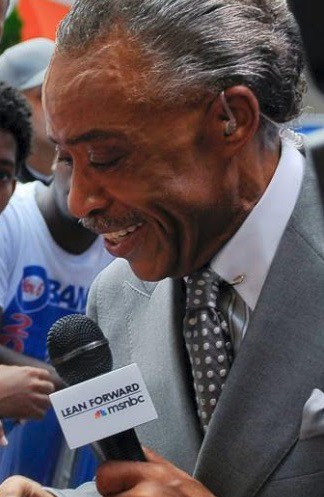
Comcast supporter turned Comcast-owned MSNBC host.

Sharpton: Comcast supporter turned Comcast-owned MSNBC host.

Few expected that Sharpton himself would be a direct beneficiary of Comcast’s gratitude after the merger was approved. Sharpton was suddenly hired (for an undisclosed amount) as host of his own MSNBC weeknight show, still on the network today.

The New York Times noticed.

“Rarely, if ever, has a cable news channel employed a host who has previously campaigned for the business goals of the channel’s parent company,” the newspaper wrote.

Since the cable company began cutting checks to the NAN, Sharpton has towed the line on Comcast’s public policy agenda.

Last July, Sharpton’s group joined several other civil rights groups (most, if not all financially supported by Comcast) complaining that enforcing Net Neutrality would “harm communities of color.”

“The groups wrote to the FCC to tell them that ‘we do not believe that the door to Title II should be opened,'” said Lee Fang in a piece that was quickly censored by a Comcast-owned news outlet. “Simply put, these groups, many of which claim to carry the mantle of Martin Luther King Jr., are saying that Comcast and Verizon should be able to create Internet slow lanes and fast lanes, and such a change would magically improve the lives of non-white Americans.”

“Just as Martin Luther King Jr.’s children have embarrassingly descended into fighting bitterly over what’s left of his estate, the civil rights groups formed to advance Dr. King’s legacy seem willing to sell out their own members for a buck,” Fang concluded.

Search This Site:

Contributions:

Recent Comments:

Your Account:

Stop the Cap!