Home » Competition » Recent Articles:

Yes, N.Y. State Regulators Have Delayed Final Consideration of the Comcast-TWC Merger Yet Again

No approval for the Comcast-Time Warner Cable merger proposal in New York for yet another month as the state Public Service Commission has once again delayed making a final decision until the end of February.

“Pursuant to a request from Department of Public Service staff in the above-referenced matter, Comcast Corporation and Time Warner Cable Inc. agree to action by the Public Service Commission on the Joint Petition at a Commission Session held on or by February 26, 2015, with a final order being issued no later than March 3, 2015,” is the word from Comcast and Time Warner Cable’s law firm.

Channeling Pinnochio, NCTA Cable Lobby Launches “The Infinite Internet” (They Want to Usage Cap)

Phillip Dampier January 20, 2015 Astroturf, Competition, Consumer News, Data Caps, Editorial & Site News, Net Neutrality, Online Video, Public Policy & Gov't, Video, Wireless Broadband Comments Off on Channeling Pinnochio, NCTA Cable Lobby Launches “The Infinite Internet” (They Want to Usage Cap)

pinnocThe National Cable & Telecommunications Association (NCTA), the nation’s largest cable lobbying group, has outdone itself with a brand new fact-challenged video truth-seekers will quickly discover is little more than industry propaganda.

“For nearly 20 years, cable has been building Internet networks that are empowering everyone from innovators and entrepreneurs to kids in the garage,” says the NCTA in its introduction of its new video “The Infinite Internet.” “The Internet propels business, education, entertainment – whatever we want. It’s a platform of possibilities and the fast growing technology in history. Cable is proud of the part we’ve played in advancing America’s future and we’ll continue to make it faster and more accessible.”

Except many NCTA member companies want to introduce usage caps and consumption billing that limit those possibilities on an already absurdly profitable service. The same broadband duopoly of cable and phone companies also holds America’s broadband rankings back, and has demonstrated its real priority is to charge more money for less service.

We’ve reviewed the video and found credibility problems with almost every claim:

Claim: “America’s ISPs have invested trillions of dollars and laid 400,000 miles of fiber optics.”

Our finding: FIB Even industry mouthpieces like the Progressive Policy Institute and NCTA members themselves have a problem with “trillions.” The chief executives of AT&T, Bright House Networks, Cablevision, CenturyLink, Charter, Comcast, Cox, Frontier, Suddenlink, Time Warner Cable, 15 other companies, and industry groups such as the National Cable & Telecommunications Association itself, the Telecommunications Industry Association, and the CTIA Wireless Association claimed in the spring of 2014 that the entire telecommunications industry (not cable alone) spent a combined $1.2 trillion on communications infrastructure. A considerable percentage of that investment was to build out cellular networks, first for mobile phone calls and only later for wireless data. The cable industry spent far less than $1 trillion on its own infrastructure and at the time of its most rapid growth, it was intended primarily to deliver cable television, not broadband.

Stop the Cap! also found the NCTA cheating in its claims of increasing investment in broadband. The trade group was citing cumulative spending, not actual year-to-year spending. A careful review shows broadband investments are generally flat or in decline and are nowhere near comparable to the investments the industry made in the late 1990s.

Although it may be true the cable industry has deployed 400,000 miles of fiber optics, the overwhelming majority of cable customers cannot directly access any of it. Virtually all the cable industry’s fiber is deployed between the company’s headquarters and individual communities where it is connected to the same coaxial cable platform that has been around since the 1960s. Most of the rest is laid for commercial purposes, notably providing backhaul connectivity for cell towers. Time Warner Cable alone deployed fiber to its 10,000th cell tower back in 2013. It’s a lucrative business, earning that cable company more than $61 million a quarter.

BroadbandNow found no cable company appearing on the list of top fiber broadband providers. In fact, as of 2012 only 23% of Americans have access to fiber broadband ranking the United States 14th among western countries in fiber optic penetration according to the OECD.

Claim: “High speed connections reach nearly every home with blazing fast speeds that power our lives.”

Our finding: HIGHLY MISLEADING The NCTA fails to define its terms here. What exactly constitutes a “high-speed connection.” The FCC currently defines broadband as providing speeds of 4Mbps or better. Is that “blazing fast?” The FCC is currently considering redefining broadband to mean speeds of at least 25Mbps, well below many cable company entry-level broadband tiers. The NCTA also likes to claim that 99% of households have access to high-speed Internet, but they include wireless technology at any speed in those figures. If you can get one bar from AT&T’s 3G wireless Internet network, you’ve got high-speed broadband in their eyes.

In fact, when it comes to stingy coverage areas, cable is notoriously not available outside of the biggest cities and suburbs, as the government’s own National Broadband Map depicts:
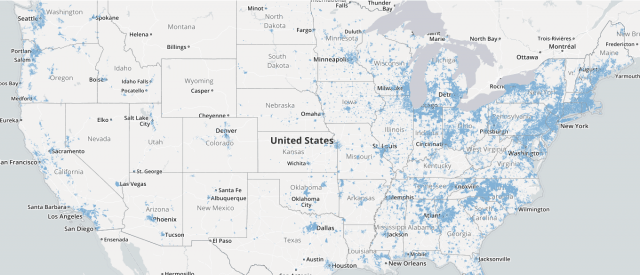
Map showing cable companies offering at least DOCSIS 3.0 cable broadband service.

Map showing cable companies offering at least DOCSIS 3.0 cable broadband service.

Claim: “ISP’s want access for everyone.”

Our finding: TRUE, WITH MISSING FINE PRINT What company would not want to offer its products and services to everyone. The real question is whether they plan on doing that or simply wishing they had. The cable industry has no intention of implementing sweeping changes to the Return On Investment (ROI) formula that determines whether your home gets access to cable or not. Some companies like Time Warner Cable and Frontier Communications are expanding their cable and DSL networks, but only when the government steps in with broadband deployment grant funding.

Assuming service is available, the next hurdle is cost. BBC News reported in 2013 home broadband in the U.S. costs far more than elsewhere. At high speeds, it costs nearly three times as much as in the UK and France, and more than five times as much as in South Korea. Today it costs even more when you count the growing number of providers charging modem rental fees as high as $10 a month and often cap usage or force customers into usage-based billing schemes.

Claim: “With over 300,000 public Wi-Fi hotspots, the Internet of Things is emerging.”

Cox Cable sells their customers on accessing over 300,000 Wi-Fi hotspots, with a prominent asterisk.

Cox Cable sells their customers on accessing over 300,000 Wi-Fi hotspots, with a prominent asterisk. Access is only available for free if you are a current cable broadband customer.

Our finding: MISLEADING The NCTA is referring to collaboration between Bright House Networks, Cox Communications, Optimum, Time Warner Cable and XFINITY that allow each other’s high-speed Internet customers to use to each company’s Wi-Fi hotspots. They key word is “customers.” The hotspots may be technically reachable by the public, but unless you are a current cable broadband subscriber, using them typically requires the purchase of a daily use pass.

Claim: “Cable will continue to invest, building this platform of possibilities, if we preserve the freedom that created the Internet.”

Our finding: EMPTY CLAIMS The NCTA’s commitment that the cable industry will continue to invest is fulfilled if one cable operator spends just $1 on their network infrastructure. Notice the NCTA does not commit its members to stopping the ongoing decline in broadband investment, much less move to increase it. It also has no explanation for the annual rate increases and new fees and surcharges customers are paying, as the gap between broadband pricing abroad and at home grows even larger. 

“Preserve the freedom” is code language for maintaining the deregulation that the industry has used to its advantage to raise prices in a broadband market most Americans will find is either a monopoly or duopoly. Although the NCTA implies it, the cable industry did not create the Internet. It was a government project (gasp!) initially developed through contracts with the Department of Defense and soon broadened to include educational institutions. The first significant commercial ISPs emerged only in the late 1980s. Cable industry broadband finally showed up around a decade after that. The industry’s claims are akin to boasting Lewis and Clark discovered Kansas City… in 1966.

If the cable industry gets some oversight of its broadband service and enforced protection of Net Neutrality, does that mean investment will flee? First, providers are already spending a lower percentage of capital on broadband expansion in the current deregulatory environment. Second, as broadband becomes the cable industry’s top earner, it provides an endless supply of revenue without the headaches of negotiating programming contracts, dealing with cable television network rate increases, and the growing phenomenon of cord-cutting. In other words, without significant new competition, it remains a license to print money.

[flv]http://www.phillipdampier.com/video/NCTA The Infinite Internet 1-20-15.mp4[/flv]

The NCTA is trying to make hay with its new video, “The Infinite Internet” which purports to share how Big Cable’s vision of the Internet is making new things possible. They don’t mention many of their member companies want to place a usage cap on that innovation, even as they continue to raise prices way out of proportion of the cost of delivering the service. It’s classic cable industry propaganda. (1:08)

Republicans’ Fake Net Neutrality Alternative Contains Grand Canyon-Sized Loopholes

Thune

Thune

When Sen. John “Net Neutrality is unjustified” Thune (R-S.D.) and Rep. Fred “Net Neutrality is a solution in search of a problem” Upton (R-Mich.) last week magically became Internet activists ready to solve the Net Neutrality issue with an “unambiguous” bill to “protect Americans” from greedy ISPs, you will pardon me if I am just a tad suspicious.

The two Republicans who champion “less government regulation is better” and “let the marketplace decide for itself”-principles are proposing new legislation that will regulate the conduct of Internet Service Providers, claiming it will tie their hands and prevent the launch of Internet fast lanes and ban traffic degradation.

The two legislators are traveling in a fast lane of their own — hurrying to schedule hearings, mark up a bill, and speed it to the floor for consideration by the end of this month. That’s a marked departure for the U.S. Congress-as-usual, the one that can’t manage to pass virtually anything, much less in a hurry. So where is the fire?

It is at the Federal Communications Commission in Washington, scheduled to vote on its own new Net Neutrality proposal by the end of February. Thune and Upton are hoping to launch a pre-emptive strike against the anticipated strong Open Internet protections the FCC will probably enact on a party line vote. The FCC is likely to pursue a reclassification of broadband away from the lobbyist-lovin’, largely deregulated “information service” it is today towards a “telecommunications service” under Title II of the Communications Act. That represents Comcast’s worst nightmare.

???????????????????????????????Current FCC rules have allowed traffic shenanigans from ISPs like Comcast that don’t mind slowing their customers’ Netflix experience to a crawl until the streaming company opens its checkbook. The FCC’s anticipated new proposal would strictly forbid any creative end-runs around the concept of paid fast lanes Comcast can get away with today.


The proposed Republican alternative suggests a “third way” compromise only Comcast and AT&T could love. While ostensibly banning intentional interference with Internet traffic, the two legislators include a Grand Canyon-sized loophole in the form of one word you could fly an Airbus A380 through: reasonable

SEC. 13. INTERNET OPENNESS.

(a) OBLIGATIONS OF BROADBAND INTERNET ACCESS SERVICE PROVIDERS.—A person engaged in the provision of broadband Internet access service, insofar as such person is so engaged (1) may not block lawful content, applications, or services, subject to reasonable network management; may not prohibit the use of non-harmful devices, subject to reasonable network management; may not throttle lawful traffic by selectively slowing, speeding, degrading, or enhancing Internet traffic based on source, destination, or content, subject to reasonable network management; may not engage in paid prioritization; and shall publicly disclose accurate and relevant information in plain language regarding the network management practices, performance, and commercial terms of its broadband Internet access services sufficient for consumers to make informed choices regarding use of such services and for content, application, service, and device providers to develop, market, and maintain Internet offerings, except that a provider is not required to publicly disclose competitively sensitive information or information that could compromise network security or undermine the efficacy of reasonable network management practices.

No ISP has ever declared its own traffic management policies unreasonable, so whatever they do, in their minds, is “reasonable” by definition.

Upton

Upton

The proposed bill would keep Net Neutrality far away from the critical Title II foundation it needs — essential armor that will help withstand inevitable court challenges by providers outraged by the government’s attempt to interfere with their free speech rights (at the expense of their customers’ freedom from content-killing traffic slowdowns).

The concept of “network management” is Play-Doh in Comcast and AT&T’s hands. It could mean balancing traffic by adding more capacity as needed or implementing a “fair access policy” that rations inadequate capacity. Both could easily be called “reasonable” by them. Customers paying for 25Mbps and getting 6Mbps during the evenings may think otherwise.

But no worries, the Republicans’ plan requires ISPs to disclose exactly how they are undercutting the broadband service you paid good money to receive. They claim that will give you an “informed choice,” except for many Americans, there is no choice.

The FCC’s plan is much more likely to stop to the tricks, traps, and traffic manipulation in whatever form arises now or in the future. It uses well-established precedent that is unlikely to be thrown out by the courts, delivers real oversight desperately needed in the monopoly/duopoly broadband marketplace, and will actually protect consumers.

The Republican alternative primarily protects AT&T, Comcast, and their chances of getting more campaign contributions from their friends in the cable and phone business. In short, it isn’t worth your time, and you should tell your member of Congress it isn’t worth theirs either.

Updated: GCI Changes Usage Cap Policies: Automatic Overlimit Fees Replaced With Speed Throttling

GCI_logoAlaska’s largest cable company today unveiled changes to its Internet plans, ditching surprise overlimit fees in favor of a speed throttle.
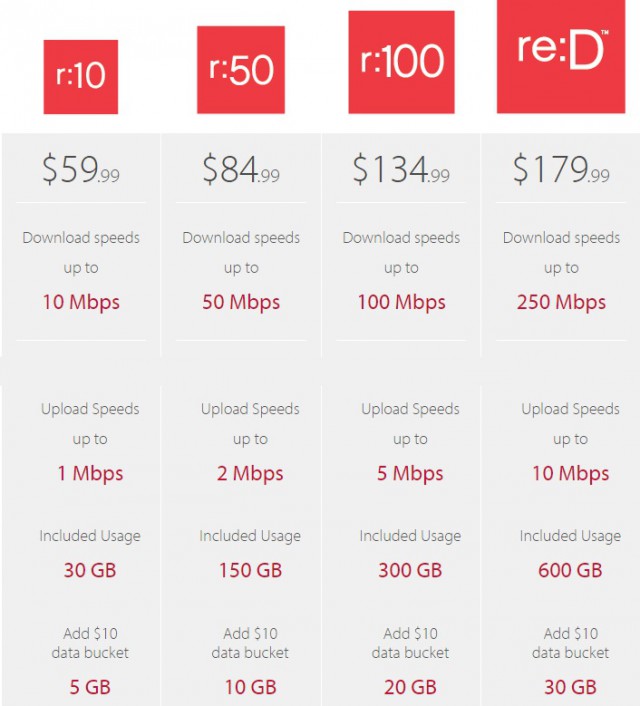

GCI has been the subject of bad press in the past, with some customers experiencing up to $1,200 in overlimit fees after exceeding GCI’s usage allowances. In an effort to avoid public relations nightmares like that, GCI will stop assessing automatic overlimit fees and instead impose a speed throttle on customers over their limit that will temporarily reduce broadband speeds to less than 1Mbps until the next billing cycle begins. Customers can voluntarily pay for more usage in $10 increments, which buys a reprieve from the speed throttle.

GCI “No Worries” Broadband Plans offer varying usage caps and extra usage allotments:

no worries

Customers on lower speed plans continue to face a lower usage allowance and will receive considerably less extra data for their $10 add-on data plan. GCI’s highest speed re:D offering does get a bigger usage allowance: 600GB, up from 500GB. An $11.99/mo surcharge continues for broadband-only customers.

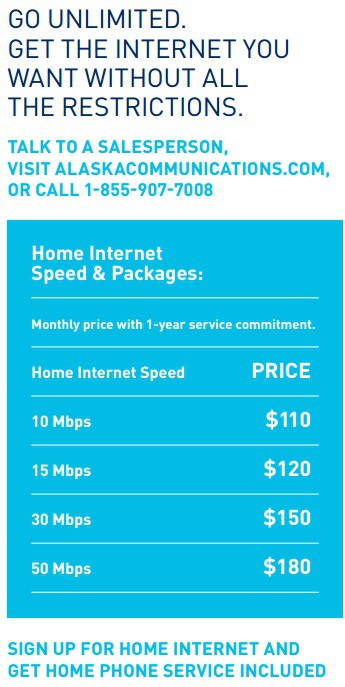
GCI’s largest competitor remains telephone company ACS, which heavily markets its unlimited usage DSL plans. Almost as an afterthought, ACS now markets packages that include landline service with unlimited local calling and 180 minutes of long distance for free.

acs unlimited

A price comparison between the two providers is somewhat hampered by the fact GCI does not publicize a broadband+home phone bundle package on their website. GCI Home Phone is priced at $19.99 a month.

A 10Mbps unlimited use package from ACS costs $110/month. A 10Mbps plan from the cable company with a 30 40GB allowance + GCI Home Phone costs $79.98. On price, GCI wins at this speed… if you stay within your allowance. A 50Mbps unlimited use package from ACS runs $180 a month. GCI charges $104.98 with 150GB of included usage. Again, the price winner is GCI if you stay within your allowance. Taxes, surcharges and government fees are extra.

Heavier users may find ACS’ initially higher prices worthwhile if they are forced to buy GCI’s add-on data buckets. Both companies charge considerably more than providers in the lower 48 states.

Last year, nearly 10% of GCI’s revenue was earned from automatically applied overlimit fees. Giving up some of that revenue is a concession, but one that is likely to end bill shock and negative media attention. Still, usage allowances remain arbitrary. GCI’s entry level 10Mbps plan only offers a paltry 30 40GB a month — an allowance largely unheard of among other U.S. cable providers. GCI will also have a difficult time explaining why $10 will only offer one customer 5GB of extra usage while others will get up to 30GB. The costs for the additional data to GCI are the same.

Our thanks to an anonymous reader for sharing the news.

Updated 4:08pm EST 1/15: After going to press, GCI changed their website, adjusting the usage allowance for their 10/1Mbps plan to 40GB (up from 30GB) and deleted references to the $11.99 surcharge for broadband-only customers, which apparently no longer applies.

President Obama Calls for an End to State Bans on Community Broadband; Public Networks Save $

Obama

President Barack Obama

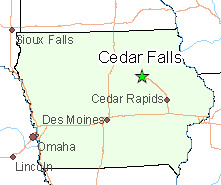
President Barack Obama will be in Cedar Falls, Iowa today to announce steps his administration plans to take to improve broadband in the United States, including a call to end laws that restrict community broadband development that limits competition.

“Today, too few Americans have affordable and competitive broadband choices, but some communities around the country are choosing to change that dynamic,” says a statement issued by the White House. “As a result – as outlined in a new report being issued today – cities like Lafayette, Chattanooga, and Kansas City, have broadband that is nearly one hundred times faster than the national average, yet still available at a competitive price. By welcoming new competition or building next-generation networks, these communities are pioneers in broadband that works, and today in Cedar Falls, Iowa, the President is highlighting their remarkable success stories and providing municipal leadership and entrepreneurs new tools to help replicate this success across the nation.

The report, produced by the National Economic Council and Council of Economic Advisers, finds no evidence to support industry contentions that community-owned broadband duplicates existing broadband services and wastes taxpayer dollars. It also challenges cable and phone industry-backed groups claiming publicly owned broadband networks are business failures.

It cites the success of Chattanooga’s EPB Fiber service, operated by the local municipal utility. Not only is EPB successful financially, but it has introduced Chattanooga residents to the kind of competition sorely lacking in most cities for telecom services.

cedar falls“EPB’s efforts have encouraged other telecom firms to improve their own service,” states the report. “In 2008, for example, Comcast responded to the threat of EPB’s entrance into the market by investing $15 million in the area to launch the Xfinity service – offering the service in Chattanooga before it was available in Atlanta. More recently, Comcast has started offering low-cost introductory offers and gift cards to consumers to incentivize service switching. Despite these improvements, on an equivalent service basis, EPB’s costs remain significantly lower.”


In Wilson, N.C., Time Warner Cable customers pay significantly less for cable and broadband service than other North Carolina customers because of the presence of Greenlight, the community-owned fiber to the home provider. TWC customers in Wilson pay stabilized prices for service while residents in the nearby Research Triangle pay as much as 52 percent more for basic Internet service, according to the report. Greenlight’s competition has brought gigabit broadband to the community as well as lower prices for customers who decide to remain with Time Warner. The combined savings is estimated at more than $1 million annually for Wilson residents.

EPB is the municipal utility in Chattanooga, Tenn.

EPB is the municipal utility in Chattanooga, Tenn.

Those who believe municipal broadband is a waste of taxpayer dollars should consider the story of Lafayette, La.’s LUS Fiber. In addition to bringing superior broadband service to a city dominated by a cable operator that used to treat the market as an afterthought, the presence of LUS’ fiber to the home network has forced Cox Cable to improve service, offer significant customer retention deals to departing customers and defer rate increases. The investment in community broadband has saved residents an estimated $4 million from rate hikes that went ahead in other Cox cities, with an estimated total savings of between $90 and $100 million for Lafayette-area broadband customers over LUS’ first 10 years of service.

Taxpayer-supported institutions like local government, law enforcement, and schools have also seen dramatic savings by switching to municipal solutions. In Scott County, Minn. the local government’s annual bond payment for constructing their own broadband network is $35,000 less than what the county used to pay private companies for a much slower network. Area schools that formerly paid private sector telecom companies $58 per megabit of Internet speed now pay $6.83 — a savings of nearly 90 percent. Schools also received dramatic speed increases from 100 to 300Mbps. They paid less for more service — from $5,800 a month before to $2,049 a month today. Those payments go straight back to the county government instead of into the hands of out-of-state investment bankers and shareholders. On the state level, Minnesota’s public institutional network is saving taxpayers almost $1 million a year.

With the broadband profit gravy train for big cable and phone companies grinding to a halt in competitive areas, several of these companies have spent millions lobbying state governments to outlaw public broadband services. They have succeeded in 19 states, primarily with the assistance of the corporate-funded American Legislative Exchange Council (ALEC), which appeals to primarily Republican lawmakers with claims government broadband is unfairly competing with the private sector. In fact, private providers have not been driven out of communities where they face municipal competition, but they have been forced to lower prices and improve service for customers.

Today the president will call for a new effort to support local self-determination for broadband by strongly opposing industry-backed, anti-competitive deterrents and bans on community-owned networks. The president will also sign a letter addressed to FCC chairman Thomas Wheeler encouraging him to move forward with a federal ban on state broadband laws that restrict broadband development.

He will also announce additional funding for rural broadband expansion and take steps to bring local leaders together to explore how the development of community broadband initiatives in their cities and towns can make a major difference in the 21st century digital economy. The president recognizes that most Americans lack sufficiently competitive choices for broadband service and often have just one choice — the cable company — for broadband speeds greater than 25Mbps. That means many Americans are seeing their broadband speeds lag while their monthly bills continue to grow.

Community-owned broadband may be the only alternative many cities have for better broadband as would-be competitors are scared off by high construction costs and an inability to secure cable television programming at competitive prices for their customers.

Search This Site:

Contributions:

Recent Comments:

Your Account:

Stop the Cap!