

 Subscribe
 While consumer groups were busy fighting the Comcast-Time Warner Cable merger, AT&T’s $49 billion purchase of DirecTV has largely flown under the radar, with no comparable organized consumer opposition to the deal. But that does not mean the FCC will approve it as-is.
Negotiations with federal regulators and an exchange of regulatory filings and comments between AT&T, the FCC, and deal critics have apparently forced AT&T to agree to several concessions to make regulators amenable to approving the transaction.
The Washington Post reports that chief among those concessions is AT&T’s willingness to voluntarily abide by certain Net Neutrality rules regardless of any court challenges, including banning the slowing or blocking of websites and agreeing not to accept payments from website operators to speed up their content. AT&T has not said how long it intends to keep that commitment.
Deal opponents are also seeking other concessions from AT&T:
No paid interconnection deals: AT&T must route incoming content to customers without any fees charged to the companies originating the traffic. This became a hot button issue when Netflix felt it was forced to pay Comcast a fee to assure its streamed video content would reach Comcast customers without buffering or other errors. AT&T is expected to fiercely oppose this condition and says it should have the right to make private deals with content delivery firms.
AT&T must offer standalone broadband: With AT&T’s acquisition of DirecTV, more than ever it will have an incentive to sell customers a television bundle with Internet service. Regulators want AT&T to assure broadband-only service remains readily available. AT&T has offered 6Mbps DSL for $34.95 a month as its standalone option. Content delivery firms like Cogent want AT&T to offer 25Mbps service in all of AT&T’s markets for $29.95 a month for at least seven years. The FCC recently defined 25Mbps the minimum speed to qualify as broadband.
No end runs around Net Neutrality with data caps and exemptions: AT&T wants the right to exempt its preferred partners from its usage caps and claims that is beneficial to consumers. But cap opponents claim that is simply another way to collect money from content companies for preferential treatment — an end run around Net Neutrality rules. Opponents of these cap exemptions, known as “zero-rating” claim all content should be treated the same. AT&T could resolve this by removing data caps from its DSL and U-verse services altogether.
 With AT&T’s arrival in the Mexican wireless marketplace with its purchase of Iusacell and Nextel, América Móvil is responding with
  Hong Kong Telecom Group (HKT) chief technical officer Paul Berriman believes copper phone wiring is a thing of the past and is nonplussed by efforts to wring a few more years of life out of infrastructure that cannot reliably support high-speed Internet and is costly to maintain. The only solution that makes sense is to get rid of the copper and replace it with fiber optic wiring.

 “The boss of Liberty, a cable and media conglomerate, he has struck more deals than perhaps any other tycoon in the world—buying and selling hundreds of firms worth over $100 billion since the 1970s, often negotiating on his own, using calculations that fit on a napkin,” said the publication. “Unusually for an empire-builder he has made his investors a ton of money, and has little interest in the public eye.”
 Malone does not share the concerns of some Time Warner Cable and Charter investors that the merger will generate a “staggering” $66 billion in debt from day one, initially loaned from Wall Street investment banks. The Economist notes Malone seems to be violating his own rule to never overpay in a deal. In the British financial press, Charter’s deal for Time Warner Cable and Bright House does not pass Malone’s own smell test.
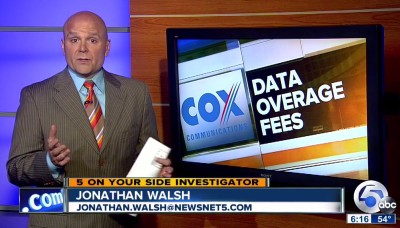 This weekend will end the first phase of our campaign to fight Cox usage caps being tested in Cleveland, Ohio. We’re collecting the names and e-mail addresses of interested citizens that would like to participate in the fight to get Cox to drop its usage-based billing and overlimit fee scheme. If you are interested, use the link at the top to “Contact Us” as a volunteer and include your name and a valid email address.