Home » Competition » Recent Articles:

Louisville, Kentucky Says Hello to Cable Competition from AT&T U-verse, But Long Term Savings Remain Elusive

Phillip Dampier September 1, 2009 AT&T, Competition 4 Comments

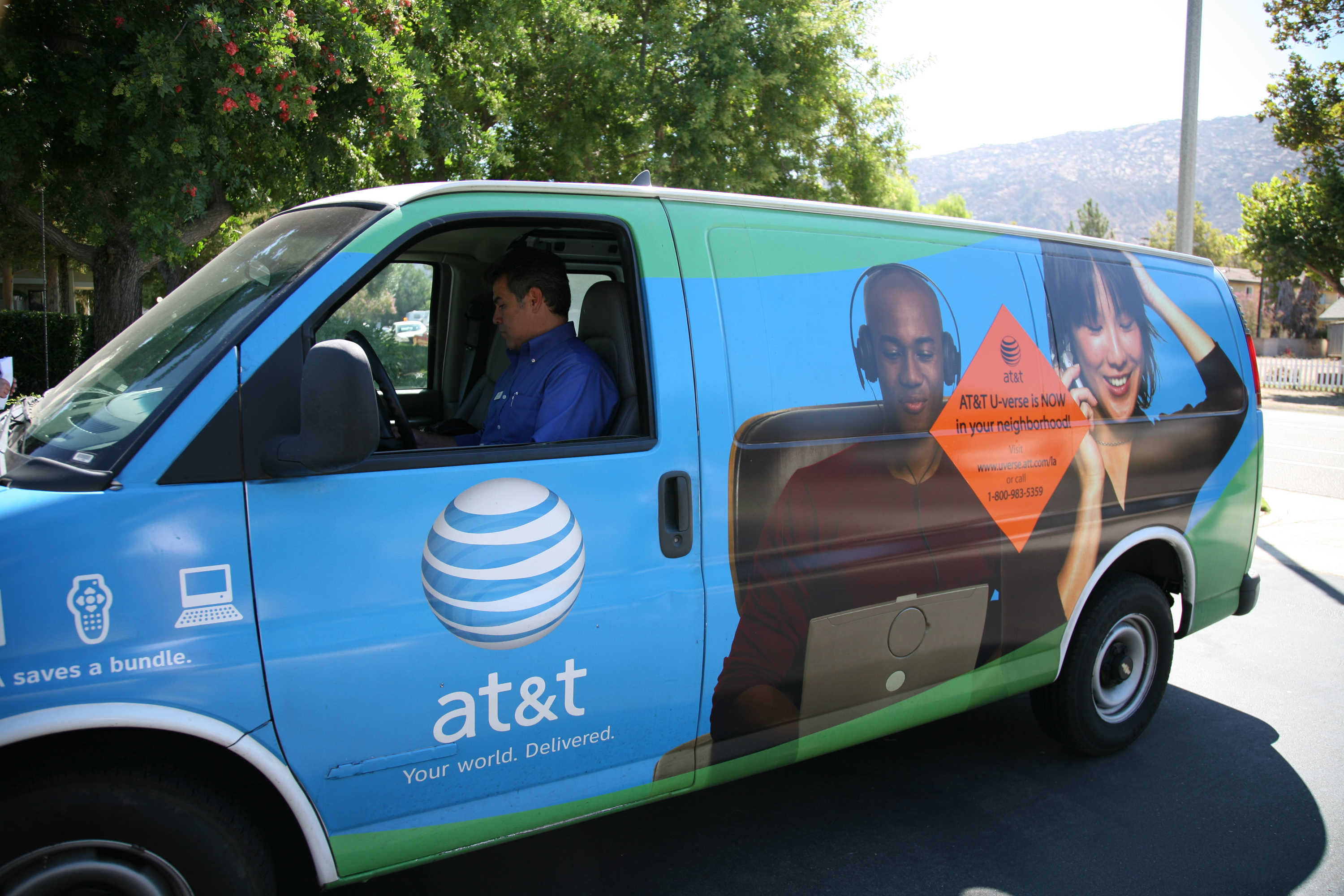
uverseAT&T unveiled its U-verse service Monday in Louisville, in a ribbon-cutting ceremony with claims that residents “finally have a choice” for cable service in the area.

AT&T will compete head-on with incumbent cable operator Insight Communications, which has been the only cable provider in Jefferson County for at least a decade.

AT&T promises customers packages starting at $49 a month, as well as digital video recorder set top boxes that can record up to four shows at the same time, and display the recorded programming on any AT&T-wired television in the house.  AT&T also promises residents significant savings when they choose AT&T for video, telephone, and broadband service, and will even include a “quad-play” bundle including AT&T Wireless mobile phone service, resulting in one bill for all AT&T services.

AT&T’s U-verse system is an advanced form of DSL, using a hybrid network of fiber optic cables wired into neighborhoods that interface with ordinary copper telephone wiring that already exists in most Louisville homes.  The technology reduces the costs of wiring every home with fiber optics, but can still offer advanced services “beyond what cable can offer,” according to AT&T.

Consumers across Louisville welcomed the competition.

Tabitha Rhodes told the Louisville Courier-Journal the lack of competition was bothersome.  “It is like there is only one shoe store in town,” she said. “I want 20 shoe stores.”

Rhodes’ husband, Tate, said he hopes AT&T’s competition will force Insight to become a more reliable cable company. Rhodes said their cable service has experienced dropped channels, poor quality pictures, and even pesky neighborhood squirrels that gnawed through the cable line serving his street.

The U-verse service also ties in with an Apple iPhone application, which when run on AT&T’s wireless network allows customers to program their television recording remotely.

Insight customer Rhonda Petr, 44, said she now pays $15 per month for digital video recorder service for each of two television sets in her home, in addition to a bundled monthly subscription for premium cable, phone and Internet service.

Petr said she liked the idea of DVR service without “nickel and dime” charges for each TV set.

Insight Communications dismissed AT&T’s U-verse as little more than smoke and mirrors, according to company spokesman Jason Keller.

“Insight has been Louisville’s technology leader for more than a decade,” company spokesman Jason Keller said Friday.

“One more competitor… won’t change that,” Keller said.

Insight’s system in Louisville is the largest in the company’s nationwide portfolio.  Company officials point to investments Insight has made in the Louisville area to introduce additional services, including “a broadband service that is faster than what AT&T is offering.”
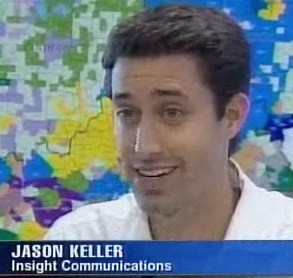
kellerInsight offers 20Mbps service for $17 less than what AT&T charges for 18Mbps, according to one reader.

Insight claims that AT&T is relying on the same old wiring that has been around “since the days of Alexander Graham Bell” to deliver service, and Insight has a “technological advantage in broadband width.”

The question on everyone’s mind is, how much will consumers save?

As the Courier-Journal notes, both are primarily competing on services, not on price:

Both Insight and AT&T offer bundled packages combining telephone, television and Internet starting at about $100 per month.The two compete chiefly on features. For instance, Insight offers faster Internet access, while AT&T is promoting U-Verse’s features that link television, home phone service, wireless phone service, and Internet together.

Rob Enderle, a technology consultant and president of the Enderle Group based in San Jose, Calif., told the newspaper the big savings are found in new customer promotional offers, which he calls “low teaser rates.”  In many Verizon FiOS TV areas that compete with cable, promotional new customer offers also often include long-term contracts lasting 12-24 months.

Incumbent cable companies often launch pre-emptive marketing blitzes to sell their customers on “price protection agreements” just before a competitor comes to town.

“They will try to lock up as many customers as they can,” Enderle told the newspaper.

In Louisville, Insight may have managed to accomplish that with their one-year “price protection agreement” they have managed to sell many of their customers.  The marketing for such agreements promises no price increases for the term of the contract, something that might sound attractive to price-sensitive cable subscribers facing relentless annual rate hikes.

AT&T has no such contract requirements in Louisville, although the company has used them in other markets to lock in customers taking advantage of promotional offers.

Once those promotional offers expire, the two companies will end up charging roughly the same prices for the various packages they offer.  Customers can choose which provider gives them the channels and services they want, as well as which offers better quality service.  The elusive savings, once the promotions expire, are still hard to find.

One Louisville reader called both companies to compare:

Just did a comparison on the different packages AT&T would offer: slower Internet, any additional DVR boxes would be $15/mo (same as Insight), HD channels would be $10/mo (free with Insight), and they would offer no more channels than Insight and both offer garbage as far as programs go. Yeah, I think Insight needs some competition in order to provide its customers with better pricing and better quality, but slower Internet and having to pay to access HD channels is BS. AT&T better come up with something better.

Multiple video news reports about AT&T’s U-verse launch in Louisville can be found below the jump.  Many also include product introductions and short demos.
… Continue Reading

Verizon FiOS Wins Franchise in Easton, Mass. – Marks 100th FiOS TV Franchise Agreement in the State

Phillip Dampier September 1, 2009 Comcast/Xfinity, Competition, Verizon 1 Comment

Easton,_MA_SealVerizon today announced the 100th franchise agreement in the state of Massachusetts for FiOS TV. The Easton Board of Selectmen on Monday granted a cable franchise to Verizon to begin wiring the town of 23,000 with fiber optic service. Residents will receive visits from Verizon employees to explain and market the service, which will compete directly with incumbent cable provider Comcast.

Verizon’s growth in the state has already put them in second place behind Comcast as the largest provider of wired television and broadband service.  That position was formerly held by RCN, a cable overbuilder providing service in the Boston area.

Verizon celebrated the 100th franchise agreement by donating $1,000 to the Easton Area Public Library to purchase 100 new books.

“As a result of this new franchise, consumers in Easton will be able to choose their cable provider as easily as they choose their phone company,” said Cupelo. “Competition drives innovation, value and service quality, and it puts the consumer in control.”

Easton, Massachusetts

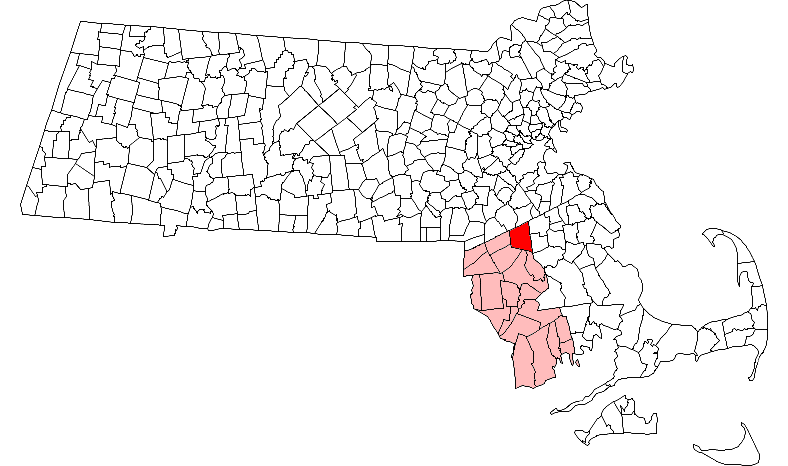
Easton (in dark red), part of Bristol County, Massachusetts

Verizon research indicates 87 percent of Massachusetts residents favor more competition and choice for video services.  Independent studies suggest competition in the video market can bring reduced prices, better packages and improved service, although experiences in many communities indicate providers are more apt to compete on services and packaging, and not as much on price.

Verizon’s license agreement with the city of Easton is for 10 years.  The agreement contains provisions for the network’s future growth; financial support and capacity for educational and government access channels; cable service to government buildings; and other important benefits to the city, including insurance, indemnification and enforcement protections.

“Verizon will compete aggressively for subscribers in Easton with our FiOS services, which are fueled by our lightning-fast fiber-optic network,” Cupelo said. Verizon soon will begin its door-to-door sales campaign in Easton, explaining the many advantages of FiOS TV to local consumers.

For some local residents, the competition can’t arrive soon enough.

Comcast has alienated many Easton residents by not carrying all of the HD signals from Boston area television stations.  Easton, although essentially halfway between Boston and Providence, Rhode Island, has been defined by the Federal Communications Commission as being in the “Providence DMA” (an area of significant influence.)  That’s because parts of Bristol County have towns that are considered suburbs of Providence.  Easton’s allegiance, in the minds of many who live there, is to Boston, and residents are upset that the majority of HD broadcast stations on Comcast Cable are from Providence.

The town is actually part of a regional effort to redefine their part of Bristol County to be in the “Boston DMA” so they can petition the FCC to make a change.

The Easton Cable Commission has gotten an earful from annoyed residents, who have faced an intransigent Comcast.  They have even prepared an FAQ for residents on the matter:

Why can’t I get some Boston based HD channels on Comcast?
This is an important issue to many Easton cable subscribers. We want to take some time to explain the relevant issues just so you understand why most believe Easton residents are not getting the channels they want and the channels that they believe serve them best.

The starting point is the DMA that Easton is in.  What is a DMA?  Well, that is our problem.  DMA is short for Neilsen Media Research Designated Television Market Area. DMA’s are generally split up according to county.  Easton is in Bristol County.  A good part of Bristol County is actually considered part of suburban Providence.  Therefore, Easton, although not a suburb of Providence, is in the Providence DMA.  All cable providers must carry the primary channels that serve a DMA.   At present, Comcast must carry Providence DMA stations.  There is an effort underway to move towns inside of Route 495 into the Boston DMA.  We will petition the FCC for this change.

Oakes Ames Memorial Hall and Ames Free Library (North Easton, MA)

Oakes Ames Memorial Hall and Ames Free Library (North Easton, MA)

But the greater issue here is whether Comcast chose to eliminate Boston channels in High Definition or whether they had no choice.  For the most part, this is a Comcast choice.  The Town of Easton and our Cable Committee, unfortunately, cannot force Comcast to provide Boston channels in High Definition.  Along with the concept of DMA, there is also the concept of “Significantly Viewed” channels in an area.  This is another FCC concept which relates to stations not in the local DMA which may be referred to as “distant signals”.  A “distant signal” is one that originates outside of a satellite (or cable) subscriber’s local television market, the DMA. In addition to stations in their DMA, satellite (cable) subscribers who receive local-into-local service may, under certain circumstances, receive individual stations from markets outside their DMA that are deemed “significantly viewed” in their community. It is up to the satellite carrier whether or not to offer significantly viewed stations and a subscriber must be subscribing to local-into-local service in his or her DMA to be eligible to receive significantly viewed stations. The determination of whether or not a station is significantly viewed in a community depends on several statutory factors.  The FCC has posted the list of stations that are eligible for carriage as significantly viewed signals and the communities in which they are significantly viewed.
The following is the list for Bristol County:

Bristol
WLNE-TV, 6, Providence, RI (formerly WTEV)
WJAR, 10, Providence, RI
WPRI-TV, 12, Providence, RI
+WNAC-TV, 64, Providence, RI
WBZ-TV, 4, Boston, MA
WCVB-TV, 5, Boston, MA (formerly WHDH)
WHDH-TV, 7, Boston, MA (formerly WNAC)
WSBK-TV, 38, Boston, MA
WLVI-TV, 56, Cambridge, MA (formerly WKBG)

So, Comcast has every right to provide the above channels (which include 4,5, and 7) in High Definition.  It is their choice not to do so.  You may ask why Channel 25 is not on the above list and that is a great question.  But the answer is that the determinations for this list were made a long time ago when Channel 25 was owned by religious broadcasters.  That is how outdated all of these rules are.  It is also the reason that Comcast is forced to black out FOX 25 network programming.

There may be an alternative to Comcast in Easton by the end of the year.  We are going through a licensing process with Verizon.  They want to offer Fios tv, internet, and phone in Easton by December.  It is all of our hopes that Verizon will provide the channels that you are looking for and that competition will benefit all cable tv subscribers in Easton.

For further information please contact the Comcast Customer Care line at 1-800-COMCAST (1-800-266-2278).

In Massachusetts, FiOS TV is available in Abington, Acton, Andover, Arlington, Ashland, Bedford, Bellingham, Belmont, Boxborough, Boxford, Braintree, Burlington, Canton, Danvers, Dedham, Dover, Dunstable, Framingham, Franklin, Georgetown, Grafton, Groton, Hamilton, Hanover, Hingham, Holliston, Hopkinton, Hudson, Hull, Ipswich, Kingston, Lakeville, Lawrence, Leominster, Lexington, Lincoln, Littleton, Lynn, Lynnfield, Malden, Mansfield, Marion, Marlborough, Marblehead, Marshfield, Mattapoisett, Maynard, Medfield, Medway, Melrose, Mendon, Methuen, Middleborough, Middleton, Millbury, Nahant, Natick, Needham, Newton, Norfolk, North Andover, North Reading, Northborough, Norwood, Norwell, Plymouth, Reading, Rochester, Rockland, Rowley, Sherborn, Southborough, Stoneham, Stoughton, Stow, Sudbury, Sutton, Swampscott, Taunton, Tewksbury, Topsfield, Tyngsborough, Wakefield, Walpole, Waltham, Wareham, Wayland, Wellesley, Wenham, West Newbury, Westborough, Weston, Westwood,  Wilmington, Winchester, Wrentham and Woburn, and will soon be available in Chelmsford, Easton and North Attleborough.

Court Hands Victory to Comcast: Throws Out 30% Cap On Market Share Inviting Buying Spree At Consumers’ Expense

A federal appeals court in Washington has struck down, for a second time, a rulemaking by the Federal Communications Commission to limit the size of the nation’s largest cable operators to 30% of the nation’s pay television marketplace, calling the rule “arbitrary and capricious.”

Judge Douglas Howard Ginsburg

Judge Douglas Howard Ginsburg

The 30% rule, designed to keep no single company from controlling more than 30% of the nation’s pay-TV subscribers, was originally written in 1993 by the FCC because the agency feared a concentrated cable television marketplace would stifle innovation, lock out potential new independent programmers, and discourage new forms of competition.  The cable industry immediately called the cap an overreach, and in 2001, found a friendly reception in court, with a ruling demanding the FCC reconsider the rule in light of competition from satellite television.

The FCC determined satellite competition was inadequate alone to justify reversing the 30% ownership limit, and essentially kept the limit in place, mostly at the urging of FCC Chairman Kevin Martin, who regularly tangled with the cable industry during the Bush Administration.

The decision striking down the 30% rule came in a harshly worded ruling from Judge Douglas H. Ginsburg.

“In light of the changed marketplace, the government’s justification for the 30 percent cap is even weaker now than in 2001 when we held the 30 percent cap unconstitutional,” Judge Ginsburg wrote for a three-member panel of the court.

Ginsburg wrote the FCC was egregiously derelict in its revised rulemaking because it failed to heed the court’s direction, requiring the court to vacate the rule.

The ruling is a “significant gain for cable and apparent big victory for Comcast,” said Andrew Lipman, a Washington- based partner in the media, telecommunications and technology practice at Bingham McCutchen LLP.

The Philadelphia Inquirer noted some Wall Street analysts were pleased with the court’s decision:

Wall Street analyst Craig Moffett called the decision a “moral” victory for Comcast, which contended that the market-cap rule was politically motivated by the Federal Communications Commission and wouldn’t overcome a court challenge. The rule was passed under former FCC Chairman Kevin Martin.

Speculation about what companies Comcast could likely snap up began immediately, ranging from a conceptual merger with Time Warner Cable, the nation’s second largest cable company, to quick buyouts of smaller players like Cablevision or now-bankrupt Charter Cable.

Consumer groups were alarmed by the court ruling.

“This is not the end of the fight,” Andrew Jay Schwartzmann, president and chief executive officer of the Media Access Project, a nonprofit policy advocacy group, said in a statement. “Big cable’s anti-competitive ownership structure has increased prices and limited choices for the American public. Therefore, we will consult with the FCC on whether Supreme Court review is feasible. If not, we’ll be asking Congress to pass new legislation to ensure more choice and lower prices for cable TV service.”

Ben Scott, policy director for Free Press, noted that the intent of the original 1992 Cable Act was to promote competition and consumer choice.  Yet in most cities, consumers face a cable cartel.

“Today consumers experience perpetual price hikes by large operators that already have market dominating purchasing power to decide the fate of new channels. The promises of lower prices through competition from satellite and telecom companies in the video business have never been realized. We encourage the FCC not only to revisit cable ownership limits, but to examine a variety of policy proposals to achieve Congress’s goal to bring consumers more competition and more choice in the cable industry.”

ABC News reported that while Comcast won this legal battle, it has a way to go in the court of public opinion.

Cable providers Comcast, Time Warner and Charter draw low marks on the American Customer Satisfaction Index, tracked by the University of Michigan. On a scale of 0 to 100, Comcast and Time Warner each scored 59 this year. The satellite provider DirectTV ranked first at 71, with Cox Communications cable at 66 and DISH Network at 64.

Novus-Shaw Price War Communique – Shaw Files Defamation Suit Against Novus

Paul-Andre Dechêne August 24, 2009 Canada, Competition, Novus, Shaw 10 Comments

Shaw Communications has fired back against accusations by Novus Entertainment that it is engaged in predatory pricing by filing a defamation suit in the British Columbia Supreme Court.

Shaw president Peter Bissonnette said Novus is intentionally spreading misinformation about Shaw’s competitive promotion in the Vancouver area, which he said charged $29.85 a month for a comprehensive package including digital HD cable, high-speed broadband, and telephone service that includes free long distance calling across North America.

Novus fired the first legal shot in July, accusing Shaw Cable of engaging in predatory pricing by offering cable, broadband, and telephone service “below cost” only to residents in the high rise buildings where Novus currently offers service in the city of Vancouver.  Novus, a fiber optic-based competitor, offers service in 225 residential high rise buildings in downtown Vancouver, at prices that have traditionally been lower than those offered by Shaw, western Canada’s largest cable operator, based in Calgary, Alberta.  Novus announced it was filing a predatory pricing case with the Competition Bureau of Canada and the BC Supreme Court.

Shaw officials counter that many of those high rise buildings are owned by Concord Pacific, which also has a major ownership interest in Novus Entertainment.  Bissonnette dismisses Novus’ accusations of anti-competitive behavior, accusing Concord Pacific of blocking access to Shaw, preventing the company from wiring the buildings during their construction, which would have reduced costs significantly.

“Those buildings up until recently have never had access to our services,” he said.

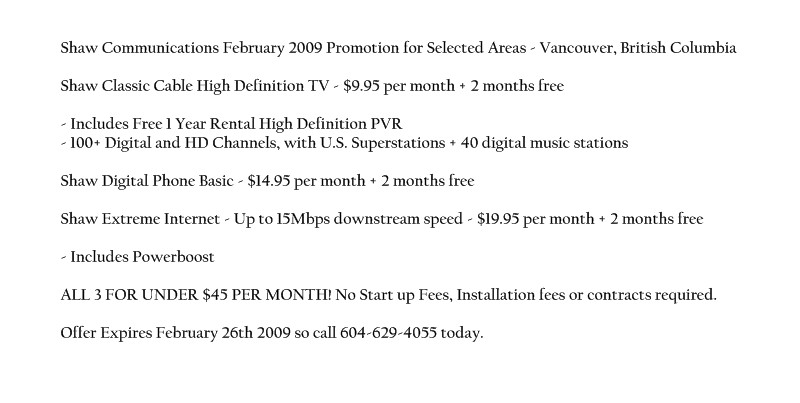
February 2009 Shaw Communications Promotional Pricing (click to enlarge)

February 2009 Shaw Communications Promotional Pricing (click to enlarge)

Novus’ disdain for Shaw began this past February, when Concord Pacific employees noticed Shaw was promoting special discount offers targeting their buildings’ residents with special discounts for new Shaw customer signups.  The special offers expired at the end of February, and the two companies stopped specifically targeting each other in greater Vancouver until July.

Novus co-president Doug Holman told the CBC that was when things really began to heat up.

The cable provider resumed its efforts in July with a more aggressive deal, which it promoted by slipping flyers under doors and with “street teams” that would stand in front of buildings and ask people entering and exiting whether they were Novus customers. If they were, they would get the $9.95 offer, he said.

The $9.95 offer Holman mentions was an even more aggressive promotion than the one Shaw offered in February. The July promotion offered each component of Shaw’s package — television, broadband, and phone — for $9.95 a month each, with two free months thrown in, as the promotional flyer obtained by Stop the Cap! illustrates (shown on the left).

Shaw's flyer distributed to Novus customers (click to enlarge)

Shaw's flyer distributed to Novus customers (click to enlarge)

Who exactly could obtain this promotional pricing became a point of contention between the two companies.  Shaw president Peter Bissonnette claims the promotion is not just available to existing Novus customers, but to any resident of West Vancouver, which he called “highly competitive” for cable and broadband service.  Novus claims the promotion is targeted specifically at their customers, and is not widely known or available outside of its own customer base.

Vancouver residents sharing their experiences with Stop the Cap! report that Novus’ version is probably closer to the truth.  When the skirmish went public with Novus’ PR and Twitter outreach campaign, many Shaw customers in Vancouver had no idea such an aggressive promotion existed.  Neither did Telus customers (British Columbia’s telephone provider).  Some Shaw customers called Shaw to complain about the wide disparity between the rates they were paying and those Novus customers enjoyed.  Some Telus customers also called Shaw in late July to inquire whether they could sign up for the promotion.  Existing Shaw customers were disqualified from the promotion because they were existing customers, and the Telus customers who shared their experiences with Stop the Cap! were told the “offer was not available in your area” by Shaw customer service representatives.

Indeed, other online forums reported some similar experiences, noting the offer was limited to a tight geographical area, notably right in the heart of Novus’ primary service areas — those high rise residential buildings.

One reader of Digitalhome.ca, one of Canada’s largest home entertainment forums, said Shaw would offer this promotion to him if he “moved downtown.”  He also noted some friends who do live downtown are trying to shovel through a blizzard of promotional mailers from Shaw received day after day, as well as personal visits from Shaw sales employees knocking on the doors of residents known to live in buildings wired for Novus, despite posted signs “clearly marked ‘No Canvassing’.”

On the CBC website, one Vancouver resident has received dozens of promotional mailers and plans to return them to Shaw at some point: “It’s insane; some friends and I are saving them up to dump on Shaw’s doorstep at some future point.”

Over on Broadband Reports, one resident looking for service outside of Vancouver was told the promotion was not available:

“I phoned up Shaw asking them to give me this offer at my residential house that is not located in Vancouver. They would not.  The closest deal that the Shaw customer service representative would give me is $70/month for six months and then $110/month after that – Citing at first that they could only offer this promotion to buildings with Novus/Telus/Bell. When I asked why I could not get the promotion at my house because I have Telus available, the CSR backtracked and told me that it was only available in multi-dwelling buildings. Eventually the CSR backed down and told me that Shaw was only offering the promotion to buildings with Novus.”

Another reader who did live in the right neighborhood and ostensibly should have qualified was told he did not:

“I called 15 minutes ago and spoke to a CSR about setting it up in my Kits apartment (moving on Aug 15, do not have an account with Shaw currently) and he came right out and told me it’s only for Novus customers. I said I understood it to be an offer to multi-dwelling buildings and that Telus was offered in my apartment as well, but he said that I don’t qualify because I’m not in a Novus building.”

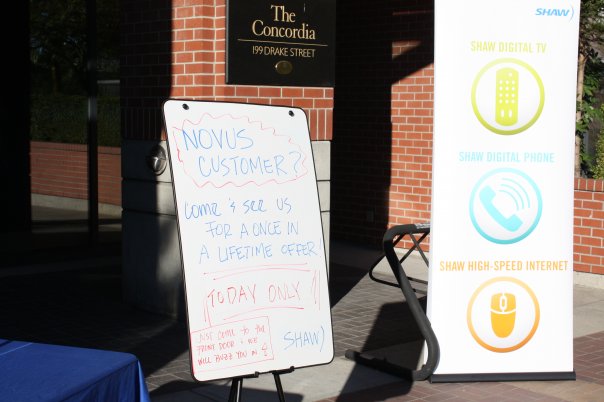
Sign outside of The Concordia in Vancouver promoting Shaw Communications' special offer (click to enlarge)

Sign outside of The Concordia in Vancouver promoting Shaw Communications' special offer (click to enlarge)

One possible clue about who this promotion was intended for could be found on a signboard placed just outside the entrance of one Vancouver building heavily promoting the Shaw offer (see photo on right).

Meanwhile, both companies continue their war of words:

“They’ve publicly stated in the past that they’re going to become the bane of the life of Shaw,” Shaw’s Bissonnette said. “True to their word, they’ve embarked on this defamation campaign.”

Counters Novus’ Holman: “That number [$9.95] is way below our cost. We don’t know what Shaw’s cost is, but it’s hard to believe it could be that low and that their cost savings could be that much better than ours,” Holman said. “If we price matched on that, we’d be losing buckets of money.”

Vancouver residents have mixed reactions to the war of words (and pricing.)

Some are eager to take advantage of the competitive price war, and are dropping Novus for a year’s worth of service from Shaw at a fraction of the regular price, citing the savings during the current economic climate.

Others defend Shaw’s aggressive pricing as competition, brutal as it might appear, doing its job in reducing prices for consumers.  Some have suggested the aggressive rate cutting exposes the enormous profit margins enjoyed by the cable industry, particularly pointing to Shaw’s comments that they are not losing money, even at the low prices they are charging in certain areas of Vancouver, as clear evidence of the gouging that goes on elsewhere in cable pricing.

But some Vancouver residents are defending “the little guy,” upset that Shaw may be using its market power and presence across western Canada to put an upstart like Novus out of business.

One CBC reader summed up the views of Novus defenders:

I’m increasingly annoyed by how heavy-handed Shaw is being in this price war. I qualify for Shaw’s anti-competitive price, but have no intention of switching to get it. If I leave Novus now then I’d be playing right into Shaw’s dream of a city-wide monopoly.

And that’s before I even start to mention the aggression of Shaw’s sales tactics. Green-shirted employees on every street corner downtown, bugging me multiple times as I walk from point A to point B on a weekly basis. Two or three pieces of junk mail a week that get around the red dot I have in my mailbox that indicates I Do Not Want Junk Mail, because they’re addressed to Current Occupant.

I’m all for healthy competition, but this ain’t it.

A few Novus customers have found a happy middle ground while the war plays out in the courtroom.  They contacted Novus and asked them to match Shaw’s prices:

Novus customers who are tempted to switch should contact Novus, as they will match the deal. That is what I did, and I am now paying $10 bucks a month for 20Mbps (23.79 according to Speedtest.net) download speed. My total Internet bill over the next year will be $120 for a service that is equivalent to Shaw’s “High Speed Warp” package, a service that costs $94 a month! That’s the apples to apples comparison, and it works out to be a $1000 savings for Novus customers.

I felt really guilty asking Novus to match, since I am extremely happy with their service and was paying a very reasonable $30 a month. But it’s hard to pass up a deal like that, and I will do my best to spread the gospel about how much better value Novus is over Shaw, and especially Telus and Bell. Healthy competition is great, but I do hope the CRTC steps in to ensure Novus isn’t bullied out of the market.

Telus hasn’t gotten involved because they are more concerned with selling the worst service at the highest price, while Bell is busy pitching you on how fast their service is to your face, and then throttling your speed behind the scenes to the point where Google has come out against them. I haven’t had any bad experiences with Shaw myself, but Novus is a real gem.

So those of you who live in downtown Vancouver should do the logical thing, and stick with Novus. You have access to a service that most people across North America, let alone Canada, drool over.

Lobbyist Money Party: Comcast & AT&T Stuff Millions Into Lawmaker Pockets for Telecom Issues & Executive Pay “Reform”

Corrupt PoliticianIn just the second quarter of 2009, Comcast doled out nearly $3.3 million dollars of their subscribers’ money lobbying elected officials on a myriad of issues, covering everything from executive compensation to sports channels to unionizing efforts.

Forbes reported last week the nation’s largest cable company has lobbied on:

  • the Excessive Pay Capped Deduction Act of 2009, a bill that would stop tax deductions on excessive compensation given to any employee. Excessive pay is defined as any amount above 100 times the average employee’s compensation at the company;
  • the Income Equity Act of 2009, which curbs executive pay by limiting tax deductions on pay greater than 25 times that of the lowest paid employee, or $500,000, whichever is greater;
  • the Shareholder Bill of Rights Act of 2009, which gives shareholders the right to approve or reject executive compensation packages.  Shareholders have long been in contention with Comcast over the near $25 million annual salary paid to CEO Brian Roberts;
  • the right to carry regional sports channels on terms favorable to the cable operator, both in terms of channel/package placement and pricing;
  • the nation’s Broadband Stimulus program — how the funds would be allocated, on what terms, and for what types of projects;
  • the issue of unionization activity at Comcast;
  • limits on Comcast’s ability to increase ownership of additional cable-related assets and systems.

Meanwhile, Brian Dickerson, a columnist at the Detroit Free Press has also been noticing that AT&T, promising to bring competition to Comcast in cities like Detroit, came at the price of a trojan horse called “statewide franchising,” an issue we’ve covered at length on Stop the Cap!

Deregulating the cable TV business in Michigan was supposed to be good news for metro Detroit cable subscribers and bad news for Comcast, long the dominant cable provider in our region.

At least, that’s how area legislators justified a 2006 law that streamlined the franchising process for rival cable operators such as AT&T and stripped pesky local governments of their authority to stand up for aggrieved cable customers.

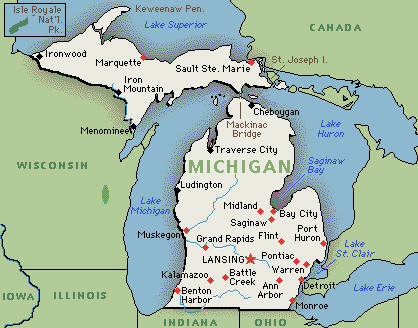
michiganDickerson recites a familiar tune to our readers about how AT&T came to the Michigan state legislature in 2006 promising to bring hardcore competition to Comcast, the state’s most prominent cable provider, if only they would permit AT&T to obtain one statewide franchise agreement, allowing them the flexibility to launch U-verse in cities throughout the state without negotiating with each local government first.

The astroturfers turned up right behind AT&T’s open checkbook (the company spent at least $672,000 in 2006 in Michigan on lobbying and political contributions), touting the benefits of AT&T’s “creative solution” to cable competition.  FreedomWorks even invaded one meeting of the Michigan Municipal League and Michigan Townships Association in the spring of that year “to set the record straight.”  That really meant representing AT&T’s position, and offering plenty of empty promises to Michigan communities seeking competition and lower prices for their residents.

FreedomWorks rapidly also devolved the debate into a partisan “conservative” vs. “liberal” sideshow, hoping to pick up conservatives that would reflexively adopt a pro-AT&T position if it meant doing battle with “liberals.”  And in a two-for-one win for AT&T, the conservative action group also helped jettison Net Neutrality protections.

FreedomWorks President Matt Kibbe was quoted in a December 2006 press release: “To the very end, liberal special interests held out for additional regulatory mandates misleadingly labeled “neutral.” On behalf of more than 12,000 citizen activists in Michigan, I applaud the franchise reforms adopted this week while warning against new efforts in the 94th Legislature to deny basic property rights under the banner of “net neutrality.” We are prepared to defend consumer interests and property rights through relentless grassroots education and advocacy.”

FreedomWorks Michigan Director Randall Thompson concluded, “The issue of franchise reform is evidence that the Freedom Movement is deeply rooted in Michigan. Regular citizens made their voices heard, leading free market think tanks and scholars weighed in on the issue and as a result, public officials adopted good policy.”

Freedom Isn’t Free: Prices escalate across Michigan despite “competition.”

Now, three years after AT&T’s champions in the Legislature crowed that Comcast’s reign as the 800-pound. guerrilla of Michigan cable service was over, Comcast remains the state’s dominant provider, maintains a de facto wire-line monopoly in most its franchise areas, charges higher rates for basic cable service, and has far fewer legal obligations to the subscribers and communities it serves.

Indeed, the story is even worse for Michigan consumers, who in effect paid, as part of their monthly cable bills, for the lobbying and astroturf campaign battle launched against their own best interests and wallets.

The promised competition has arrived in some parts of Michigan, but often at pricing even higher than that charged by the dominant cable company in the area.  Many customers enjoy temporary savings as part of promotional new customer offers, that once expired, leave the customer stuck with everyday high pricing.  As seen in Tennessee, AT&T U-verse packages compete more on numbers of channels offered, not on the pricing of monthly basic service.  A-la-carte channel choice remains unavailable.

In fact, the second biggest winner of the Lobbying Money Party from AT&T ironically turned out to be Comcast.  After all, if AT&T was to be granted special provisions for statewide franchising and other deregulatory benefits, why can’t Comcast receive those benefits as well?

It seemed only fair that if legislators were prepared to relieve AT&T of any obligation to negotiate with local governments, Comcast and other cable providers should enjoy the same privilege. But what about the franchise agreements Comcast had already struck in places where AT&T had no immediate plans to compete?

Some legislators suggested that Comcast be required to live up to existing franchise agreements until competitors were offering service to at least 5% of the community’s residents. But when Sen. Nancy Cassis, R-Novi, proposed such a rule, she was defeated by a voice vote — the anonymous roar of Comcast’s many beneficiaries on both sides of the aisle.

As is the case in Tennessee, should a local franchise agreement not be renewed on favorable terms, there is always the possibility of securing that statewide franchise, bypassing local officials, reneging on hard fought agreements on things like:

  • Guarantees that cable service would be made available to all residents, from the poorest to richest neighborhoods;
  • Cable operators would agree to customer service benchmarks from call answer time to repair call timeframes;
  • Provision and funding of local Public, Educational, and Government (PEG) access channels on the basic tier.

And so, three years after the blizzard of cash was long since pocketed, and astroturfers like FreedomWorks moved on to other industry-sponsored causes célèbre, where are the consumers after the “good public policy” applauded by FreedomWorks was adopted?

Absolutely in the exact same place they were before, only worse.

The Michigan Chapter of the National Association of Telecommunications Officers and Advisors says Comcast celebrated the first anniversary of cable deregulation by raising the price of its cheapest cable package by 25% in many communities; rates for other service tiers jumped between 9%-25%.

Brian Brown, spokesman for a consortium of Michigan cable providers led by Comcast, says the price increases reflect the cost of enhanced services subscribers are demanding. “That’s what the market wants,” he says.

Meanwhile, Comcast has shuttered many of the local service locations it was obligated to maintain under franchise agreements, and is waging a federal court fight to move public access programming off the basic cable line-up.

That’s right.  The market wants higher prices, no local service locations, and a parade of formerly analog cable channels being moved into digital tiers, necessitating additional consumer expense to rent digital converter equipment for every cable-connected television in the home.

Those are the same consumers whose interests have routinely been ignored by the politicians and the providers, and distorted by their bought and paid for political astroturf groups that hoodwink consumers into believing this is a “right-left issue.”

As the battle for Net Neutrality protections begins again this summer, and as we vigilantly maintain watch and prepare for opposition to any reintroduction of Internet Overcharging schemes, just remember the tale of Michigan and Tennessee and the real agenda of the astroturf groups sure to raise their well-financed opposition to pro-consumer legislation and activism yet again.

Search This Site:

Contributions:

Recent Comments:

Your Account:

Stop the Cap!