Home » Competition » Recent Articles:

Cell Phone Follies: AT&T Sues Verizon Over 3G Map, T-Mobile Suffers Second Nationwide Outage

Phillip Dampier November 4, 2009 AT&T, Broadband Speed, Competition, Verizon, Wireless Broadband 3 Comments

[flv]http://www.phillipdampier.com/video/There’s a Map for That 1.flv[/flv]

Verizon’s “There’s a Map for That” Advertising Campaign: Spot 2 (pre-revision — includes “out of touch” language (30 seconds)

Verizon's advertising only displays network coverage of 3G service areas

Verizon's advertising only displays network coverage of 3G service areas

AT&T Mobility has filed suit against Verizon Wireless in the Northern District Court of Georgia (Atlanta Division) demanding the court order Verizon to stop running ads that suggest AT&T has lousy wireless 3G data coverage.

The suit comes in response to a series of advertisements from Verizon that compare the coverage maps of both companies “3G” wireless data networks.  The term “3G” refers to the third generation (3G) of mobile telephony standards – IMT-2000.  In general terms, local wireless networks upgraded to provide 3G service can provide much faster wireless data speeds than those still operating under older standards like “2G.”

Verizon Wireless has aggressively deployed 3G upgrades across its service area, while AT&T has largely focused on more urban population centers for their 3G upgrades, something Verizon’s advertising calls out.

The crux of the suit is exactly how Verizon depicts the differences in coverage.

AT&T claims the ads leave viewers with the impression that those vast white areas depicted on the coverage map designated by Verizon as “AT&T,” are areas without any data coverage at all.  Most cell phone company coverage maps routinely depict “no service” areas in white, and AT&T claims Verizon underlined the impression in its ads, including one on radio, that included the phrase “out of touch” when speaking about non-3G AT&T service areas.  AT&T described the ad above as showing “a frustrated or sad AT&T customer sitting alone on a bench because she is not able to use her wireless device to meet up with her friends.”

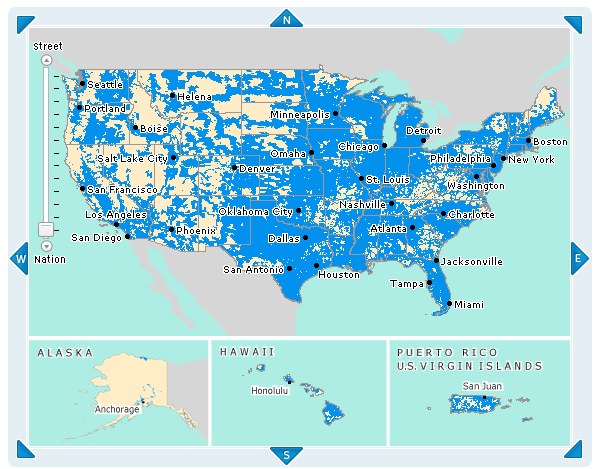
AT&T Mobility’s own coverage map depicts data coverage in varying hues of blue, designating the different types of data service coverage available nationwide, but those different hues and service areas only become apparent after starting to zoom in on specific regions of the country.

AT&T's "Nationwide" Coverage Map for Data

AT&T's "Nationwide" Coverage Map for Data

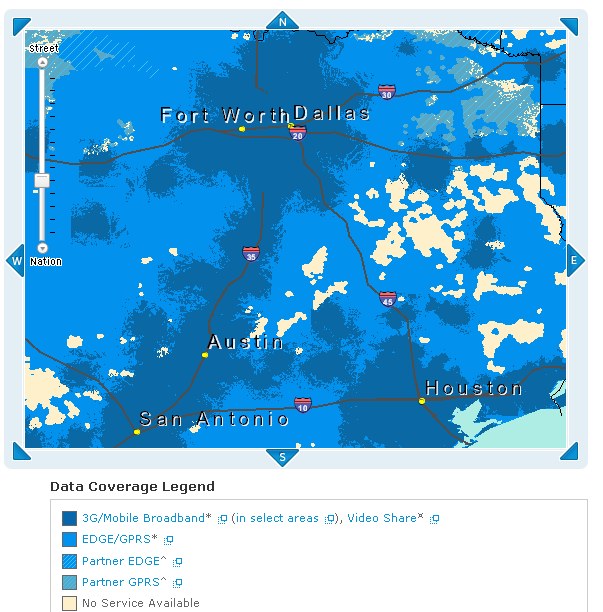
AT&T's coverage map changes when you zoom in, depicting the different types of network standards used in different areas.  This map of eastern Texas shows coverage ranging from 3G to woefully slow EDGE networks owned by "AT&T partner" companies

AT&T's coverage map changes when you zoom in, depicting the different types of network standards used in different areas. This map of eastern Texas shows coverage ranging from 3G to woefully slow EDGE networks owned by "AT&T partner" companies

On AT&T’s maps, areas in white are labeled “no service available.”

On October 7th, AT&T Mobility contacted Verizon Wireless and demanded that they either cease the ads or modify them to make them, in AT&T’s words, “less misleading.”

In response, Verizon dropped the “out of touch” language from the ads and inserted a fine print disclaimer at the bottom indicating “Voice and data services available outside of 3G areas.”

AT&T considers the modifications inadequate and filed the lawsuit asking for a cessation of the ads and monetary damages from perceived ill-gotten profits from Verizon snatching away AT&T customers.

Verizon’s defense?  Accuracy.  Verizon Wireless’ ads never stop referring to “3G service” and both maps include specifically labeled “3G Coverage.”

AT&T argues that their network is actually more expansive than Verizon’s, when you also include AT&T’s more prevalent 2G and earlier wireless data standards.  But that’s arguing apples and oranges.  Verizon intends to promote and leverage benefits from upgrading its service areas, large and small, to 3G service.  AT&T has not done that, and in fact has been on the receiving end of criticism from customers frustrated at times with the poor performance of its network, including slow data speeds, dropped calls, and insufficient coverage in certain areas.

Verizon's ads clearly depict "3G Coverage" on their map comparison

Verizon's ads clearly depict "3G Coverage" on their map comparison

The gadget enthusiast press has not been enthusiastic about AT&T’s lawsuit, wishing the company would be as enthusiastic with network upgrades as they are engaging their legal team to fight Verizon, or is little more than a whining villain that has been exposed for its inadequacies.

AT&T customers frustrated with their mobile experience are probably still better off than T-Mobile customers, some of whom spent much of yesterday with no service at all.  In the second nationwide outage in two months, T-Mobile claims about two million customers nationwide experienced voice and data service outages for much of the day, although anecdotal reports suggest a company estimate of “five percent of customers impacted” is low.  No explanation for the outage was given.  This comes after an embarrassing server failure in October which led to some T-Mobile Sidekick customers being without service for up to a month, as well as a loss of stored data which company officials have slowly tried to restore weeks after the system crashed.

Hong Kong Broadband Network Cuts Price in Half – 100Mbps Service for $13 A Month

Phillip Dampier November 2, 2009 Broadband Speed, Competition, Video 9 Comments

Hong Kong Broadband Network, the wholly owned subsidiary of City Telecom, has just slashed the price for its 100Mbps “bb100” fiber optic broadband service.  When a customer finds a friend willing to sign up, both will receive the broadband service for $13 US per month for 24 months, which represents a 50% discount for each customer.

At this price, Hong Kong residents pay just $0.06/megabit-per-second, which includes a speed guarantee that customers will receive at least 80% of advertised speed when surfing domestic websites.

William Yeung, Chief Executive Officer of HKBN noted that at least 32% of Internet users in Hong Kong suffer from broadband speeds below 10Mbps, and the Hong Kong special administrative region of the People’s Republic of China lags behind Korea and Japan in terms of fiber to the home service, something Yeung would like to see changed.

He considers Hong Kong’s broadband development rating “comfortably enjoying today’s applications” to be inadequate, and wants to see Hong Kong have universal access to 100Mbps or greater speed broadband.

“Being the second largest broadband service provider, we have a duty to improve Hong Kong’s global standings,” Yeung said.

HKBN provides speeds up to 1Gbps in Hong Kong over its fiber optic network.  Hong Kong’s broadband ranking is important to the region for economic reasons, attracting new industry and high paying technology jobs with fast, affordable broadband service.

What Hong Kong considers inadequate is still well ahead of the United States, which continues to lag behind several Asian nations in constructing advanced high speed broadband platforms.

Hong Kong’s population density, which poses a challenge for some services, is actually a benefit for telecommunications, because construction costs are lower when wiring densely populated multi-dwelling units and apartments.

The company currently has 391,000 broadband customers, attracted to the company in part by their creative advertising campaigns.

[flv]http://www.phillipdampier.com/video/HKBN Member Get Member Promotion.flv[/flv]

HKBN makes Hong Kong’s population density a net plus for fast, affordable broadband.  William Yeung announces “Member Get Member Promotion” from HKBN and unveils new advertising campaign. (3 minutes)

Several weeks ago, Stop the Cap! included several HKBN ads for your review.  We’ve now obtained English subtitled copies to share, below the jump.

… Continue Reading

Shaw Invades Ontario With Approval of Mountain Cablevision Acquisition, Becomes Canada’s Largest Cable Operator

Phillip Dampier October 29, 2009 Canada, Competition, Public Policy & Gov't, Shaw Comments Off on Shaw Invades Ontario With Approval of Mountain Cablevision Acquisition, Becomes Canada’s Largest Cable Operator
Mountain Cablevision becomes part of the Shaw Cable family with the approval of the CRTC

Mountain Cablevision becomes part of the Shaw Cable family with the approval of the CRTC

The Canadian Radio-television and Telecommunications Commission has given approval to Shaw Communications for its acquisition of Hamilton-based Mountain Cablevision, Ltd., a small independent cable operator in southern Ontario.  The $300 million dollar transaction brings 41,000 cable customers, 29,000 Internet subscribers, 30,000 digital phone lines, and 135 Mountain Cablevision employees into the Shaw family, making the Calgary-based cable company Canada’s largest.

“This is a great move for us to come in there and be able to start being around that market. We always said that […] we want to be in Alberta, British Columbia, and Ontario,” Shaw chief executive Jim Shaw said Friday.

“Rogers had passed on the acquisition so we decided to go in there,” Shaw told analysts. “This is a great move for us, being around that market.”

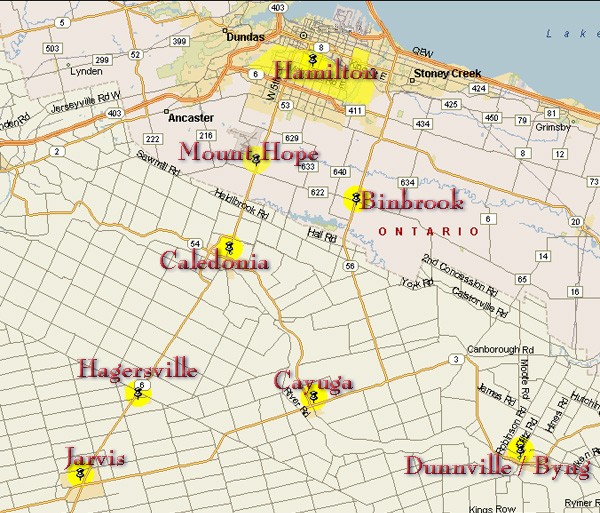
Mountain Cablevision serves a small part of Hamilton and surrounding communities in southern Ontario

Mountain Cablevision serves a small part of Hamilton and surrounding communities in southern Ontario

Shaw’s entry into Ontario upset Rogers Communications, eastern Canada’s dominant cable provider.  Rogers sued Shaw in an Ontario court, claiming the purchase violated a near-decade long agreement made personally between Ted Rogers and Jim Shaw to stay out of each other’s territories — Shaw stays out of eastern Canada if Rogers moves no further west than Ontario.

Canadian courts aren’t compelled to recognize handshake deals made over dinner, and the court ruled against Rogers.

With the agreement swept away, some analysts predict Rogers will investigate acquisition opportunities in western Canada, probably in the more populated regions.

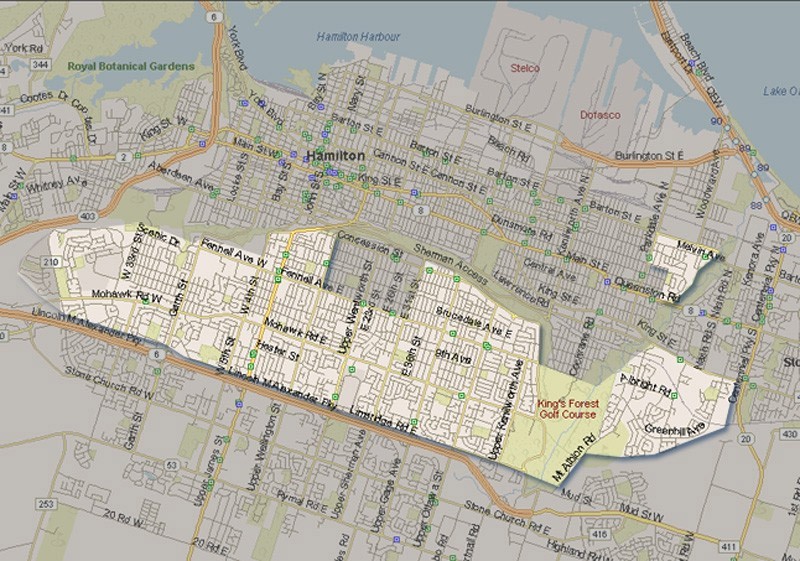
Shaw claims it will upgrade Mountain Cablevision’s small cable footprint, which serves only a portion of greater Hamilton – Hamilton Mountain and East Hamilton, as well as the communities of Mount Hope, Caledonia, Hagersville, Jarvis, Dunnville/Byng, Cayuga and Binbrook, all in Ontario.  The company promises better broadband, cable, and telephone service after the upgrades are complete.  Shaw also says it will expand the Mountain Cablevision system into several unserved neighborhoods and townships.  That’s an important distinction, because it indicates Shaw has no intention of competing head to head with Rogers or Ontario’s other dominant cable company Cogeco.

The deal comes during challenging times for Shaw, who announced a 6% decline in profits in the fourth quarter, with gains only from new digital cable additions.  More than 110,000 Shaw customers signed up for digital cable in the third quarter, up from 23,000 in the third quarter a year ago.

In other areas, Shaw lost customers — 5,000 canceling broadband, 4,500 dropping Shaw’s direct to home satellite service, and nearly 9,000 disconnecting their Shaw digital phone line.

Shaw’s next product introduction will likely be its new cell phone service.  The company spent $190 million dollars last year acquiring 18 airwave licenses in northern Ontario, Manitoba, Saskatchewan, Alberta, and British Columbia.

Mountain Cablevision's concentrated service area in the city of Hamilton

Mountain Cablevision's concentrated service area in the city of Hamilton (click to enlarge)

But Shaw is taking a “very cautious approach” to wireless mobile services, according to the company.  It has refused to set a timetable when service would begin.  Shaw faces a growing number of wireless competitors introducing service in Canada late this year and into early 2010.  DAVE Wireless, Wind Mobile, and Public Mobile are all poised to launch in major Canadian cities, expecting to put competitive pressure on pricing and bring about lower priced, more generous service plans.

Shaw claims it’s not concerned, telling The Financial Post, “If they’re in there, we don’t really care. We already have a relationship with customers and they have zero,” Shaw said. “We have 3.4 million customers we have a relationship every month with.”

Telecommunications companies are increasingly concerned with offering customers “bundles” of telecommunications services from video, broadband, wired phone lines, and now increasingly wireless data and mobile phone services.  Customers purchasing bundles tend to remain loyal to the companies offering them.

TelecomGate: City Up In Arms Over Loan Controversy With Municipally Owned Burlington Telecom

Burlington city officials are mired in controversy over the legality of a recently revealed $17 million dollar unpaid loan given to Burlington Telecom, an apparent violation of the terms of its license issued by the Vermont Public Service board.  While the municipally-owned fiber optic network is permitted to borrow money from the city, it must be repaid within 60 days, because the city charter insists that Burlington Telecom be an independently financed venture that does not become a taxpayer liability.

Dubbed by some as TelecomGate, it has become a major media story in Vermont’s largest city.  Some taxpayers are upset by the perceived “bailout” of Burlington Telecom after the company exhausted its commercial loans of almost $34 million dollars to construct a fiber network serving homes and businesses.  The Burlington Free Press has reported the city began quietly funding Burlington Telecom as early as late 2007, for both capital expenditures and some operating costs.  As of today, Burlington Telecom has an accumulated debt of $50 million dollars, $17 million of which is owed to the city.

[flv]http://www.phillipdampier.com/video/WCAX Burlington Telecom Controversy 10-16-09.flv[/flv]

WCAX-TV in Burlington breaks the story about the funding controversy on October 16th. (3 minutes)

Burlington officials admit they underestimated construction costs, in part because they failed to complete a comprehensive engineering study prior to construction.  Installing underground fiber cabling has literally hit a rock ledge, part of the geological character of underground Burlington, that will require an additional $10 million to cope with.

The fact the public is just finding out about it now is a major reason for the controversy.  Jonathan Leopold, the city’s chief administrative officer, said he learned that the financing violated the company’s license terms last November.  The Free Press reports he only informed the city council responsible for overseeing the operation in May of this year, six months later.  The city council itself waited four months until late September before it notified Vermont state officials about the apparent violation, which led to the matter finally going public.

State officials publicly criticized the Burlington city government for the apparent transgression and for what some have called a cover-up, and State Auditor Thomas Salmon called on Burlington Telecom to have greater openness and transparency.  State Public Service Commissioner David O’Brien called the funding irregularity a potential violation of law and that Burlington Telecom was “in debt beyond their ability to recover,” a charge which brought a hot response from Burlington mayor Bob Kiss:

“Commissioner O’Brien’s statements as quoted in today’s Burlington Free Press are inaccurate, inflammatory and totally inappropriate given there is a present proceeding before the Vermont Public Service Board in which his Department is supposed to be representing the public interest. Commissioner O’Brien knew or should have known of the City’s use of pooled cash to fund BT’s capital expenses and start up costs for almost a year. His comments only serve to undermine the confidence of BT’s customers, the interests of whom his Department is charged by statute to protect.”

O’Brien responded that Kiss was “shooting the messenger.”

[flv]http://www.phillipdampier.com/video/WCAX Burlington Burlington Telecom Scandal 10-20-09.flv[/flv]

WCAX-TV reports Burlington city council members had tough words for Jonathan Leopold at a meeting on October 20th, but Burlington mayor Bob Kiss is standing by Leopold. (3 minutes)

City council members have scurried for cover after the local press revealed they approved Burlington Telecom’s funding 13-1 at a city council meeting held October 5th.  That may serve to back up Leopold’s position that he never hid any details about the loan arrangements — city officials and lawyers were well aware of these transactions, he says.  Several public venting sessions were rapidly scheduled to allow constituents to express their concerns.

The Burlington Free-Press editorialized that the city can no longer keep information about city-owned Burlington Telecom’s problems and violations from residents by saying the secrets are necessary for business reasons and is calling for an independent investigation and audit.

State and local politics have also become deeply ingrained into the debate, with accusations flying between political parties that the flap has now become more about undermining the current administration than ferreting out and resolving issues with Burlington Telecom.

[flv]http://www.phillipdampier.com/video/WPTZ Plattsburgh – Taxpayers Give City Council Piece Of Their Mind 10-22-09.flv[/flv]

WPTZ-TV in Plattsburgh covered the public venting session on October 22 set up by the city council to allow residents to speak their minds.  (2 minutes)

Leopold, whose administration duties involve Burlington Telecom, and who has been the most visible figure in the middle of the dispute, called attacks on him by some local politicians part of a scapegoating witch hunt.

City council voted 8-6 at 1:30am this morning approving a resolution to ask for the suspension of Jonathan Leopold anyway.  So far Mayor Kiss won’t hear of it.  At a press conference he reiterated his full support for Leopold, saying his suspension is “not warranted by the facts and is not in the best interests of the city. As mayor, I will not suspend the CAO from his service to the city.”

Caught in the middle is Burlington Telecom and its 4,600 subscribers.  The provider is in apparent violation of its license for its loan arrangements, needs additional money to complete its buildout, and will likely also be cited for not completing that buildout on the schedule it committed to as part of its license to operate.

Commentary: Our Take

Too often municipal broadband projects end up as political footballs kicked all over town, especially when controversy erupts.

[flv]http://www.phillipdampier.com/video/WPTZ Plattsburgh State Demands Repayment 10-20-09.flv[/flv]

WPTZ-TV covers the political repercussions and damage control operations in full force after news of the controversy erupted. (10/20/2009 – 2 minutes)

Burlington Telecom made a crucial mistake when it failed to undertake a detailed engineering study to determine the true costs of wiring Burlington with fiber optics, something incumbents Comcast and FairPoint have not been willing to undertake.  A true picture of the start-up costs would have resulted in a better understanding of initial construction costs and the financing required to pay for it.

City officials also erred in how they began funding some of the costs to administer the system after initial financing ran out.  Good intentions or not, the fact there is a perceived cover-up makes things much more attractive to a media that often ignores or buries telecommunications stories on the business pages.

A frank and open discussion explaining the challenges and resolutions to them might have brought about temporary city loans with the consent of the community, without melodramatic political theater.  Residents have a unique buy-in with Burlington Telecom because it’s municipally-owned.  Many would be more than willing to see that and some additional investments pay off instead of collapsing with a complete shutdown.

[flv]http://www.phillipdampier.com/video/WCAX Burlington Mayor Defends Administration Over Telecom Issue 10-26-09.flv[/flv]

WCAX-TV covers Burlington mayor Bob Kiss who held a press conference yesterday to defend his administration’s role in Burlington Telecom (3 minutes)

When the story broke, the usual and very predictable campaign of finger-pointing, ducking for cover, and scapegoating began.  This time-honored political damage control method is voter approved, if you stick your finger to the wind and see where voter sentiment seems to be blowing.  That’s precisely what state Commissioner O’Brien did, only he overplayed his populist hand.  This is, after all, the same commissioner who initially made excuses on behalf of FairPoint and seemed all too willing to give that company the benefit of the doubt, right up until it became politically untenable.  You cannot be a credible torch-bearer in a populist mob if you helped build the castle you now seek to burn to the ground.

Mayor Kiss was correct in calling O’Brien out, not just for his convenient criticism, but for trying to win the Self-fulfilling Prophecy Award by predicting Burlington Telecom’s demise.  Vermont residents should ask him where his clairvoyance was when he was publicly stating FairPoint was doing “pretty well” a year ago.  O’Brien needs to be part of the solution for a change, not part of the problem.

Leopold appears to be a classic scapegoat.  As he struggled to keep Burlington Telecom afloat, it is inconceivable he was cutting loan deals without the knowledge and consent of others in the city administration.  The same city council now demanding his suspension seemed all too willing to go along just a few weeks ago when it voted almost unanimously with going forward.  That speaks volumes.  But when the media lights fire up, and angry residents start writing and calling, the complete turnaround is a site to behold.  A series of self-serving, concern trolling speeches followed, along with complaints they were never given enough information or were confused by what they heard.  If that is the kind of leadership Burlington has, perhaps residents need to consider making some changes.

[flv]http://www.phillipdampier.com/video/WCAX Burlington City Council Undecided About Burlington Telecom 10-26-09.flv[/flv]

Late last night, WCAX reported city council was still undecided about what to do about the Burlington Telecom controversy.  (3 minutes)

The public has a right to be upset, but are all too often satisfied with the political theater designed to quickly “resolve” the problem by expelling the designated scapegoat from their midst.  Mayor Kiss has remarkably withstood the usual pattern very well thus far.

While the politicians play “not my fault,” Burlington Telecom customers need answers to know if their provider is endangered.  An independent audit and review, free of political know-nothings would be a start.  How about bringing in those with actual expertise in deploying municipal networks.  How about excluding involved, self-interest-protecting elected officials, especially those who had any hand in the FairPoint debacle.

It’s also time to fund that engineering study for the unwired portions of Burlington to get a true cost analysis.  A review as to why Burlington Telecom is not attracting a larger segment of the market is also needed.

In broadband, at least, that’s a no-brainer.  Burlington Telecom’s speeds on the download side are too slow and too expensive.  Comcast offers faster downstream service at lower prices, so why would anyone want to switch?  Burlington Telecom is trying to market their synchronous speed network (your downstream speed and upstream speed is the same), which would normally be appealing to a segment of Internet customers frustrated with cable and DSL shortchanging them on upload speeds.  But the customers who understand and appreciate the difference will not accept a broadband service that tops out at 8Mbps for an enormous $71.80 a month.  That’s far too slow and too expensive when Comcast is offering 12Mbps/2Mbps (upload speed with PowerBoost) for $42.95 per month.  Service for 16Mbps/2Mbps is $10 more, still twenty dollars less than Burlington Telecom is charging for half the speed.  Burlington Telecom can attract a larger base of broadband customers by accelerating speeds on their network beyond what Comcast provides.

Municipal broadband projects can be successful, but should be based on a true and honest appraisal of the costs, a complete understanding of the competitive landscape, a flexibility to respond to changing markets, and a good reason why they should exist in the first place.  Fulfilling the needs residents want, but incumbent providers will not provide is always the best answer.  Customers don’t want anemic broadband at high prices.  Provide that and a municipal broadband project will fail, even without political grandstanding and finger-pointing.

[flv]http://www.phillipdampier.com/video/WPTZ Plattsburgh Kiss Refuses To Punish Leopold Over Telecom Flap 10-27-09.flv[/flv]

This morning Burlington residents learned Burlington mayor Bob Kiss was still standing behind Jonathan Leopold, despite their calls for Leopold to be suspended. (WPTZ) (2 minutes)

Below the jump, find a one hour video interview between The Burlington Free Press and city officials on the Burlington Telecom matter.

… Continue Reading

The Wall Street Journal Quotes Stop the Cap! Founder & Addresses Internet Overcharging Schemes

Phillip "I Also Told You So" Dampier

Phillip Dampier

The Wall Street Journal today published an article reviewing the landscape of flat rate broadband service and how some Internet providers want to change it.

The article quotes me on the issue of Internet Overcharging becoming a political football in the Net Neutrality debate.

“This could come down to carriers saying, ‘If you don’t allow us to manage our networks the way we see fit, then we will just have to cap everything,’ ” says Phillip Dampier, a consumer advocate focusing on technology issues in Rochester, N.Y. “They’ll make it an either/or thing: give them more control over their network or expect metered broadband.”

Mr. Dampier was among those who forced Time Warner Cable to shelve a metered Internet pilot program in several cities last year. The company, which had argued the plan would be a fairer way to charge for access, acknowledged it was a “debacle.” It won’t say if it plans to revive the trials.

Unfortunately, the article never bothers to mention Stop the Cap!, the website dedicated to fighting these overcharging schemes.

AT&T's Internet Overcharging Experiment Gone Wild

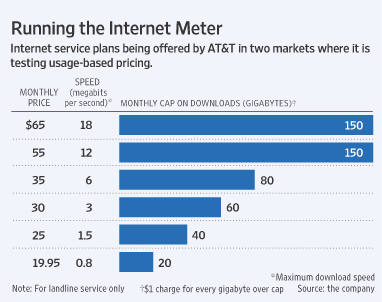
AT&T weighs in on their experiment to overcharge consumers in Beaumont, Texas and Reno, Nevada, and analysts think Net Neutrality arguments may give providers an excuse to expand those experiments, launch price increases and blame it on Net Neutrality policies:

“Some type of usage-based model, for those customers who have abnormally high usage patterns, seems inevitable,” an AT&T spokesman says. AT&T declined to provide more details on its trials.

“Unquestionably, the carriers erred in their initial selling of broadband with a flat rate,” says Elroy Jopling, research director of Gartner Inc. “They assumed no one would use it as much as they do now, but then along came high-definition movies. They’re now trying to get around that mistake.”

Network neutrality deals primarily with ensuring that Internet providers don’t favor any online traffic over any other. Still, Mr. Jopling and other analysts argue, the net neutrality debate might provide the carriers with an opening to argue for changing that pricing.

“With network neutrality enforced, the only other option for carriers is to charge by the byte or to raise the flat-rate pricing,” says Johna Till Johnson, president of Nemertes Research. “Right now they’re just deciding which one to do. Just be prepared to pay more.”

It's "Rep. Eric Massa," Not 'Joe Messa'

It's "Rep. Eric Massa," Not 'Joe Messa'

The article has several flaws.

  • It mis-identifies Rep. Eric Massa (D-New York) as “Rep. Joe Messa.”  Rep. Massa introduced legislation to ban Internet Overcharging when companies cannot produce actual evidence to justify it, particularly in the limited competitive marketplace for broadband in the United States.
  • The article fails to mention the usage limits proposed by smaller broadband providers, including Frontier’s infamous 5GB usage definition in their Acceptable Use Policy.  This is a very important fact to consider when the article quotes Professor Andrew Odlyzko, an independent authority on broadband usage, as stating the average broadband consumer uses triple that amount (15 gigabytes per month).
  • The quotation about the number of e-mails or web page views available under plan allowances that routinely appear in such articles ignores the increasing use of higher bandwidth applications like online video.  Telling a consumer they can send 75 million e-mails is irrelevant information because no consumer would ever need to worry about usage limits if they only used their account for web page browsing and e-mail usage.  They very much do have to be concerned if they use their service to watch online video from Hulu or Netflix, or use one of the online backup services.
  • The article makes no mention of publicly available financial reports from broadband providers like Time Warner Cable that prove that at the same time their profits on broadband service are increasing, the company’s costs to provide the service continue to decline, along with the dollar amounts they spend to maintain and expand that network to meet demand.  Providing readers with insight into the true financial picture of a broadband provider, instead of simply quoting the public relations line of the day would seem particularly appropriate for The Wall Street Journal.
  • The article doesn’t make mention that the same providers arguing increased Internet traffic is creating a problem for them are also working to launch an online video distribution platform that will rival Hulu in size and scope.  TV Everywhere will consume an enormous amount of the broadband network they claim can’t handle today’s traffic without Internet Overcharging schemes being thrown on customers.  Of course, such usage limits are very convenient for companies like Comcast, Time Warner Cable and AT&T, which are now in the business of selling pay television programming to consumers.  Should a consumer choose to watch all of their television online instead of paying for a cable package, a usage allowance will help put a stop to that very quickly, as will planned restrictions that only provide online video to “authenticated” existing pay television subscribers.

One thing remains certain – providers are still itching to overcharge you for your broadband service.  Consumers and the public interest groups that want to represent them must stand unified in opposition to Internet Overcharging schemes and for Net Neutrality protection, and never accept sacrificing one for the other.

Search This Site:

Contributions:

Recent Comments:

Your Account:

Stop the Cap!