Home » Competition » Recent Articles:

Attention North Carolina: They’re Baaack… Telecom Special Interests Pushing HB1252 (Again) – In Committee on Monday!

welcomencLast spring, consumers across North Carolina banded together to oppose legislation custom-written by the telecommunications industry to keep municipal broadband networks from competing with cable and telephone companies.  Your efforts made a dramatic impact on state legislators and the bill was set aside.  One representative that helped push it has since resigned after being caught up in a campaign contribution scandal.  But we always knew the industry would be back.  The threat of competition, and a reduction in their fat profits, is too great to ignore.

HB1252 – The “Level Playing Field” bill, which is among the most ironically named pieces of state legislation around, will be in the North Carolina House Select Committee on High Speed Internet in Rural and Urban Areas on Monday morning at 10am.  For those of you who might want to attend, the meeting will be held in Room 415 of the Legislative Office Building at the General Assembly in Raleigh.

For those smart enough to recognize a telecom industry power play when they see one, a reality check for our state legislators is imperative.

I have been attempting to be added to the agenda to speak against HB1252 as a consumer.  So far, no call back.

I believe that I have a unique perspective on this issue, as I hail from Greensboro, one of the communities that experienced the attempt by Time Warner Cable to force classic Internet Overcharging schemes like metered billing and data caps on consumers in the Triad region.  These experiments came as a direct result of the large void many of us have in the area of competition.

HB1252 would make it next to impossible for municipalities to have their own city run broadband service to compete.  The city of Wilson made the dream a reality.  What costs a Time Warner Cable customer $180 to bundle cable, telephone, and Internet service together is on offer in Wilson from their municipal system for a mere $99.  That’s nearly half the price.

Wilson’s Greenlight system offers a direct fiber to the home connection to subscribers.  Wilson customers get speeds up to 100Mbps, ten times faster than cable or DSL.  What has Time Warner Cable done in Wilson to compete?  They reportedly cut their prices, particularly for consumers calling to cancel.

HB1252 will help protect Time Warner Cable and other providers in North Carolina from ever having to cut prices and take a profit hit.  By taking away your community’s right to provide service the cable and phone companies refuse to provide, at an affordable price, this piece of legislation assures you of paying more and having less choice.

If you cannot attend Monday’s session, you can still deliver a wakeup call to state legislators by reminding them you are paying close attention to this issue, and know exactly who is behind the push for HB1252.  Tell your representative Time Warner Cable and other telecommunications interests should not be ghost-writing legislation that favors them and protects their monopoly.  Ask your legislators to firmly oppose HB1252 and demand as much competition as the marketplace can stand, be it from phone, cable, wireless, or municipally run fiber to the home.

Here is the list of North Carolina representatives.  We won the first few rounds on behalf of North Carolina consumers.  Time to win one more!

Verizon Can Engage In FiOS Internet Overcharging Because It Can: Heavy Users Are A Potential Profit Windfall

Brian Whitton, Verizon's Executive Director of Access Technologies

Brian Whitton, Verizon's Executive Director of Access Technologies

At least Verizon is honest about it.  As providers contemplate slapping customers with usage limits, overlimit fees, and other tiered pricing systems, they’ve typically said they’re justified because of the strain they claim heavy users place on their broadband networks.  One network that doesn’t face that problem is Verizon’s robust fiber optic FiOS network, which is on the way to upgrading from the ridiculously fast current speeds to the “next generation” of FiOS speed: delivering 10 Gbps downlink and 2.5 Gbps uplink, shared among 32 locations.  That makes the cable modem competition, which shares slower speeds among many more customers wilt at the prospect.  DSL instantly becomes the dial-up service of the decade in comparison.

Make no mistake, Verizon tells all who ask: Fiber to the Home is near-infinitely upgradeable for decades to come, simply by swapping out some hardware at each end of the pipe.

Yet Verizon began making noises about ending its all-you-can-eat broadband buffet this past September, when Verizon Chief Technology Officer Dick Lynch said Verizon was in favor of consumption-based billing, too.

But why should Verizon FiOS, often priced higher than the cable competition, opt for Internet Overcharging schemes when it has a network that is nowhere near capacity and will increase its speeds even further next year?

As GigaOm’s Stacey Higginbotham found out, the answer is – because they can:

Brian Whitton, executive director of access technologies at Verizon did acknowledge how valuable broadband has become—precious enough that people will pay for premium access to it, especially those using up a disproportionate amount of network assets. “Ultimately this is the fairest cost-recovery model, and with a tiering plan or a meter everyone is paying their fair shares to finance the network,” Whitton said. Unlike other ISPs, Verizon doesn’t view heavy bandwidth users as hogs, but it does view them as potentially high-end customers.

Yet Verizon already does charge users a fair share to finance their network, based on the speed tier that customer chooses.  Those high-end customers are already paying Verizon premium prices for the fastest available speeds on Verizon’s fiber optic system.  Verizon’s ability to recoup their investment becomes easier and easier as costs decline to construct the fiber optic systems that will protect Verizon’s viability for decades to come, unlike those traditional phone companies sticking with copper wire lines until the last customer out the door turns the lights out for good.  Verizon’s average revenue per subscriber has never been higher with its ability to market video programming, speeds that make most cable operators blush, and an infinitely more reliable telephone network, all on one bill.  That helps achieve subscriber loyalty, particularly when offering service that keeps customers happy.

Creating Internet Overcharging schemes for your broadband service simply to monetize consumption does not keep customers happy.  Verizon sees the cream rising to the top — charging broadband enthusiasts more while promising nothing for customers who use the service less.  With average consumption per broadband user rising, there’s going to be a lot more cream to skim, charging an increasing number of customers more money for the exact same level of service.

No consumption billing scheme to date has ever provided customers with a “fair share” system, because none of them result in no charge for no consumption or charge a flat fee per gigabyte.  Instead, customers are allocated a pre-determined allowance for usage, charged whether they use it or not.  If they exceed it, punishing overlimit fees are always the result, unless a provider takes another step towards monetizing broadband by inventing overpriced “insurance plans” to protect consumers from overage fees.  The cost of delivering that data is already built-in to the price of today’s broadband plans, and those costs continue to decline.

Higginbotham adds another factor in the equation: with insufficient competition, those “fair share” schemes can inflate prices and lower allowances at a whim, as most customers lack a wide variety of competitors to choose from, which could help keep the greed factor in check.

Most places have two providers that offer slightly different sets of services and plans, making it hard to compare prices. I don’t mind paying more for a better network (I do so for my cell phone), but most consumers lack that option when it comes to wired access. Comcast—which competes against Verizon in about 12% of its footprint—is rolling out faster broadband to ensure that customers don’t leave the cable provider for Verizon’s fiber. But in other areas of the country, such as here in Austin, Tex., folks must choose between DSL (with some U-verse) and cable that hasn’t been upgraded to the faster DOCSIS 3.0 speeds.

Austin was one of the test markets for Time Warner Cable’s reviled “consumption billing experiment” this past April.  In other test cities, it’s more of the same.  In Rochester, New York broadband service is realistically available from two major players — Time Warner Cable and Frontier Communications.  The former has apparently passed over Rochester for DOCSIS 3 upgrades because the cable operator sees little need to upgrade service in an area whose only primary competitor believes DSL service is good enough, one that has stubbornly kept an Acceptable Use Policy defining an appropriate amount of usage at a piddly five gigabytes per month, and thinks fiber is for breakfast cereals, not for Flower City residents.

Verizon’s words help call out the fiction that some providers have used to peddle Internet Overcharging schemes on their customers.  It’s not about “fairness,” it’s not about “exafloods and Internet brownouts,” nor is it about “expanding networks.”  It’s about profit, pure and simple.  When you have a duopoly in place for broadband and almost no regulation governing that service, the sky is the limit for price increases and limits on usage.

[flv width=”480″ height=”284″]http://www.phillipdampier.com/video/Verizon Whitton On Telecom Delivery 2-25-09.flv[/flv]

Verizon’s Executive Director of Access Technologies Brian Whitton speaks about the future of telecommunication delivery technologies with Kimberlie Dykeman of Web2point0.tv at The Future of Television East conference in New York (February 25, 2009 – 11 minutes)

Adding Insult to Injury: Verizon Wireless Further Pummels AT&T in New Round of Holiday Ads

Phillip Dampier November 17, 2009 AT&T, Broadband Speed, Competition, Verizon, Video, Wireless Broadband 2 Comments

AT&T Mobility wanted Verizon Wireless to stop showing ads that call out the differences between the two wireless competitors’ national 3G networks.  When Verizon didn’t, AT&T sued.  This week Verizon Wireless doubles down with three new holiday season ads that are guaranteed to enrage AT&T even further.

Anyone who has seen a Rankin/Bass holiday special will instantly recognize at least one of the ads is a play on the Island of Misfit Toys, seen in the 1964 holiday classic Rudolph, the Red-Nosed Reindeer.

[flv width=”620″ height=”380″]http://www.phillipdampier.com/video/Verizon Wireless Verizon Misfit Toys Ad.flv[/flv]

Verizon Wireless – “The Island of Misfit Toys” (30 seconds)

AT&T accuses Verizon Wireless of misrepresenting its national data coverage by showing non-3G areas in white, a color AT&T says traditionally represents no service at all.  AT&T says its wireless data network, in its entirety, is more expansive than Verizon’s.  Verizon counters its ads only compare 3G coverage, and clearly label the maps as such, including a fine print disclaimer indicating “voice and data services available outside 3G coverage area.”

AT&T further argues watching frustrated consumers shaking their phones or sitting alone because they were unable to meet up with their friends would suggest to a casual viewer they weren’t able to access any service.

[flv width=”620″ height=”380″]http://www.phillipdampier.com/video/Verizon Wireless Blue Christmas Ad.flv[/flv]

Verizon Wireless – “Blue Christmas” is sure to draw the ire of AT&T as a frustrated father visibly shakes his iPhone and never seems to be able to use it. (30 seconds)

Verizon Wireless’ attorneys officially responded to the AT&T request for a temporary restraining order to pull the ads off the air with a direct opening: “AT&T did not file this lawsuit because Verizon’s ‘There’s A Map For That’ advertisements are untrue; AT&T sued because Verizon’s ads are true and the truth hurts.”

The attorneys argue, “Remarkably, AT&T admits that the 3G coverage maps — the one thing that is common to all five ads — are accurate and that the ads’ express statement that Verizon has ‘5X More 3G Coverage’ than AT&T is true.”

AT&T has been one of the loudest voices in this advertising battle, spending many millions of dollars to market its 3G network as the “Nation’s Fastest 3G Network” and, with its exclusive partner Apple, naming the latest iPhone (only available on AT&T’s network) the “iPhone 3GS.”

The stark truth, as revealed by the concededly accurate coverage maps in Verizon’s advertising, is that the geographic reach of AT&T’s 3G network is far less extensive than AT&T would have the public believe — and far less extensive than Verizon’s 3G network. Consumers who are interested in smartphones have a strong interest in knowing the comparative 3G coverage offered by Verizon and AT&T.  Cutting off the free flow of information about Verizon’s more extensive 3G coverage would harm consumers in a way that could not be redressed.  And because injury to First Amendment rights is by definition irreparable, suppressing Verizon’s speech on an “emergency” basis before a definitive and fair adjudication would irreparably injure Verizon and its goodwill in addition to costing Verizon customers. Any harm to AT&T, in contrast, is merely speculative.

In the final analysis, AT&T seeks emergency relief because Verizon’s side-by-side, apples-to-apples comparison of its own 3G coverage with AT&T’s confirms what the marketplace has been saying for months: AT&T failed to invest adequately in the necessary infrastructure to expand its 3G coverage to support its growth in smartphone business, and the usefulness of its service to smartphone users has suffered accordingly. AT&T may not like the message that the ads send, but this Court should reject its efforts to silence the messenger.

[flv width=”620″ height=”380″]http://www.phillipdampier.com/video/Verizon Wireless Elves Ad.flv[/flv]

Verizon Wireless – “Elves” includes the line “good luck browsing the web with that one.” (30 seconds)

AT&T has gone all out to find confused consumers to back up their request for a temporary restraining order, running a survey asking ordinary cell phone users what they thought Verizon Wireless’ ads meant.  But Verizon Wireless answers the survey wasn’t limited to smartphone customers, who are already well aware of the differences between 3G and older, slower speed data networks, and for that reason the results are invalid.

Verizon Wireless says it will continue the aggressive campaign beyond the all-important holiday season, when cell phone handset sales are at some of their highest traditional levels.

Phone & Cable Companies: Install Fiber-to-the-Home Using Your Existing Cable – Buckeye Cable Upgrades Without Rewiring

Phillip Dampier November 16, 2009 Buckeye, Competition, Video 4 Comments

buckeyeAre you a cable or telephone company scared of the costs associated with tearing out existing underground or overhead copper-based wiring to upgrade to fiber optics?

Why bother going through all of that effort when you can just yank the old copper wire out and push state-of-the-art fiber cable in.

Buckeye CableSystem, a Toledo, Ohio cable operator intends to do just that, using a process invented by an Austrian company, Kabel-X.

Buckeye will inject a Kabel-X supplied fluid between the outer jacket and the inner core of the cable.  This allows the cable company to pull the copper center conductor and the insulating material right out of the center of the cable, leaving plenty of space to insert new fiber optic cables, without having to tear up streets, get permission from local zoning authorities to string new cable, or go through the expense of completely replacing it.

Better known in Europe, where the process has been used throughout the continent, Kabel-X is now making inroads in North America with small scale projects with companies like Buckeye.  Kabel-X has been particularly attractive in eastern Europe, where the process is more affordable than complete cable replacement.  With more limited budgets, re-using existing cable already in place provides an attractive alternative.

Buckeye CableSystem in Toledo

Buckeye CableSystem in Toledo

The company claims it can replace up to 1000 feet of existing coaxial cable with fiber in as little as three hours.

Buckeye intends to experiment with the technology in a Toledo subdivision to see how well it works.

The one major downside to using Kabel-X is that service is typically interrupted while the cable work is being done.  Should something go wrong, customers could be left entirely without service, a prospect that mandates small scale experiments to train cable engineering crews to work speedily and efficiently, and prove the technology can work well in a variety of conditions.

“We see the Kabel-X technology as an innovative tool that will allow us to cost effectively deploy a fiber-to-the-home architecture in areas currently served by a traditional hybrid fiber coax network,” Buckeye Cablevision chief technology officer Joe Jensen said.

Buckeye’s efforts to upgrade to true fiber-to-the-home service may come as a response to AT&T’s U-verse service, which began competing for Toledo customers about a year ago.  Buckeye has 150,000 subscribers in the Toledo area, and remains the largest pay television operator, but U-verse is positioned to steal away some of those customers over time.

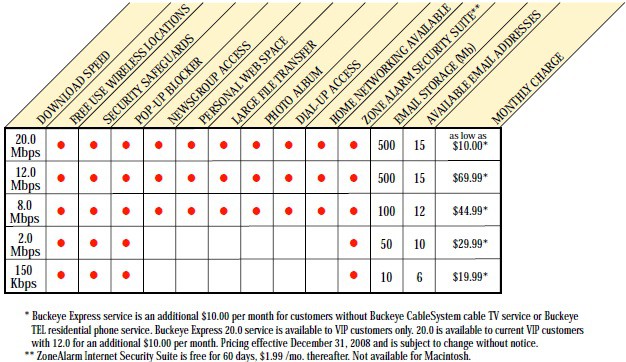
Buckeye’s cable broadband service, bex-Buckeye Express, offers customers up to 20Mbps service, if you opt to subscribe to other Buckeye services.

bex

The company’s Acceptable Use Policy indicates they do not impose limits on usage at this time, but curiously do admit to throttling the speed of peer-to-peer traffic and dynamically reducing speeds for customers who are considered “high bandwidth users” during peak demand periods.  Both of these seemed to get Comcast into hot water with the Federal Communications Commission.

BUCKEYE EXPRESS™ HIGH SPEED INTERNET SERVICE ACCEPTABLE USE POLICY

Buckeye uses reasonable network management techniques to improve overall network performance and reserves the right to employ additional techniques as necessary or desirable. Some applications, including certain peer-to-peer applications, can consume inordinately high amounts of bandwidth on the network and degrade network performance. Buckeye’s current network management techniques include:

Speed Caps – limiting the speeds that a modem can transmit or receive data. Buckeye may lower the transmission rate or reception rate of high bandwidth users during times of high network demand. This may slow the transmission or reception rate for affected modems.

Connection Limits – limiting the number of simultaneous connections for any modem during an online session. With a typical user having a dozen or so simultaneous connections for routine use, this limit provides a means of identifying and hopefully thwarting malicious attempts to harm the network or other users. This limit is currently set well above the number of connections used by typical user in a session.

Application-based Rate Limiting– limiting transmission speed of certain high bandwidth applications. Some applications, typically peer-to-peer applications, can consume large amounts of bandwidth, often without the knowledge of the user/customer. By limiting the portion of the network capacity available for these applications during periods of high traffic, Buckeye is able to improve the overall performance of the network for all users. Transmission of traffic subject to this technique may be slower during periods of high network usage.

[flv width=”480″ height=”380″]http://www.phillipdampier.com/video/Kabel-X Demo.flv[/flv]

Watch the Kabel-X process at work in this company-produced demonstration video. (7 minutes)

New Zealand Heads Towards Elimination of Broadband Usage Caps: Reviled Limits Unnecessary With Upgrade

Phillip Dampier November 16, 2009 Competition, Data Caps, Public Policy & Gov't Comments Off on New Zealand Heads Towards Elimination of Broadband Usage Caps: Reviled Limits Unnecessary With Upgrade

nz-flagNew Zealand, along with Australia and Canada are often cited by broadband providers as examples of places where broadband usage limits are commonplace.  With dreams of Internet Overcharging schemes in their heads, Time Warner Cable, among several others, have routinely pointed to Internet service abroad to justify limiting your usage at home.

But providers always ignore the fact customers despise the limitations on their service, in several cases ranking it among the biggest problems they have with their Internet Service Provider.  Internet rationing plans that barely budge in broadband allowances are a major factor in broadband mediocrity, and government officials are increasingly taking notice.  In some countries, national broadband policies seek to expand infrastructure where private providers won’t.

kordiaIn New Zealand, the push for better connectivity comes through expansion of the undersea fiber cables that connect the country with the rest of the online world.  In the south Pacific, it is that connectivity problem which directly impacts consumer pricing of broadband and bring limits on service.

Today, the only major connection New Zealand has with the world is through Southern Cross Cable Networks, which have cables stretching from Auckland in New Zealand to Sydney, Australia and between Auckland and Hawaii.

Now, a second company hopes to dramatically expand connectivity with an expanded capacity cable to be laid between Auckland and Sydney.  Kordia, a state-owned enterprise, which plans to run the 2,350km cable, says this expansion will dramatically lower broadband pricing for New Zealand and allow providers to vastly expand or discontinue broadband usage caps.

southern crossKordia says the cable, costing between $112-149 million dollars US, will be operational by the end of 2011 if all goes according to plan.

“Our proposed cable will take the most direct, quickest and least expensive route for New Zealand customers.  OptiKor is a better proposition for New Zealand than any other cable project – we are the most direct route to Australia and through our partners, we can deliver New Zealand traffic all the way to the United States,” Kordia Chairman David Clarke says.

Prices are already dropping in New Zealand just from the threat of competition.  Southern Cross Cable slashed prices on its cable 75 percent in anticipation of Kordia’s future competition.  Kordia claims that price cutting is designed to help drag down the company’s efforts to obtain contracts with telecommunications companies in advance of construction.

Still, should the cable be laid, in addition to the prospect of ending aggravating usage caps, Kordia estimates New Zealanders will save almost $1.5 billion US on Internet access between now and 2020.

Search This Site:

Contributions:

Recent Comments:

Your Account:

Stop the Cap!