 Exasperated consumers fed up with a two party system feasting on big corporate campaign contributions buying legislative favors from Washington have a point. With a Supreme Court decision ripping the limits off the corporate ATMs installed in the halls of Congress, corporate interests will now spend more than ever to keep their agendas front and center among lawmakers.
Some consumers demand an end to the money-influence machine in Washington with public financing of campaigns, an allotment of free advertising, and strict ethics laws to prohibit corporations from buying favors from elected officials. Others have joined a “tea party” movement that believes a wholesale slashing of the size of the federal government will help accomplish the goal of keeping government out of our lives.
The demand for real change is sincere, even if the proposed solutions differ. The debate comes after years of watching common-sense, pro-consumer public policy get watered down or blown out of the water after lobbyists descend on the Capitol like locusts swarming a field of wheat.
It’s unfortunate that those swarms don’t just wreak havoc on lawmakers — they’ve also quietly infested the “tea party” movement that advocates reform.
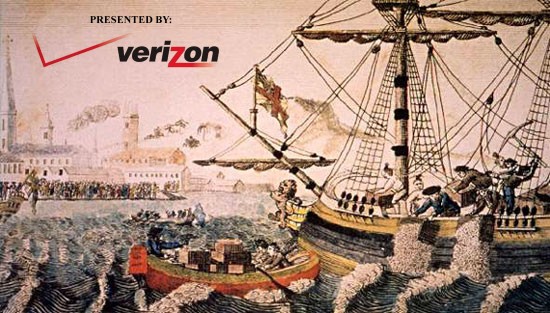
It’s akin to the Boston Tea Party being sponsored and organized by the East India Company.
After this weekend’s “tea party” convention in Nashville, it’s more apparent than ever that teabags come with corporate strings attached.
Perhaps that shouldn’t be surprising, considering the modern reincarnation of the “tea party” was channeled by a business news network. About a year ago, CNBC reporter Rick Santelli ranted on air about the federal government bailing out Americans underwater on their mortgages after the housing market collapsed.
“We’re thinking of having a Chicago tea party in July,” Santelli offered.
For Stop the Cap! readers, the names and groups affiliated with the “tea party” movement are already familiar. FreedomWorks’ Dick Armey (R-TX), the former House majority leader in Congress openly considers himself a leader in the movement. But his day job involves creating fake “grassroots” campaigns for corporate interests, including Verizon and AT&T. Phil Kerpen from Americans for Prosperity promptly registered “taxpayerteaparty.com” and joined the movement while continuing to represent the broadband industry against Net Neutrality and against municipal broadband network competition.
Kerpen’s group should be called “Americans for the Prosperity of Big Telecom.” They oppose Net Neutrality to the degree Kerpen appeared twice on Glenn Beck’s Fox News show, mostly as an enabler of Beck’s paranoid rantings about Net Neutrality. After two sessions of Beck’s chalkboard conspiracy theater, the host had Kerpen nodding in agreement to the proposition that Net Neutrality was Maoist. The group also harassed North Carolina residents with robocalls opposing municipal broadband service that would bring fiber optic connectivity to residents.
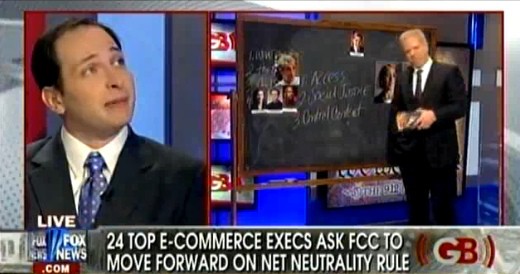
Americans for Prosperty's Phil Kerpen on Glenn Beck's show opposing Net Neutrality
Wherever common-sense pro-consumer public policy threatens to become law, the corporate-backed lobbying groups take the anti-consumer view and hoodwink consumers into supporting the corporate agenda. Trying to convince Americans they are better off taking the anti-consumer position takes a lot of money. You can’t argue your position beneath your corporate banner. That’s too transparent. It’s much more effective to spend tens of millions on creating fake “grassroots” groups with no visible ties to their corporate benefactor. You need to fund so-called “independent” research groups to cook up phony reports that prove pre-conceived corporate positions. Writing big fat checks to elected officials can’t hurt either.
Billions in profits are at stake. In 2008 it was the oil industry and the ridiculous spike in energy prices. Millions were spent to keep oil and gas interests free from meddlesome Washington and their pesky investigations. In 2009, the health care industry spend tens of millions of dollars to fight health care reform, while Wall Street bankers tried to keep up with tens of millions of their own to preserve the special favors they earned from being “too big to fail.”
Right after big oil, health care, and banks comes the telecommunications industry.
Last Friday, Verizon had the dubious distinction of appearing on USA Today’s top-20 big spenders. The only good news is the company only spent $17,820,000 in 2009 on their lobbying efforts. That’s down from 2008, when Verizon spent $18,020,000.
Not to be too outdone, the cable television industry handed over part of your rate increase to their own lobbying machine. In 2008, the National Cable and Telecommunications Association spent $14,500,000. But your rates went up in 2009, and so did their total spending on an army of lobbyists — $15,980,000 worth.
That buys a lot of plastic grass.
Where does the money go? Among Verizon’s benefactors and friends:
Consumers for Cable Choice: Common Cause notes Verizon spent $75,000 in just one year on this group, which fights for statewide cable franchises, mostly benefiting phone company cable TV from Verizon and AT&T. While this short cut may bring consumers a choice in providers, it doesn’t bring them any savings.
FreedomWorks: Adamantly opposed to Net Neutrality, FreedomWorks also backs those statewide video franchises, thanks to generous fees paid by AT&T and Verizon to take those views.
The Progress and Freedom Foundation: They define “progress” much differently than consumers. Opposed to a-la-carte pricing for cable television packages (letting you choose and pay only for the channels you want), P&F also hates Net Neutrality and the concept of government issuing franchises for cable and telco TV in the first place. Let them dig up your streets and backyards without oversight! The group receives so much corporate telecommunications money, it would be easier to list the companies that don’t cut them a check.
The American Legislative Exchange Council: They exchange Verizon’s money in return for strong opposition to Net Neutrality. They are at the forefront of opposition to municipal broadband networks, with a staff of lawyers who “helpfully” draft legislation for state lawmakers to ban such networks. Part of the broadband protectionist racket, ALEC makes sure even unprofitable, unserved areas stay that way. ALEC believes Net Neutrality will harm states’ economies, which would be true if a state was defined as a corporate broadband provider.
New Millennium Research Council: They “develop workable, real-world solutions to the issues and challenges confronting policy makers, primarily in the fields of telecommunications and technology.” This so-called “think tank” issues suspect reports mostly for the benefit of Congress, which some members use as cover when voting against their constituents and for the provider. You’re certain to hear elected officials railing against pro-consumer policies quoting liberally from these industry-backed “think tanks,” which provide a patina of independent legitimacy to corporate-backed propaganda. Need to scare people with stories about an overburdened Internet that will crash and burn without “network management” that slows service and enriches providers? No problem! (That the group has had Verizon employees working for them doesn’t hurt either.)
Broadband for America: This relatively new group is infested with Verizon and AT&T contributions from top to bottom. In addition to direct contributions from big telecom interests, virtually every single public interest non-profit group on their roster has an AT&T or Verizon lobbyist on their board of directors, or accepts generous contributions from the telecom industry.
Frontier of Freedom: Another so-called “free market” group advocating deregulation, FF doesn’t disclose its donors and considers itself independent, but a familiar pattern belies that. Frontier of Freedom advocates statewide video franchises and has even run advertising promoting telco-friendly legislation in states like Texas. The cable industry was displeased because Frontier of Freedom used to represent their best interests but suddenly flipped sides in 2005. Money talks.
MyWireless.org: “MyWireless.org is a national non-profit consumer advocacy organization” the site declares, without bothering to disclose it is really a sock puppet of the cell phone industry’s trade group CTIA – The Wireless Association. Ostensibly interested in stripping taxes and government-mandated surcharges off of cell phone bills, the group also opposes Net Neutrality and consumer protection laws. It’s a bit difficult to call yourself pro-consumer when you oppose a California and Minnesota consumer Bill of Rights that would have required a 30 day penalty-free trial of cell phone service, expanded a toll-free complaint hotline, set minimum service standards, and required easy-to-understand billing.
NetCompetition: Another front group bought and paid for by the industry it seeks to zealously protect. Adamantly opposed to Net Neutrality, NetCompetition also spends its time Google-bashing and attacking Free Press, seen as one of the strongest advocates for Net Neutral policies and consumer protection from provider abuses. Their member page explains everything.
The unfortunate part of all this is that many participants of the “tea party” movement seem blissfully unaware of the corporate manipulation of their movement, all happening barely beneath the surface. Millions of dollars are flowing into the bank accounts of astroturf groups doing all they can to channel public anger against Washington into something they can use to benefit their corporate backers. The end result may be the ultimate feedback loop — consumers already angered by Washington not listening to their needs and concerns compounded by providers picking their pockets. That bitter tea may be easy to brew but impossible to swallow.
[flv width=”640″ height=”500″]http://www.phillipdampier.com/video/Phoney Baloney Ad.flv[/flv]
Phoney Baloney: The National Cable & Telecommunications Association, the cable industry lobbying group, ran this hissyfit ad to combat Verizon and AT&T outmaneuvering the cable industry over statewide video franchising laws. (1 minute)


 Subscribe