CenturyTel Inc. agreed Thursday to buy Qwest Communications International, Inc. in an all-stock deal that values the last legacy “Baby Bell” at nearly $10.6 billion, in one of the nation’s largest telecommunications deals.
The merger would dwarf Frontier Communications’ purchase of Verizon landline service and create the nation’s largest independent phone company with operations in 40 states.
Qwest has been off and on the sales block for years, considered the weakest player among the split-up remnants of the old Bell System. Qwest has fallen well behind AT&T and Verizon in adopting next generation technology to keep landline service relevant in a changing marketplace. CenturyTel’s business model, like that of Windstream and Frontier, depends on serving rural areas with basic broadband and phone services, without incurring the costs larger providers have in deploying fiber to the home or fiber to the curb networks needed to compete with cable television providers.
Critics contend the consolidation of independent phone companies has left them preoccupied with their stock value and dividend payouts, unwilling to make substantial investments many believe are essential to keep such companies relevant in the long term. Cell phones continue to eat away at landline service, and the kind of slow speed DSL service available from most of these players cannot compete effectively against cable and fiber broadband service, except in rural communities where customers have just one choice.
We will have additional coverage on this important development shortly.
As I have been reporting here, the moratorium on municipal broadband is alive and well in the legislative halls of Raleigh. Senator David Hoyle (D-Gaston), sponsor of last year’s consumer atrocity HB1252, is back again asking Senator Daniel Clodfelter (D-Mecklenburg County) for a vote May 5th on a proposed moratorium for municipal broadband projects. Hoyle is not running for re-election.
While no new legislation has surfaced yet, several legislators continue to hint that a new bill is forthcoming. Be assured any such legislation will be designed to protect today’s monopoly/duopoly marketplace for broadband service in North Carolina.
Senator David Hoyle calls on the legislative committee to introduce and vote for a moratorium on municipal broadband projects in North Carolina. (April 21, 2010) (1 minute, 30 seconds)
You must remain on this page to hear the clip, or you can download the clip and listen later.
<
p style=”text-align: center;”>
Meeting Highlights:
Senator Daniel Clodfelter (D-NC)
• Senator Clodfelter opened the meeting stating that he “wants to focus on revenue issues/financing, not whether or not high speed Internet is a good thing.”
• Heather Fennell, from the research division at the General Assembly gave a presentation citing laws that govern cities, the original lawsuit that established precedent for cities to construct municipal fiber networks, what cities have them, and who pays the taxes on different systems.
• Vance Holloman, Deputy Treasurer-State and Local Finance Division spoke next. He assured the committee and attending audience that North Carolina’s existing municipal systems are in good standing and he expected they would be able to pay down debts incurred from initial construction and deployment costs. Holloman added the Local Government Commission, which has to approve the financing of these systems, believed these projects represent “solid economic development investments.” Holloman’s strong presentation should have encouraged legislators to favor economic development from fiber optic broadband, but we had a strong sense several members had already made up their minds made up to oppose these projects. You will have to convince them to reconsider.
• The next part of this session divided 50 minutes between private commercial providers and municipalities to share their views.
The commercial providers went first, beginning with attorney Marcus Trathen from the law firm Brooks/Pierce. Today, he was representing the North Carolina Cable Communications Association (NCCCA). Trathen has also appeared at prior meetings representing the interests of Time Warner Cable.
Trathen’s presentation was about as expected – talking points loaded with misrepresentations and misinformation. Trathen told the committee the industry does not object if cities build private networks for internal communications (how generous), but doesn’t want those networks competing with NCCCA members.
Kelli Kukura, NC League of Municipalities
Suddenlink Communications’ Bill Paramore and AT&T lobbyist Herb Crenshaw also spoke, speaking in glowing terms about investments already made to improve service in the state. Crenshaw claimed AT&T is providing U-verse service in North Carolina after spending $1.2 billion dollars on system upgrades, an amount some have questioned (a 2007 press release pegged it at $350 million.) Of course, North Carolina’s cable and broadband customers who were promised savings from all this “robust competition” have instead been stuck paying annual rate increases that more often than not exceed the rate of inflation.
Next up were the municipalities.
Kelli Kukura from the North Carolina League of Municipalities started by challenging industry propaganda designed to downplay the benefits of municipal broadband. Kukura noted at least 30 North Carolina communities enthusiastically applied for Google’s proposed 1 gigabit fiber to the home network, illustrating intense interest in fiber networks. Google has also been an active proponent of municipal broadband, Kukura noted, reminding legislators the search engine giant defended the rights of municipalities seeking to deploy next generation broadband networks.
Among the communities that have their own municipal systems, job growth grew by an average of 6.4 percent. Kukura cited broadband success stories in Bristol, Virginia and Wilson, North Carolina.
Salisbury small businessman Brad Walser, owner of Walser Technology Group testified that North Carolina community’s new municipal broadband network Fibrant would meet his company’s needs for broadband capacity not available from commercial providers. Walser noted Salisbury is suffering from an unemployment rate exceeding 14 percent. Advanced broadband, he believes, could help the city attract new businesses that will help create new, high paying jobs. Fibrant is expected to launch later this year.
EPB provides broadband service for residents in Chattanooga, Tenn.
Some of the strongest testimony came from Colman Keane, senior strategic planner for municipally-owned EPB Telecom. Keane traveled all the way from EPB’s home in Chattanooga, Tennessee to share his experiences confronting a telecommunications industry hostile to the prospect of facing a new competitor. Keane has seen and heard the industry arguments all before, noting Chattanooga heard the exact same scare stories legislators in Raleigh were hearing today. Chattanooga also faced a proposed one year moratorium and a blizzard of industry-backed lawsuits, all which were won by the city.
The benefits of fiber optic broadband in Chattanooga include dramatically-improved broadband speeds as well as a more efficient power grid made possible from smart meters that help Chattanoogans reduce their peak power usage, saving money. I want to thank Colman for making the long journey on behalf of consumers in North Carolina.
• Finally, Raleigh community activist and former city council candidate Octavia Rainey spoke out against municipal broadband, which concerned me. Rainey spent her time seated with the telecom lobbyists, and her presentation illustrated the impact of astroturf efforts to co-opt good-hearted consumers into the industry cause. I hope to establish a dialogue with Ms. Rainey to share our information with her and learn more about how she reached her views on this subject. More to come.
The complete hearing of the Revenue & Laws Committee of the North Carolina Legislature on the issue of the financial implications of municipal broadband, chaired by Senator Daniel Clodfelter (D-Mecklenburg County) (April 21, 2010) (2 hours, 8 minutes)
You must remain on this page to hear the clip, or you can download the clip and listen later.
<
p style=”text-align: center;”>
[Octavia has a long history of community involvement in Raleigh, trying hard to improve her neighborhoods and life in general for area residents, something she is to be applauded for doing. I suspect Ms. Rainey has formed her views on municipal broadband in part from her close working relationship with AT&T, who has a long history trying to make friends with various community groups in part to win favor for their corporate agenda. In this case, Octavia admits AT&T’s Cynthia Mitchell and her have become “great partners.” AT&T provided support in building an area playground and also paid for lunch for volunteers working on the project, adding the company wanted to be a part of the Raleigh community. There is nothing wrong with that, of course, but one wonders if the conversation also drifted into AT&T’s talking points along the way.
Ms. Rainey also praised AT&T for delivering free Internet service to 290 Raleigh-area families last fall, which would make it ironic if she didn’t support municipal broadband, which has a proven track record of erasing the digital divide and lowering prices for hard-pressed consumers. These are the people that need some fact-based information about the true benefits of municipal broadband. — Phillip Dampier]
Today was expected, but disappointing nonetheless. Hoyle actually suggested that fiber networks may be obsolete in five years and we may be moving to wireless. If that were true, why is he hellbent on a moratorium and the banning of such networks at the industry’s behest? Why would the telecommunications industry be concerned about “obsolete fiber networks?” The only thing obsolete here are the broadband networks owned by big cable and phone companies Hoyle wants to preserve and protect.
Rep. Pryor Gibson (D-NC)
Rep. Pryor Gibson, who we noted is a manager for Time Warner Cable Construction agreed to recuse himself from this issue after it became a point of contention and sat in the back corner of the room.
All of your e-mails and calls have been getting through to the legislators. This kind of attention makes them nervous and I ask you to continue. I can assure you that we here at Stop the Cap!, along with Communities United for Broadband, Broadband for Everyone NC, and Save North Carolina Broadband are going to ratchet up attention on this issue.
WHAT YOU CAN DO TO HELP
Continue writing and calling the legislators below and asking them to oppose a moratorium on municipal broadband. Make plans on May 5th to come to Raleigh and be part of the crowd that opposes the moratorium. I will post meeting details as they develop.
Please thank the legislators we have identified on this committee as friends of our cause:
Sen. Daniel T. Blue, Jr. Wake [email protected] (919) 733-5752 Democrat (919) 833-1931 Attorney
Sen. Fletcher Lee Hartsell, Jr. Cabarrus, Iredell [email protected] (919) 733-7223 Republican (704) 786-5161 Attorney
Sen. Josh Stein Wake [email protected] (919)715-6400 Democrat (919)715-6400 Lawyer
Rep. Paul Luebke (Co-Chair) Durham [email protected] 919-733-7663 Democrat 919-286-0269 College Teacher
Rep. Jennifer Weiss Wake [email protected] 919-715-3010 Democrat 919-715-3010 Lawyer-Mom
The rest of the lot either doesn’t support North Carolina consumers or have not yet made their views known on this issue. We must pin them down and identify those elected legislators that represent the people versus those representing big cable and phone interests. Be sure to tell them you will interpret any support for a moratorium on municipal broadband to mean they are opposed to competition, opposed to lower prices for consumers, opposed to job creation and economic growth, and obviously for the cable and phone interests that will stop at nothing to keep these systems from being built.
Ask them how they could possibly support keeping North Carolina 41st in the country in broadband rankings, why they are against reducing the 11.2 percent unemployment rate (10th worst in the country) in North Carolina, and how they can justify a vote that guarantees exactly more of the same. If you are from a city that applied for Google Fiber, remind your legislator passing this kind of hostile moratorium delivers a strong message this state is not serious about the next generation of broadband, and Google should look elsewhere.
Above all, note now that they understand the true implications this moratorium will have on constituents, you are confident there is no way they could ever support such a bad idea. Their delivery of a strong “no” vote reminds you why you supported them in the last election and will consider doing so again in the next.
Always be polite, professional, and persuasive in your correspondence, but deliver a clear and firm message that supporting a moratorium is completely unacceptable. Finally, be sure to ask them to get back in touch with you regarding their position on this issue as soon as possible. Then let us know!
Sen. Daniel Gray Clodfelter (Co-Chair) Mecklenberg [email protected] (919) 715-8331 Democrat (704) 331-1041 Attorney
Sen. Peter Samuel Brunstetter Forsyth [email protected] (919) 733-7850 Republican (336) 747-6604 Attorney
Sen. David W. Hoyle Gaston [email protected] (919) 733-5734 Democrat (704) 867-0822 Real Estate Developer/Investor
Sen. Samuel Clark Jenkins Edgecomb, Martin, Pitt [email protected] (919) 715-3040 Democrat (252) 823-7029 W.S. Clark Farms
Sen. Jerry W. Tillman Montgomery, Randolph [email protected] (919) 733-5870 Republican (336) 431-5325 Ret’d school teacher
Rep. Harold J. Brubaker Randolph [email protected] 919-715-4946 Republican 336-629-5128 Real Estate Appraiser
Get out your tiny violins. Telephone and cable companies that have ignored your neighborhood for years are decrying attempts by the federal government to fund projects that would finally extend broadband service to rural America. Companies ranging from tiny Eagle Communications in Kansas, to major regional telephone companies like FairPoint Communications and Windstream, are upset that new providers are on the way to deliver broadband service to bypassed homes or communities stuck in their broadband slow lane.
The Associated Press reports coast-to-coast complaints from incumbents who have refused to deliver service or force customers to accept 1-3Mbps speeds indefinitely.
From the Blue Ridge Mountains to the Great Plains, some local phone and cable companies fear they will have to compete with government-subsidized broadband systems, paid for largely with stimulus dollars. If these taxpayer-funded networks siphon off customers with lower prices, private companies warn that they could be less likely to upgrade their own lines, endangering jobs and undermining the goals of the stimulus plan.
That’s rich coming from some providers who threaten to refuse to upgrade lines they’ve never upgraded, endanger employees they’ve long since cut, and threaten their quest for monopoly profits serving rural Americans larger carriers are rapidly abandoning.
Anemic Broadband Is Not in Kansas Anymore
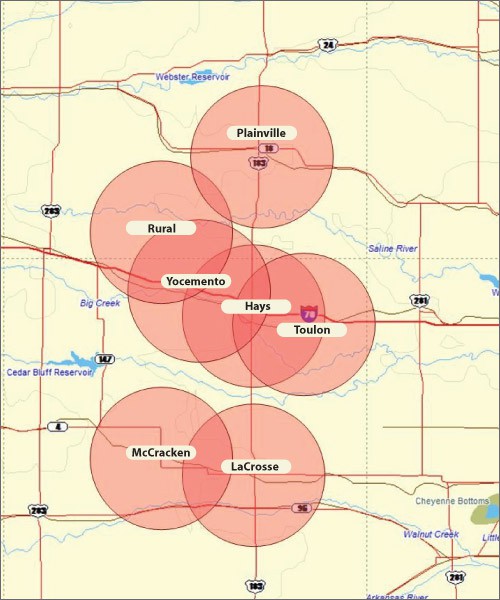
Rural Telephone's Exchange Map (click to enlarge)
Kansas-based Eagle Communications provides cable and wireless broadband service to more than a dozen small towns in the state. For more populated areas, it’s cable broadband service. For the rural parts of its service areas, Eagle relegates everyone to a slower speed, more expensive wireless network.
The company is upset to learn about additional expansion forthcoming from Rural Telephone Company, a cooperative which recently won a $101 million stimulus grant to construct a fiber optic system to expand service. With the grant, the co-op phone company will move beyond its currently constrained DSL broadband network into areas even Eagle’s rural wireless signal won’t reach.
Rural Telephone Company says their broadband grant will provide service “in an area 99.5 percent unserved/underserved and provide a rural infrastructure required for economic stability, education and health care.”
Eagle says it’s unfair competition.
“It is extremely unfair that the government comes in and uses big government money to harm existing private businesses,” Gary Shorman, president of Eagle Communications, told the AP. “This hurts our company.”
“It’s a little disappointing that companies that aren’t adequately serving these areas are trying to undercut those of us who are trying to step in and get the service where it’s needed,” says Lawrence Strickling, head of the National Telecommunications and Information Administration, the arm of the Commerce Department handing out much of the stimulus money.
The $101 million Kansas project, for instance, will bring connection speeds of up to 1 gigabit to businesses and up to 100 megabits to as many as 23,000 homes. While the network will cover the population center of Hays, where both Rural Telephone and Eagle Communications already offer broadband, that accounts for just eight of the 4,600 square miles to be reached. Much of the area has no broadband at all, says Larry Sevier, Rural Telephone’s chief executive.
The goal is to “close the digital divide between Hays and the outlying areas,” says Jonathan Adelstein, head of the Rural Utilities Service, which awarded the money.
Eagle Communications' Wireless Service Area - Central Region (click to enlarge)
For rural Kansans choosing between Eagle’s wireless service or Rural Telephone’s current maximum 1.5Mbps DSL service for those outside of the Hays city limits, the definition of “high speed service” maxes out at an anemic 3Mbps:
Rural Telephone Company Pricing for Outside the City Limits – Hays, Kansas
Rural Telephone’s 1.5Mbps DSL — $29.95 per month
Rural Telephone’s 512kbps DSL — $19.95 per month
Gone With the Windstream: Phone Company Says Broadband Stimulus Doesn’t Give a Damn About Their Georgia Business Model
Many of the projects seeking funding don’t actually want to get into the Internet Service Provider business, preferring to construct fiber-based networks available equally to all-comers at wholesale pricing. Sure they’ll wire government buildings, schools, and libraries as a public service, but their real goal is to make available super high speed networks that incumbent providers haven’t, under the theory a rising tide lifts all boats. They even invite existing ISP’s to hop on board, buying access to deliver improved service to their existing customers.
But because some providers don’t own or control the infrastructure outright, they’re not interested.
One such project is the North Georgia Network Cooperative, created from a consortium of private business advocates, a state university, and two power company co-ops.
North Georgia sees broadband as a major economic stimulant… if they actually had it. Large parts of the region don’t, so the Cooperative applied for and won a $33.5 million NTIA grant to construct a 260-mile fiber ring running through 12 counties in the state. The network will easily deliver connections upwards of 10Gbps for institutions and broadband speeds far faster than incumbent DSL provider Windstream currently provides across the region.
Windstream's biggest promotional push is for its 6Mbps DSL service
Windstream’s DSL packages look better than many other independent phone companies, at least based on their website. Windstream offers 3, 6, and 12 Mbps DSL packages across northwestern Georgia, but that doesn’t mean you can actually obtain service at those speeds. Stop the Cap! reader Frederick, who tipped us off to this story, notes that he can’t obtain more than 1.5Mbps DSL service from his home in Dalton, Georgia because the phone lines in his area won’t support faster speeds.
“I’m actually less than a mile from my area’s central office, but because the phone lines in my area are deteriorated, they had to lock my speed in at 1.5Mbps — anything faster causes the modem to reset,” Frederick writes. “Windstream does the same thing to my cousin in Lafayette, who was offered 6Mbps service but can only get 3Mbps in reality.”
Frederick says most people in the community don’t really care where the faster broadband comes from — just that it comes.
“If Windstream, who incidentally also applied for government money, could do it there would have never been a need to go around them in the first place,” he says. “Hell, the ironic part is the Cooperative will sell wholesale access to Windstream to use as it sees fit, but because Windstream doesn’t own it they’re pouting, refusing to participate.”
Windstream says it has already invested $5 million in network upgrades covering northern Georgia over the last three years and the Cooperative’s stimulus grant undermines the economics of that investment. Michael Rhoda, Windstream’s vice president of government affairs told AP Windstream now has to share rural customers with a government-funded competitor. Windstream wants that funding limited strictly to those areas where broadband service is uneconomic to provide. To underline that point, the company has applied for $238 million in stimulus funding to reach the “last 11 percent” who don’t have broadband in Windstream’s service areas.
Maine’s Three Ring Binder Project Snaps Shut on FairPoint’s Monopoly Fingers
Maine's Three Ring Binder Project plans to serve most of Maine (click image for additional information)
More often than not, independent efforts to launch improved broadband service in a region come after years of dealing with an intransigent provider comfortable moving at a snail’s pace to improve service. Financially-troubled FairPoint Communications has been struggling to meet Maine’s broadband needs since the company took over service from Verizon two years ago. The state government, university, and smaller telecommunications companies decided they could do better — applying for, and winning a $25.4 million dollar grant to construct three fiber rings across the state.
FairPoint insists the project duplicates the company’s own efforts to improve connectivity in Maine and has appealed to lawmakers to stop the project. But FairPoint recently called a truce when it reached a deal to charge users of the new network a usage fee, with FairPoint getting a large share of the proceeds to expand its own broadband efforts.
[FairPoint’s financial problems have left the company] unable to bring broadband to wide swaths of rural Maine, says Dwight Allison, chief executive of Maine Fiber Co., which was created to build and operate the stimulus-funded network. The project, he says, represents a serious competitive threat to a company that “feels its monopoly is being attacked.”
Of course nothing precludes FairPoint from getting access to the new fiber network at the same wholesale pricing other providers will pay, but the company so far doesn’t seem interested.
Various talking points designed to derail the project are debunked by the Maine Fiber Company:
Fiction: It’s government-run broadband.
Fact: Three Ring Binder will be owned and operated by Maine Fiber Company, a private company based in Maine. MRC is unaffiliated with any telecom carrier to ensure fair and equal access to the system for all competitors.
Fiction: This project will create unfair competition for private providers.
Fact: MFC will be a wholesale provider of dark fiber, and its customers will be Internet Service providers, wireless carriers, and telephone companies. MFC will not provide “lit” service in competition with private broadband carriers. MFC is required to provide service on an open access and non-discriminatory basis. All carriers in Maine will be able to use the network to serve their customers in Maine, resulting in robust competition for the benefit of Maine consumers.
Fiction: This project duplicates service FairPoint already provides.
Fact: Prior to receiving a federal stimulus grant, the project was carefully reviewed by the National Telecommunications Information Agency (NTIA) of the US Department of Commerce to determine whether there was overlap with existing carriers. NTIA determined that TRB would substantially improve access to high-speed Internet access in rural Maine. If material duplication had been discovered, TRB would not have been funded. TRB will offer a mid-mile, dark fiber service that is fundamentally different from what currently exists in rural Maine. In fact, carriers seeking to obtain dark fiber service along the TRB route have routinely been denied access by incumbent fiber providers.
When millions of dollars are at stake, some commercial broadband providers will stop at nothing to preserve the duopoly they enjoy across most of North Carolina. Their formula for success — delivering the least amount of service at the highest possible price. When communities like Wilson and Salisbury decided that formula wasn’t working for them, they embarked on their own municipally-built, fiber-based broadband networks. It wasn’t something either community took lightly. They asked, they pleaded, they begged for better broadband service from incumbent providers who decided what they were providing was already good enough.
The biggest shock of these providers’ lives came when both communities decided to build better networks themselves.
Now, the commercial providers who are challenged to upgrade to compete are instead spending enormous sums of money in the North Carolina legislature to put a stop to these municipal projects. Why spend money on upgrading when you can simply ban the potential competition?
Last year, Stop the Cap! teamed up with other consumer advocates to put a stop to legislation custom-written by the cable industry and introduced by a very-compliant state legislator. When our readers and others called to complain, some found the phone handed off to a cable lobbyist literally sitting in his office!
Your outrage over paying big bills for bad service from too few providers was heard in Raleigh, and the legislation was de-fanged and buried in a committee charged with “studying the issue.” The legislator who introduced it resigned under an ethical cloud last fall.
Unfortunately for consumers in North Carolina, there is always someone else willing to pick up where the last one who sold his constituents down the river left off.
Our North Carolina issues coordinator Jay Ovittore, who is now working with Communities United for Broadband to promote better broadband, is here with a report about the latest developments in North Carolina and a Call to Action! for all of our readers. Preserving successful municipal broadband projects and those working to get off the ground protects this option for every community faced with intransigent broadband providers who won’t improve service. — Phillip Dampier
As I told everyone on Stop the Cap! last summer, they would be back.
They are, and now they’ve shown us their cards.
North Carolina’s incumbent cable and phone companies are once again trying to ram through an anti-municipal broadband bill, and their timing is designed to rush it through committee before a groundswell of consumer opposition has a chance to build. Time is short — the bill will be taken up April 21st in the Revenue Laws Study Committee, so your immediate action is imperative!
Clodfelter
This year’s push for anti-consumer legislation comes courtesy of Senator Daniel G. Clodfelter (D-Mecklenburg County).
He reportedly wants a moratorium on all municipal broadband deployments on the alleged basis that these are bad for the private sector and will harm state tax revenue. Hello? Virtually every municipal broadband project underway fuels job creation as crews work to install the fiber optic networks that will come to represent an economic catalyst and job creator. When communities no longer have to turn away digital economy jobs lost because of inadequate broadband by existing providers, that’s an economic victory for hard-pressed North Carolina, where unemployment is at 11.2 percent these days — 10th worst in the country.
The FCC’s National Broadband Plan has prioritized stimulating the deployment of ultra high-speed broadband (100/50Mbps) service to 100 million households in ten years, so why are some in our legislature standing in the way of better broadband options for North Carolina? You need to ask them!
Just look at Wilson’s community broadband project for evidence of a broadband success story. Wilson pleaded with providers to deliver 21st century broadband service to no avail. So Wilson did it themselves.
Cable and phone companies howled in protest. They even brought in their astroturfing friends from corporate-funded groups like FreedomWorks and Americans for Prosperity to try and hookwink consumers into opposing municipal broadband.
It’s just another classic case of providers not wanting to spend money to upgrade their networks to compete. Communities like Wilson getting the broadband service they deserve are good examples of why the industry is afraid such projects could spread.
Watch what happens when a municipal provider competes for your business. Catherine Rice of Action Audits delivered the undeniable proof at a December NC House Select Committee on High Speed Internet Access in Rural and Urban Areas hearing, showing while cable and broadband rates across the state march ever higher, they strangely don’t in Wilson, where GreenLight, the municipal alternative, keeps rates in check. Click here to download a PDF copy of the slides Rice refers to in her presentation. (11 minutes)
Some members of the legislature will stand with their constituents and vote against this anti-consumer nightmare. Some may not be fully informed on the issues and are only hearing the telecommunications industry talking points. For some others, I’m afraid it’s a case of following the money.
The telecommunications industry in North Carolina is very generous to their benefactors, only too willing to return the favor writing the industry’s wish-list into state law.
You will recognize some of the names from the Follow the Money series I wrote last year (read Part 1, Part 2 and Part 3). It’s a new year, so Part 4 will follow in the coming days, updating the financial contributions of incumbents and introducing new members and how much they’ve accepted from this industry.
Ironically, one of the legislators, Rep. Pryor Allan Gibson, III works as a contractor for Time Warner Cable! His vote will be particularly interesting to follow.
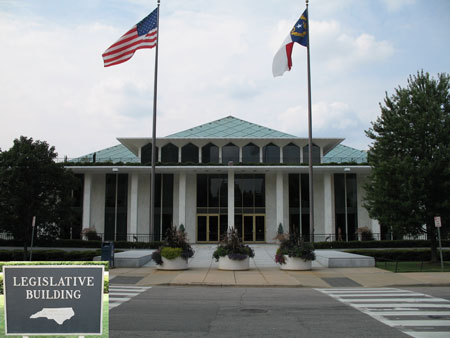
North Carolina Legislature
North Carolina Call to Action!
Phone calls are always the most effective, and they are timely coming just days before the April 21st meeting of the Revenue Laws Study Committee. But you can also e-mail representatives (and that’s not a bad idea even if you also called). North Carolina deserves world-class, next-generation broadband. Don’t allow a handful of the same companies overcharging you for today’s slow service strangle your best chance for competition!
Here is a sample e-mail message to send to all of the Committee members involved:
Subject: Don’t You Dare Vote for an Anti-Municipal Broadband Bill!
Message: As a consumer, I was disturbed to hear the Revenue Laws Study Committee was prepared to vote for an industry-sponsored Anti-Municipal Broadband Bill on April 21st. Please do not vote for this or any other bill that removes competitive choice for broadband service. Our local communities should not be stopped from deploying 21st century fiber to the home systems other providers refuse to deliver. Such fiber networks create jobs, keep North Carolina business competitive, and stimulate economic development, which will deliver needed tax revenue.
The same providers backing this bill that are not delivering service to unserved communities, or offer inadequate service in others, have had a decade to deliver the service municipal providers are actually providing today in our state. Instead of delivering, they’ve offered a litany of excuses and now want special legislative protections to preserve their entrenched market position.
As a consumer, I am fed up with relentless rate increases year after year. In communities like Wilson, where a municipal provider delivers excellent service, the rate increases from cable and phone companies have stopped. A vote for this bill guarantees we’ll be paying higher and higher cable and phone bills indefinitely, and that’s something I would definitely remember come Election Day. Make no mistake — this proposed legislation is an obvious gift to the telecommunications industry at the expense of all of your constituents, including myself. That’s why I am confident you will stand up and make your opposition heard to this and similar measures.
At a time when the FCC’s National Broadband Plan envisions 100 million households with ultra-fast broadband service delivering economic benefits, it’s ironic our state legislature is even considering impeding the very providers that are on track to fulfill that goal.
With 11.2 percent unemployment — the 10th worst in the country, now is not the time to put a moratorium on North Carolina’s communities considering a better future through municipally-provided broadband.
With all this in mind, I am confident you will deliver for constituents like myself and oppose these industry-backed bills. I look forward to hearing from you soon on this issue.
For best results, use your own wording and talk about the broadband market in your community. You can reference the excitement over Google’s fiber to the home project.
Here are the Committee members to write or call, including their district area and what they do for a living:
(Please send individual messages to members, even if the contents are essentially the same — avoid simply CC’ing a single message to every representative.)
Sen. Daniel Gray Clodfelter (Co-Chair) Mecklenberg [email protected] (919) 715-8331 Democrat (704) 331-1041 Attorney
Sen. Daniel T. Blue, Jr. Wake [email protected] (919) 733-5752 Democrat (919) 833-1931 Attorney
Sen. Peter Samuel Brunstetter Forsyth [email protected] (919) 733-7850 Republican (336) 747-6604 Attorney
Sen. Fletcher Lee Hartsell, Jr. Cabarrus, Iredell [email protected] (919) 733-7223 Republican (704) 786-5161 Attorney
Sen. David W. Hoyle Gaston [email protected] (919) 733-5734 Democrat (704) 867-0822 Real Estate Developer/Investor
Sen. Samuel Clark Jenkins Edgecomb, Martin, Pitt [email protected] (919) 715-3040 Democrat (252) 823-7029 W.S. Clark Farms
Sen. Josh Stein Wake [email protected] (919)715-6400 Democrat (919)715-6400 Lawyer
Sen. Jerry W. Tillman Montgomery, Randolph [email protected] (919) 733-5870 Republican (336) 431-5325 Ret’d school teacher
Rep. Paul Luebke (Co-Chair) Durham [email protected] 919-733-7663 Democrat 919-286-0269 College Teacher
Rep. Harold J. Brubaker Randolph [email protected] 919-715-4946 Republican 336-629-5128 Real Estate Appraiser
HK Broadband offers 100% Fiber Optic service to residents of Hong Kong
Next time you pay your broadband bill, consider what you are getting for your money.
Then consider Hong Kong residents can now buy 1,000Mbps symmetrical broadband service for $26 per month. Symmetrical broadband offers identical upstream and downstream speeds, so transferring large files back and forth becomes an afterthought, not a nuisance.
This week Hong Kong Broadband Network (HKBN) introduced wide availability of its mega-fast 1/1 gigabit per second service at prices that most American broadband providers won’t match for slow “lite” or “budget” tiers. The new gigabit service joins an even more affordable 100/100Mbps broadband service HKBN sells for $13 a month.
“Symmetric 1 Gbps broadband at US$26/month (HK$199) is a global breakthrough service, and is by far the best value in terms of cost per Mbps in Hong Kong. We are pleased to contribute towards making Hong Kong a global Fibre Oasis,” said June Lam, Associate Director, Marketing, HKBN.
Be Sure to Read Part One: Astroturf Overload — Broadband for America = One Giant Industry Front Group for an important introduction to what this super-sized industry front group is all about. Members of Broadband for America Red: A company or group actively engaging in anti-consumer lobbying, opposes Net Neutrality, supports Internet Overcharging, belongs to […]
Astroturf: One of the underhanded tactics increasingly being used by telecom companies is “Astroturf lobbying” – creating front groups that try to mimic true grassroots, but that are all about corporate money, not citizen power. Astroturf lobbying is hardly a new approach. Senator Lloyd Bentsen is credited with coining the term in the 1980s to […]
Hong Kong remains bullish on broadband. Despite the economic downturn, City Telecom continues to invest millions in constructing one of Hong Kong’s largest fiber optic broadband networks, providing fiber to the home connections to residents. City Telecom’s HK Broadband service relies on an all-fiber optic network, and has been dubbed “the Verizon FiOS of Hong […]
BendBroadband, a small provider serving central Oregon, breathlessly announced the imminent launch of new higher speed broadband service for its customers after completing an upgrade to DOCSIS 3. Along with the launch announcement came a new logo of a sprinting dog the company attaches its new tagline to: “We’re the local dog. We better be […]
Stop the Cap! reader Rick has been educating me about some of the new-found aggression by Shaw Communications, one of western Canada’s largest telecommunications companies, in expanding its business reach across Canada. Woe to those who get in the way. Novus Entertainment is already familiar with this story. As Stop the Cap! reported previously, Shaw […]
The Canadian Radio-television Telecommunications Commission, the Canadian equivalent of the Federal Communications Commission in Washington, may be forced to consider American broadband policy before defining Net Neutrality and its role in Canadian broadband, according to an article published today in The Globe & Mail. [FCC Chairman Julius Genachowski’s] proposal – to codify and enforce some […]
In March 2000, two cable magnates sat down for the cable industry equivalent of My Dinner With Andre. Fine wine, beautiful table linens, an exquisite meal, and a Monopoly board with pieces swapped back and forth representing hundreds of thousands of Canadian consumers. Ted Rogers and Jim Shaw drew a line on the western Ontario […]
Just like FairPoint Communications, the Towering Inferno of phone companies haunting New England, Frontier Communications is making a whole lot of promises to state regulators and consumers, if they’ll only support the deal to transfer ownership of phone service from Verizon to them. This time, Frontier is issuing a self-serving press release touting their investment […]
I see it took all of five minutes for George Ou and his friends at Digital Society to be swayed by the tunnel vision myopia of last week’s latest effort to justify Internet Overcharging schemes. Until recently, I’ve always rationalized my distain for smaller usage caps by ignoring the fact that I’m being subsidized by […]
In 2007, we took our first major trip away from western New York in 20 years and spent two weeks an hour away from Calgary, Alberta. After two weeks in Kananaskis Country, Banff, Calgary, and other spots all over southern Alberta, we came away with the Good, the Bad, and the Ugly: The Good Alberta […]
A federal appeals court in Washington has struck down, for a second time, a rulemaking by the Federal Communications Commission to limit the size of the nation’s largest cable operators to 30% of the nation’s pay television marketplace, calling the rule “arbitrary and capricious.” The 30% rule, designed to keep no single company from controlling […]
Less than half of Americans surveyed by PC Magazine report they are very satisfied with the broadband speed delivered by their Internet service provider. PC Magazine released a comprehensive study this month on speed, provider satisfaction, and consumer opinions about the state of broadband in their community. The publisher sampled more than 17,000 participants, checking […]


 Subscribe
 CenturyTel Inc. agreed Thursday to buy Qwest Communications International, Inc. in an all-stock deal that values the last legacy “Baby Bell” at nearly $10.6 billion, in one of the nation’s largest telecommunications deals.
 Critics contend the consolidation of independent phone companies has left them preoccupied with their stock value and dividend payouts, unwilling to make substantial investments many believe are essential to keep such companies relevant in the long term. Cell phones continue to eat away at landline service, and the kind of slow speed DSL service available from most of these players cannot compete effectively against cable and fiber broadband service, except in rural communities where customers have just one choice.