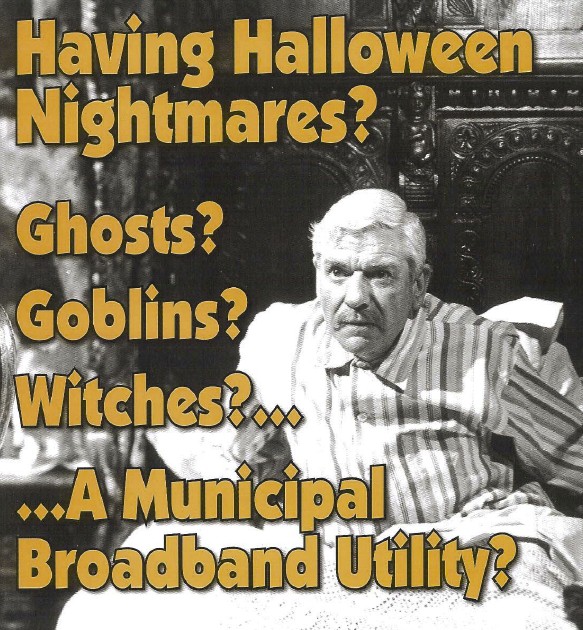
Senator Hoyle's legislation lays the foundation for cable and phone companies to spend hundreds of thousands of subscriber dollars to mail smear campaign pieces like this one from Comcast.
(This piece is written by Jay Ovittore and Phillip Dampier.)
The good news is that all the pushback on an all-out-moratorium on municipal broadband was successful and Senator David Hoyle (D-Gaston) withdrew the idea. The bad news is he had an even worse idea to replace it.
Hoyle Wednesday unveiled a new draft bill that hopelessly ties up municipal broadband projects into knots of red tape that, if passed into law, will bury municipal broadband projects in North Carolina indefinitely.
Hoyle sprung his telecom-industry-friendly legislation on the public after getting plenty of input and encouragement from the state’s cable and phone companies who already knew what was in it because they helped craft it.
For a retiring state senator who doesn’t have to worry about the next election, what better parting gift can you give to your friends in the cable and phone industry than a bill that preserves the comfortable duopoly they’ve enjoyed for years.
Hoyle and those supporting the legislation will argue their bill doesn’t ban municipal broadband — it simply places conditions on such projects before they can go forward. But what are those conditions?
Section One of the draft bill requires local governments to get funding for “external communications services” (ie. municipal broadband) by way of a General Obligation Bond (a GO Bond). In North Carolina, that requires a taxpayer-funded referendum to be held for public input at the next election.
On the surface, getting public approval for municipal broadband isn’t a bad idea — no local government official expecting to win re-election would ever proceed on such projects without voter support. But this requirement also gives plenty of advance notice to incumbent providers that a new player could be invading their turf.
We know what that means. A well-funded opposition campaign to demagogue the project. Local cable companies can insert an unlimited number of free ads during every advertising break to slam the proposal. Phone companies can release a blizzard of opposition mailers to convince consumers it’s as scary as Halloween — all tricks and no treats.
How can a local city or county government respond to the misinformation barrage? They can’t. Public officials can’t spend taxpayer dollars to promote such projects or refute industry propaganda. They can’t even financially assist a citizen-run campaign.
That’s a fight with ground rules only Don King could love.
In the end, that leaves ordinary citizens of North Carolina facing down a multi-billion dollar statewide consortium of telecommunications interests hellbent on preserving and protecting the status qu0.
The earlier-discussed moratorium was a brick wall against municipal broadband. Hoyle’s bill is the Great Wall of China with the logos of AT&T, Time Warner Cable, and CenturyLink plastered all over it.
But wait, there’s more. To deal with municipal broadband projects that got an initial green light to dare to interfere with the phone and cable industries’ grand business plans, another provision provides a near endless supply additional referendums to get rid of the projects. Hoyle’s bill actually demands more votes should existing systems need:
- refinancing to reduce the interest rate or restructure existing debt;
- to make repairs to the system’s “fixtures;” and/or
- to upgrade the system to meet subscribers’ needs.
Ponder the insanity:
- The legislation could be interpreted to demand a public referendum if your service goes out. Can you wait until the next election to get back your cable service?
- If a municipal broadband fiber cable falls in your backyard, does it make a sound? It won’t, but you will when you learn that cable might not be reattached to the pole until the whole town holds a referendum about it;
- Would you be upset if your local municipal provider could refinance its debt at a much lower interest rate, letting them cut their prices, but they can’t before the next election?
- While cable and phone companies refuse to upgrade their service to levels that would have made such municipal alternatives unnecessary, they also want to make certain the one provider that did meet your needs can’t upgrade… without a public vote.
These systems are not constructed with public tax dollars, but Senator Hoyle wants every citizen in a community, subscriber or not, to ponder the future of a local municipal broadband provider. It’s like giving AT&T veto power over Time Warner Cable’s channel lineup. Guess who has to pay for these constant referendums? Taxpayers. So while Senator Hoyle complains municipal broadband costs the state tax revenue, his legislation guarantees increased government spending on pointless referendums. That’s logic only a politician working for the interests of big cable can appreciate.
For the cable and phone companies, and their good friends in the North Carolina legislature, this is their idea of a level playing field. In reality it’s about as level as a downhill ski run.
Let’s extend that “fairness” out to incumbent cable and phone companies and consider whether you got a vote on:
- Whether or not the cable and phone companies got to put their wires on phone poles plunked down in front of your house;
- Whether or not you wanted either company to dig up your yard to bury their wiring;
- Whether you wanted that giant metal refrigerator-sized metal box installed on your street, in your yard, or on the phone pole you see from your window every day;
- Whether or not you want the cable company to repair Mrs. Jenkins’ problems with HBO up the street whenever it rains or replace the cable the squirrels chewed up;
- What channels and services you want to pay for, which ones you do not, and at what price you need to pay your local phone or cable company.
- What cable or phone company gets to provide service in your community.
Apparently the fairness concept only applies to potential new competitors, not the existing providers.
Let’s also consider the cable television industry didn’t just magically bloom into a multi-billion dollar business without government help. In the early days of cable television, investors were assured that they were financing a monopoly provider, guaranteed through a franchise agreement process that gave newly built cable companies exclusivity to help repay construction costs. Franchise wars broke out between 1978 and 1984 as competing companies promised the moon with state-of-the-art two-way cable systems with the capacity to offer 70 or more channels. The players then included Time’s American Television and Communications Corporation, Warner’s Amex, and Telecommunications, Inc. (TCI). ATC and Amex would later evolve into Time Warner Cable and TCI became AT&T Cable before being sold to Comcast. Communities seeking cable television for their residents would later learn a lot of these promises made were promises broken – reneged on by large cable companies with few, if any consequences.
During the Reagan Administration, then-FCC Chairman Mark Fowler bestowed additional deregulation benefits on the cable industry. The Museum of Broadcast Communications explains:
The Cable Communications Policy Act of 1984 addressed the two issues that still hindered cable television’s growth and profitability: rate regulation and the relative uncertainty surrounding franchise renewals. Largely the result of extensive negotiation and compromise between the cable industry’s national organization, the National Cable Television Association, and the League of Cities representing municipalities franchising cable systems, the act provided substantial comfort to the cable industry’s future.
Its major provisions created a standard procedure for renewing franchises that gave operators relatively certain renewal, and it deregulated rates so that operators could charge what they wanted for different service tiers as long as there was “effective competition” to the service. This was defined as the presence of three or more over-the-air signals, a very easy standard that over 90% of all cable markets could meet. The act also allowed cities to receive up to 5% of the operator’s revenues in an annual franchise fee and made some minor concessions in mandating “leased access” channels to be available to groups desiring to “speak” via cable television.
Additional reforms guaranteed pole attachment rights to the cable industry so they could wire and service their network unencumbered by utility company interference or high pole attachment fees. Cable consolidation allowed formerly mom and pop cable systems to become part of a cable industry where just a handful of cable companies provide service to the majority of cable households. Countless millions are spent each year by the industry to lobby state and federal governments to keep the party going without regulatory interference, suggesting competiti0n alone is the only regulation required.
Except when a new competitor enters the market, of course. Fearing competition from municipal providers who will force cable and phone companies to charge reasonable rates and upgrade service, the best possible solution is to find a way to ban such projects.
Forcing regular referendums and the complexities and expenses associated with them guarantees no community in North Carolina would ever bother with the onerous requirements to launch municipal broadband projects.
That’s not just Jay and I saying that. What Hoyle has proposed hardly breaks new ground. It’s the same dog and pony show the industry has brought to other states to stop competition and keep prices high and service slow.
So let’s learn from the painful experiences of others:
First lobbying for legislation requiring referendums and then winning it, SBC (later AT&T) and Comcast used the opportunity to spend more than $300,000 of their subscribers’ money to launch a major misinformation campaign with misleading and inaccurate mailers that successfully fought off a proposition to deliver better and cheaper service through a municipal broadband project in Batavia, Geneva, and St. Charles, Illinois. Fiber for Our Future documented the whole sordid affair from start to finish as a lesson to others confronting industry-backed referendum requirements.
[flv]http://www.phillipdampier.com/video/unproven.flv[/flv]
Want a preview of the distortion and misinformation-campaign cable and phone providers will bring to stop municipal broadband? Watch this SBC (today AT&T) executive tell city officials in Illinois that fiber is “unproven,” that the phone company’s DSL speeds are comparable to Comcast Cable, and that consumers don’t need the 3Mbps speed the company was delivering back in 2004 when this video was taken. “What are you going to do with 20 megabits. I mean, it’s like having an Indy race car and you don’t have the race track to drive it on.” (3 minutes)
Longmont, Colorado spent years suffering with bad broadband service from Comcast and Qwest and sought a better alternative with a municipally-run provider. But then the cable and phone giants spent $200,000 to put a stop to that. While local subscribers may have preferred that $200,000 be used to reduce their rates, for Comcast and Qwest it was an investment in maintaining future pricing only duopolies can achieve, all while delivering “good enough for you” broadband service to Longmont residents. In 2006, the Baller Herbst Law Firm collected information on industry-backed barriers to municipal broadband, and the list went on for nine pages. Many of them sound eerily familiar to what Hoyle proposes (after cable and phone companies whispered time tested, industry proven ideas into his ear).
The city of North St. Paul, Minnesota has advice for states like North Carolina after their own experience with a coordinated industry-backed smear campaign against municipal broadband enabled by legislation similar to what Hoyle proposes:
What should be of interest to all communities was the organized opposition. It appears that the incumbent providers, industry associations and politically conservative think tanks teamed up to promote negative news stories, do polling and opposition phone calls, provide transportation for identified “no” voters and create web sites.
While we heard some advocates lamenting this high priced anti-municipal fiber effort, this response is something that community leaders must expect and be prepared for. A strong community education and mobilization effort must be a part of any municipal telecommunications initiative. A coalition of business owners and residents must be created and maintained that can counter the expected efforts of the incumbent providers. The benefits of the community-owned network should be documented and promoted so that an overwhelming majority of voters will choose to vote yes. We hope that, one way or the other, North St. Paul gets the “More, Better Broadband” that the MN Broadband Coalition supports.
Of course, when local communities are banned from spending a nickel on advocacy for their projects, it effectively hands a restraining order to broadband advocates who can’t even get on the playing field, level or otherwise.
Outraged yet?
It will only get worse if Hoyle’s bill ever becomes law. Residents in communities like Salisbury endured a sampling of the kind of negative campaign this industry will launch wherever municipal broadband competition threatens to appear. In 2009, residents were hassled with push-polling phone calls from industry-backed astroturf groups claiming to represent ordinary citizens, but were actually little more than sock puppets for big telecom. Your mailbox will be filled with blizzards of misleading mailers that current cable and phone customers pay for. If they need more money, they can always raise your rates to cover the difference. In the end, with the help of elected officials who don’t care about North Carolina consumers, existing municipal projects can bleed themselves dry (later to be used by the industry as “failed examples” to claim such projects are too risky to try) and proposed ones will never see a spade plunged into the soil to bury the first strand of fiber optic cable.
But it’s not all bad news. It doesn’t have to happen this way. You can tell your state representative you are watching them like a hawk on this issue. Any “yes” vote for legislation like that proposed by Senator Hoyle is a no vote for them at the next election. Let them know you are well aware of the game plan here — it has been tried in other states with similar legislation that is little more than protectionism for big telecom. Tell your elected officials you already have the power to choose whether or not you want these projects simply by voting for or against the elected officials that propose them. While the concept of a referendum sounds fair on the surface, it’s not when you consider the past experiences of other communities who faced well-funded opposition campaigns, helpless to correct the record or fairly argue their position on the matter. Providers know that, which is why they advocate this type of legislation in the first place. It effectively stops competition, stops better service, and stops North Carolina residents from enjoying lower priced cable, phone, and broadband service.
There are a few stand-up representatives of the people of North Carolina who do deserve our gratitude and thanks today.
Rep. Paul Luebke, (D-Durham County) (who co-chairs the Revenue Law Study Committee) [email protected] 919-733-7663 College Teacher
Rep. Jennifer Weiss, (D-Wake County) [email protected] 919-715-3010 Lawyer-Mom
They both will likely face fierce opposition from the incumbent providers and their fellow legislators. Please take the time to thank them for standing with consumers today and for trying to protect the future of North Carolina and its economy.
Stop the Cap! will have video of today’s remarks by both legislators soon. We hope to follow with a complete video record of today’s events surrounding the anti-competition legislation proposed by Senator Hoyle. It will serve as a testament to just how much work we have to do to remove legislators who have stopped representing the public interest, and renew our support for those who stand with consumers.
Meanwhile, check out these two delightful pieces paid for by the cable and phone industry, sent to homes where municipal broadband projects faced a referendum in 2003 and 2004. More than a dozen different mailers were sent to every home in the communities of Batavia, Geneva, and St. Charles, Illinois from phone and cable companies. Now imagine the repercussions when not one of those communities could respond with their own mailers correcting the record and giving their side of the argument. There is a reason why special interests spend enormous sums of money to protect their turf, and the battle is over before it even begins when those interests demand the other side not have the opportunity to respond in kind.
What smears do providers in North Carolina have in store for you?
… Continue Reading


 Subscribe
 While the Federal Communications Commission hand-wrings over how far to dip its toe into the shark-infested water of corporate-controlled broadband, Finland has launched a major investigation over charges of price-fixing and collusion by the country’s major broadband providers.
 “The authority has discovered flaws and problems in the pricing of several telecom operators, and there is even reason to suspect that unlawful activity occurs in the broadband market,” FICORA said in a statement.
 Finland was the first country in the world to declare broadband a universal right, and every citizen should have access to at least 1Mbps service no later than this July. By 2015, Finland plans to deliver universal access to at least 100Mbps service. Finland is a world leader in broadband adoption — as of 2007 a full 79 percent of Finns regularly access the Internet. With universal access a national priority, FICORA referees the private marketplace to make sure the Finnish people benefit the most from the broadband revolution.