Home » Competition » Recent Articles:

New Study Reveals Why Your Broadband Bill Is Still High: Lack of Competition in a Broadband Duopoly

What is the last technology product you purchased that never declined in price after you bought it?  If you answered your broadband service, a new study proves you right.

Since there are no public data on what has happened to broadband prices over the last decade, Shane Greenstein, a professor of management and strategy at the Kellogg School of Management, and his co-author Ryan McDevitt, an assistant professor of economics and management at the University of Rochester and a graduate of Northwestern University, analyzed the contracts of 1,500 DSL and cable service providers from 2004 to 2009.

The results every broadband user already knows.

At best, prices have declined only slightly — typically between 3-10 percent, partly from a “quality adjustment” the authors included to account for gradually increased broadband speeds when measuring prices.

Greenstein blames a broadband duopoly for the stagnation in broadband pricing.

Greenstein

“So if you were in such a market as a supplier, why would you initiate a price war?” Greenstein asks. With no new entries on the market, suppliers can compete by slowly increasing quality but keeping prices the same. According to Greenstein, quality is where providers channel their competitive urges.

Meanwhile, once companies have installed the lines, their costs are far below prices. “At that point, it becomes pure profit,” Greenstein says. A company might spend around $100 per year to “maintain and service” the connection, but people are paying nearly that amount every other month. Greenstein says that it is not surprising that prices were high during the buildout phase in the early and mid-2000s, since the firms were trying to recover their costs. “However, we are approaching the end of the first buildout, so competitive pressures should have led to price drops by now, if there are any. Like many observers, I expected to see prices drop by now, and I am surprised they have not.”

The authors also confirm Stop the Cap!‘s long-standing contention that providers are enjoying dramatically reduced costs to deliver broadband to customers, yet are not spending some of those profits on important network upgrades.  That could lead to a broadband bottleneck, Greenstein contends, especially with the growth of online video.  We argue it is a recipe for Internet Overcharging — triggering increased pricing to “pay for upgrades” while limiting usage of broadband service, despite the mountain of profits available today to cope with usage growth.

McDevitt

Greenstein and McDevitt pored over 1,500 broadband contracts over several years, tracking pricing, service bundling, and speed improvements.  Pricing, adjusted for speed improvements, was generally flat.  Because the cable industry has delivered most of the speed growth Americans enjoy, the “quality adjustment” the authors used credited most of the modest price declines to the cable industry, especially for customers moving to bundled packages of services.  The authors found DSL and its providers almost completely stagnant — both in pricing and speed.

The most surprising discovery, Greenstein says, is that national decisions are being made without the type of data that he created in the consumer price index. “As an observer of communications policy in the U.S., I find it shocking sometimes how often government makes decisions by the seat of their pants,” he says. Without real data and statistics, decisions are based solely on who has better arguments—in essence, a debate. A better consumer price index will help produce better decisions for the future of the Internet and its users.

It may also serve as an effective challenge to telecommunications industry lobbyists who engineer their own statistics and claims about the performance of the nation’s phone and cable companies.

Thanks to Stop the Cap! readers Bones and Michael for sending along the story.

Australian ISP Says National Broadband Network’s 1Gbps Speeds Are “Crap”; Old People Don’t Care So Why Do It?

John Linton, CEO Exetel

Australia’s planned National Broadband Network (NBN) delivering the country access to broadband speeds up to 1Gbps face many of the same criticisms American municipal providers hear when incumbent commercial providers face imminent competition from fiber broadband.

But nobody can top the venomous spray of Exetel’s CEO John Linton, who called the entire concept of public broadband for the public good “a load of crap” and those behind it a mix of ‘thugs,’ ‘pretenders,’ and generally incompetent and stupid.

Linton’s Internet Service Provider delivers broadband to most of its customers over Telstra landlines, using DSL.  But the company has grudgingly agreed to participate in the NBN project, even while still despising it to the core.

Exetel’s pricing on NBN’s fiber network charges for speed and usage.  Much like cable broadband, Exetel delivers much faster downstream speeds (up t0 100Mbps), with upload speeds maxing out at 8Mbps. The higher the speed, the higher the monthly access fee.  Users receive no usage allowance, paying fees per gigabyte for all of their usage.  Exetel still reserves the right to throttle customer speeds for certain online applications, and “traffic shape” users based on their usage.

In Tasmania, Exetel has introduced a 25/2Mbps broadband plan with no usage allowance — but no monthly access fee either — charging a flat $2 per gigabyte of usage.

Exetel Fiber Pricing In Tasmania

Plan Speed Down Speed Up Monthly Access Download Charges Upload Charges Contract Length Usage Allowance
A 25 mbps 2 mbps $0.00 $2.00 per GB Nil 12 Months None
B 50 mbps 4 mbps $25.00 $1.00 per GB Nil 12 Months None
C 100 mbps 8 mbps $50.00 $0.75 per GB Nil 12 Months None

Linton spews most of his angry commentary on his personal blog, which he closed to non-Exetel customers unless they made a $20AUS contribution to the company’s endangered wildlife protection programs.  But he rarely pulls punches in public either.

Is this Australia's broadband future?

A sampler:

With wireless broadband waiting in the wings, those excited by NBN’s 1Gbps speeds are “unthinking and just plain stupid, pretty much along the same lines as the stone age cargo cult dwellers in the jungles of New Guinea are excited about the next ‘goods drop’ from the strange colored bird.”

Australia’s aging population, “who don’t play computer games or get a surrogate sex life from pornography” have zero interest in getting terabyte broadband speeds, making the whole endeavor a giant waste of money.

“The number of people who want 100Mbps are almost none today and aren’t going to be very many in five years time.   Probably 40-50% of people today will never want to use a piece of fiber […] and they’re certainly not gamers playing, or those other things.  They’re the other half of Australia that has a life rather than a half life.”

On the results of the recent election and the decision to move forward with the NBN: “God help us all.”

On Communications Minister Stephen Conroy (Australia’s version of FCC Chairman Julius Genachowski): “He was his usual mixture of bewilderment, ignorance and barely concealed thuggery, but I was amused at his reference to Exetel (not by name).” Linton wrote on his blog. “While I’m grateful for the ‘free plug’ I thought it was an obvious example of “straw clutching” if it wasn’t based on appallingly bad briefing, which I would doubt, because for him to have been aware of any actual pricing would have required some sort of briefing,” added Linton.

On NBN co-chief Mike Quigley, who will help manage NBN service: “Is [Mike Quigley] god? Can he reverse 100 years of telecommunications going one way and say, ‘Oh, I’m Mike Quigley, and I haven’t worked here in 30 years, I know nothing about running major networks, but someone has paid me $2 million a year so I can pretend I can’.  The only one who can do it is Telstra. It would do it cheaper than a bloody government.”

Linton blames all of the talk about a publicly-owned broadband network for the decrepit state of Australia’s commercial broadband market, claiming it dried up private investment in new ADSL products: “The situation as I see it is that the suppliers — Telstra, Optus, AAPT — are not really investing in anything new, especially when you’re referring to ADSL type broadband products. The current suppliers are holding on to the margins they have at the moment, and if anything they will seek to increase them rather than reduce them,” says Linton.

Since nearly every broadband user in Australia knows Linton hates fiber broadband, what technology does he believe represents Australia’s future?

Or this?

3G wireless.

“Most people that I know, including me, put a much higher priority on mobility than they do on speed,” he told ZDNet. “The average person needs a 100Mbps internet connection about as much as they need to have their arms amputated.”

While mobility is important, his critics charge, there is no way 3G wireless can deliver Australia its broadband future.  Service is not ubiquitous across the country, speeds are far below even what DSL offers, streaming multimedia is challenging at best, and the usage fees and limits that accompany wireless service plans in the south Pacific would create an even greater divide between those who can afford wireless broadband, and those who cannot.

A report released yesterday by the Bureau of Statistics shows Australians are downloading more data than ever before, increasing more than 50 percent in the second quarter compared to the same period last year. The amount of data downloaded every three months is now 11 times higher than March 2005 and 126 times higher than March 2002.

Australia’s National Broadband Network is open to all Internet Service providers that wish to participate, reselling their broadband plans using NBN’s infrastructure.

EPB’s 1Gbps Service Embarrasses Big Telecom; Who Are the Real Innovators?

EPB’s new 1Gbps municipal broadband service is causing some serious embarrassment to the telecom industry.  Since last week’s unveiling, several “dollar-a-holler” telecom-funded front groups and trade publications friendly to the industry have come forward to dismiss the service as “too expensive,” delivering speeds nobody wants, and out of touch with the market.

The “Information Technology and Innovation Federation,” which has historically supported the agenda of big telecom companies, has been particularly noisy in its condescending dismissal of the mega-speed service delivered in Chattanooga, Tenn.

Robert Atkinson, president of ITIF, undermines the very “innovation” their group is supposed to celebrate.  Because it doesn’t come from AT&T or Verizon, it’s not their kind of “innovation” at all.

“I can’t imagine a for-profit company doing what they are doing in Chattanooga, because it’s so far ahead of where the market is,” Atkinson told the New York Times.

“Chattanooga definitely is ahead of the curve,” Atkinson told the Times Free Press. “It’s like they are building a 16-lane highway when there is a demand for only four at this point. The private companies probably can’t afford to get that far ahead of the market.”

Bernie Arnason, formerly with Verizon and a cable industry trade association also dismissed EPB’s new service in his current role as managing editor for Telecompetitor, a telecom industry trade website:

Does anyone need that speed today? Will they in the next few years? The short answer is no. It’s kind of akin to people in the U.S. that buy a Ferrari or Lamborghini – all that power and speed, and nowhere to really use it. A more apropos question, is how many people can afford it – especially in a city the size of Chattanooga?

[…]Will there be a time when 1 Gb/s is an offer that is truly in demand? More than likely, although I still find it hard to imagine it being really necessary in a residential setting – I mean how many 3D movies can you watch at one time? Maybe a service that bursts to 1 Gb/s in times of need, but an always on symmetrical 1 Gb/s connection? Truth be told, no one really knows what the future holds, especially from a bandwidth demand perspective.

Supporting innovation from the right kind of companies.

Arnason admits he doesn’t know what the future holds, but he and his industry friends have already made up their minds about what level of service and pricing is good enough for “a city the size of Chattanooga.”

Comcast’s Business Class broadband alternative is priced at around $370 a month and only provides 100/15Mbps service in some areas.  Atkinson and Arnason have no problems with that kind of innovation… the one that charges more and delivers less.

For groups like the ITIF, it’s hardly a surprise to see them mount a “nobody wants it or needs it”-dismissive posture towards fiber, because they represent the commercial providers who don’t have it.

Fiber Embargo

The Fiber-to-the-Home Council, perhaps the biggest promoter of fiber broadband delivered straight to customer homes, currently has 277 service provider members. With the exception of TDS Telecom, which owns and operates small phone companies serving a total of 1.1 million customers in 30 states, the FTTH Council’s American provider members are almost entirely family-run, independent, co-op, or municipally-owned.

Companies like American Samoa Telecommunications Authority, Hiawatha Broadband Communications, KanOkla Telephone Association Inc., and the Palmetto Rural Telephone Cooperative all belong.  AT&T, CenturyLink, Frontier, Verizon, and Windstream do not.  Neither do any large cable operators.

While not every member of the Council has deployed fiber to the home to its customers, many appreciate their future, and that of their communities, relies on a high-fiber diet.

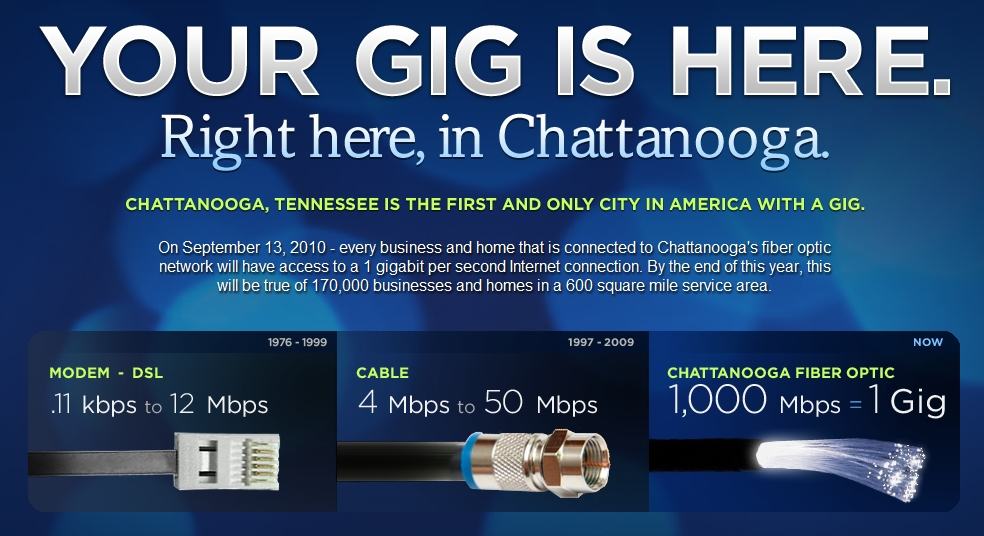
EPB’s announcement of 1Gbps service was made possible because it operates its service over an entirely fiber optic network.  Company officials, when asked why they were introducing such a fast service in Chattanooga, answered simply, “because we can.”

The same question should have been directed to the city’s other providers, Comcast and AT&T.  Their answer would be “because we can’t… and won’t.”

Among large providers, only Verizon has the potential to deliver that level of service to its residential customers because it invested in fiber.  It was also punished by Wall Street for those investments, repeatedly criticized for spending too much money chasing longer term revenue.  Wall Street may have ultimately won that argument, because Verizon indefinitely suspended its FiOS expansion plans earlier this year, despite overwhelmingly positive reviews of the service.

So among these players, who are the real innovators?

The Phone Company: Holding On to Alexander Graham Bell for Dear Life

Last week, Frontier Communications told customers in western New York they don’t need FiOS-like broadband speeds delivered over fiber connections, so they’re not going to get them.  For Frontier, yesterday’s ADSL technology providing 1-3Mbps service in rural areas and somewhat faster speeds in urban ones is ‘more than enough.’

That “good enough for you” attitude is pervasive among many providers, especially large independent phone companies that are riding out their legacy copper wire networks as long as they’ll last.

What makes them different from locally-owned phone companies and co-ops that believe in fiber-t0-the-home?  Simply put, their business plans.

Companies like Frontier, FairPoint, Windstream, and CenturyLink all share one thing in common — their dependence on propping up their stock values with high dividend payouts and limited investments in network upgrades (capital expenditures):

Perhaps the most important metric for judging dividend sustainability, the payout compares how much money a company pays out in dividends to how much money it generates. A ratio that’s too high, say, above 80% of earnings, indicates the company may be stretching to make payouts it can’t afford.

Frontier’s payout ratio is 233%, which means the company pays out more than $2 in dividends for every $1 of earnings! But this ignores Frontier’s huge deferred tax benefit and the fact that depreciation and amortization exceed capital expenditures — the company’s actual free cash flow payout ratio is a much more manageable 73%. Dividend investors should ensure that benefit and Frontier’s cash-generating ability are sustainable.

In other words, Frontier’s balance sheet benefits from the ability to write off the declining value of much of its aging copper-wire network and from creative tax benefits that might be eliminated through legislative reform.

The nightmare scenario at Frontier is heavily investing in widespread network upgrades and improvements beyond DSL.  The company recently was forced to cut its $1 dividend payout to $0.75 to fund the recent acquisition of some Verizon landlines and for limited investment in DSL broadband expansion.

Frontier won’t seek to deploy fiber in a big way because it would be forced to take on more debt and potentially cut that dividend payout even further.  That’s something the company won’t risk, even if it means earning back customers who fled to cable competitors.  Long term investments in future proof fiber are not on the menu.  “That would be then and this is now,” demand shareholders insistent on short term results.

The broadband expansion Frontier has designed increases the amount of revenue it earns per customer while spending as little as possible to achieve it.  Slow speed, expensive DSL fits the bill nicely.

The story is largely the same among the other players.  One, FairPoint Communications, ended up in bankruptcy when it tried to integrate Verizon’s operations in northern New England and found it didn’t have the resources to pull it off, and delivered high speed broken promises, not broadband.

Meanwhile, many municipal providers, including EPB, are constructing fiber networks that deliver for their customers instead of focusing on dividend checks for shareholders.

Which is more innovative — mailing checks to shareholders or delivering world class broadband that doesn’t cost taxpayers a cent?

Cable: “People Don’t Realize the Days of Cable Company Upgrades are Basically Over”

While municipal providers like EPB appear in major national newspapers and on cable news breaking speed records and delivering service not seen elsewhere in the United States, the cable industry has a different story to share.

Kent

Suddenlink president and CEO Jerry Kent let the cat out of the bag when he told investors on CNBC that the days of cable companies spending capital on system upgrades are basically over.

“I think one of the things people don’t realize [relates to] the question of capital intensity and having to keep spending to keep up with capacity,” Kent said. “Those days are basically over, and you are seeing significant free cash flow generated from the cable operators as our capital expenditures continue to come down.”

Both cable and phone companies have called a technology truce in the broadband speed war.  Where phone companies rely on traditional DSL service to provide broadband, most cable companies raise their speeds one level higher and then vilify the competition with ads promoting cable’s speed advantages.  Phone companies blast cable for high priced broadband service they’re willing to sell for less, if you don’t need the fastest possible speeds.  But with the pervasiveness of service bundling, where consumers pay one price for phone, Internet, and television service, many customers don’t shop for individual services any longer.

With the advent of DOCSIS 3, the latest standard for cable broadband networks, many in the cable industry believe the days of investing in new infrastructure are over.  They believe their hybrid fiber-coaxial cable systems deliver everything broadband consumers will want and don’t see a need for fiber to the home service.

Their balance sheets prove it, as many of the nation’s largest cable companies reduce capital expenses and investments in system expansion.  Coming at the same time Internet usage is growing, the disparity between investment and demand on broadband network capacity sets the perfect stage for rate increases and other revenue enhancers like Internet Overcharging schemes.

Unfortunately for the cable industry, without a mass-conversion of cable-TV lineups to digital, which greatly increases available bandwidth for other services, their existing network infrastructure does not excuse required network upgrades.

EPB’s fiber optic system delivers significantly more capacity than any cable system, and with advances in laser technology, the expansion possibilities are almost endless.  EPB is also not constrained with the asynchronous broadband cable delivers — reasonably fast downstream speeds coupled with paltry upstream rates.  EPB delivers the same speed coming and going.  In fact, the biggest bottlenecks EPB customers are likely to face are those on the websites they visit.

EPB also delivered significant free speed upgrades to its customers earlier this year… and no broadband rate hike or usage limits.  In fact, EPB cut its price for 100Mbps service from $175 to $140.  Many cable companies are increasing broadband pricing, while major speed upgrades come to those who agree to pay plenty more to get them.

Which company has the kind of innovation you want — the one that delivers faster speeds for free or the one that experiments with usage limits and higher prices for what you already have?

No wonder Big Telecom is embarrassed.  They should be.

[flv width=”640″ height=”500″]http://www.phillipdampier.com/video/EPB Interviews 9-20-10.flv[/flv]

EPB and Chattanooga city officials appeared in interviews on Bloomberg News and the Fox Business Channel.  CNET News also covered EPB’s 1Gbps service, introduced last week.  (12 minutes)

Online Cable: ivi Offers Free Trial of 25 NY & Seattle TV Stations, But Watch Quick Before the Lawsuits Fly

Phillip Dampier September 16, 2010 Competition, Issues, Online Video 5 Comments

A Seattle startup launched its new “online cable TV system” this week offering a 30-day free trial of 27 live feeds of over-the-air television stations from New York and Seattle.

Dubbed ‘ivi,’ the online video service expects to charge customers $5 a month for the package of broadcasters delivering shows from all of the major American networks, plus several superstations most Americans haven’t seen on their cable lineup since the early 1990s.

‘ivi’ claims it offers more content than Hulu — providing online access to every network and syndicated show seen on New York and Seattle TV screens, and for an introductory price of $0.99 more per month, the company plans to turn your home computer into a giant DVR, capable of recording and storing any of the programming on ivi’s lineup for later viewing.

“The cable industry has spent countless millions of dollars on so-called ‘TV Everywhere’ solutions in a blind effort to prop-up outdated technology and business models” said Todd Weaver, founder and CEO of ivi, Inc. “However, ivi empowers its users to experience TV Anywhere, offering them major broadcast channels delivered live to their laptop or desktop, anywhere on the planet. Whether eventually integrated into Google TV, Apple TV, or meshed with an existing platform’s digital strategy, ivi makes the set-top-box and any ‘Web to TV’ products obsolete. Instead of attempting to bring the Web to the TV, ivi intuitively brings TV to the Web.”

The ivi TV player is currently available for download to any Windows, Apple, or Linux computer, and will soon be available on other platforms, including mobile devices, tablets, and set-top-boxes.  It allows customers to access its lineup anywhere in the world where a broadband connection exists.

The company provides over-the-air stations in both New York and Seattle to serve different time zones, but the lineup also provides viewers the flexibility of catching a network show twice — once on East Coast time and again three hours later.

The lineup covers all the bases, particularly from America’s top television market — New York City.  Spanish language programming from New York stations provides access to Estrella TV, Univision, TeleFutura, and Telemundo.  Since many stations have agreements to use their digital sub-channels to deliver additional programming, ivi viewers also get access to RTV – The Retro TV Network, Universal Sports, This TV from MGM, and a handful of specialty PBS feeds.  KONG-TV from Seattle, a classic independent station not affiliated with any network, is also included.

Some other less notable stations making it to the lineup include Cedarburg TV, a public access channel from Cedarburg, Wisconsin, which spends part of its broadcast day airing NASA-TV, Radio Tele-Luxembourg, a station from the Grand Duchy of Luxembourg in Europe, CCTV-9, the English language TV network from the People’s Republic of China, and PlayTV — a music video channel.

Stop the Cap! snagged a copy of the Windows version of the player and gave the service a test run.  Those seeking a free trial can apply on the company’s website, but you will have to supply a valid credit card number to participate (if you cancel within 30 days, you will not be charged).  If you are concerned about this, consider using a “one time” credit card number, a service often available from credit card companies that generates a one-time-use credit card number.

The player, like ivi’s website, is apparently a work in progress — fairly spartan in design and looking somewhat outdated.  But the player is less than three megabytes in size, a welcome change from oversized “bloatware.”  It was also nice to see versions for Linux and the Mac during launch week, instead of the more typical “coming soon” attitude other new ventures rely on.

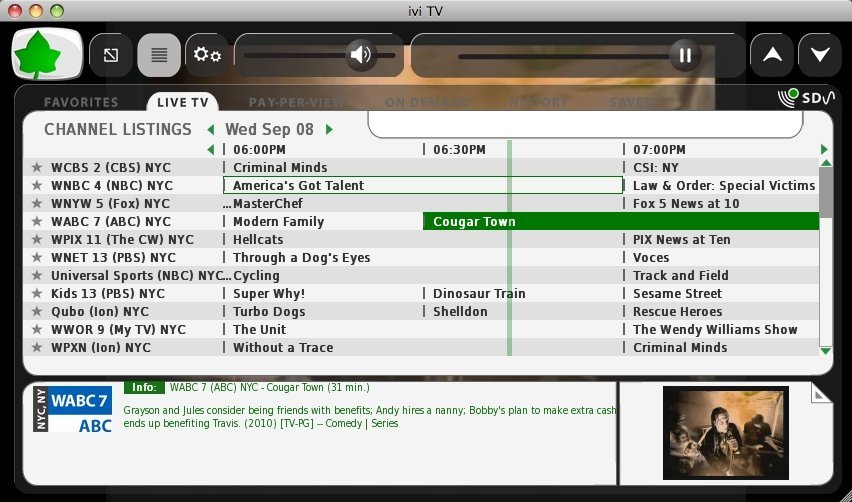
The player is generally intuitive to operate, letting you control how much bandwidth to use for the service.  The version we tested allows you to pause, rewind, and fast forward paused programming.  A channel guide offers basic program information customized for your particular time zone.

ivi's electronic program guide

Playback quality has issues, however.  Despite setting our player for “high definition” playback, the encoding rate was far too low to actually deliver anything close to HD viewing.  In fact, viewing artifacts ranging from shading errors to soft pixelization were readily apparent even in a reduced-size player window.  At full screen, playback reminded me of a medium-quality RealVideo stream from an earlier era.  It was watchable, but I wouldn’t call it a “cable-TV killer.”  On a large screen TV, it’s likely to be even more problematic.

Still, for $5 a month, it might be worth it, especially if you have dropped cable and don’t get reasonable reception of broadcast signals, or your local TV market doesn’t offer broadcast affiliates of the CW, MyNetwork TV, or those networks made-for-broadcast-subchannels — RTV and This TV.

Besides, if you sign up for the free trial today, you may not even have to pay a cent if the broadcasting industry sues the pants off the founders and shuts it all down before the end of the month.

Remarkably, ivi founder and CEO Todd Weaver told the Puget Sound Business Journal he was unaware of any other startup company attempting to deliver live TV feeds.

We here at Stop the Cap! do.  Weaver might want to talk to Bill Craig, founder of a very similar Canadian venture called iCraveTV in December, 1999.  We remember iCraveTV very well, because it delivered 17 channels of programming from Canadian over-the-air broadcasters and several network affiliates from nearby Buffalo, N.Y.  We especially remember the blizzard of lawsuits that promptly followed, all because the Canadian startup never bothered to get permission from the stations involved and they let Americans watch.

Weaver offers conflicting accounts about whether ivi secured permission from the stations it started streaming this week.

FierceIPTV reports the company hasn’t.

At the moment, the company has no contracts with any broadcasters, but ivi claims it doesn’t need to, since it’s an online cable system and, as long as it pays fees to the U.S. Copyright Office–which get disbursed to the broadcasters–it’s covered. Although Weaver says it’s not inconceivable that the company will face some legal challenges.

But the Puget Sound Business Journal reports the opposite:

The company has secured the rights to deliver live television feeds from local affiliates in Seattle and New York, with plans to expand to LA, San Francisco and other markets in the near future. Ivi pays the stations an undisclosed amount to pick up the signal, which it does by either placing a physical encoder device at the station or capturing it from satellite or antennae.

The folks at iCraveTV thought they were covered so long as they paid copyright fees, too.  Craig said Canadian laws gave it the right to retransmit broadcast television signals, in the same way that cable companies and satellite companies do. As long as the company doesn’t tamper with the programming and paid copyright holders for their work, he argued, iCraveTV was completely legal.

The National Football League, horrified by the prospect of this venture airing its football games to Canadian and American viewers without a contract, promptly found a judge in Pittsburgh who issued a restraining order — the beginning of the end of iCraveTV and the start of some hefty legal bills.  When it was all over, 10 Hollywood studios, the Motion Picture Association of America, three major American television networks, and three television stations in Buffalo either filed or contemplated filing lawsuits asking for at least $5 million in damages from the venture.

Considering ivi was reportedly bankrolled for less than $1 million in “angel financing,” they better have a liability policy bigger than that.

“Whenever someone first hears that we are carrying their linear feed, the knee jerk reaction is: ‘I must protect my content, always,'” said Weaver. However, he noted that some broadcasters see ivi as a means to sell more advertising and a new distribution mechanism altogether. “We do not disrupt the existing live distribution models,” he said.

While that may be true for Cedarburg, Wisconsin’s public access channel, the major American networks that own the network-affiliated stations in New York are unlikely to see things that way, unless they own and control the venture, of course.  Neither will local network affiliates, who stand to lose local advertising revenue should large numbers of viewers flock to web-based, out-of-area network stations.  Local broadcasters effectively stopped satellite providers from reselling access to distant network stations in areas where local stations already provided that service, so it’s very likely they’ll strongly oppose ivi for the same reasons.

Still unsure how the industry will react?  Consider a combined Comcast-NBC network facing an online venture that promotes itself as a “cable cord cutter” asking NBC for permission to stream its programming online so viewers can cancel their Comcast subscriptions.

Enjoy ivi while you can.

Update #2: Charter Cable Adding More Junk Fees to Your Cable Bill: Here’s How to Fight Back and Save More

Phillip Dampier September 15, 2010 Charter Spectrum, Competition, Consumer News 14 Comments

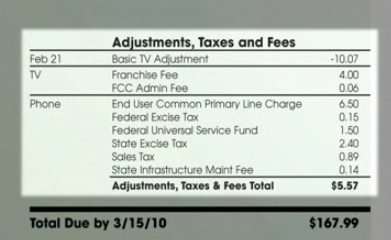
Charter's dumping ground for sneaky rate increases can be found in the Adjustments, Taxes and Fees portion of your monthly bill.

Charter Cable is literally passing the buck onto its cable TV subscribers.

Effective this October, Charter Cable customers will pay about a dollar more per month thanks to a new junk fee the company is adding to subscribers’ bills.

Federal law allows local U.S. broadcast television stations (i.e., affiliates of networks such as CBS, NBC, ABC, Fox, etc.) to negotiate with cable and satellite providers in order to obtain “consent” to carry their broadcast signals (Cable Television Consumer Protection and Competition Act of 1992).

As a direct result of local broadcast, or “network-affiliated,” TV stations increasing the rates to Charter to distribute their signals to our customers, we will be passing those charges on as a Broadcast TV Surcharge, in the Taxes and Fees section of the billing statement. These local TV signals were historically made available to Charter at no cost, or low cost. However, in recent years the prices demanded by local broadcast TV stations have necessitated that we pass these costs on to customers.

For most customers, the fee will average $0.94 per month, but in some areas it will be as high as $1.31 per month.  Charter argues the fee is not arbitrary. claiming it represents the average price the company pays – per subscriber – for local broadcast stations in the communities it serves.

Stop the Cap! contacted Charter this morning and learned the company intends to impose this new fee even on customers with Charter’s Price Guarantee Package, which is supposed to guarantee customers no change in pricing for up to two years (see notes at the end of the article for an update).  A Charter representative we contacted claimed the company will impose the fee on all customers, including those on contract, because of a clause in the terms and conditions which says, “The guaranteed price does not include the cost of installation and equipment, any applicable franchise fees, taxes or late fees, or costs for other ancillary services that you may order.”

Of course, the new fee is completely arbitrary and is neither a franchise fee or tax, nor is it for an “ancillary service.”  We predict a closer review of Charter Cable’s thinking on this matter by state regulatory agencies and Attorneys General.

Charter’s FAQ seeks to pass the blame for the new fee to the federal government and local broadcasters:

Federal law treats [cable networks and over-the-air TV stations] differently. Unlike cable TV networks, local broadcast TV stations distribute their signals over the air, using free spectrum granted to them by the federal government. In effect, taxpayers are subsidizing the distribution of broadcast TV signals. These same broadcast TV stations are then allowed by the government to charge for their signals — and if we don’t agree to pay, broadcasters can force us to drop their channels, thereby adversely impacting our customers.

“Given cable’s well-documented history of raising rates 4-6 times the annual rate of inflation, it seems rather disingenuous for them to now claim their rate hikes are coming as a result of broadcast TV stations, which provide the highest-rated entertainment and local news programming on the cable line-up,” National Association of Broadcasters Executive VP Dennis Wharton told Multichannel News in response to Charter’s move.

The new Broadcast TV Surcharge will appear in the Taxes and Fees section of your bill, joined by other junk fees Charter has invented to pass along the ordinary costs of doing business to cable subscribers while claiming they are not increasing rates:

Charter’s “It’s Someone Else’s Fault We Charge These” Junk Fees

  • TV and Internet Late Payment Fee — A late fee will be assessed for past due unpaid Charter TV and Internet charges.
  • Phone Processing Fee — This fee is assessed when Charter does not receive payment for the full balance of your phone charges.
  • Regulatory Cost Fee — The cost of doing paperwork and whatever else the company deems.
  • State Telephone Relay Charge — Funds a Telecommunications Relay Service for hearing impaired/speech disabled residents.
  • Federal Communications Commission (FCC) Fee — The FCC charges an annual regulatory fee for cable operators.
  • Franchise Fee — Local communities collect a percentage of revenue from cable operators in return for doing business in the community.
  • Public Education and Government Channels (PEG) Fee — Many cable franchise agreements ask cable operators to help fund the operations of these channels.
  • Public Utilities Commission (PUC) Fee — Some states ask regulated providers to defray the costs of utility commissions that oversee providers on the state level.
  • County 911 Charge (9-1-1 fee) — Some counties ask telephone providers to help pay to administer emergency 911 service.
  • Telephone Right Of Way Fee (Municipal right-of-way fee) — A fee used to compensate municipalities for the use of their rights-of-way.
  • E911 Equalization Surcharge (9-1-1 equalization fee) — A fee charged in wealthier, urban areas to help subsidize the costs of 911 service provision in rural and poor areas.

(Those fees in blue represent completely optional “junk fees” that hide revenue enhancements.)

(Those charges in red are fees mandated by government entities, but traditionally deemed “the cost of doing business.”  Nobody requires these fees be billed directly to subscribers on a line-by-line basis, and most cable operators used to include them in the monthly price for service.  But in a quest for increased revenue, cable companies began breaking them out of cable package pricing, charging for them independently.  That effectively raises your total bill without changing the price of the programming package.  It’s comparable to an airline charging for your airline ticket, but then padding the price with a Seat Rental Fee, a Boarding Fee to enter and exit the plane, an FAA Cost Recovery Fee to pay the Federal Aviation Administration for its services, a Flight Plan Filing Surcharge to cover the costs of filing a flight plan, and a Control Tower Charge to defray the expense of dealing with air traffic controllers.  Snacks and soft drinks are extra.)

Charter Cable has been notifying subscribers about the new fee in mailings sent to subscribers.  The company’s argument that broadcasters and the federal government conspired to make subscribers pay more may have some merit, but nobody forced Charter Cable’s hand to add a new junk fee to customer bills.

Local broadcasters are in an enviable position because federal government rules have given them all the cards to charge whatever they want for cable carriage.  Government policy forbids most cable systems from taking their business elsewhere — perhaps to a station in a nearby city or network affiliate delivered via satellite that is willing to accept less than what local stations demand.  Network-affiliated stations need not compete for cable carriage because they can demand cable systems not go outside of the area for an alternative.

Broadcasters do not enjoy “free spectrum granted by the federal government.”  Television stations pay license fees and taxes just like other spectrum users and are mandated by the federal government to meet certain minimum programming standards and decency rules.  Unlike other private license holders, broadcasters are supposed to serve the public interest, although what exactly defines that has evolved and eroded over the years.  Cable programming is not regulated.

Charter Cable’s claim that “taxpayers are subsidizing the distribution of broadcast TV signals” is dubious at best.  Broadcast radio and television preceded the paid television industry by decades, and was created to deliver unique “local service” to communities where stations were licensed in the public interest.  Should Charter argue that broadcasters should bid for auctioned spectrum, they’d have much more to complain about when those costs are passed on in considerably higher broadcast carriage fees.

As usual, regardless of who wins the spat over local broadcast carriage fees, it’s Charter’s subscribers who will lose thanks to the higher bills that follow.  But not our readers.

If you follow our advice, you can save far more than a dollar a month.

Score a new customer promotion and save far more than Charter hoped to collect from its new Broadcast TV Surcharge.

Stop the Cap! has been in touch with several Charter subscribers who successfully argued their way to considerably lower monthly bills, often by $20 or more a month.  Here’s how you can let the bully boys argue over someone else’s money:

Gather Information

Get out a copy of your latest Charter Cable bill showing your packages, programming fees and the taxes and surcharges piled on at the end of the bill.  Then, visit DISH Network or DirecTV’s website and gather pricing information for a comparable video package using their promotional pricing for new customers.  Also visit your local phone company website for pricing for their phone and broadband services, taking note of any new customer promotional pricing and gifts.

On a sheet of paper, list the costs for Charter’s services on one side and the prices you would pay with their competitor(s) on the other and determine how much you would save with the competition.

Armed with this information, you’re now ready to sit down, call Charter, and talk business.

Sit Down And Make the Call

When you call Charter, select the option to cancel service or just say the word “cancel.”  This will transfer you to Charter’s “customer retention” department.  This group of customer service representatives have been specially trained to talk you out of dropping your service.

Explain that you are calling to cancel your Charter service after you received word of the latest fee increase.  Tell them it was the last straw after years of rate increases and that you’ve been comparison shopping.

A Sample Conversation

You: “My husband/wife and I carefully considered an offer we received from [competitor] last night and decided it was time to make a change.  It’s really all about the pricing.  This economy has been killing us and we simply cannot handle a higher bill.  When we looked at [competitor’s] offer, we discovered we could be saving $20 (insert amount applicable to you) or more a month over your own pricing.  But I’ve been a Charter subscriber for a long time and I decided I should call and see if there was any way we could stay as a customer, if we could only negotiate a lower bill.”

Charter: “I see you have been a customer for a long time.  Did you know that Charter delivers… (expect a comparison about the differences between satellite and phone company competition and Charter at this point.  Your goal is to patiently wait until they finish and then stick to your guns that it’s really all about the monthly cost).

You: “I understand all that but you have to understand the only reason we are calling to cancel service is because of your prices.  I am really giving you a last chance to see if we could stay and pay a lower price.”

Charter: “Let’s review your bill and see if we can drop any services you may not be using or perhaps sign you up for a different tier of broadband service.”

You: “The thing is, with [competitor’s] service, I don’t have to drop anything and I will still get a much lower price.  Let me suggest an alternative idea.  You could save our family as a customer if you could sign me up for the same kind of package pricing new customers pay.”

Charter: “I’m sorry, but those prices are only for new customers.  But perhaps if we credited your account for a year’s worth of the fee you are upset about, that would help?”

You: “No, not really.  Not after I saw what we could be paying by switching.  Again, we’ve really already decided on making this change, but I decided it would be fair to give Charter a last chance to come closer to the prices I would be paying with your competitor.  Isn’t there anything you could do to sign me up to a new customer promotion?”

Charter: “Well, let me put you on hold and talk to my supervisor.”

At this point, you may or may not get your request granted.  Sometimes the representative will try and negotiate dollar amounts, try to sell you a bundled package of services to deliver “more savings,” or offer you a lower discount.  Stick to your guns, but always remain polite.  Sometimes their counteroffer may not deliver new customer pricing, but will still leave you saving far more than when you started, and keeps you off a term contract.  If you are uncomfortable with the progress of the negotiations, or find an unsatisfactory outcome, politely end the call telling the representative you would like some time to think about it.  It’s your chance to call back and speak with someone else.

In general, the more seriously they sense you are ready to commit to the competition, the better the offers will get to stay.  Feel free to let them know you’ve already scheduled an installation with the “other guy” or would like information about where to drop off your cable equipment.  If you are queasy about playing hardball, blame it on your spouse, letting Charter know “he/she will never go for that.”  Stay friendly with the representative at all times — try to make them your advocate by encouraging them to find an even better deal for you and that you appreciate the time they are spending working with you.  It’s a lot easier to get a better offer when you are not screaming at the representative that can’t wait to get off the phone with you.
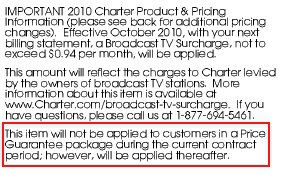
A Charter customer e-mailed this segment of their bill to clarify whether or not customers under a Price Guarantee contract would also pay the dollar fee.

If you find stubborn resistance to discounting your bill, consider showing up at the local cable office with your equipment and try negotiating one last time.

Charter Cable allows customers to cancel service and, after 30 days, sign up under a new customer promotion, so asking them to waive the 30 day requirement when it will save them money to reinstall service may be something they’ll consider.  You could also re-establish “new service” under a spouse’s name for an even faster turnaround.

As Charter has taught their subscribers, it’s all about business with them.  Turnabout is fair play, so give them the business about their pricing and demand savings.

[Updated 9:42pm ET — A Charter subscriber e-mailed Broadband Reports a copy of their latest Charter Cable bill saying the fee would -not- be applied to customers under a current Price Guarantee contract, in direct contradiction to what a Charter representative told us this morning.  This is not much of a surprise, considering it took eight calls to Time Warner Cable last week to get the straight story about their DVR price hike in upstate New York.

Perhaps we should start calling cable companies not less than five times for answers to basic questions and then average the responses we get.  As we said last week, we’ll believe the bill over what company representatives say any day.

Thanks to our reader Gabe and Broadband Reports for for alerting us to this development and helping clarify matters.]

[Update #2: 10:52am ET 9/16 — A Charter customer on Broadband Reports shared an online chat he had with Charter that shows I’m not the only one getting inaccurate information about this fee:

Scott: I heard that charter decided to add a new fee to user bills for “broadcast tv surcharge” even for customers that have locked in rates.

TTD Straissan : Yes. That is correct. The locked rates are for the services that are included on the locked promotion. Taxes and fees are not part of the locked promotion we have.

TTD Straissan : Broadcast TV Surcharge
Federal law allows local U.S. broadcast television stations (i.e., affiliates of networks such as CBS, NBC, ABC, Fox, etc.) to negotiate with cable and satellite providers in order to obtain “consent” to carry their broadcast signals (Cable Television Consumer Protection and Competition Act of 1992).

As a direct result of local broadcast, or “network-affiliated,” TV stations increasing the rates to Charter to distribute their signals to our customers, we will be passing those charges on as a Broadcast TV Surcharge, in the Taxes and Fees section of the billing statement. These local TV signals were historically made available to Charter at no cost, or low cost. However, in recent years the prices demanded by local broadcast TV stations have necessitated that we pass these costs on to customers.

This surcharge displays in the Taxes and Fees section of the bill statement.

Scott: when will this be on my bill?

TTD Straissan : Expected increase will be around October 1, 2010 on some areas.]

Search This Site:

Contributions:

Recent Comments:

Your Account:

Stop the Cap!