
Home » Competition » Recent Articles:

Shaw’s Shark-Like Wallet Biters Are Back for More of Your Money: Company Response Rebutted

Phillip Dampier October 28, 2010 Canada, Competition, Data Caps, Editorial & Site News, Shaw 5 Comments

A firestorm erupted this week on Broadband Reports over news that Shaw Cable was turning its existing “soft” Internet Overcharging scheme into a “hard” system filled with usage limits and overlimit fees.  One of Shaw’s social media representatives tried to throw some water on the fire:

I’ve seen a lot of discussion here about the new policy, and quite a bit of inaccurate or incomplete information and speculation, so I’d just like to set all of this straight.

Essentially, the system works like this: your package includes an allowance for a certain amount of traffic. If you exceed that traffic for one billing cycle, you will receive a notice on your bill advising you of the fact. We also automatically activate your traffic monitor so that you can monitor your usage from that time forward.

Since the bill arrives, of necessity, after your billing cycle ends, we give you a cycle’s grace between the period when you exceeded and when we start charging. That is to say that if you exceed in billing cycle one, you’ll receive your bill part of the way through billing cycle two, and so we won’t start charging for excess traffic until billing cycle three.

As to how much bandwidth will cost, here’s how it works:

If you exceed your monthly traffic allowance, you’ll receive a bill for $1 per GB for Extreme and above, $2 per GB for High Speed and High Speed Lite. Considering how much media, etc, you can obtain in 1 GB, $1 is not expensive.

However, if you plan to exceed by a considerable margin, data packs are also available, and what these do is allow you to increase the traffic allowance by the following amounts:

  • $5 for 10 GB
  • $20 for 60 GB
  • $50 for 250 GB

So this gives you the option to increase your monthly traffic allowance to meet your needs. It’s also considerably less expensive than the standard $1-$2 per GB rate.

The best part about the data packs is that you can apply them at any time up to three days before the end of your billing cycle. So if you discover that you’ve exceeded your included usage allowance, and still have three days to the end of the billing cycle, just give us a call (or chat) and ask that we add the appropriate data pack for you.

[…]I’ve seen some posts here suggesting that this new policy has been financially motivated to avoid upgrading our networks. That’s actually not the case. In fact, just a few weeks ago we increased the included usage for all of our services by 25%, just in time for NetFlix. If you want to think about it in financial terms, just consider how much more bandwidth the network would need to allow a 25% increase for every customer, and how much that kind of network upgrade would cost. It’s pretty clear that our motives are not financial. If they were, increasing the included usage would not be very sensible, would it? It would, after all, considerably reduce the number of customers exceeding their monthly traffic allowance, would it not?

I hope that this clarifies the situation, but if there are any questions, please do feel free to ask.

James – Shaw

Shaw tinkers with their Internet Overcharging scheme

In part, this rebuttal was also directed to Stop the Cap!, because we are actively participating in that discussion.  Shaw’s argument about usage limits and how the company’s implementation of them benefits their customers is familiar to many of our readers who fought off usage caps proposed by Time Warner Cable last year.  Somehow, the same company that sets unjustified limits and penalty prices on already-overpriced broadband service is doing customers a real favor by offering alternative pricing plans for heavier users that reduces war-crime profiteering to pickpocketing.

That’s logic Stalin might have appreciated, but most customers already burdened with high cable and broadband bills won’t.

Our response:

Don’t you just love it when Internet Overchargers always claim their new gotcha fees are never about the money?

“James” from Shaw offers a classic example of what happens when your broadband provider implements a scheme to boost your broadband bill and then claims it’s good news that the company has some options to keep those overlimit fees from stinging too badly.

When Internet Overchargers tell you it’s not about the money, it’s really ALL about the money.

Here's what happens when a third provider ruins a Canadian broadband duopoly

Who knew that an invisible border that makes unlimited Internet possible in Vancouver, Washington makes it impossible in Vancouver, B.C. Using Shaw’s argument, providers south of the border are headed straight for bankruptcy court while companies like Shaw barely hold on with “free usage upgrades” of existing limits.

But of course the financial reports for shareholders Shaw’s social media mavens don’t talk about tell the real story. Shaw enjoys considerable revenue from their broadband division thank you very much, and plans to do even better now that they can achieve ‘revenue enhancers’ from their enforced Internet Overcharging schemes.

That’s another way of saying Shaw’s Wallet Biters are back for more of YOUR money.

Whether it’s 20 cents per gigabyte (at least a 100 percent markup) or $2 (rape and pillage pricing), these schemes are hardly good news for Shaw customers. Indeed, if Shaw was truly concerned about saving their customers something under their cap ‘n tier regime, they’d deliver those “usage paks” to customers automatically instead of forcing them to call the company to add them when they go over the limit. If you remember to ask, Shaw gets extra profits they can take to the bank. If you forget, Shaw throws a Money Party on the extra high everyday overlimit rates.

What Shaw forgets to tell you is the cost to deliver increased usage and bandwidth to customers is ALWAYS dropping, and dropping fast. The price charged to move 10GB of traffic not too long ago moves 100GB today. So it’s hardly rough on Shaw to expand yesterday’s unjustified limit to today’s higher, still unjustified limit.

When one also considers yesterday’s “soft cap” is about to become tomorrow’s budget-busting “hard cap,” few Shaw customers are calling 1-800-FLOWERS to send a thank-you bouquet to Calgary.

Having been to Calgary, I know the people in Alberta and elsewhere across western Canada know a ripoff when they see one. They ask, “why is our broadband so overpriced and usage limited?” They wonder where the CRTC has been. They wonder why countries in Asia and even eastern Europe are now beating the pants off Canadian broadband with faster speeds at lower prices.

The fact is, Shaw pulls these overcharging tricks on their customers because they can. The broadband duopoly in Canada from cable and phone companies deliver punishing usage limits on Canada that are being banished in other countries around the world. Even notorious cappers like Australia and New Zealand are finally ridding themselves of broadband that is always capped, always throttled.

What would be sensible is that Shaw, a multi-billion dollar major player in Canada would plow some of their enormous profits into network capacity upgrades that can accommodate the needs of Canada’s growing knowledge economy, not inhibit its growth. Then, earn additional profits by selling even faster speed tiers and content customers can access over those networks.

Considering even Shaw admits only a small percentage of customers create traffic problem on their networks, it’s not hard to see the company’s new reliance on hard Internet Overcharging is designed to capture new revenue from those hitting their caps, thanks to the increasing number of broadband customers using their fast connections for high bandwidth content.

And hey — bonus: it also discourages those customers from even considering pulling the plug on their cable package to watch everything online.
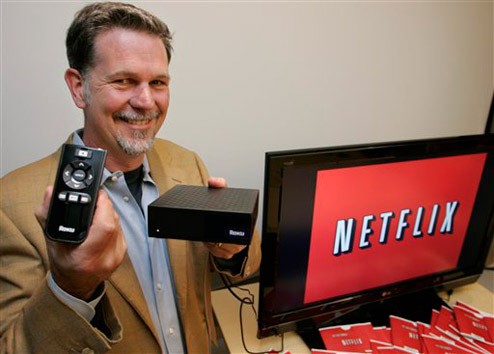

Netflix to Broadband Industry: Please Don’t Kill Us With Usage Caps

Reed Hastings, CEO of Netflix, shows off the company's growing reliance on broadband streaming, moving away from its original DVD-by-mail rental business.

Last week, Netflix CEO Reed Hastings was showered with questions from Wall Street during the company’s third quarter-results conference call.  At the top of the agenda — the company’s shifting business model away from DVD rentals-by-mail gradually towards instant on-demand streaming over broadband networks.

At issue is how Netflix can survive a broadband industry that controls the pipeline Netflix increasingly depends on for its continued existence.

Hastings tried to assuage his cable competitors by telling investors the company is hardly a threat to cable-owned movie channels and basic cable.  But he admits ultimately the company will be in a real mess if Internet Overcharging schemes like usage caps and speed throttles limit the amount of content customers can affordably access:

“We have some vulnerability depending on capped usage and what happens. Comcast has a cap, but it’s 250 gigabytes and so most users feel that they have an unlimited experience, and it gives us plenty of room to deliver a high-def stream. On the other hand, AT&T Mobile data on an iPad is now capped at two gigabytes, [and that’s] not enough room to deliver hours and hours of high-def.  We are definitely sensitive [to the issue] in the long term [whether] the industry ends up at 250 gigabytes or two at the other extreme.”

There is some limited evidence Netflix’s success in Canada is already being tempered by usage limits near-universally imposed in the country.  Rogers, a major cable company in eastern Canada, even reduced usage caps for certain tiers of service around the same time Netflix announced its imminent arrival north of the border.

Barry McCarthy, Chief Financial Officer notes fewer Canadians are converting their free trials of Netflix’s streaming service into paid subscriptions.

“We anticipate we are seeing slightly lower conversion rates in Canada than we see in the U.S.,” McCarthy told investors.

As Netflix moves towards higher quality video streams, the amount of data consumed increases as well.  In Canada, that eats into broadband usage allowances, and fast. As soon as customers start receiving warnings they are nearing their monthly usage limit, or receive a broadband bill with overlimit fees, Netflix is likely to lose that customer.

Cable and phone companies in Canada are already warning customers that online video is a major culprit of exhausted usage allowances.  Both are also happy to remind their customers they are happy to sell them access to unlimited video — through cable or telco TV subscriptions.  Rogers owns a major chain of video rental stores as well.

What can Netflix do about usage capped broadband?  Not much, admits Hastings.

“There is a not a lot of improvement in compression techniques. But what we can do is just deliver a lower bit stream, a lower quality video experience. So, for example, not too high-def. So, that’s one possible way to partially mitigate that impact,” Hastings said.

Netflix will soon face increasing competition, especially from the cable industry’s TV Everywhere projects, and they won’t deliver a lower quality video experience.

Time Warner Cable and Comcast this month both formally introduced their respective video on demand services.

Comcast’s Xfinity online service arrives after months of beta testing.   Comcast customers can watch video selections from nearly 90 movie and television partners, including programming from HBO, Viacom, and Paramount.  Ultimately, the online video service is expected to deliver access to dozens of cable channels and individual programs from studios and networks at no charge to those who subscribe to a cable television package.

Time Warner Cable took a more modest approach last week by introducing ESPN Networks to its cable subscribers who register with the cable company’s MyServices website.  The new customer portal allows subscribers to review and pay their cable bill, add new services (but not cancel existing ones), remotely program DVR boxes, and also verifies subscriber status for future cable subscriber-only online video programming.

Netflix may soon find itself at the mercy of the cable and telephone companies which deliver broadband access to the majority of Americans.  Not only is it difficult to convince customers to pay a monthly fee for programming the cable industry may eventually give away for free, it may be downright impossible for Netflix to survive if those providers decide to squeeze the customer’s pipeline to unlimited Netflix content.

[flv width=”640″ height=”380″]http://www.phillipdampier.com/video/Comcast Xfinity Ad Spot 10-2010.flv[/flv]

Comcast Ad Introducing Xfinity Online.  (1 minute)

Don Quixote: Angry N.J. Mayor Invites Other Cable Companies to Compete Against Cablevision

You can’t blame a guy for trying.  As the Cablevision-Fox dispute continues to drag on — keeping several Fox-owned cable networks and two New York stations off Cablevision screens, Hamilton Mayor John Bencivengo decided it was time to start shopping for some cable competition.

Bencivengo wrote thoughtful letters to executives of Comcast and Time Warner Cable trying to sell the two cable companies on coming to Mercer County.

“I am writing to inquire as to any interest your company may have in entering into Hamilton Township (Mercer County), NJ as a cable television provider,” Bencivengo’s letter reads. “I understand that any business decision would be predicated on the economic feasibility of entering into a new market, either through a franchise agreement with Hamilton Township or through a statewide franchise agreement available from the State of New Jersey through the BPU (Board of Public Utilities),” the letter reads. “It is a vibrant market that seems ripe for picking at this time.”

He’s also reminding both cable companies they are free and clear to deliver service just by signing a franchise agreement — the one Hamilton Township had with Cablevision expired back in 2005.

The New Jersey Times notes the area is not well-served by cable competition.  Verizon FiOS is an option for only about half of the residents of Hamilton, and only a quarter of residents in nearby Robbinsville.  The only other alternative is attaching a satellite dish to the roof.

Hamilton Township is part of Mercer County, N.J.

“Here we are again with stations that are pretty popular off the cable network without any reimbursement to the cable customers, and that’s unfortunate,” Bencivengo told the New Jersey newspaper. “I want to be proactive to try to woo these people to Hamilton Township.”

Unfortunately, the cable industry in the United States resembles an organized crime network (their prices sure are a crime), each with their own respective territories companies have quietly agreed never to cross.  Comcast and Time Warner Cable are the Godfathers of their respective service areas, and neither will compete head-to-head.  Even though many residents affected by the Fox blackout may think of Cablevision as the Fredo of the cable industry, the chances of another cable company arriving in town to compete with them is next to zero.

Verizon offers the most immediate opportunity for cable competition, but consumers will find pricing generally comparable to what Cablevision charges.

The mayor of Hamilton need not tilt at windmills, however.  There is another way.

If Hamilton Township is fed up with Cablevision’s HissyFits and Verizon’s high prices, the alternative is to build support for a community-owned municipal system that can deliver video, phone, and broadband service to residents.  That’s what communities ranging from Wilson and Salisbury, North Carolina to Opelika, Alabama are doing, among many others.

They’ve decided the future of their communities’ telecommunications needs can no longer be entrusted to a handful of bully boys who put customers in the middle of every dispute over the money those customers will ultimately have to pay no matter who wins.

It’s a far better long term solution than replacing one bad cable company with another.

Washington Post Hackery: Editorial for NBC-Comcast Merger Downplays WaPo’s Own Conflict of Interest

The Washington Post editorial page yesterday published a self-serving piece that openly advocated the approval of a merger between NBC-Universal and Comcast, creating one of America’s largest and most concentrated media companies.  But considering who owns the Post, the editorial might as well have been written by Comcast CEO John Roberts.

Containing only a non-specific disclosure that the newspaper “has interests in broadcast and cable television,” the editorial laments interference from “advocacy groups” that oppose the merger, claiming they are “poor prognosticators of the effects of large media mergers.”  The newspaper found no problems with media concentration in the United States, which itself should be an indictable offense, until one realizes the company that publishes the newspaper is, itself, a concentrated media company.

The Washington Post and Cable One are both owned by the same company.

The newspaper owns Cable One, a particularly nasty, low-rated cable operator that spied on its broadband customers and overcharges them for broadband service through a complicated Internet Overcharging scheme.  In fact, Cable One is the cable company that brought America the “$10/GB overlimit fee,” a low blow for the company’s customers on the so-called “economy tier,” which delivers pathetic 1.5Mbps service with a maximum limit of just 1GB!  This is the kind of cable company that proves sometimes dial-up service -is- better.

As far as the Post is concerned, the FCC will keep America safe from any uncompetitive market-power-enabled-abuses from a Comcast-NBC behemoth, itself a stunning statement from a newspaper that claims to know what is really going on in Washington.

Even our readers know complaining to the FCC about anything is like talking into a black hole.

When it comes to the Washington Post editorial page, profits come first, and Cable One can generate them with its own abusive pricing practices.

For the rest of the country, the irony of a dead-tree-format newspaper finger-pointing at advocacy groups (that don’t own cable companies), accusing them of getting the future wrong is a mighty rich irony.

The reality-based America I live in thinks media is already too-consolidated, too shallow, and increasingly abusive and too expensive.  The Post‘s advocacy of a mega-merger like Comcast-NBC only points to just how out of touch the newspaper is getting these days.  As Americans clamor for more media diversity, more competition, and more choices at lower prices, the Washington Post is just fine with the exact opposite.  But then you’d expect that from a company whose business plan depends on it.

World Wide Wait: DSL = (D)ead, (S)low and (L)ousy — the Dial-Up of the 2010s, Says Analyst

Telephone companies will lose up to half of their broadband market share if they insist on sticking with DSL technology to deliver Internet access, according to a new report from Credit Suisse analyst Stefan Anninger.

Anninger predicts DSL will increasingly be seen as the “dial-up” service of the 2010s, as demand for more broadband speed moves beyond what most phone companies are willing or able to provide.  Credit Suisse’s analysis says DSL accounts sold in the United States top out at an average speed of just 4Mbps, while consumers are increasingly seeking out service at speeds of at least 7Mbps.  The higher speeds are necessary to support high quality online video and the ability for multiple users in a household to share a connection without encountering speed slowdowns.

A lack of investment by landline providers to keep up with cable broadband speeds will prove costly to phone companies, according to Anninger. He believes a growing number of Americans understand cable and fiber-based broadband deliver the highest speeds, and consumers are increasingly dropping DSL for cable and fiber competitors.  Any investments now may be a case of “too little, too late,” especially if they only incrementally improve DSL speeds.

Anninger says providers may be able to offer up to 18Mbps in five years by deploying ADSL 2+ or VDSL technology, but by that time cable operators will be providing speeds up to 200Mbps, and many municipal providers will have gigabit speeds available.

The impact on phone company broadband market share will prove bleak for phone companies in all but the most rural areas, Anninger predicts.  He says by 2015, cable companies will have secured 56 percent of the market (up by 2 percent from today), phone companies will drop from 30 percent to just 15 percent, Verizon FiOS, AT&T U-verse, and wireless broadband will each control around 7 percent of the market, with the remainder split among municipal fiber, satellite, and other technologies.

Anninger is also pessimistic about wireless broadband being a wired broadband replacement in the next five years.

A Credit Suisse online survey of 1,000 consumers in August found that less than half would consider going wireless only.  The reasons?  It’s too slow, too expensive and most plans have Internet Overcharging schemes like usage caps and speed throttles.

Although cable companies are on track to be the big winners in broadband market share, still have one giant hurdle to overcome — a lousy image.  Just 36 percent of cable customers say they are “very satisfied” with their local provider.  More than 60% of FiOS and U-verse’s broadband customers said they are “very satisfied” with the services these advanced telephone company networks provide.  Consumer Reports has regularly awarded top honors to Verizon FiOS for the last several years.

Independent phone companies and smaller cable operators routinely score at the bottom, typically because they are relying on outdated technology to supply service.

This makes the marketplace ripe for disaffected consumers to jump to an alternative provider.  Unfortunately, as most Americans face a duopoly of the cable company they hate and the phone company that doesn’t deliver the services they want, there is no place for them to go.

Anninger also predicts the risk of broadband reform by reclassifying broadband under Title II at the Federal Communications Commission is now “minimal.”  That suggests Net Neutrality enforcement at the FCC is not a priority.  The Credit Suisse analyst says if action hasn’t been taken by winter or spring of next year, it’s a safe bet the Commission will never re-assert its authority.

Search This Site:

Contributions:

Recent Comments:

Your Account:

Stop the Cap!