Home » Competition » Recent Articles:

Broadband Hearings Expose Emptiness of Provider Talking Points About Internet Overcharging

Phillip Dampier February 14, 2011 Audio, Bell (Canada), Broadband "Shortage", Canada, Competition, Consumer News, Data Caps, Editorial & Site News, Public Policy & Gov't, Video Comments Off on Broadband Hearings Expose Emptiness of Provider Talking Points About Internet Overcharging

Canada’s House of Commons Standing Committee on Industry Science and Technology has taken an in-depth look at Internet Overcharging in an ongoing series of hearings to explore Bell’s petition to charge usage-based billing.  The request, earlier approved by the Canadian Radio-television and Telecommunications Commission (CRTC), would end flat rate, unlimited usage plans across the country, and mandate Bell’s proscribed usage cap regime on every ISP in Canada.

Remarkably, even Canada’s Conservative Party, which laid the deregulatory framework that allowed Canada’s barely-competitive market to stick it to consumers and small businesses, refuses to defend the overcharging schemes.

So far, the three hearings deliver everything Stop the Cap! has warned about since we began this fight in the summer of 2008:

  1. Proof that usage caps, and consumption-based billing have nothing to do with cost recovery or fairness.  They are, at their root, economically engineered to discourage use of the Internet and protect revenue from the provider’s other businesses, especially video.
  2. There is no evidence of a data tsunami, exaflood, or whatever other term providers and their financially-connected allies in the equipment business cook up to warn about an explosion of data usage mandating control measures.  Data usage is increasing at a slower rate than the development of new equipment and fiber pipelines to manage it.
  3. Nobody ever saves a thing with Internet Overcharging schemes.  While Bell and other providers make up scary stories about “heavy users” picking “innocent” users’ pockets, it’s the providers themselves making all the money.  In fact, bytes of data have no intrinsic value.  The pipelines that deliver data at varying speeds do, which is why providers are well-compensated for use of them.  Levying additional charges for data consumption is nothing more than extra profit — a broadband usage tax.  Providers make plenty selling users increasingly profitable connections based on speed.  They do not need to be paid twice.
  4. For all the talk about the need to invest in network expansion, Bell has reduced infrastructure spending on its core broadband networks the last three years’ running.  They are spending more on deploying Internet Protocol TV (IPTV), a service the company swears has nothing to do with the Internet or their broadband service (despite the fact it travels down the exact same pipeline).
  5. Caps and usage billing never bring about innovation, except from providers looking for new ways to charge their customers more for less service.

I strongly encourage readers to spend an evening watching and listening to these hearings.  At least download the audio and let Canada’s broadband story penetrate.  You will laugh, cringe, and sometimes want to throw things at your multimedia player.

In the end, the hearings illustrate the points we’ve raised here repeatedly over the past three years, and it only strengthens our resolve to battle these Internet pricing ripoffs wherever they appear.  If you are a Canadian citizen,write your MP and demand an end to “usage-based billing” and make it clear this issue is paramount for your vote at the next election.  Don’t debate the numbers or waste time “compromising” on how much you want to be ripped off.  There is no middle ground for usage-based pricing.  It should be rejected at every turn, everywhere, with no compromises.  After all, aren’t you paying enough for your Internet connection already?

The Standing Committee on Industry, Science and Technology

Meeting # 54 – Usage-based Billing Practices

February 3, 2011

This video is encoded in the Windows Media format which presents some technical challenges.  Full screen or 200% zoom-viewing mode is recommended.

[For Windows users, right click the video and select ‘Zoom->Full Screen’ or ‘Zoom->200%’.]

This hearing was televised and had the most media attention.  Testimony from the CRTC was decidedly defensive, and almost entirely in support of usage-based billing and Bell’s petition.  The Commission found no friends in this hearing.

Appearing from the Canadian Radio-television and Telecommunications Commission: Konrad W. von Finckenstein, Chairman; Len Katz, Vice-Chairman, Telecommunications; Lynne Fancy, Acting Executive Director, Telecommunications.  (1 hour, 29 minutes)

If you want to take the hearing audio along for a ride, you can download the MP3 version.

The Standing Committee on Industry, Science and Technology

Meeting # 55 – Usage-based Billing Practices

February 8, 2011

The second in a series of hearings exploring Usage-based billing included witnesses from independent Internet Service Providers who could face extinction if they are forced to pay higher prices for wholesale broadband access.

Appearing: Rocky Gaudrault, CEO of TekSavvy Solutions Inc., Matt Stein, vice-president of network services for Primus Telecommunications Canada, and Jean-François Mezei, a Montreal-based telecommunications consultant who most recently petitioned the CRTC to repeal its decision. (120 minutes)

You must remain on this page to hear the clip, or you can download the clip and listen later.

The Standing Committee on Industry, Science and Technology

Meeting # 56 – Usage-based Billing Practices

February 10, 2011

The third in a series of hearings exploring Usage-based billing included witnesses from Bell Canada, which originally proposed the idea, and additional testimony from independent Internet Service Providers and their trade association, and consumer advocates who oppose the pricing scheme.

Appearing: OpenMedia.ca: Steve Anderson, Founder and National Coordinator. Bell Canada: Jonathan Daniels, Vice-President, Law and Regulatory Affairs; Mirko Bibic, Senior Vice-President, Regulatory and Government Affairs. Shaw Communications Inc.: Jean Brazeau, Senior Vice-President, Regulatory Affairs; Ken Stein, Senior Vice-President, Corporate and Regulatory Affairs. Canadian Association of Internet Providers: Monica Song, Counsel, Fraser Milner Casgrain LLP. MTS Allstream Inc.: Teresa Griffin-Muir, Vice-President, Regulatory Affairs. Union des consommateurs: Anthony Hémond, Lawyer, Analyst, policy and regulations in telecommunications, broadcasting, information highway and privacy. Canadian Network Operators Consortium Inc.: Bill Sandiford, President; Christian S. Tacit, Barrister and Solicitor, Counsel. (128 minutes)

You must remain on this page to hear the clip, or you can download the clip and listen later.

Bell Admits Usage Billing is About Smashing Independent Competition

During the third day of hearings on usage-based billing, Mirko Bibic from Bell admitted that usage-based billing “prevents [other ISPs] from differentiating their offers from our own.”

That remarkable admission is exactly what independent Internet Service Providers have been arguing since the issue of wholesale usage-based billing was first proposed by Canada’s largest broadband supplier.

Independent providers have managed to carve out a niche supplying primarily residential DSL customers with flat rate usage plans, made possible because of wholesale access provisions assured under Canada’s telecommunications regulations.  As Bell, Rogers, Shaw, and Videotron have systematically imposed usage limits on their residential customers (and occasionally lowered them), consumers seeking better value have found it from smaller ISPs that still offer unlimited access.

As Bell frets over its inability to reap retail revenue from customers departing for other providers, the idea of imposing usage-based billing on wholesale accounts ends that revenue erosion once and for all.  As Bell admits, it forces every provider in Canada to charge the same high prices they do for Internet access.

Canada’s telecom regulator, the CRTC, still cannot define what a “heavy user” is, and neither could Bibic.  But with these pricing schemes, now they don’t have to.  Imposing higher prices with vague promises that the resulting revenue will expand Canada’s broadband networks is eerily familiar to what Time Warner promised residents in several major cities, and then didn’t deliver.

In western New York, the cable company promised a new generation of blazing fast speeds on a world class broadband network, as long as customers agreed to pay up to $150 for unlimited residential service per month.  The old price was $50.  But the cable company provided those upgrades in other cities instead — without usage based pricing.  No wonder residents were furious.  After two weeks of protest, Time Warner threw in the towel.

Two years later, the promised upgrades are finally slated to arrive, long after being made available in most large cities in New York State.

Provider-promised bait and switch broadband upgrades merely represent sucker bets, and no one except the provider wins.

If Bell gets its way, there will be no reason for anyone to do business with an independent service provider.  They’ll be forced to charge increased prices, sometimes even higher than Bell itself.

Stealing the Broadband Revolution with Internet Overcharging: A Report from CBC Radio

Phillip Dampier February 9, 2011 Audio, Canada, Competition, Consumer News, Data Caps, Online Video, Public Policy & Gov't Comments Off on Stealing the Broadband Revolution with Internet Overcharging: A Report from CBC Radio

CBC Radio One: The Current explores Internet Overcharging in Canada:

It’s hard to believe that just eighteen years ago — back in 1993 — we were only beginning to grasp what the Internet could do for us. Today, the Internet is an integral part of the global economy, a powerful political tool, and something many couldn’t imagine living without. That’s partly why the cost of Internet access has been at the centre of a national debate for the past week.

The debate was sparked by the CRTC’s decision to approve what’s known as “usage-based billing.” Then Federal Industry Minister Tony Clement tweeted that Ottawa wouldn’t accept the ruling. And the CRTC is now reviewing its decision and has put out a call to Canadians asking them to weigh in with their opinions.

Today we look at the implications of the different ways of charging for Internet access and we also ask if the Internet should be treated more like a utility or even a human right.

CBC Radio One’s program, The Current explores Canada’s attitude towards usage-based billing and what implications it hold for an increasingly digital society. Steve Anderson from Openmedia.ca joins the program to debate the notion usage-based billing “saves” light users’ money.  (28 minutes)
You must remain on this page to hear the clip, or you can download the clip and listen later.


CRTC Begins Government-Mandated Review of Usage Based Billing

Despite claims from the Canadian Radio-television and Telecommunications Commission that it is reviewing its recent decision about usage-based billing on its own accord, the telecommunications regulator has bowed under government pressure to begin an immediate review of the Internet billing practice.

At issue is how Bell prices wholesale access to Internet bandwidth, utilized by most independent Internet Service Providers who resell that access to residential and business customers, often for a flat monthly rate.

The original CRTC decision would allow Bell to charge wholesale prices not based on annual contracts, but rather on the amount of usage consumed by their wholesale clients.  The CRTC ordered Bell to discount its wholesale rates by 15 percent earlier this month, but that amount was too small to stop providers from canceling unlimited use service plans across Canada.

The decision sparked a public outcry.  Hundreds of thousands signed a petition demanding the CRTC rescind its decision.  In fact, so many signed it broke all-time records for a petition drive.

Industry Minister Tony Clement announced last week that if the CRTC didn’t reverse its decision, the government would.  Despite an intransigent appearance before a Commons committee late last week, CRTC chair Konrad von Finckenstein has been moderating his position this week.

“The great concern expressed by Canadians over this issue is telling of how much the internet has become an integral part of their lives,” the chairman acknowledged in a statement issued yesterday.

The CRTC now says it is open to views from the public about Internet pricing as part of its review.

The commission will seek public comments until April 29 through an online form on:

  • How to make sure ordinary consumers served by small ISPs don’t have to “fund the bandwidth used by the heaviest residential internet consumers.”
  • How to ensure small ISPs offering “competitive alternatives” to large ISPs can continue to do so.
  • Whether small ISPs should be required to buy a minimum amount of bandwidth per retail customer when purchasing network access wholesale from large ISPs, and, if so, what that minimum should be.
  • Whether the CRTC should hold an online consultation as part of its review.
  • Whether the CRTC should hold an oral public hearing as part of its review.

[flv width=”640″ height=”388″]http://www.phillipdampier.com/video/CBC CRTC Reviews UBB 2-8-11.flv[/flv]

CBC News reports the CRTC will review its earlier decision that eliminated flat-rate broadband plans in Canada.  (2 minutes)

AT&T’s Microcell Giveaway: Holding Onto (Some) Rural Customers With Mini Cell-Towers

Gertraude Hofstätter-Weiß February 9, 2011 AT&T, Competition, Consumer News, Wireless Broadband Comments Off on AT&T’s Microcell Giveaway: Holding Onto (Some) Rural Customers With Mini Cell-Towers

Here in West Virginia, cell phone reception is often by the grace of God.  The incredibly mountainous state makes “line of sight” communications a real problem when the nearest cell tower is blocked by a gigantic shale rock formation someone blasted through to build a road decades earlier.

AT&T probably still delivers the largest coverage of rural areas in the state because its towers expand beyond the major highways other carriers cover. But even with that expanded service, using a smartphone indoors is going to be a problem in many places.

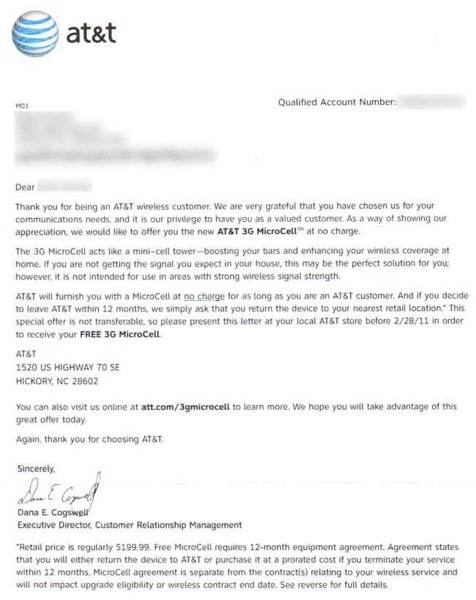
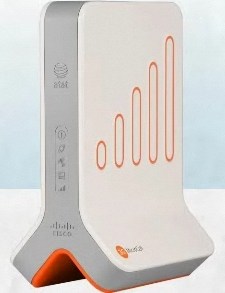
Recently, AT&T sent letters to approximately 7.5 percent of their customers in the rural areas most likely to have reception problems, offering a free “MicroCell,” which is comparable to a mini cell tower inside your home or office.  The equipment works with your existing broadband connection to expand “coverage” inside your home.  For data purposes, the MicroCell doesn’t deliver anything your personal Wi-Fi connection couldn’t, but if you rely on a cell phone, having signal bars makes all the difference if you are waiting for an important call.

A considerable number of those letters reached families in West Virginia, and that is no surprise considering the state is by far the most difficult to blanket with wireless coverage in the eastern half of the country.

A letter to AT&T customers inviting them to receive a free MicroCell

But the problem is, some families are receiving the free offers, while others are not, and that is creating reception envy.

AT&T 3G MicroCell

Charlotte, who lives in Whipple, W.V., outside of Oak Hill, was visiting with her neighbor Joy last week and noticed her husband fiddling with the latest gadget on his computer desk.

“It looked odd because of the way it spread out on the bottom, so I asked Joy what in the world he was installing,” Charlotte says.

“It’s a cell tower thing AT&T gave us to get better reception,” Joy responded.

Despite the fact the two families live only a few homes apart and signed up for AT&T service with the exact same phones within weeks of each other, Charlotte was never offered AT&T’s MicroCell.

AT&T notified qualified customers with a letter containing a personal reservation code, and the offer was not transferable.

“Maybe you got it and threw it away,” Joy offered.

“No, ever since the credit card companies started changing terms on us, we open every envelope that comes into this house,” Charlotte replied.

Assuming it must be an oversight, Charlotte dropped by her local AT&T store to inquire about the offer.

“We quickly learned we were not the first family to bring up this issue with AT&T as the store manager told us he was fielding complaints from all over town about the highly-selective offer,” Charlotte said.

Even worse, there was nothing the manager could do to rectify the situation.

“His hands were as tied as my patience was tried,” Charlotte tells Stop the Cap!

“The store manager offered to sell me the MicroCell for around $100 with a rebate, but why should I pay AT&T for better reception they should already be providing?” Charlotte asks.  “It seems to me if they are giving away these things to some people in a neighborhood, they should be doing it for everyone, because we pay the same bill our neighbors do.”

The seemingly random offers of MicroCell units are not limited to West Virginia.  We’ve noticed complaints from residents in northern California, the Pacific Northwest, and northern New England from others who get reception while outdoors or on the go, but find their phones useless for making and receiving calls at home.

In most cases, irate customers seeking redress from AT&T run into a bureaucratic brick wall.

Rick McGee, commenting on Engadget’s website:

I have talked to Marketing, Technical Support, and my local store, and nobody can tell me who to contact to qualify for a MicroCell. I have been an AT&T Mobility customer for over four years, with four family plan phones and two more phones on corporate contracts. The reception at my house is usually zero, at times maybe one bar, but never enough to maintain an incoming call or make an outgoing call. I guess I am a glutton for punishment, but this is the last straw.

If AT&T does not magically send me one of the MicroCell coupons, I will total up my termination fees and determine the earliest date I am willing to dump AT&T and try another carrier. In addition to the cell phones, I have two AT&T land lines, plus an AT&T internet account, so I am likely in the top tier of residential customers. With no reception at my house, I don’t see how I would fail to qualify for a MicroCell, but AT&T has no process to help individual customers with bad reception. Everyone I talk to claims ignorance. I’ve done my part, AT&T — either step up, or I am gone.

Others find similar experiences — apologies from in-person sales staff about the corporate roadblocks even they cannot navigate around.

But every once in awhile, one does.  Casey Robinson’s neighborhood lost all AT&T cell phone service when their local cell tower was destroyed in a storm.  The replacement redirected most of its signal elsewhere, leaving them with no bars.

After arguing with corporate phone support in the AT&T store for 2 hours they told me pay the $149 [for a MicroCell] or tough luck. I responded by telling them to take my family plan +2 lines, my roommates family plan +3 lines, and our Uverse U400 package with high speed internet and shove it, we will be changing carriers immediately since I have tower data from AT&T pre and post storm to show they breached our contract.

The AT&T store rep was amazing through all of this. He apologized continuously and said if it was up to them they would give out the MicroCell as soon as we walked in the door, unfortunately their computers physically block them from comping a MicroCell. While I was very distraught on the phone with AT&T, he called his manager at home and explained the situation. She drove in to the store, again apologizing for everything we had to go through, checked us out with the MicroCell then credited our account for the full purchase price and credited a month’s service to both my line and my roommate’s line for the issues we had been having. They are the only reason we still have AT&T. Of course we wrote to their district manager and AT&T corporate applauding the employee and manager, and of course from what we’ve heard they still haven’t been acknowledged for their good work.

Some others have had recent success filing complaints with the Better Business Bureau, when executive level customer service representatives come to the rescue with a free MicroCell.

Charlotte’s family intends to deal with the MicroCell Gap in their own way — by switching to Verizon Wireless, which improved service in the Oak Hill region a few years ago while they’ve been under contract with AT&T.

“We were willing to put up with the MicroCell doing the job their own cell towers should be doing, but because they don’t care about us, we’re done with them,” Charlotte says.

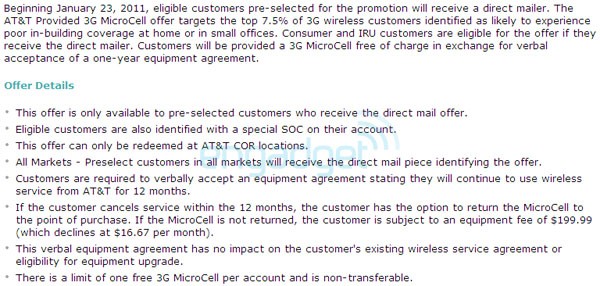
Customers accepting AT&T’s free offer must verbally commit to stay with the carrier at least 12 months or return the MicroCell when they depart.  If they don’t, AT&T will bill an equipment fee up to $199.

Engadget obtained this inside memo about the MicroCell offer.

Search This Site:

Contributions:

Recent Comments:

Your Account:

Stop the Cap!