Home » Competition » Recent Articles:

North Carolina: Your Phone Calls & E-Mail Bring “Unwanted Attention” to Corporate Giveaway

Consumers across North Carolina can celebrate their successful effort to protest legislation that would effectively ban community-owned broadband networks in the state.

Thanks to an outpouring of phone calls and e-mails this afternoon, legislators have been forced to delay placing the controversial legislation on the agenda for tomorrow’s planned meeting.  Our sources tell us the reason for the delay was “all of the unwanted attention” the bill was getting from outraged citizenry.

But victory may be short-lived.  The proposed legislation has been re-inserted on the agenda for a meeting to be held next Wednesday.  That means one more week for you to keep the pressure on.

Use this time to tell your friends and family to contact legislators and let them know in no uncertain terms this bill needs to be killed for good right now.  One week, one month, or one year — there is no good time for this kind of corporate welfare to become law in a state that has a long way to go to achieve top-rated broadband service.  North Carolina’s economy depends on robust, world-class broadband.

The state’s phone and cable companies are spending their money on lobbyists to defeat competition, not bring the kind of service communities in Wilson and Salisbury now enjoy.

Call to Action: North Carolina’s Big Telecom Corporate Welfare Bill Being Fast-Tracked

Rep. Marilyn Avila

North Carolina residents:  Rep. Avila’s H129, brought to you by Time Warner Cable, is being jammed through the state legislature tomorrow with no public input, no real review, and no thought for the ordinary voter in the state.

The House Public Utilities Committee will “discuss” the measure during Wednesday’s Public Utilities Committee meeting at 12 noon, in room 643 of the Legislative Office Building in Raleigh, quickly followed by a vote.  Bought and paid for by the state’s cable and phone companies, this bill will guarantee every resident in the state will face relentless rate increases, unchecked by competition.  Even worse, the state of the art broadband networks that finally deliver the kind of quality broadband the state deserves will be forced to shut down because of the ludicrous conditions the legislation requires for them to continue.

That means no more fiber broadband for your state — just the same old slow cable and DSL service that has left North Carolina far back in national broadband rankings.  Even worse, without community-owned networks, the chances of a competitor arriving to bring better service at lower prices are practically zero.

For rural North Carolina, H129 is nothing less than total devastation.  It will destroy any chance for rural communities to take care of the broadband needs of their citizens big cable and phone companies have ignored for years.  Make no mistake — H129 spells disaster for every North Carolina resident who isn’t an executive of a cable or phone company.

No citizens have asked for H129 to be introduced. It, like all of its predecessors, is a creature of Big Telecom — custom-written to do their bidding at your personal expense.  With a wined-and-dined Republican majority (some of whom were flown out to San Diego for a telecom-paid vacation seminar, complete with a BBQ bash), the only thing that stands in the way of this nightmare becoming law is you.

Every legislator knows there is a price to be paid for special interest legislation like this.  If it threatens to cost them enough votes to put their re-election at risk, they will bury the legislation or openly vote against it.  If they believe you are not paying attention, they’ll vote yes and gratefully accept the cable company’s next contribution check for a job well done.

You have less than 24 hours to make sure they know you are paying attention, and you will not support any legislator who votes against your best interests.

Tell them to vote NO on H129. Representative Steen is the Committee Chair and can be reached at [email protected] or 919-733-5881.

Here is a complete contact list for your convenience.  Click on the representative(s) to get their direct contact information.  Phone calls are most effective followed by e-mail.  Feel free to pursue both.

North Carolina's House of Representatives

The House Public Utilities Committee

Chairman Rep. Steen
1st Vice Chairman Rep. Brubaker
2nd Vice Chairman Rep. Cook
3rd Vice Chairman Rep. Hager
Members Rep. K. Alexander, Rep. Blackwell, Rep. Brawley, Rep. Brisson, Rep. Collins, Rep. Dockham, Rep. Earle, Rep. Gill, Rep. Harrison, Rep. Hastings, Rep. Hilton, Rep. Hollo, Rep. Howard, Rep. Jeffus, Rep. Johnson, Rep. LaRoque, Rep. Lucas, Rep. Luebke, Rep. McComas, Rep. McLawhorn, Rep. T. Moore, Rep. Owens, Rep. Pierce, Rep. Pridgen, Rep. Samuelson, Rep. Setzer, Rep. Tolson, Rep. E. Warren, Rep. H. Warren, Rep. West, Rep. Womble, Rep. Wray

North Carolina's Cable Monopoly Protection Act

QUESTIONS THAT NEED TO BE ASKED ABOUT REP AVILA’S ANTI-BUSINESS, ANTI-LOCAL BROADBAND BILL

Will the industry be subject to the “level playing field” requirements of H129/S87?

NO. The industry would cease providing broadband services if they were subject to the requirements of this bill, due to the onerous burdens it places on broadband providers.The federal government and North Carolina deregulated broadband and cable services years ago; this bill re-regulates those services only if they are provided by local communities. The purpose of this industry-sponsored bill is to slant the competitive playing field in the industry’s direction and prevent local communities from providing their residents the broadband they need.

Why does the industry want local governments subject to the requirements of H129/S87?

So local broadband networks don’t develop Industry spokesmen say if local governments want to enter the broadband business they must play by the same rules as the private sector. Cable and broadband services were deregulated years ago and community broadband systems are subject to the same broadband rules as the private companies. This bill is designed to remove business and consumer choice and access to broadband services.

Is this bill actually good for the private sector?

NO. This bill will harm the private sector. The real private sector, local businesses, depend on access to reliable, advanced broadband infrastructure to sell goods and services.Yet large portions of our state remain unserved by the large telecoms or are served by unreliable, dated technology.  So local communities have stepped in to build the critical reliable infrastructure that will let their private sector flourish. This bill is only good for the large out-of-state telecom corporations whose monopolies benefit from being able to charge our local businesses higher rates due to lack of choice. North Carolina needs more broadband providers, not less.

Will this bill prevent public/private broadband partnerships, like Google Fiber?

YES. §160A-340.4 limits the funding, construction or improvement of any community broadband to general obligation bonds which impose severe limits on private sector investments in the system.  This bill will stop even public/private attempts to compensate for a lack of local broadband service.

Are the cable and telephone industry really interested in the welfare of taxpayers?

NO. The industry does not care about local taxpayers; they care about profit. If Time Warner Cable cared about taxpayer burdens,why have they raised cable rates on businesses and residential taxpayers every year? §160A-340.4 of the bill, actually shifts the financial risk of local systems directly to taxpayers by requiring that community systems are funded directly on the backs of taxpayers via general obligations bonds. §160A-340.1(b) also removes the requirement that the public vote before the sale of a community system occurs!

Big Telecom dollars buy custom-written corporate welfare bills that you will eventually pay for.

How do we ensure public accountability on public broadband projects without H129/H87?

The General Assembly has already established: (1) rules governing Public Enterprises (NCGS Chapter 160A, Article 16); (2) strict rules in the Budget and Fiscal Control Act governing all municipal budgets and expenditures, including hearing and disclosure requirements (NCGS Chapter 159, Article 3); and (3) strict oversight of municipal borrowing by the Local Government Commission (NCGS Chapter 159); and municipalities are subject to public document “Sunshine” laws, which Time Warner Cable has repeatedly used to obtain access to municipal financial and strategic planning decisions. In contrast, North Carolina’s telephone and cable companies are not required to publicly reveal any information about their systems.

Are portions of H129/S87 unconstitutional?

YES. The big telecoms want you to vote for a bill that is in contravention of NC’s state constitution. Their bill violates § 2(3) of Article v of North Carolina’s Constitution, which exempts all municipally-owned property from taxation by requiring municipalities to pay property taxes on broadband and other communication systems by renaming the property tax a “payment in lieu of taxes.

Will H129/S87harm public safety networks?

YES. Public Safety networks are typically regional communication networks of Counties, Cities, and Towns who pay fees and receive federal grants to cover operational costs. This bill would shut them down by limiting their service areas and imposing restrictive rate-setting and financial limitations;it will also make them ineligible for Homeland Security, ARRA and Farm grants.


Wealthy Suburbs Pay the Least for Broadband, Inner City Areas Overcharged, Rural America Pillaged

Phillip Dampier February 21, 2011 Broadband Speed, Competition, Public Policy & Gov't, Rural Broadband, Wireless Broadband Comments Off on Wealthy Suburbs Pay the Least for Broadband, Inner City Areas Overcharged, Rural America Pillaged

Inner city Americans pay substantially more for broadband service than their neighbors in wealthy suburbs, while rural America pays the highest prices of all for broadband service, according to the results of a new study.

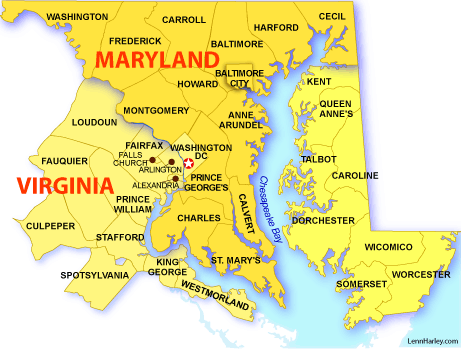
The Investigative Reporting Workshop at American University analyzed broadband speeds and service around the nation’s capital to learn how broadband is priced in different neighborhoods and communities.  The study covered the eighth largest metro area, which included over five million residents in the District of Columbia, Maryland, and Virginia.

Broadband providers never release specific data about their customers’ broadband service and the prices they pay for it, considering it a closely guarded business secret.  The Workshop went direct to consumers to get around this limitation, combining actual speed test results with the true cost of standalone broadband service reported by study participants.  It’s among only a handful of studies that rely on actual raw performance and pricing data — not company-provided general marketing information about speeds and pricing.

The conclusions expose a dramatic difference in broadband pricing depending on where one lives, what company they do business with, and how well each company’s network performs.

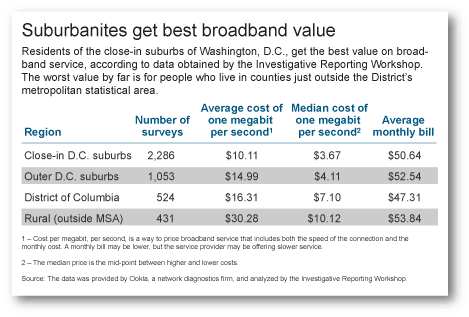
The results?  Broadband pricing was cheapest from Comcast, the region’s dominant cable company and most expensive, by far, from a wireless ISP (WISP) that serves the Culpepper, Virginia area.  Residents in wealthy suburbs in Fairfax County, Virginia and Montgomery County, Maryland enjoyed the best bang for their buck, charged nearly half the price-per-megabit that residents inside the urban District of Columbia pay.  Rural residents were stiffed with high prices for comparatively slow speed service.

Verizon, the area’s dominant phone company did poorly in the study, in part because of the substantial number of legacy DSL customers who are paying a lot for little speed.  Although Verizon’s fiber-optic FiOS service is making inroads in some parts of the study area, its high speeds don’t reach enough customers to offset Verizon’s larger base of DSL customers.

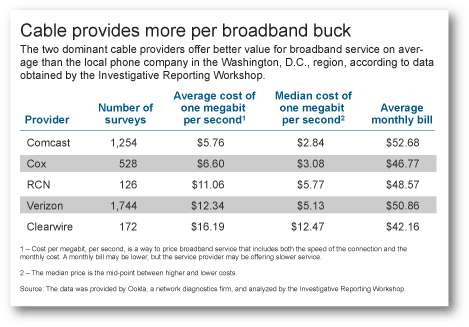
Here’s how Comcast and Verizon compared:

  • Comcast, according to an average of 1,254 surveys, charged customers $5.76 per Mbps;
  • Verizon, according to 1,744 surveys, charged $12.34 per Mbps — more than twice as much as Comcast.
  • Verizon charged $50.86 per month on average.
  • Comcast charged $52.68.
  • The median, or midpoint price, is much lower, at $5.13 per Mbps for Verizon and $2.84 for Comcast.

Cox Communications, a cable company that serves Fairfax County and Fredericksburg in Northern Virginia, charges $6.60 per Mbps, according to 528 surveys. Cox’s monthly average cost was $46.77.

Rounding out the five regional providers, RCN Corp., averaged $11.06 per Mbps, or $48.57 per month, for a median price of $5.77 per Mbps, according to 126 surveys, and Clearwire Corp., according to 172 surveys, averaged $16.19 per Mbps for $42.16 per month and a median price of $12.47 per Mbps.

By far the worst values went to rural customers.  Overall, the study found rural residents pay $30.28 per Mbps (based on 431 surveys) and $53.84 per month for service, a per-megabit rate far higher than the other three regions.

Virginia Broadband LLC, a Culpeper, wireless broadband provider, offered the worst value. According to a summary of 24 surveys, the company charges a whopping $198.13 per Mbps, the most of any company that underwent more than one test. The average monthly bill was $94.07, and the average speed was less than a megabit per second.

Comcast, RCN, and Virginia Broadband did not respond or refused to comment.  Verizon said the results were unfair because it did not distinguish between FiOS fiber to the home customers and their traditional DSL service.

They also criticized the study’s price comparisons, which relied solely on standalone broadband service pricing.  Verizon, like most providers, discounts services to customers who choose to bundle their telecommunications products together.

The study arrives at the same time the federal government has released their own national broadband map, which relies to a large degree on information volunteered by broadband providers.

The study has been criticized for not accurately depicting true broadband speeds and pricing, which can distort the true picture of broadband availability across the United States.

Can Google TV Replace Your Cable Service?

Gertraude Hofstätter-Weiß February 21, 2011 Competition, Consumer News, Online Video, Video 1 Comment

[flv width=”480″ height=”380″]http://www.phillipdampier.com/video/WCPO Cincinnati Can Google TV Replace Cable 2-18-11.flv[/flv]

Can Google TV replace your monthly cable bill?  WCPO-TV in Cincinnati explores whether the time is right for getting rid of cable television.  (3 minutes)

The National Broadband Map is Here, and It Has Some Flaws

The National Telecommunications and Information Administration unveiled America’s broadband map early this morning, showing broadband availability, speeds, and coverage areas across all 50 states.

“A state-of-the-art communications infrastructure is essential to America’s competitiveness in the global digital economy,” said Acting Commerce Deputy Secretary Rebecca Blank. “But as Congress recognized, we need better data on America’s broadband Internet capabilities in order to improve them. The National Broadband Map, along with today’s broadband Internet usage study, will inform efforts to enhance broadband Internet access and adoption — spurring greater innovation, economic opportunities, and advancements in health care, education, and public safety.”

The map, searchable by street address or zip code, delivers data largely volunteered by service providers themselves.  Some of the data, particularly for broadband speeds, represent best-case scenarios, not actual results.  Regardless, looking at the nation as a whole, there are some dramatic gaps in coverage.  Large areas west of the Mississippi are without broadband, which can be understandable in the sparsely populated region.  To the east, the biggest problem by far as in the Appalachians, especially in West Virginia, western Virginia, and the western Carolinas.  West Virginia in particular stands out as the state with the least amount of coverage in the east, perhaps only rivaled by Maine.  In the southern U.S., Alabama, Mississippi, Louisiana, and northern Florida are problem areas.  East Texas outside of major cities is as well.  In rural areas, the coverage map fills in the most when rural wireless mobile providers are introduced, but their broadband plans are hardly suitable as a replacement for wired, unlimited access service.

“The National Broadband Map shows there are still too many people and community institutions lacking the level of broadband service needed to fully participate in the Internet economy. We are pleased to see the increase in broadband adoption last year, particularly in light of the difficult economic environment, but a digital divide remains,” said Assistant Secretary for Communications and Information and NTIA Administrator Lawrence E. Strickling. “Through NTIA’s Broadband Technology Opportunities Program, digital literacy activities, and other initiatives, including the tools we are releasing today, the Obama Administration is working to address these challenges.”

Reviewing the map for Stop the Cap!‘s headquarters — Rochester, N.Y., shows a correct list of providers, but the data about their products is more fantasy than reality:

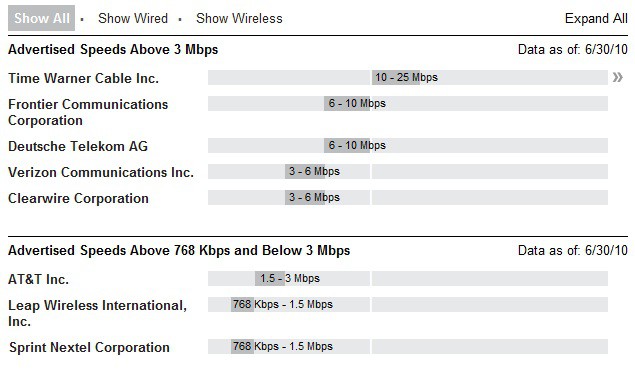
  • Time Warner Cable does not deliver 25/1.5Mbps service to residential customers in Rochester at this time, but its PowerBoost temporary speed gimmick might, for around 30 seconds.  Currently, Time Warner Cable maxes out at 15/1Mbps in the Rochester area;
  • Frontier’s claim of 10Mbps is a theoretical maximum.  Most DSL customers don’t come close.  In our area (Brighton, N.Y.) Frontier couldn’t deliver more than 3.1Mbps.
  • Wireless carrier data is simply wrong.  Sprint-Nextel is beaten down to a maximum 1.5Mbps, despite the arrival of its 4G network, which can manage better than that.  Verizon’s 3-6Mbps service is in their dreams, considering this data came from last June — before the introduction of LTE service in Rochester.  Clearwire is also guilty of boasting speeds they will never deliver on their increasingly throttled network.

The NTIA touts their map will be verifiable using “crowdsourcing,” but we found visitors are only able to confirm if a provider serves an area, but not how well and at what speeds.

Price data is also missing.  Strickling blames that on fast-changing industry practices.  We blame it on the fact providers refused to disclose that information, along with more specific details about their broadband networks.  Large providers claimed releasing proprietary, confidential business information could harm them competitively.

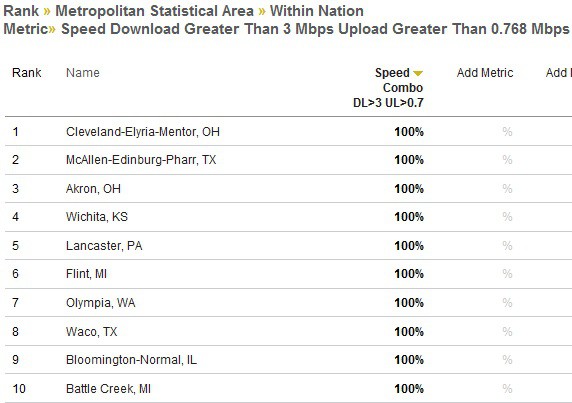
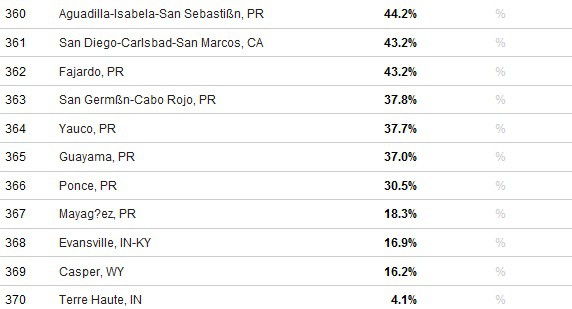
Another glaring example of questionable accuracy is the compelled-to-report top and bottom 10 cities in the country for service.  According to the NTIA, America’s number one city for broadband availability at speeds greater than 3Mbps is… Cleveland, Ohio.

Cleveland?

The worst?  Terre Haute, Indiana.

Really?

Search This Site:

Contributions:

Recent Comments:

Your Account:

Stop the Cap!