Home » Competition » Recent Articles:

The Truth About North Carolina’s Community Networks Told in Four Minutes

Phillip Dampier March 14, 2011 Broadband Speed, Community Networks, Competition, Data Caps, Public Policy & Gov't, Rural Broadband, Video Comments Off on The Truth About North Carolina’s Community Networks Told in Four Minutes

[flv width=”640″ height=”380″]http://www.phillipdampier.com/video/North Carolina Community Networks Best Broadband.flv[/flv]

Despite provider-financed arguments in opposition of North Carolina’s community broadband networks, here is a fact incumbent cable and phone companies simply cannot argue with: Fibrant and GreenLight deliver far better broadband service with the fastest speeds in the state, all without slowdowns or Internet Overcharging schemes like usage limits.  (4 minutes)

Updated: Dollar-a-Holler Industry Lobbyist Attacks North Carolina’s Community Networks

Phillip Dampier March 14, 2011 Astroturf, Broadband Speed, Community Networks, Competition, Consumer News, Editorial & Site News, Public Policy & Gov't, Rural Broadband Comments Off on Updated: Dollar-a-Holler Industry Lobbyist Attacks North Carolina’s Community Networks

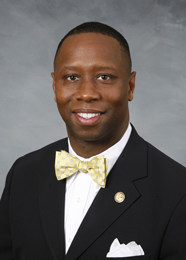
Bennett

We received word this afternoon proponents of community-0wned broadband in North Carolina were under attack by the ironically-named Innovation Policy Blog from the Information Technology & Innovation Foundation (ITIF), a thinly-disguised, industry-funded think tank.

Charges and counter-charges are flying fast and furious. Well-travelled muni broadband consultant Craig Settles says the authors are in the pockets of Time-Warner Cable, and urges people around the country to lobby NC legislators to kill the bills:

The battle is now fully joined in NC. But it’s not just their fight, and it’s not a fight solely about broadband. This fight affects everyone who believes that communities deserve the freedom to choose their own best solutions to key problems involving economic development. Communities own the problems of this terrible economy.

Philip Dampier, the supporter of former New York Congressman Eric Massa who joined the broadband policy fight when Time Warner was experimenting with metered pricing, is even more shrill than Settles.

I suppose being called “shrill” is a little better than “mean and nasty,” even if perennial industry defender and comment troll Richard “I Don’t Work for a K Street Lobbyist, But I Do” Bennett doesn’t bother to spell my name correctly.

Bennett’s read of North Carolina’s H.129 is that it’s a minor little bill that does no harm.

I don’t see what our perpetual network operator-haters are so worked up about, although I can certainly see that the network equipment vendors want more outlets for their gear; more power to them. The bills actually don’t place any restrictions at all on unserved communities (where 90% or more can’t get broadband) who want to build themselves a first-class, triple-play enabled, broadband network or anything else better than dial-up. If there weren’t such an exemption, I’d be just as riled as the people I’ve quoted.

Supporting innovation from the right kind of companies.

I suspect Bennett may have trouble seeing the facts on the issue because they are obscured by the $20,000 stipend he picked up from Time Warner Cable.  That is in addition to his regular salary provided by players with a dog in the fight.

Unfortunately for those who accidentally stumble their way into the warped world of “innovation” some of our biggest telecommunications companies have in store for us, Bennett forgets to disclose who pays him.

Our argument (the one that comes without industry money-strings attached) is explored in great detail here.

For the benefit of those who don’t want to dirty themselves wading through the ITIF’s blog, here is our response in full:

Richard and I have discussed several issues impacting the broadband community over the past two years.  He always takes the side of the industry that pays him well to serve as their mouthpiece, and I represent actual consumers and do not take a penny of industry money.

The ironically named “Innovation” blog attacks the very innovation that community broadband brings to hard-pressed communities in North Carolina who want to reinvent themselves from their tobacco and cotton-past.  The reason these networks exist is because existing companies refused to provide the service needed to accomplish this task.  Richard has no idea what these communities and ordinary North Carolina consumers are going through because his article exists merely as a “drive-by” hit piece that mischaracterizes the bill, the people that oppose it, and leaves his readers thinking he doesn’t have direct ties to a company that helped write the bill.

Gone undisclosed: Bennett accepted a $20K stipend from Time Warner Cable and does work on behalf of a K Street lobbyist.  That’s “dollar a holler” reporting.

Folks, follow the money.  If a Big Telecom company is involved, Richard reflexively adopts their position, often to the detriment of consumers.  He is also factually wrong.

1) Wilson did not “buy” their fiber to the home network, they built it.
2) Davidson and Mooresville bought a bankrupt Adelphia system that needed major upgrades.  Time Warner would have done precisely the same thing the community did, only they would pay for it with rate hikes across the state (except in Wilson which has avoided rate increases from Time Warner precisely because GreenLight is running there).
3) Salisbury has had a waiting list for signups.  Not bad for a “failure.”  EPB just finished their award-winning network in Chattanooga ahead of schedule.

The public-private partnership idea has no opposition, except among providers who won’t hear of anything they don’t own, operate, and control outright.  It is telling ongoing negotiations over Ms. Avila’s Time Warner-written bill have broken down because she still objects to language that would keep those networks in business to create those kinds of success stories.

All of the pipe dreams in this piece come from the author.  I’m not an industry consultant.  I just know a much better deal when I see one.  GreenLight, EPB, and Fibrant all deliver better service than the cable company or phone company and the money paid to them remains in those communities.  They also deliver unlimited service, an issue that now becomes more important than ever with AT&T’s attempt to launch its Internet Overcharging scheme.

The key question Bennett never asks is exactly how H.129 will improve broadband in the state, whose broadband rankings are unworthy of its potential.  Answer: it won’t.  It simply delivers protection for incumbent providers who will continue to not deliver the kind of service people want and will continue to ignore rural areas they have always ignored.  When a “small government” conservative like Marilyn Avila writes micro-management requirements for these networks right down to banning them from promoting themselves and arguing over service area boundaries (conditions Time Warner is exempted from), it tells you how far certain legislators will go on behalf of large telecom companies.

As for voter approval, it already exists in the form of elections.  I haven’t seen any “throw the bums out” movement in Tennessee or North Carolina over this issue.  In fact, the only ones out of office are the last two legislators that proposed these anti-community broadband bills.  Ty Harrell resigned in disgrace and David Hoyle left office admitting, on camera, Time Warner Cable wrote the bill he introduced.

Nice try, Richard.  Maybe if Time Warner gave you $40k, you would have spent more time coming up with legitimate arguments instead of just attacking the “music men” who can name your tune after the first predictable note.

Phillip M. Dampier
Editor, Stop the Cap!

[Update 3:42pm — We just received a carbon copy of an e-mail Rep. Marilyn Avila (R-Time Warner Cable) sent out after Bennett’s piece was published (coordinated effort, anyone?).  Amusingly, she forgot to hide the carbon copy list.  Among the recipients — two lobbyists from Time Warner Cable, the state’s top cable association lobbyist, and CenturyLink.  The most hilarious part of all — her claims Bennett’s piece represented an “independent explanation” to correct the “false record” on her anti-consumer bill.  Every resident in North Carolina should be on the phones and e-mail today telling the Finance Committee to oppose H.129, and also let them know Ms. Avila’s office is sending out distorted articles written by a K Street lobbyist who accepted a $20k stipend from Time Warner Cable, the company that most strongly supports this bill.  How “independent” is that?]

Stop the Cap! Investigates AT&T’s Justification for Internet Overcharging

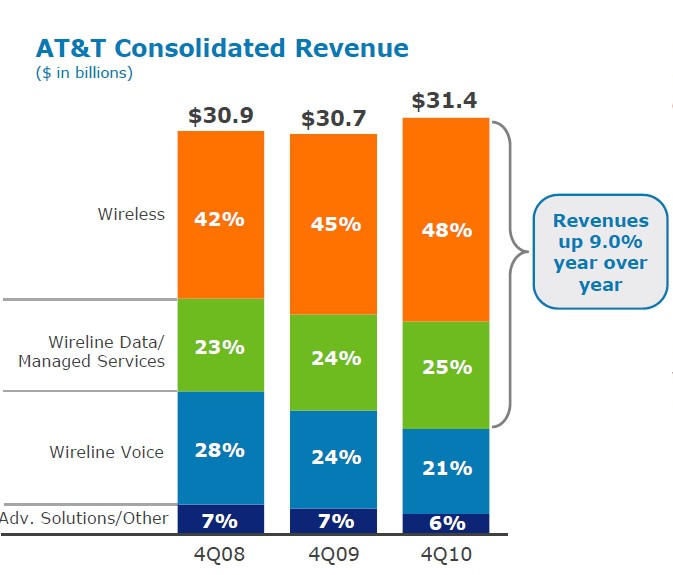
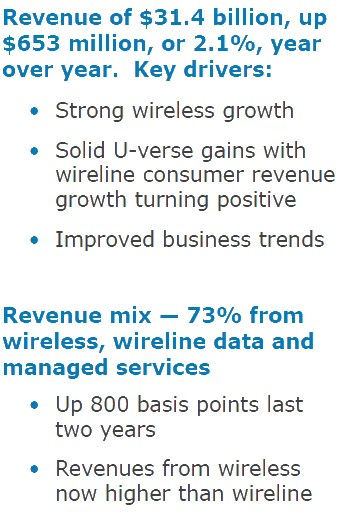
AT&T's revenue is on the rise, especially from its broadband and wireless service divisions.

AT&T’s announcement that it is will impose usage limits on its DSL and U-verse (wireline) customers this May is just another case of overcharging consumers for Internet access.

Stop the Cap! has been reviewing AT&T’s financial reports looking for justification for imposing usage controls on the company’s customers.  Most providers who enact these kinds of pricing schemes claim they are about controlling heavy users, reducing congestion, and covering the costs to provide the service.

But after reviewing some of AT&T’s financial reports, the only explanation apparent for these limits is a quest for additional revenue and profits from subscribers.

AT&T continues to earn billions every quarter — $7 billion in the last three months alone — from its data products division, the vast majority of which comes from selling IP — Internet access — services to customers.  At the same time, the company continues to cut operations and support expenses, reducing its operating costs, and increasingly relies on its wireless and wireline divisions for the majority of the company’s revenue.

There is no evidence AT&T broadband usage costs are significantly impacting the company’s revenue in any way.  In fact, its U-verse platform, which can deliver higher speed, premium broadband service (at a correspondingly higher price) is actually delivering higher revenue from the “heavy users” the company is now complaining about.

In short, AT&T wants to reap the financial rewards of selling more costly, higher speed broadband service, but wants to limit customers’ use of those services.

We reviewed both the quarterly and annual results for AT&T’s wireline division and discovered what we routinely find true among every provider that wants to implement an Internet Overcharging scheme: the company wants to raise prices on broadband customers even as it enjoys ongoing cost reductions to manage broadband traffic and reduces the amount of investment made to manage it.

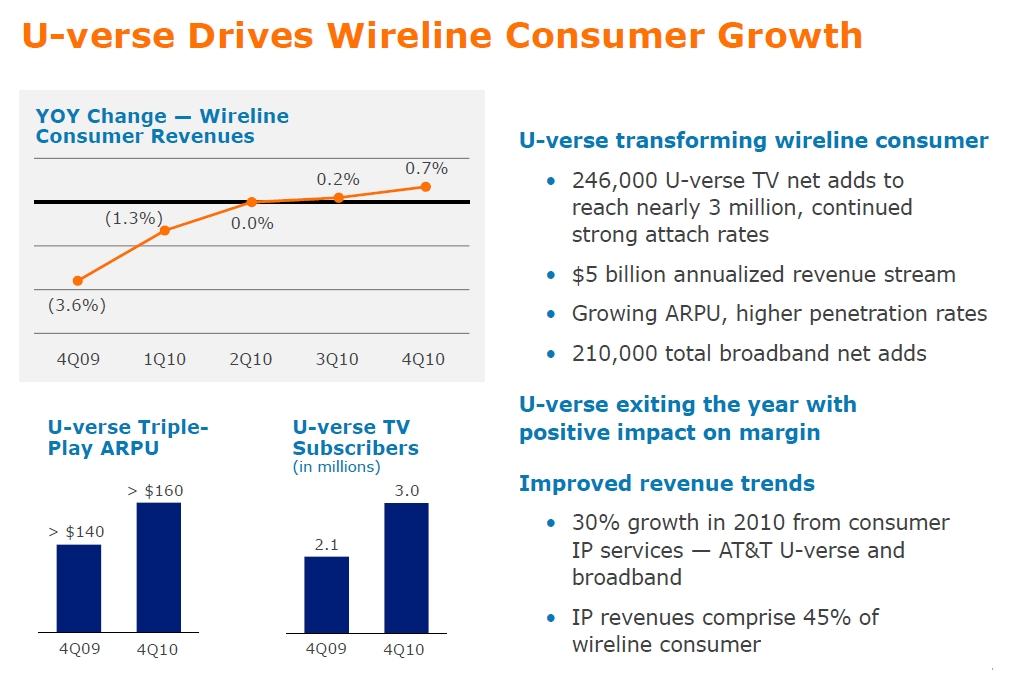
AT&T's own facts and figures tell the story of a company that has no need to slap usage limits on its broadband customers.

Some interesting facts from AT&T:

  • AT&T earns $5 billion (annualized revenue stream) from its U-verse platform;
  • AT&T saw 30 percent revenue growth from residential broadband alone;
  • 45 percent of AT&T’s revenue in wireline services comes from broadband/IP services;
  • In 2011, AT&T says it has a “focus on growth” — of revenue and profit, that is.  The company seeks increases in its “operating margins,” plans capital expenditures that will be focused on a “slight increase in wireless spending,” and ongoing cost-cutting where possible.

AT&T plans to continue to invest in U-verse expansion, critical for a company that is rapidly losing revenue from departing landline customers. In the 2010 Annual Report, AT&T noted the vast majority of cash used in investing activities went towards construction costs related to improved wireless network capacity, which is dramatically different than wired broadband service, and U-verse.  This does not cover ongoing expenses from providing the service.

It’s an important strategy for AT&T, which needs to replace revenue from lost landline customers:

We continue to lose access lines due to competitors (e.g., wireless, cable and VoIP providers) who can provide comparable services at lower prices because they are not subject to traditional telephone industry regulation (or the extent of regulation is in dispute), utilize different technologies, or promote a different business model (such as advertising based) and consequently have lower cost structures.

In response to these competitive pressures, for several years we have utilized a bundling strategy that rewards customers who consolidate their services (e.g., local and long-distance telephone, high-speed Internet, wireless and video) with us. We continue to focus on bundling wireline and wireless services, including combined packages of minutes and video service through our U-verse service and our relationships with satellite television providers. We will continue to develop innovative products that capitalize on our expanding fiber network.

Unfortunately, the benefits U-verse provides broadband users will be tempered by usage limits on it.

Considering AT&T’s U-verse pipeline is one giant broadband connection, the disturbing fact the company will not implement these overcharging schemes on its voice or video services cannot be ignored.  Only the broadband service, on which customers could entirely bypass AT&T’s TV and phone products for a competitor, is impacted.  The risk of that happening with the company’s usage cap is now diminished.

As Stop the Cap! has warned for nearly three years — this is the ultimate end run around Net Neutrality. Instead of actively blocking or throttling competing services, AT&T simply uses a usage limit to discourage customers from using the competitor, relying on unlimited AT&T TV and phone services instead.

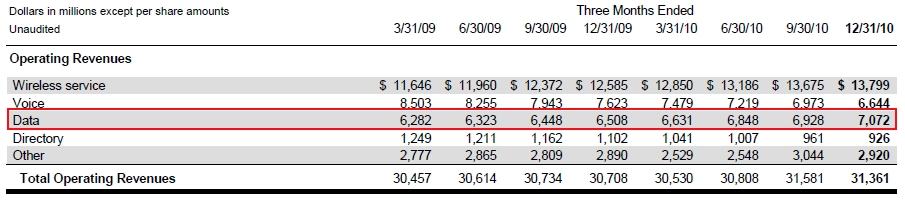
AT&T's annual report illustrates the ongoing wireline losses attributable to departing landline customers.

But things are much brighter in the broadband division. Notice the increasing revenue.

U-verse represents a successful example of benefits earned when companies invest in their networks to provide improved service to customers.

But what happens when companies gradually reduce their expenses and investments in those networks? They try and make up the difference with an Internet Overcharging scheme that places limits on service to keep costs down and profits up.

“Mean and Nasty” Stop the Cap! Upsetting Time Warner’s Apple Cart in North Carolina

Community broadband networks deliver the best value and speed for North Carolina consumers and businesses

Word has reached Stop the Cap! that hundreds of e-mails and phone calls are pouring into Rep. Marilyn Avila’s (R-Time Warner Cable) office protesting her hard work on behalf of the state’s largest cable company.  We are being called “mean and nasty” by those supporting Avila’s anti-consumer bill, H.129.

Our answer to that: we are not “mean” or “nasty.”  We are fed up c0nsumers (and voters) who have serious concerns about certain state legislators who introduce bills custom-written by cable lobbyists to enact their business agenda into law.

These anti-community broadband bills have come year after year in North Carolina, despite the fact the state has an “also-ran” reputation as a broadband backwater, with tremendous room for improvement in broadband speed, price, availability, and choice of providers. The bills have also been nothing but trouble for those that have introduced them, alienating constituents and bringing them bad press:

Ty Harrell resigned his office in disgrace over financial irregularities, but he was already in hot water when he introduced his bill. We were stunned when his office staff literally handed the phone to a cable industry lobbyist sitting there to answer questions.  We held him accountable.

David Hoyle did not leave office at his finest moment either, openly admitting on television Time Warner Cable wrote the bill he introduced.

This year, it’s Ms. Avila, who repeatedly promised to hold existing community-owned networks harmless by exempting them from the draconian, project-killing legislation she has proposed.  But after closed door meetings, we learned those promises were hollow.  The words of her bill may have changed, but the results are exactly the same — she is micromanaging community networks into insolvency (while exempting the companies that wrote the bill she introduced).

The unanswered, critical question every legislator needs to ask is: How does H.129 improve North Carolina’s dismal broadband ranking and deliver improved service?

The former Rep. Harrell

The answer is, it does nothing.  Not only does it ignore the chasm of low quality service prevalent west of Charlotte and north of Winston-Salem, it specifically erects roadblocks to keep any community from trying to resolve a situation they’ve dealt with for years and years.  Ask any rural community’s leader if they’ve heard from constituents upset by the unavailability or quality of broadband in their area and you will get an earful.  The truth is, had the cable and telephone companies in the state had a real interest in providing 21st century service to these communities, they would have already done it.  With H.129, they can rest easy knowing nobody else will try.

This is not an auspicious position for Ms. Avila to take.  She ran for office upset with backroom deals, insider political maneuvering, and closed government.  Reviewing her campaign platform, the one thing she emphasized time and again was her promise to bring “open government” to the people in her district, just north of the state capital.

Where is the open government on H.129?  Nowhere to be found.

Stop the Cap! would have loved to include the complete video record of the first meeting to modify her bill to protect incumbent providers.  Only there is no video record.  The meeting was held behind closed doors, and it took a source to reveal details about how the cable and phone companies ran it as their own.  It’s the epitome of the kind of back-room deals Ms. Avila railed against in her campaign.

Considering the results, we can understand why the meeting was secret.  The cable lobby understands full well the power of sunshine’s disinfecting power.  Shining a bright light on the cozy connection between legislators and the companies whose interests they brazenly represent tells a story they do not want the voting public to hear.

Unfortunately, it gets worse.  We’ve learned Ms. Avila plans to bring H.129 to a vote in the Finance Committee as early as this Thursday, with no public discussion allowed.  Voters can be spectators of their own broadband demise, but they will not be allowed to say a word about it.  Meanwhile, certain members of the legislature have had plenty of time to meet repeatedly with cable and phone company lobbyists.

As we’ve seen time and time again, that lobbying campaign of disinformation tries to muddy the implications of bills such as these.

You cannot hear if you are not open to listening.

Legislators who may not understand what H.129 is really all about need to hear from the public and communities to understand precisely what they are voting for and what impact this legislation will have.  The ripple effects go far beyond just keeping Time Warner and CenturyLink free from pesky competition.

Neither company is truly harmed by community broadband networks.  In fact, both of them have thumbed their noses and shrugged their shoulders even in the presence of much larger competitive threats in their urban markets — Time Warner for the phone company and AT&T’s U-verse, which is available in limited areas.

The best thing Ms. Avila could do is withdraw her legislation because it simply is not in the best interests of North Carolina.  Barring that, she should do what she promised and specifically exempt ALL existing community networks in the state from the provisions of her bill.  At this point, that delivers a win to bondholders who will see their investment pay off, communities can continue to provide service to interested customers, and everyone else will continue to enjoy the benefits of lower rates these networks bring every telecommunications customer.

That’s common sense to everyone except the cable and phone companies that will stop at nothing to bury community-owned providers.

Where does your legislator stand?  If you have not made your feelings known to the members of the Finance Committee, time is running out.  Call and e-mail them and let them know you expect them to vote NO on H.129 when it reaches their committee this week.  We’re going to do our best to watch what may turn out to be another “voice vote” that prevents voters from knowing how individual members voted.  This time, we’ll be paying close attention to the lips and movements of individual committee members and take our own vote so we know who to thank and who needs to held accountable.

Finance Committee Members

(click each name for contact information)

Senior Chairman Rep. Howard
Chairman Rep. Folwell
Chairman Rep. Setzer
Chairman Rep. Starnes
Vice Chairman Rep. Lewis
Vice Chairman Rep. McComas
Vice Chairman Rep. Wainwright
Members Rep. K. Alexander, Rep. Brandon, Rep. Brawley, Rep. Carney, Rep. Collins, Rep. Cotham, Rep. Faison, Rep. Gibson, Rep. Hackney, Rep. Hall, Rep. Hill, Rep. Jordan, Rep. Luebke, Rep. McCormick, Rep. McGee, Rep. Moffitt, Rep. T. Moore, Rep. Rhyne, Rep. Ross, Rep. Samuelson, Rep. Stam, Rep. Stone, Rep. H. Warren, Rep. Weiss, Rep. Womble


Time Warner Cable Proves DOCSIS 3 Is A Winner for Everyone

Two years ago, when Time Warner proposed to limit consumption of consumer broadband accounts with an Internet Overcharging experiment, Stop the Cap! suggested they should instead upgrade their networks to meet the demands of their Internet-hungry customer base.

With thanks, they have taken our advice.  As DOCSIS 3 upgrades continue to roll across the cable company’s service areas, it is bringing immediate benefits to every Road Runner customer, and the company itself.

Several weeks ago, we shared the story of Time Warner customers in Webster, N.Y.  Time Warner had hopelessly oversold its broadband service in the growing town just northeast of Rochester.  Speeds plummeted to as low as 900kbps most evenings and weekends, and did not return to normal until most customers were back at their day jobs.

As a shared network, cable broadband delivers a limited amount of bandwidth into individual neighborhoods, shared by every customer.  When too many people pile on, speeds plummet.  When this happens, cable companies are supposed to either increase capacity, or more commonly divide a congested area into two or more parts, each served with their own broadband pipe.  In less densely populated towns, or where less net-savvy consumers tend to reside, capacity upgrades may come only once or twice over several years, and speeds are consistently fast day and night.  But where college students predominate, or where new housing developments deliver plenty of new upper-income homeowners more likely to leverage their broadband connections, the tell-tale evening and weekend slowdowns create problems.

A speedtest performed before the upgrade

“A good clue of overcongestion is when download speeds suffer, but upload speeds remain fairly consistent,” shares Prakash Patel, who consults with cable companies on HFC “cable” broadband deployment.  “Typically, if both speeds falter at different times of the day, that is usually a sign of a technical fault on one’s cable connection — not network congestion.”

For Stop the Cap! readers in Webster, the ongoing congestion made Road Runner virtually unusable during the evening and weekends, particularly for higher bandwidth applications like video or downloads.

Several of our readers filed complaints with the cable company and one took his case to the Better Business Bureau, who obtained a sympathetic response from Time Warner — but no immediate solution.  The Bureau accepted that explanation and “administratively closed” the complaint.

As we recommended, customers remained very vocal about the ongoing congestion problems in the town.  We’ve found the old adage, “the squeaky wheel gets the grease,” effective in moving upgrades higher up the list of priorities cable engineers deal with in maintaining their networks.

Original plans to deal with the problem were scheduled for late March, but Time Warner bumped the upgrade forward to this past weekend.  Instead of simply dividing up the town, Time Warner installed DOCSIS 3 technology, which greatly increases the size of the broadband pipeline available to customers.  The upgrade did the trick.

Our reader Tim shares the good news:

“I ran some speed tests Tuesday night and the improvement was very noticeable,” he writes.  “We were able to achieve speeds in the early evening that were previously only possible in the very early morning hours.”

Patel believes cable companies will continue to win a majority in the broadband marketplace using DOCSIS 3, which he considers an affordable and easy-to-deploy upgrade.

The results after the upgrade was completed.

“Not only is DOCSIS 3 relatively inexpensive, it provides plenty of new revenue opportunities for the companies that deploy it,” Patel says.  “It also fits well from an engineering standpoint, because it is an evolutionary update to a successful technology.”

Patel believes DOCSIS 3 and future versions of the cable broadband standard will allow operators to successfully compete, at least in download speeds, with virtually any provider.

“Cable companies can simply bond several channels together and accelerate download speeds,” Patel says.  “Upload speeds are proving to be a bigger issue, as most companies limit them to around 5Mbps.”

At least for now, customers in Webster are happy they are once again getting the service they paid to receive.  The upgrade solved the congestion issue for Time Warner, and the cable company plans to sell higher speed service to interested customers later this spring, earning new revenue to pay for the upgrades.

That’s a win-win everyone can appreciate — all done without an Internet Overcharging scheme.

Search This Site:

Contributions:

Recent Comments:

Your Account:

Stop the Cap!