Home » Competition » Recent Articles:

American Broadband: A Certified Disaster Area

Vincent, one of our regular Stop the Cap! readers sent along a link to a story about the decrepit state of American broadband: it’s a real mess for those who can’t get it, can’t get enough of it, and compare it against what other people abroad are getting.

Cracked delivers the top five reasons why American broadband sucks.  Be sure and read their take (adult language), but we have some thoughts of our own to share:

#5 Some of Us Just Plain Can’t Get It

Large sections of the prairie states, the mountain states, and the desert states can’t get broadband no matter how much they want it.  That’s because they are a hundred miles or more from the nearest cable system and depend on the phone companies — especially AT&T, Frontier, CenturyLink, and Windstream to deliver basic DSL.  AT&T is trying as hard as possible to win the right to abandon rural America altogether with the elimination of their basic service obligation.  Verizon has sold off some of their most rural territories, including the entire states of Hawaii, New Hampshire, Maine, Vermont, and West Virginia.  CenturyLink has absorbed Qwest in the least populated part of America — the mountain and desert west.

Frontier and Windstream are betting their business models on rural DSL, and while some are grateful to have anything resembling broadband, neither company earns spectacular customer ratings.

So long as rural broadband is not an instant profit winner for the phone companies selling it, rural America will remain dependent on dial-up or [shudder] satellite fraudband.

#4 Often There are No Real Options for Service (and No Competition)

Cracked has discovered the wonderfully inaccurate world of broadband mapping, where the map shows you have plentiful broadband all around, but phone calls to the providers on the list bring nothing but gales of laughter.  As if you are getting service at your house.  Ever.  Stop the Cap! hears regularly from the broadband-deprived, some who have had to be more innovative than the local phone company ever was looking for ways to get service.  Some have paid to bury their own phone cable to get DSL the phone company was reluctant to install, others have created super-powered Wi-Fi networks to share a neighbor’s connection.  The rest live with broadband envy, watching for any glimpse of phone trucks running new wires up and down the road.

Competition is a concept foreign to most Americans confronted with one cable company and one phone company charging around the same price for service.  The most aggressive competition comes when a community broadband provider throws a monkey wrench into the duopoly.  Magically, rate hikes are few and fleeting and speeds are suddenly much better.  Hmmm.

#3 Those Who Have Access Still Lag Behind the Rest of the World
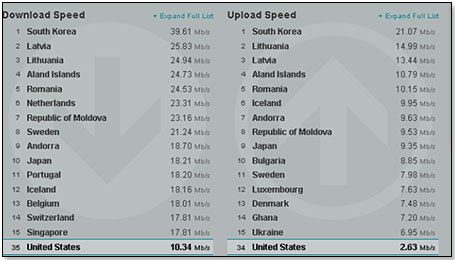
We're #35!

This is an unnerving problem, especially when countries like Lithuania are now kicking the United States into the broadband corner.  You wouldn’t believe we’re that bad off listening to providers, who talk about the innovative and robust broadband economy — the one that is independent of their lousy service.  In fact, the biggest impediment to more innovation may be those same providers.  Some have an insatiable appetite for money — money from you, money from content producers, money from taxpayers, more money from you, and by the way there better be a big fat check from Netflix in the mail this week for using our pipes!

Where is the real innovation?  Community providers like Greenlight, Fibrant, and EPB that deliver their respective communities kick-butt broadband — service other providers would like to shut down at all costs.  Not every commercial provider is an innovation vacuum.  Verizon FiOS and Google’s new Gigabit fiber network in Kansas City represent innovation through investment.  Unfortunately Wall Street doesn’t approve.

Still not convinced?  Visit Japan or Korea and then tell us how American broadband resembles NetZero or AOL dial-up in comparison.

#2 Bad Internet = Shi**y Economy

The demagoguery of corporate-financed dollar-a-holler groups like “FreedomWorks” and “Americans for Prosperity” is without bounds.  Whether it was attacking broadband stimulus funding, community broadband endeavors, or Net Neutrality, these provider shills turned broadband expansion into something as worthwhile as a welfare benefit for Cadillac drivers.  Why are we spending precious tax dollars on Internet access so people can steal movies and download porn they asked.  Why are we letting communities solve their own broadband problems building their own networks when it should be commercial providers being the final arbiter of who deserves access and who does not?  Net Neutrality?  Why that’s a socialist government takeover, it surely is.

It’s like watching railroad robber barons finance protest movements against public road construction.  We can’t have free roads paved by the government unfairly competing with monopoly railway companies, can we?  That’s anti-American!

The cost of inadequate broadband in an economy that has jettisoned manufacturing jobs to Mexico and the Far East is greater than we realize.  Will America sacrifice its leadership in the Internet economy to China the same way we did with our textile, electronics, appliances, furniture, and housewares industries?  China, Japan and Korea are building fiber optic broadband networks for their citizens and businesses.  We’re still trying to figure out how to wire West Virginia for 3Mbps DSL.

#1 At This Point, Internet Access is Kind of a Necessity

The United Nations this week declared the Internet to be a basic human right.  Conservatives scoffed at that, ridiculing the declaration for a variety of reasons ranging from disgust over any body that admits Hugo Chavez, to the lack of a similar declaration for gun ownership, and the usual interpretation of broadband as a high tech play-toy.  Some folks probably thought the same way about the telephone and electricity around 1911.

Yes, the Internet can be frivolous, but then so can a phone call.  Cursed by the U.S. Post Office for destroying their first class mail business, by telephone directory publishers, and those bill payment envelope manufacturers, the Internet does have its detractors.  But should we go back to picking out commemorative stamps at the post office?  Your local phone and cable company sure doesn’t think so.  We don’t either.
Capping the Cappers: Putting Limits on How Many Licenses Rogers, Telus and Bell Can Buy

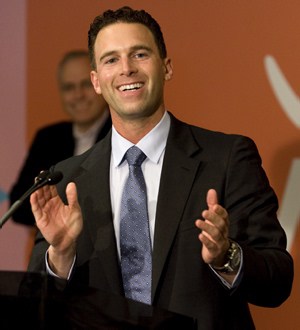
Anthony Lacavera

Large Canadian telecommunications companies like Rogers, Telus, and Bell are loudly protesting a proposal to cap the maximum number of wireless licenses they can beg, borrow, or buy.

The proposal, from Wind Mobile and Quebecor Inc.’s Vidéotron Ltée, would tell some of Canada’s largest telecom companies they cannot buy up every available wireless license that becomes available in the future in an effort to lock out would-be competitors.  Both companies fear that without such a license cap, the deep pockets of larger providers could sustain a wireless cartel to keep mobile competition at bay.

“Competition doesn’t just ‘happen’,” said Wind Mobile’s Anthony Lacavera. “True competition and the long term benefits of competition for Canadians will occur when, and if, our regulatory framework is improved, our access to foreign capital is unhindered and the playing field is leveled to the benefit of Canadians.”

Lacavera’s upstart Wind Mobile has faced incumbent provider-fueled scrutiny over claims of foreign ownership violations in an effort to keep Wind’s discount service out of Canada.  In addition to fending off regulatory challenges, Lacavera is wary of Conservative Party policy towards wireless competition, which he suspects is too shallow and lacks important protections against further marketplace concentration.

The idea of a license limit met with predictable hostility from the three larger incumbents.

On Wednesday, Telus’ chief financial officer rejected the idea out of hand, telling the government they should not be giving advantages to discount carriers and foreign entities over Telus, which he said was more focused on “innovation.”

Wind Mobile

Rogers called a license cap “a slap in the face” to millions of their customers, and Bell pulled an AT&T — without allowing companies like Bell to have the chance to outbid everyone else, Canada will run the “risk of lagging” behind the United States, harm innovation, and deprive the government of much needed auction revenue.

Bell CEO George Cope also warned letting foreign companies into the Canadian market could leave rural Canada with older technology.  At the risk of shooting down his own earlier argument, Cope specifically targeted his remarks at U.S. carriers, who presumably could be among Canada’s future wireless players.  In Cope’s mind, U.S. providers like AT&T would treat Canada as an afterthought.

“If you really believe that if a U.S. carrier had owned Bell at the time we launched HSPA+ (an advanced iteration of 3G), do you really believe Prince Edward Island, that province, would have had HSPA+ before Chicago?” Cope asked. “You’ve got to be kidding me.”

Large incumbent carriers also accused the smaller competing upstarts of simply trying to boost their own value before they sell out.  Telus and Rogers should know — they fought over buying that competition, like Microcell’s Fido, which Rogers eventually acquired in 2004.

Cloud Storage Hype Meets Internet Overcharging Realities As ISPs Feel Threatened (Again)

Phillip Dampier

This week, the tech community has been buzzing over new entrants in the world of cloud computing.  Apple’s iCloud in particular has sparked enormous media coverage as the company plans to encourage customers to access all of their favorite content over their broadband connection.  Apple is also moving towards online distribution of many of its software products, including the forthcoming OS X Lion operating system, suggesting consumers can pass up traditional physical media like CD-ROMs or DVDs.

Cloud storage theoretically allows you to store your entire music, video and photo collection online for easy access from any device.  Watching the 20-somethings buzz about 100GB+ secure file lockers and the end of traditional file storage as we know it has been amusing, but these people need to get their heads out of the clouds.  Unless they become politically involved in America’s broadband debate, it is not going to happen the way they hope it will.

Tech entrepreneur?  Meet broadband provider reality check: the Internet Overcharging usage cap and “excessive use” pricing scheme.

While Steve Jobs was introducing iCloud, broadband providers and their industry friends have been ruminating over the impact all of this new traffic will have on their broadband networks.  In an homage to former AT&T CEO Ed Whitacre’s “you can’t use my pipes for free,” the drumbeat for implementing “control measures” for cloud computing and video traffic has been amplified several times over by certain providers, Wall Street analysts, and their trade press and equipment supplier lackeys.

One alarmed provider pondered the impact of iCloud in terms of their past experience with iTunes, which also spiked traffic when it was first released.  Others balk at the notion of consumers using broadband platforms to move entire libraries of content back and forth, especially on wireless networks.  The only sigh of relief detected?  Apple won’t start iCloud with video content — just music, at least at first.

The enemies list

The biggest targets — the companies that get a lot of pushback from providers for using “their networks” to earn millions for themselves are Google, Netflix, Amazon and Apple.  Each of them are rapidly moving into the online entertainment business, threatening to provoke more cable TV cord-cutting.  Netflix is now responsible for 30 percent of online traffic during primetime hours, a fact that some use as an accusation — as if Netflix should be held to account for its own success. Amazon has opened its own cloud based music storage and is also increasingly getting into online video content streaming.  Apple has a novel approach at handling its forthcoming iCloud music feature which should save hours in uploading, but the company is also moving towards online distribution of a growing proportion of its software, including the huge bug fixes and upgrades that will easily exceed a gigabyte if you own several Apple products.

Google is a frequent Washington target and honestly delivers the only truly effective corporate pushback to anti-consumer broadband pricing some providers have contemplated.  In fact, Google is putting its money where its mouth is building a gigabit network larger providers repeatedly scoff at as unnecessary, too costly, and too complicated.

While millions in venture capital funds new online innovations, only a miniscule amount of money is being spent to counter the lobbying major providers are doing in Washington to redefine the broadband revolution in their terms, complete with usage pricing that bears no relation to cost, arbitrary usage limits, and ongoing lack of true competition.

Online innovation is grand, but allowing providers to strangle it with Internet Overcharging schemes guarantees to end the party real fast.

Individually, none of the new cloud services are likely to blow out usage caps in excess of 100GB, but in combination they certainly could.  Anyone using online file backup, cloud storage of video and large music collections, uses Netflix or other online streaming services, and spends lots of time on the web will easily approach the limits some providers have established.  That doesn’t even include large software updates.  Unless you have an unlimited usage plan on the wireless side, don’t even think about using most of these services with AT&T’s 2GB monthly wireless usage cap.

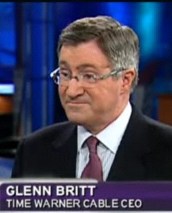
Glenn Britt: The Internet is a utility which is why we can keep raising the price.

In the handful of countries with ubiquitous Internet Overcharging, little of this will pose a problem — companies won’t launch cloud computing services in markets where usage caps will effectively keep customers from using them.

That is why it is critical for some of America’s largest technology companies to get on board the fight against Internet Overcharging, and demand Washington recognize broadband as a utility service that should be wide open and usage cap free.  The evidence is right in front of you.  Time Warner Cable CEO Glenn Britt recognizes the fact broadband is an essential part of our lives today, which is why he is confident enough to keep raising the price and charging even more in the future.  It’s not about “network congestion,” “building the next generation of broadband,” or “pricing fairness.”  Stop the Cap! started at ground zero for Time Warner Cable’s 2009 version of “pricing fairness” — $150 a month for an unlimited use broadband account that likely cost major providers less than $10 a month to provide.  It’s about pure, naked profiteering, unchecked by free market competition in today’s broadband duopoly.

Unless a company like Google can vastly expand its own broadband rollouts, it is increasingly apparent to me (and many others), we may have to move towards an entirely different model for broadband in the United States — one built on the premise of the Interstate Highway System.  One advanced, publicly-owned fiber network open to all providers on which telecommunications services can travel to homes and businesses from coast to coast.

Nobody says private companies shouldn’t be able to compete, but every day more evidence arrives they will never be inclined to deliver the next generation of service that other countries around the world are starting to take for granted.  They will instead protect their current business models at all costs, even if that means throwing America’s broadband innovation revolution under the bus.

[flv width=”640″ height=”380″]http://www.phillipdampier.com/video/CNN Will iCloud Measure Up 6-7-11.flv[/flv]

CNN takes a look at what makes Apple’s iCloud service different from competitors from Google and Amazon.  (5 minutes)

[flv width=”640″ height=”380″]http://www.phillipdampier.com/video/CNN Dropbox Cloud Computing 6-8-11.flv[/flv]

CNN talks with the folks at Dropbox about their cloud file storage system.  (3 minutes)


Toronto Waterfront Getting 10Gbps Broadband: 100/100Mbps Service for $60 a Month, No Caps

An artist rendering of Don River Park, part of the mixed-use spaces that hallmark the Toronto Waterfront revitalization project.

About seven years ago, Rochester’s Fast Ferry offered daily service between Rochester, N.Y. and Toronto’s Waterfront.  Tens of millions of dollars later, the Rochester Ferry Company discovered that nobody in southern Ontario was that interested in a shortcut to Rochester, many locals found driving to Canada’s largest city faster, more convenient, and cheaper, and the point of arrival on the Canadian side was hardly a draw — situated in a rundown, seedy industrial wasteland.

By the end of 2006, the ferry was sold and sent on its way to Morocco, the CBC got a barely used International Marine Passenger Terminal (built for the Rochester ferry) to use as a set location for its TV crime drama The Border, and the rundown waterfront was well-embarked on a major reconstruction effort.

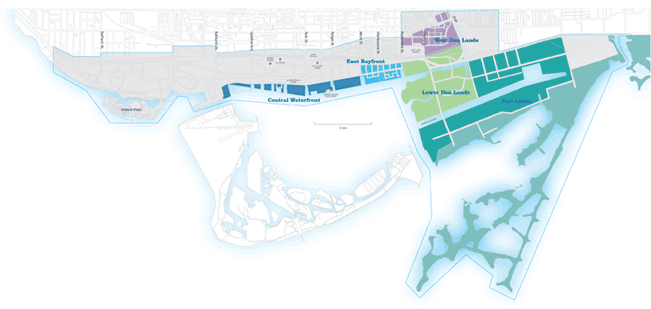
This week, Toronto’s Waterfront learned it was getting a broadband makeover as well, with the forthcoming launch of insanely fast 10/10Gbps fiber broadband for business and 100/100Mbps for condo dwellers along the East Bayfront and West Don Lands.

Best of all, Beanfield Metroconnect, the parent company responsible for constructing the network, promises no Internet Overcharging schemes for residents and businesses… forever.  No usage caps, no throttled broadband speeds, no overlimit fees.  Pricing is more than attractive — it’s downright cheap for Toronto:  $60 a month for unlimited 100/100Mbps broadband, $30 a month for television service, and as low as $14.95 for phone service.  Bundle all three and knock another 15 percent off the price.  The provider is even throwing in free Wi-Fi, which promises to be ubiquitous across the Waterfront.

The project will leapfrog this Toronto neighborhood into one of the fastest broadband communities in the world.

Toronto Waterfront Fiber Broadband Coverage Map

“Having this sort of capacity available to residents will allow for a whole new world of applications we haven’t even conceived of yet,” said chief executive Dan Armstrong.

The rest of Toronto, in comparison, will be stuck in a broadband swamp courtesy of Rogers Cable and Bell, where average speeds hover around 5Mbps, with nasty usage caps and overlimit fee schemes from both providers.  DSL service in the city is notoriously slow and expensive, as Bell milks decades-old copper wire infrastructure long in need of replacement.

The public-private broadband project is a welcome addition for an urban renewal effort that has been criticized at times for overspending. Created in 2001, Waterfront Toronto has a 25-year mandate to transform 800 hectares (2,000 acres) of brownfield lands on the waterfront into a combination of business and residential mixed-use communities and public spaces.  At least $30 billion in taxpayer funds have been earmarked for the renewal project, although project managers say no taxpayer dollars will be spent on the broadband project.

Waterfront Toronto’s efforts have been recognized as bringing Toronto’s first “Intelligent Community” to the city with the construction of the open access fiber network.

Still, the public corporation has its critics.  Earlier this spring Toronto city councilman Doug Ford called the urban renewal project a boondoggle.  Other conflicts rage with the Toronto Transit Commission and the mayor’s office over other redevelopment projects.  But the revitalization project’s broadband initiative has significant support, especially among knowledge workers that could eventually become residents… and paying customers.

The 21st century broadband project is also likely to bring broadband envy across the entire GTA, who will wonder why service from the cable and phone companies is so much slower and more expensive.

For broadband enthusiasts, Toronto’s broadband future looks much brighter than yesterday’s failed ferry service, which proves once again that regardless of the technology — slow, expensive, and inconvenient service will never attract much interest from the value-conscious public.

[flv width=”640″ height=”380″]http://www.phillipdampier.com/video/TVO The Need for High Speed 5-2010.flv[/flv]

Canada’s digital networks are some of the slowest in the world, running between one hundred to a thousand times slower than other countries in the developed world. In this episode of “Our Digital Future – The Need for High-Speed,” Bill Hutchison, Executive Director of Intelligent Communities for Waterfront Toronto describes the sorry state of Canada’s digital infrastructure, stressing the need for major investments in advanced broadband networks.  (4 minutes)

Time Warner’s Glenn Britt: The Marie Antoinette of Cable – Rate Hikes, Metered Internet In Your Future

More than halfway into Glenn Britt’s appearance last week at a Wall Street-sponsored investor event, the head of the nation’s second largest cable company candidly admitted years of price hiking is finally driving a growing segment of America’s hard-pressed middle class out of the market:

“There is a segment of our economy that should be of concern.  We have a bifurcating economy where people who are college educated and like everybody in this room are doing okay.  For that segment, pay TV [pricing] is fine.  There is another group of people who are sort of falling out of the middle class.  For some of those people, pay TV is too expensive.”

That’s a remarkable admission from a cable company that has consistently raised prices for its products well in excess of inflation for at least a decade, and judging from the rest of his comments, there is plenty more of the same on the way.

Britt is nearing his 10th anniversary as CEO of what is now Time Warner Cable, formerly a division of AOL/Time-Warner.  In the past decade, the company he oversees has undergone a transformation in its business model. In 2001, digital cable was all the rage, delivering the 500-channel television universe at the cost of rapidly increasing cable bills.  Cable broadband was just coming back from the dot.com crash, with many Americans still mystified by the concept of “www” and whether a web address had a “/” or a “\” in it.

Time Warner Cable CEO Glenn Britt tells Wall Street investors at the Sanford Bernstein conference the company is using their customers’ addiction to high speed broadband as leverage for rate increases — three in the last three years. Britt’s world view for Internet Overcharging schemes like consumption billing are reinforced in a room where ordinary customers aren’t invited and the Wall Street types in attendance dream about the enormous profits such pricing would bring. June 1, 2011. (6 minutes)
You must remain on this page to hear the clip, or you can download the clip and listen later.

Today, broadband is threatening to become the cable industry’s most important product — one that Americans will crawl through broken glass to buy.  In larger cities, the competitive war between DSL and cable broadband has been settled and DSL lost.  That has brought Time Warner a steady stream of customers departing their local phone company and bringing their telecommunications business with them.  Even during the economic downturn, Britt notes, one of the last products people will agree to give up is their broadband Internet access.

“Broadband is becoming more and more central to people’s lives,” Britt said. “It is becoming our primary product. People are telling us that if they were down to their last dollar, they’d drop broadband last.”

Britt openly tells investors Time Warner Cable will take that last dollar, and many more.

“We are able to raise prices,” Britt notes. “As broadband becomes a utility, you can charge more.  So after a dozen years of not raising prices for broadband service, for the last three years we have been raising prices.”

Britt notes the company is also enjoying increased average revenue per customer as many upgrade their broadband service to higher speed tiers which deliver higher revenue to the cable operator.

But as the market for broadband matures, the next level of profits could come from so-called “consumption pricing,” which could make yesterday’s rate increases look like a miniscule price adjustment.  In 2009, Time Warner Cable sought to test new broadband pricing that would have tripled the cost of unlimited broadband from $50 a month to an astonishing $150 a month.  A firestorm of protests for this level of Internet Overcharging temporarily killed the prospect of OPEC-like profits, unsettling some Wall Street investors and analysts, many who refuse to let the dream die.

Among the biggest proponents of this kind of metered pricing is, in fact, Sanford Bernstein — the sponsor of the conference.  So it came as no surprise Britt faced additional browbeating in the hour-long interview to reintroduce these pricing schemes.  After all, Britt is told, AT&T has implemented a usage cap and Cable One has (what the interviewer calls) a “quite interesting” pricing model — delivering the smallest usage caps to customers with the highest speed tiers.  So when will Time Warner follow suit?

Once again, Britt said he’s a true believer in consumption billing and thinks the industry will move in that direction, but refused to give an exact timetable.  “Consumption billing” goes beyond traditional usage caps by establishing a combination of a flat monthly service fee, and additional charges for the amount of data you use.  Time Warner’s original proposal limited consumption to 40GB per month at today’s broadband prices, but added an overlimit fee of $1-2 for each additional gigabyte.

The strangest part of the hour was Britt’s defense of usage pricing with an impromptu discussion with his wife the evening before about the pricing models of public transit in European capitals (they’ve no doubt visited), and metropolitan New York City.

Britt shared that in the finest cities of Old Europe, bus and train travelers paid different rates based on how far they traveled within the city.  In New York, his wife noted, one price gets you access to any point in the city on the subway.  

How fair is that?

Aside from the hilariously unlikely scenario either Britt or his wife have stepped foot on a New York City public bus or subway train in the last decade, his rendition of “consumption billing is fairer”-reasoning fell flat because it argues a false equivalence between the cost to move data and the expenses of a public transit system.  Remember, Time Warner is the cable company that pitches unlimited long distance calling on the one platform that most closely resembles broadband — telephone service.

“People want us to invest more to keep up with the traffic,” Britt argued.  “People who use it should pay less — people who want to spend eight hours a day watching video online is fine with me, but they should pay more than somebody who reads e-mail once a week.”

This is the same Glenn Britt who just minutes earlier confessed the cable company has been raising prices on all of its broadband customers for three years in a row because they can.  Earlier attempts at consumption billing saved nobody a penny.  Light users were given a paltry usage allowance that could be largely consumed by downloads of security patches and software updates, after which a very punitive overlimit fee kicked in.  Besides, Time Warner Cable already sells a “lite” usage plan today that has few takers.  Most consumers want, and are willing to pay for a standard, flat rate broadband account.  That’s the account Britt and his Wall Street cheerleaders want to get rid of come hell or high water.

Britt is asked whether pay television is getting too expensive for the hard-pressed middle class. For many consumers, it is, which is why the company is developing its “welfare” tier called TV Essentials — a sampling of cable networks with plenty of holes in the lineup to remind subscribers what they are missing if they make do with this less expensive package. June 1, 2011. (3 minutes)
You must remain on this page to hear the clip, or you can download the clip and listen later.

Throughout the hour long interview, Britt’s read of the hard-pressed common American family comes across as more than a little hollow — more like hopelessly out of touch.  One part Marie “Let Them Eat Cake” Antoinette and one-part “we’ll throw a bone to some and raise prices on the rest,” Britt is content lecturing consumers — discouraging them from crazy ideas like “a-la-carte” cable pricing and reasonably priced broadband.

The Wall Street crowd loved every minute, and the friendly echo chamber atmosphere made Britt feel more than welcome at the conference.  While Time Warner Cable’s CEO spent more than a hour talking to Wall Street, he has no time to actually sit down and talk with his customers — the ones that want nothing to do with his Internet pricing schemes.  Indeed, at one point Sanford Bernstein’s host dismisses customers as “people who want everything for free,” a contention Britt partly agreed with.

Have another piece of cake.

If you are still wealthy enough to buy an iPad and are enjoying Time Warner Cable’s free streaming app, watch out. It may not be free for long. As Britt partially admits, Time Warner Cable is using the online video service as a “Trojan Horse” to get subscribers hooked on their online video, before they attach a price tag to the service. June 1, 2011. (3 minutes)
You must remain on this page to hear the clip, or you can download the clip and listen later.

And what about all of this much-ballyhooed “investment” in tomorrow’s broadband networks?

Britt confesses the cable company is spending less than ever on system upgrades and capital construction projects.  Why?  The company forecasts its demand and growth five years out and budgets accordingly.  The current target is to spend just 15 percent of revenue on such projects, and based on budget planning, there is no urgent need to upgrade Time Warner’s broadband networks to keep up with demand.  In fact, it was all smiles when Britt revealed one of the company’s biggest expenses — the costly set top box — may not be a permanent part of America’s cable future after all.  Britt offered there was a good chance capital spending might even decline further in the future.

Britt suggests the next generation of television sets will deliver the same functionality as today’s set top box at a cost paid by the consumer.  Time Warner’s slow march to all digital cable means the need for wholesale upgrades of cable systems is over for perhaps a generation.  And with an IP-based cable delivery platform, software upgrades and improvements can be made without paying the high asking price charged by today’s handful of set top manufacturers.

In fact, outside of programming costs, Britt doesn’t see any long term challenges to years of good times for investors. Even minor competition from the telephone companies, who generally charge prices very similar to what Time Warner Cable charges, pose no big threat.

His biggest nightmare?  A check on the industry’s near-unfettered power by Washington regulators.  Despite Britt’s claims the cable industry is already well-regulated, in fact it is not.  Since 1996, cable companies can charge whatever they choose for standard cable, phone and Internet service.  Consumption billing, which will almost certainly be seen as gouging by consumers, may trigger an unwelcome intrusion by Congress, especially if the industry continues to cause a drag on America’s broadband ranking, already waning.

For investors, the glory days of huge rate hikes for cable television are likely behind us, Britt warns.  But have no fear: for the generally well-heeled and barely-hanging-on there is plenty of room for more rate increases on broadband — and meters, too.

Once again, Britt unintentionally admits the truth: Time Warner Cable does not have a broadband congestion problem that requires an Internet Overcharging scheme to solve. In fact, he admits the cable company is spending less than ever on network upgrades for residential subscribers, and expects that trend to continue. He’s also avoiding overpaying for merger and acquisition opportunities. June 1, 2011. (6 minutes)
You must remain on this page to hear the clip, or you can download the clip and listen later.

Search This Site:

Contributions:

Recent Comments:

Your Account:

Stop the Cap!