Home » Competition » Recent Articles:

Virgin Tests World’s Fastest Cable Broadband for UK: 1.5Gbps Beats Your 15Mbps Service

Phillip Dampier July 25, 2011 Broadband Speed, Competition, Virgin Media (UK) 1 Comment

While cable broadband has never had the same impact on the United Kingdom that it has in North America, top honors for speedy service have been won by Virgin Media, who successfully tested the world’s fastest cable broadband network, delivering 1.5Gbps speeds in London’s East End.

By combining multiple broadband channels together using DOCSIS 3 technology, cable companies can deliver extremely fast downstream speeds to customers, depending on how much of their cable network bandwidth they wish to dedicate towards broadband.

Virgin’s successful trial managed 1.5Gbps for downloading, but a comparatively slower upload speed of 150Mbps.  The test, conducted in a redevelopment tech park designed to recreate Silicon Valley’s success in the United Kingdom, will likely lead to an eventual increase in broadband speeds for Virgin customers.  The average broadband speed today in the UK is approximately 6Mbps, hampered primarily by substantial reliance on British Telecom’s DSL network.  Satellite television became the primary provider of multichannel video in Great Britain, so development of cable television systems has never been as expansive as found in the United States and Canada.  But where cable providers like Virgin do provide service, broadband speeds have been on the increase.

Communications Minister Ed Vaizey congratulated Virgin for the successful trial, pointing out Prime Minister David Cameron has prioritized technological infrastructure improvements in London’s East End, in hopes it will one day rival Silicon Valley.

“As people are simultaneously connecting more gadgets to the Internet and doing more online than ever before, Virgin Media is delivering some of the fastest broadband in the world and, thanks to our ongoing investment, we’re able to anticipate and lead the way in meeting growing demand for bandwidth,” said Jon James of Virgin Media.

Virgin currently delivers unlimited broadband service at speeds up to 100Mbps, but customers point out the service is subject to “Fair Access Policies” which reduce speeds for heavy users during peak usage periods, particularly for peer to peer file transfers.

It is unlikely 1Gbps service will be marketed for residential customers anytime soon, but as American cable companies have expanded marketing efforts towards the business broadband market, so could British cable providers like Virgin Media.


AT&T CEO: “DSL is Obsolete”

Phillip Dampier July 21, 2011 AT&T, Broadband Speed, Competition, Rural Broadband 8 Comments

Rest in Peace, AT&T DSL

AT&T CEO Randall Stephenson doesn’t think much of the company’s largest-reaching broadband product – DSL service, telling an audience at the the National Association of Regulatory Utility Commissioners summer seminar in Los Angeles that AT&T developed DSL mostly to compete with Comcast, but “now that’s obsolete.”

That’s a remarkable admission for AT&T, which continues to provide the bulk of its Internet access to consumers over DSL on its copper-wire telephone network.  Comcast spokeswoman Sena Fitzmaurice, in attendance, promptly tweeted the news to her followers: “AT&T CEO — to chase comcast we built dsl, it is obsolete now”

The story from GigaOm’s Stacey Higginbotham only got stranger when an AT&T spokesperson tried to explain away Stephenson’s careless remarks:

Stephenson was answering a question from an audience member about how state regulators should think about new technology cycles when they are considering things like USF. He said that new technology used to be amortized over a 10-15 year period, but that has shrunk to about 5 years now. He said that DSL was introduced in the 1990s, it has been surpassed in speed by U-verse and Comcast’s DOCSIS 3.0. He also gave the example of deploying 3G in 2006 … and now 5 years later we are rolling out 4G. His point was — new technology is being surpassed by the next generation much quicker than ever before. We have millions of customers using DSL and remain fully committed to the technology — even as we constantly look to bring innovation to the marketplace.

That innovation comes mostly from the company’s more advanced DSL platform U-verse, which is only slowly working its way across urban AT&T service areas.  Unfortunately, that service will not likely be forthcoming for AT&T’s rural landline customers, who will be left with “obsolete” DSL service, if available at all, indefinitely.

With an increasing amount of AT&T’s revenue coming from its wireless division, there is little incentive for AT&T to expand DSL service into areas where it is not already sold.  In fact, most of the company’s landline-oriented lobbying has been directed at allowing the company to abandon its “universal service” obligations to provide decent, basic telephone service in rural areas.  The company has already won that deregulation in several of the states it serves, but has given no indication if and/or when it plans to shut off its landline service.

Landline providers hope American consumers will lead the way, as an increasing number disconnect their home phone lines permanently.

More than half of adults between the ages of 25 and 29 reside in wireless-only homes, according to the Federal Communications Commission.

“The number of Americans who rely exclusively on mobile wireless for voice service has increased significantly in recent years,” the FCC said, citing a January-June 2010 National Health Interview Survey.

Unfortunately, rural Americans overwhelmingly receive broadband over that landline network in the form of basic DSL, usually at speeds of 1-3Mbps.  If that network is discontinued, their opportunity for broadband service goes with it.

NAACP: ‘Having One Company (AT&T) Looking at the Whole Landscape Will Get Service to Those Who Need It’

Phillip "Not Paid by AT&T" Dampier

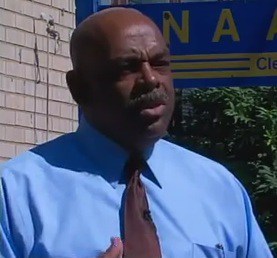
When asked if the merger of AT&T and T-Mobile will limit customer choice, NAACP’s local executive director Stanley Miller told a Cleveland, Ohio television station, “I don’t think that’s an issue in today’s environment; I think the companies are smarter today and they will make people understand and give them the beneficial services that they’ll need.”

The civil rights group had nothing to say about how much AT&T will charge for these “beneficial services.”

At least WEWS-TV in Cleveland is bothering to ask the question.  Most of America’s television news has either ignored the enormous merger on offer from AT&T and T-Mobile, or didn’t wade much further beyond AT&T’s press release about the “benefits” the merger will bring.  Unfortunately, the television station never bothered to alert viewers to the fact the civil rights group receives substantial financial support from AT&T.

Miller’s performance trying to tout his parent organization’s unqualified support for the merger sent a very clear message to anyone watching NewsChannel 5 — he doesn’t really understand what he is talking about.

On the issue of expanding wireless service into rural Ohio, Miller was left tongue-twisting his way into advocating a monopoly because they’ll be best equipped to get service to those who need it.  That’s a fascinating prospect — a monopoly spending money expanding service where it is unprofitable to provide.  That’s the reason companies like AT&T have ignored rural America, and will continue to do so — merger or not.

Miller (WEWS-TV)

In fact, AT&T’s claim that it needs the network of T-Mobile to stop the persistent problems of dropped calls and slow data service doesn’t make much sense either.  Verizon, AT&T’s closest competitor, doesn’t seem to be suffering those problems, perhaps because it has made investments in upgrades AT&T has avoided.

In California, consumer advocate Jon Fox was taking an equally skeptical look at AT&T’s claims on behalf of CalPIRG, the California Public Interest Research Group.  Fox noted AT&T’s promotion of the merger in his state came at invitation-only cheerleading sessions run by company officials:

Earlier this month, AT&T California President Ken McNeely explained to an invitation-only audience that the proposed merger with T-Mobile will create new jobs, help communities and improve wireless phone service. AT&T preferred not to take questions from the general public on how that vision fits with AT&T’s history of consolidation, layoffs and aggressive market behavior.

Nearly 30 years after regulators broke up AT&T’s unprecedented control over the U.S. wired phone market, consumers are asked to believe that this time things will be different. This notion defies both experience and common sense. Unless significant market regulation is put into place that encourages a competitive wireless arena to flourish, this proposed merger will be bad for consumers, innovation and economic growth.

Fox notes the wireless marketplace in the United States is hardly a paragon of competitiveness today.  If the merger were approved, 76 percent of Americans would receive wireless service from two providers — AT&T and Verizon.  Fox observed America’s next-most-hated conglomerate — the oil and gas industry — wishes it could have that sort of market power.  The top two oil companies in the U.S. have a combined market share of only 24 percent.  America, he notes, wouldn’t tolerate that kind of consolidation in the gasoline market, so why should we tolerate it in the mobile market?

The California Public Interest Research Group

Fox advocates more competition, not less.  He suggests the government force AT&T and Verizon to open their cellular networks to independent third party competitors at fair prices, and let everyone compete.  That could germinate competition that would end the chorus of rate increases from the largest players and allow for innovative pricing plans that don’t force customers into the nearly identical service plans AT&T and Verizon want to force you to accept.  T-Mobile already provides the most innovative pricing in the wireless marketplace, and AT&T is about to swallow that innovation whole.

What ultimately happens to a well-dwarfed Sprint remains an open question, but one many on Wall Street have already answered, suspecting America’s third largest carrier simply won’t be in a position to compete.  Fox thinks the situation is dire when two companies will have a virtual lock on wireless data services Americans increasingly depend on.

That’s not the view of the NAACP, of course.  But then the NAACP is hardly an independent observer, being the recipient of a considerable amount of money and executive talent from AT&T.  That counts for a whole lot more than the rank and file members of the organization, who will be paying the increased prices AT&T has in store for everyone.

[flv width=”360″ height=”290″]http://www.phillipdampier.com/video/WEWS Cleveland ATT T-Mobile Merger 7-14-11.mp4[/flv]

WEWS-TV in Cleveland investigates the ramifications of a merger between AT&T and T-Mobile.  More than 94% of all Ohioans filing comments with FCC oppose the merger, but groups like the NAACP support it.  NewsCenter 5 wanted to find out why.  (3 minutes)

Free Communal Broadband? Boston Firm Says Share and Share Alike and Get Service for Free

A Boston firm believes broadband is something best shared, and plans to put that notion to the test by bringing free access to wireless broadband to anyone in range of its equipment.

NetBlazr starts with gigabit fiber from Cogent Communications, and then delivers free or low-cost access to any customer that is willing to do two things:

  1. Spend $299 for their basic installation kit, which includes a high speed router, three antennas, and some cabling;
  2. Use the included equipment to receive service from NetBlazr and agree to share it with anyone in range of the wireless antennas included in the kit.

Reception of the wireless broadband signal, comparable to Business Class DSL, comes with no ongoing fees.  If you want dedicated, guaranteed speeds, NetBlazr will sell them to you at an added cost.  The more customers exchanging signals, the more robust and faster the network becomes, says NetBlazr CEO Jim Hanley.

Although the service is currently designed to operate for business customers in downtown Boston, Hanley sees the possibility of crowdsourcing a broadband platform eventually large enough to cover residential homes and businesses across the country, at almost no expense.

The venture is new, however, and the company’s FAQ warns businesses not to depend entirely on NetBlazr for dependable broadband just yet.

Because it’s still new, the quality and level of service is highly dependent on what kind of signal one can receive from the next nearest business that belongs to the cooperative.  If you are the only one for blocks around, the signal could be marginal to non-existent.

Such communal networks only work when they reach a critical mass of cooperative members to blanket areas with coverage.  At the moment, that means Boston’s Back Bay and downtown, where high-rise buildings help get the signals around densely populated neighborhoods.

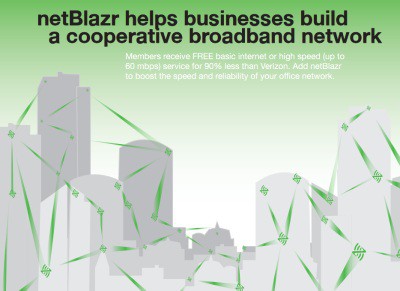
NetBlazr’s marketing brochure touts the service can deliver symmetrical speeds up to 60Mbps for free, and is particularly suited to offices that need additional broadband resources, but don’t want to sign a pricey upgrade agreement with incumbent providers like Verizon.

NetBlazr’s competitors like the aforementioned phone company are reacting with a shrug of the shoulders so far.

Verizon spokesman Phil Santoro: “Competition is always healthy and the market for Internet service is already highly competitive.”

“We aren’t familiar with this company’s business proposition, but I can tell you that Comcast already offers secure and reliable high speed Internet,” spokesman Marc Goodman told the Boston Herald.

Earlier efforts to share Internet services in neighborhoods through Wi-Fi ran into trouble when Internet Service Providers found out.  Virtually all providers specifically prohibit customers from sharing their residential service with non-paying customers beyond the property line.  But since NetBlazr arranges for its own access, this stumbling block is overcome.

Company officials say they have enough connectivity to support the demand, although business users don’t traditionally pound networks with peer-to-peer file requests or lots of online video, so how NetBlazr will ultimately perform in a residential setting remains to be seen.

The company has impressed technology mavens at the Massachusetts Innovation & Technology Exchange.  NetBlazr won this year’s “Best Bootstrapped Start-up” award.  It was also a finalist for the $1 million MassChallenge competition held earlier this year.

Hanley’s ultimate goal is to provide cheap, commodity Internet access, and thinks within five years his idea will be a major game-changer for how broadband service is delivered in the United States.

[flv width=”480″ height=”380″]http://www.phillipdampier.com/video/NetBlazr.flv[/flv]

netBlazr CEO Jim Hanley indicts America’s broadband duopoly and says direct action through new competition will solve the problem faster than public policy can.  Hanley also explains how his service works. (10 minutes)

Connected Nation-Affiliate in Ohio Celebrates Broadband Rural Ohio Doesn’t Have

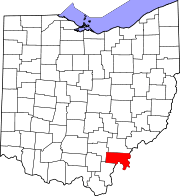
Meigs County, Ohio

Connect Ohio, one of the many state chapters working with telecommunications industry-backed Connected Nation, has released its 2011 Technology Assessment about how the state is adopting broadband technology.

Despite celebrating improvements, large parts of rural Ohio still do not receive any kind of broadband service, especially from the state’s dominant provider AT&T, one of the companies that has traditionally backed Connected Nation.

The friendly relations these broadband groups maintain with their sponsors results in reports that strenuously avoid any direct criticism of providers for ignoring rural Ohio, particularly in the southeastern part of the state where broadband is especially difficult to obtain.

Connect Ohio’s findings, mostly provided by voluntary data from Internet Service Providers and respondents to various surveys, downplays rural Ohio’s broadband drought:

Statewide, 5% of Ohio residents report that broadband is not available where they live, 85% say with certainty that broadband is available, and 10% do not know whether broadband service is available.  By comparison, Connect Ohio’s provider-validated Broadband Service Inventory found that 1.7% of households do not have terrestrial fixed broadband service access.

In rural Ohio, 8% of adults report that broadband service is not available where they live, 79% say with certainty that broadband is available, and 13% do not know whether broadband service is available where they live.  By comparison, Connect Ohio’s provider-validated Broadband Service Inventory reports that 3.7% of rural households do not have terrestrial fixed broadband access.

The disparity in Connect Ohio’s numbers is especially apparent in rural Meigs County, located in southeastern Ohio.

“Geographically speaking, nearly two-thirds of Meigs County does not have easy access to affordable broadband,” Meigs County Economic Development Director Perry Varnadoe told The Daily Sentinel. “In terms of infrastructure, access to broadband is just as important as water and sewer service to businesses.”

Varnadoe thinks the few major providers that do offer service in the county are basically done expanding their service areas, and Varnadoe believes broadband adoption has reached a ceiling in Meigs County.

With much of the county bypassed for DSL or cable modem service, the only exception to this is fixed wireless service from New Era Broadband.  Unfortunately, it’s a costly alternative to traditional DSL.

New Era Broadband of Coolville is a Wireless ISP

New Era delivers up to 1.5Mbps service for $60 a month with a $200 installation fee and a two-year service agreement, and provides service in the vicinity of the community of Racine.

The company is still waiting on a $2.9 million grant to expand service to an additional 3,000 residents, mostly in the area of Five Points, which only has access to dial-up Internet.

Only about half the residents of Belmont, Jefferson, Monroe and Harrison counties have broadband connections at home, the study also found.  The Intelligencer/Wheeling News-Register placed most of the blame for that on residents not being particularly interested in the Internet, but service and cost are likely more important factors, as cable and DSL service is also spotty in those counties as well.  If there is a computer in the home, there is a demand for broadband service, especially in households where children find Internet access increasingly important to complete study work.

For most residents, it has become a waiting game to see who will deliver access, if anyone will.  In most of Ohio, customers look to the phone or cable company for access.  Rural Ohio lacks good cable broadband coverage, and DSL from the phone company first requires an interest in providing the service, and AT&T has not proven to be aggressive in rural communities in the state.

In fact, the phone company has been seeking approval to discontinue providing rural landline service at a time and date of its choosing.  If the landline goes, the chance for wired DSL goes with it.

Search This Site:

Contributions:

Recent Comments:

Your Account:

Stop the Cap!