Home » Competition » Recent Articles:

Buffalo Group Says Verizon May Be Redlining Poor Communities With FiOS; Investigation Demanded

Phillip Dampier September 21, 2011 Broadband Speed, Competition, Public Policy & Gov't, Verizon, Video Comments Off on Buffalo Group Says Verizon May Be Redlining Poor Communities With FiOS; Investigation Demanded

A similar group in Baltimore placed bus advertising complaining about the lack of FiOS in that city in 2010.

A Buffalo group backed by the Communications Workers of America is demanding a federal and state investigation into whether Verizon is intentionally bypassing urban, ethnic, and economically-challenged neighborhoods for its fiber-to-the-home service, FiOS.

The Don’t Bypass Buffalo Coalition has stepped up the pressure on Verizon with a new billboard campaign that accuses the company of exacerbating the digital divide in western New York.

“The Verizon FiOS deployment in Buffalo is a corporate redlining scheme undermining the City of Buffalo with intentional discriminate design,” said Coalition member Jim Anderson.

Verizon suspended FiOS deployment during the height of the economic downturn, leaving some cities with a patchwork of FiOS service in some locations, traditional copper phone wiring in others.  In Buffalo, suburban areas that quickly approved the FiOS network with few franchise pre-conditions were among the first to get the fiber network.  Other suburbs, and the city of Buffalo itself, were effectively bypassed when franchise agreements and negotiations were left uncompleted at the time Verizon suspended further expansion.

The Coalition released a letter signed by two dozen local officials and community leaders that suggests Verizon may be up to something more sinister, suggesting possible racial and economic discrimination by the company over its choice of areas to deploy the service.

Coalition members note that in the 10 suburbs where Verizon offers FiOS, the proportion of African American residents in those areas is more than 13 times lower than it is in the city of Buffalo, and the Hispanic population is nearly four times lower. Even more telling, the Coalition writes, is that the network infrastructure is already in place to deploy FiOS within Buffalo city limits.

The Coalition is among the most vocal among local pressure groups Verizon has faced since its decision to suspend further FiOS expansion.  Other cities, especially Baltimore, have their own coalitions to complain about Verizon’s apparent lack of interest in restarting fiber projects.

Verizon rejects most of the charges the Buffalo-based Coalition has made.

“As Verizon has told the Coalition and local officials countless times, our focus these days is meeting the buildout commitments in the 182 municipalities across the state where we currently have TV franchises,” a Verizon spokesman said in a statement. “The allegation of discrimination with respect to FiOS deployment is just plain wrong…period. The coalition simply needs to look at other FiOS deployment areas in New York and other states to see those allegations are off base.”

[flv width=”640″ height=”380″]http://www.phillipdampier.com/video/Is Verizon Redlining Baltimore City 3-16-10.flv[/flv]

In March, 2010 Progressive Maryland held a public rally protesting the lack of Verizon FiOS in Baltimore.  (8 minutes)

Frontier’s Everyday High Prices for Slow DSL Just Don’t Make Any Sense

Phillip Dampier September 20, 2011 Broadband Speed, Buckeye, Charter Spectrum, Competition, Consumer News, Data Caps, Editorial & Site News, Frontier, Rural Broadband Comments Off on Frontier’s Everyday High Prices for Slow DSL Just Don’t Make Any Sense

Phillip "Frontier DSL is Too Slow and Expensive" Dampier

Frontier Communications occasionally sends me mailers promoting their latest offer for DSL and/or satellite service.  The price on the front of the letter looks good — usually around $20 a month — despite the fact the best Frontier can deliver my area less than one mile from the Rochester, N.Y. city line is 3.1Mbps.  But Frontier’s fine print is infamous for bill padding extra fees, charges, and service commitments that makes the out-the-door price literally higher than Time Warner Cable’s Road Runner service, which actually delivers substantially faster speed at a lower price.

I’m not alone.

Customers in several Frontier service areas are openly wondering why they should do business with the phone company when they are charging more for less service.

In Ohio, Frontier Communications competes in some areas with Buckeye Cablevision.  Frontier sells DSL Internet in northwest Ohio for $29.99 a month.  For that, customers like Inquiry receive 6.2Mbps even though they bought 7.1Mbps service.

“Their [Internet prices] are significantly higher when comparing the other providers in northwest Ohio,” Inquiry writes. “Buckeye Cablevison has 10Mbps service for $24.95/month. And they actually give the customer 10.8Mbps.”

In areas where Frontier often finds itself the only game in town, that price is downright cheap.

Frontier's "High Speed" Fantasies

Nialis in Aliso Viejo, Calif. doesn’t know what Inquiry is complaining about.  He pays $30 a month for 1.5Mbps DSL service from Frontier.

Eric McDaniel from McDavid, Fla. found small relief when he complained about the 2.2Mbps DSL service he was paying $39.99 a month to receive.

“I now pay $29.99, and that is only because I threatened to cancel my service,” McDaniel says. “Now they give me a $10 recurring credit.”

“What are you going to do when they’re the only show in town?”

Even Charter Communications, one of America’s lowest rated cable companies, has prices and service that beats Frontier hands-down.

In some Charter areas like Wausau, Wisc., Frontier DSL comes with a two year service commitment, a $14.99 monthly Wireless Router Fee, and comparatively slow service:

Frontier Communications Pricing - Wisconsin

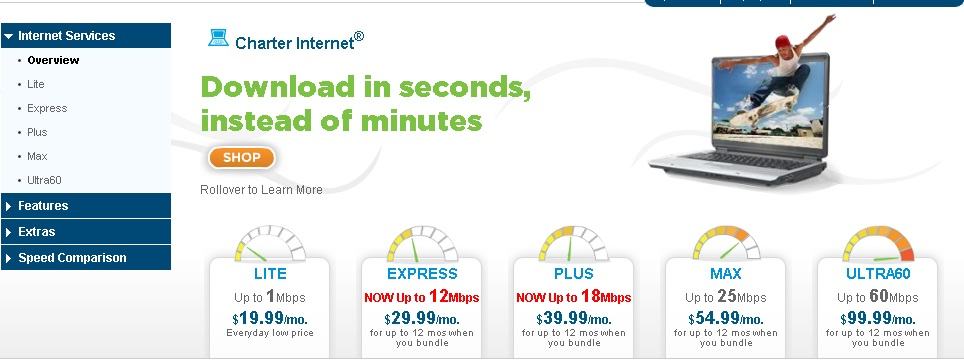
Customers can pay $29.99 a month (before fees) for “up to 3Mbps” DSL service from Frontier or spend $29.99 and get 12Mbps from Charter:

Charter Communications Pricing - Wisconsin

So how does Frontier Communications keep offering service at uncompetitive prices?  They have much greater success in the rural markets they favor, where cable competition rarely exists.  Plus, many consumers may not understand the impact of the speed differences they receive from different providers, tending to blame “the Internet” for slowdowns more than the provider delivering the service.  Some customers may also be attracted to valuable customer promotions that include free netbooks or television sets, and forget about the fine print service commitments that come with the deal.

As dwink9909 from Clintonville, Wisc. shared on the Frontier Broadband Reports forum: “Frontier Communications Inc. is free to charge the maximum the market will bear primarily because they are the only provider in most of the areas they serve. That’s certainly true here in Wisconsin. Six miles south of me you can get dial-up service from two dozen ISPs and broadband via wireless, cable or DSL, but here there is only a single provider for telephone and broadband. We are among the “under-served” millions who are just glad to have high speed Internet at any cost.”

Frontier is only too happy to oblige.

Big Cable Running Scared: Comcast/Time Warner Cable Promotions Can Save Customers A Fortune

Phillip Dampier September 20, 2011 Comcast/Xfinity, Competition, Consumer News, Editorial & Site News Comments Off on Big Cable Running Scared: Comcast/Time Warner Cable Promotions Can Save Customers A Fortune

Big cable companies are targeting their non-customers, and those current customers who refuse to sign up for triple-play bundles, with some of the most aggressively-priced promotions in years.  The two largest, Comcast/Xfinity and Time Warner Cable, have been sending out letters offering dirt cheap $20 Internet service or cable television packages that include DVR service, a second set top box, and hundreds of digital cable channels for $49.99 a month for two years.

Comcast

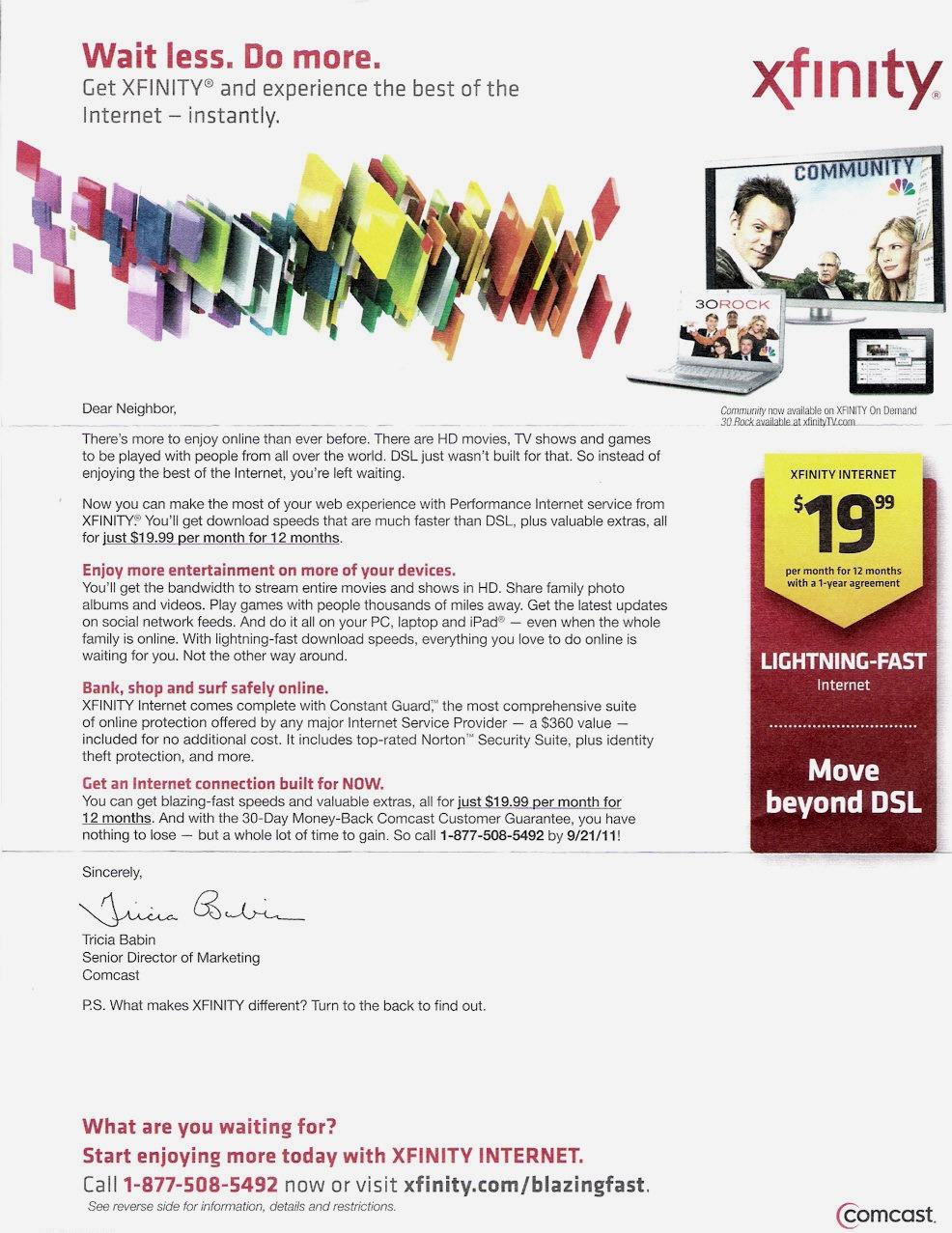
Comcast promotions vary in different markets, depending on who their competitors are.  The best pricing goes to new customers, as a recent promotion sent to suspected DSL customers in their service areas illustrates.

(click to enlarge)

The cable company is pitching 12 months of Xfinity Performance (typically around 12Mbps) for $19.99 a month for the first year for new customers only.  Some customers report they can cancel penalty-free at the end of the first year, while others are told Comcast is actually pitching a two-year contract where the price of the service increases to $34.99 a month during the second year (a early cancellation fee pro-rated to less than $50 applies in some areas if you cancel early).  This pricing applies to standalone service, which makes it aggressively priced.  Most cable providers charge a higher price for Internet-only service.  Some customers also report a $25 or more installation fee applies (and in some areas an in-person install is required for new customers).  We’ve heard from some readers that successfully qualified for the promotion under the name of a spouse if they have had Comcast service previously.  Otherwise, Comcast usually requires customers to be without service for 90 days before they are considered “new customers.”

Customers can try calling 1-877-508-5492 to request this offer: $19.99/Month for 1 year with no additional service required (Code at bottom of letter: LTP79376-0014).

If that number does not work from your calling area, other numbers to try include: 1-877-298-0903 (CA, TX), 1-877-508-5492 (CA, WV), 1-877-494-9166 in NJ (currently pitching 6-month version of this promotion without contract.)

If 12Mbps is not fast enough, ask the representative what promotional pricing exists for faster speeds.  Some customers scored 35Mbps service for $10 more per month.

A separate ongoing promotion from Comcast offers Blast Internet service at 25Mbps+ on similar terms.  But pricing varies wildly in different markets.  Customers in California were able to purchase this promotion for as little as $19.99 a month with a year-long contract, while customers in Chicago were asked to pay $39 for essentially the same service.

Comcast’s promotions list runs several pages, so if you are shot down asking for these promotions, ask about other current offers or hang up and try calling again and asking to speak with someone else.  Your results may vary depending on the representative you speak with.  Remember Comcast’s 250GB usage cap applies to all residential service plans.

Time Warner Cable

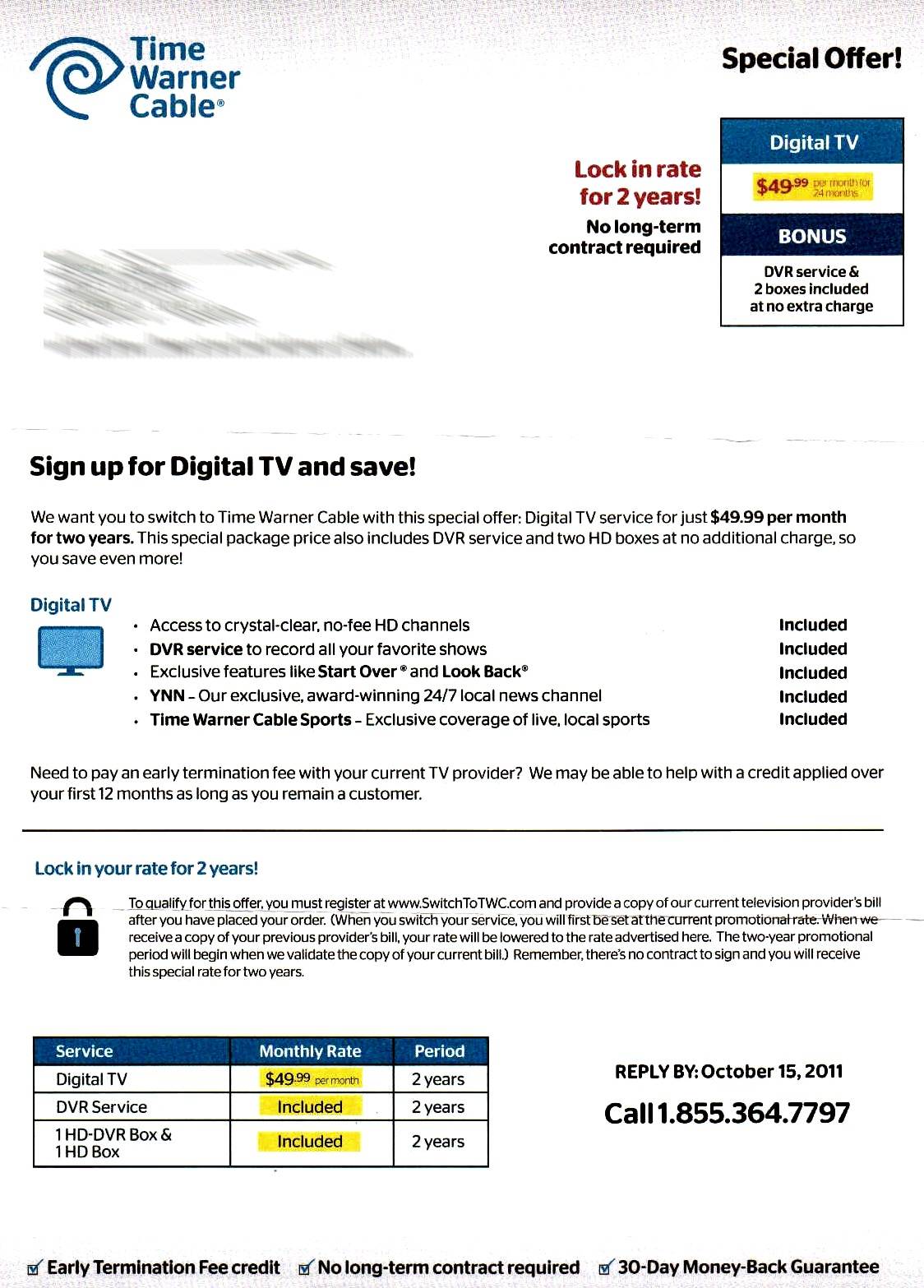
In addition to regular Road Runner standalone Internet service promotions that deliver Standard Service speeds for $29-35 a month for a year, Time Warner has been getting very aggressive trying to win back cord-cutters and those who have left for a competing pay television provider.  The cable company has mailed letters to non-cable TV customers in the northeast pitching substantial discounts on cable TV service price-locked (but no commitment term for you) for two years and includes free DVR equipment, DVR service, and a second set top box with digital cable TV for $49.99 a month.  They’ll even credit back the cost of any early termination fees charged by another provider over the course of the first year of service.

(click to enlarge)

The promotion is intended primarily for customers who already receive service from another provider, but new customers can call 1-855-364-7797 and ask for the offer without the competing provider early termination fee rebate.  If you do receive service from another provider, there are various requirements and steps to follow to qualify for up to $200 in termination fee credits.  Visit SwitchtoTWC or call them to learn the details.

Neither of these promotions work for existing Time Warner Cable customers.  If you already subscribe, discounts will be offered when you threaten to cancel service.  Retention deals from Time Warner Cable can be as aggressively priced as new customer promotions.  We have found retention offers made during the initial call to request a service disconnection are often not very aggressive.  Most representatives try and pare back your package before starting to offer retention pricing (which gradually gets better the more times you reply, “is that the best you can offer?”)

Our best recommendation is to call and request to cancel service 2-3 weeks from today and wait for a Time Warner Cable retention specialist to call you (answer those mystery caller ID calls — it could be Time Warner).  The reps that call you directly often deliver the most aggressive retention deals.  If nobody does reach out to you, call Time Warner yourself a few days before the disconnect is scheduled and ask them to make you an offer to rescind your disconnect request.  You may find some serious savings taking this approach.  If not, you still have time to rescind your disconnect request on your own before the plug gets pulled.

T-Mobile Prepaid Deal Brings Down Online Ordering System As Customers Beat Down the Doors

Phillip Dampier September 20, 2011 AT&T, Competition, Consumer News, T-Mobile, Wireless Broadband Comments Off on T-Mobile Prepaid Deal Brings Down Online Ordering System As Customers Beat Down the Doors

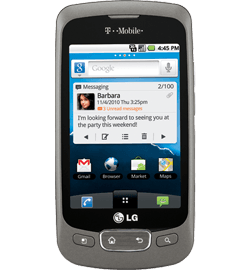
LG Optimus T

Some analysts would have you believe nobody wants to keep doing business with T-Mobile, but when the price is right, it can bring the company’s online ordering system to its knees.

T-Mobile’s prepaid division ran a sale this morning on a refurbished LG Optimus T, an entry-level Android v2.2 smartphone, for just $82.49.  In addition to free ground shipping, the phone also included $30 in airtime credit (as all of their $50+ prepaid phones currently include).

T-Mobile exhausted its supply within hours, but not without some frustration from customers who found completing the order difficult when the website began to fail from all of the traffic.

“This is an amazing deal, especially when combined with some “cashback” programs run by websites like Fatwallet, which knocked another $7.50 off the price,” writes Stop the Cap! reader Jenny Truro.  “T-Mobile’s prepaid service is actually a good deal when you top up once for $100, because all subsequent refills in any amount won’t expire for an entire year.”

Truro doesn’t use a cell phone enough to justify a standard two-year contract plan, and hated dealing with AT&T’s GoPhone prepaid plan because minutes were costly and expired quickly.

“AT&T lets you keep minutes up to a year when you spend $100, but you have to keep renewing at $100 every year if you want to hang on to last year’s minutes,” Truro says. “T-Mobile doesn’t stick you with that, and some of the other providers charge way too much per minute.”

Truro says the LG Optimus T she purchased this morning will be her introduction to smartphones.

“If I find I don’t use it enough to justify paying for prepaid data plans and other features, it was not an expensive experiment.”

The LG Optimus T can also be unlocked by T-Mobile by calling customer service 60 days after activating the phone on their network.  That allows the phone to be used on other providers’ networks with an appropriate SIM card.

Since AT&T announced its intention to merge with T-Mobile, analysts have declared T-Mobile a white elephant — one that postpaid customers are increasingly leaving.  But T-Mobile’s innovative, often-aggressive pricing proves that for the right price, customers will not only stick with the carrier, they’ll be joined by thousands of others willing to sign up.

Seven States Sue AT&T Over T-Mobile Merger; Seek Protection for Wireless Consumers

Phillip Dampier September 19, 2011 AT&T, Competition, Consumer News, Public Policy & Gov't, Rural Broadband, T-Mobile, Video, Wireless Broadband Comments Off on Seven States Sue AT&T Over T-Mobile Merger; Seek Protection for Wireless Consumers

At least seven states including New York, California, Illinois, Pennsylvania, Washington and Ohio have announced they are joining the Justice Department lawsuit to stop AT&T’s attempted buyout of T-Mobile USA.

The merger has been heavily criticized by consumer groups for its potential to reduce wireless competition and stifle the marketplace with just two dominant carriers — AT&T and Verizon Mobile.  Now several Attorneys General have joined the voices of opposition to the merger.

“This proposed merger would stifle competition in markets that are crucial to New York’s consumers and businesses, while reducing access to low-cost options and the newest broadband-based technologies,” New York Attorney General Eric T. Schneiderman said in a statement.

Washington State Attorney General Rob McKenna said the deal would “result in less competition, fewer choices and higher prices for Washington state consumers.”

“The proposed merger would create highly concentrated markets in Massachusetts and could lead to higher prices and poorer service.” Massachusetts Attorney General Martha Coakley said.

Illinois Attorney General Lisa Madigan said the deal would “substantially lessen competition for mobile wireless telecommunications services in Illinois and across the United States.”

“Blocking this acquisition protects consumers and businesses against fewer choices, higher prices, less innovation, and lower quality service,” Madigan added.

“Our review of the proposed merger between AT&T and T-Mobile has led me to conclude that it would hinder competition and reduce consumer choice,” California Attorney General Kamala D. Harris said. “Enforcement of antitrust law is the responsibility of the Attorney General and is vital to protecting our state’s economic strength and tradition of innovation for the betterment of all Californians.”

Shuler

Although the level of opposition to the transaction continues to grow, AT&T itself claims to remain confident it can push the merger through.

“It is not unusual for state attorneys general to participate in DOJ merger review proceedings or court filings,” AT&T representative Michael Balmoris said.

Several Democratic lawmakers, most of whom receive substantial campaign contributions from AT&T, would seem to underline the company has the support of at least some in Congress.

Rep. Heath Shuler (D-North Carolina), joined 14 Democratic co-signers in a letter sent Thursday to President Barack Obama encouraging him to support the merger deal.

“By settling the proposed merger of AT&T and T-Mobile USA we can put thousands of Americans back to work and promote economic development across the country,” Shuler said. “I urge the President to strongly consider the vast benefits this merger will have on job creation and the economy and quickly resolve any concerns the Administration may have with the proposal.”

Among the co-signers: Rep. John Barrow, Rep. Mike Ross, Rep. Dan Boren, Rep. Dennis Cardoza, Rep. Joe Baca, Rep. Leonard Boswell, Rep. Ben Chandler, Rep. Jim Costa, Rep. Henry Cuellar, Rep. Mike McIntyre, Rep. Mike Michaud, Rep. Collin Peterson, Rep. Loretta Sanchez, and Rep. David Scott.

AT&T currently also has support for their deal from 11 states, many which receive very little service directly from T-Mobile: Alabama, Arkansas, Georgia, Kentucky, Michigan, Mississippi, North Dakota, South Dakota, Utah, West Virginia and Wyoming.

A court hearing is scheduled for Sept. 21 to discuss settlement options.

[flv width=”480″ height=”290″]http://www.phillipdampier.com/video/KFOR Oklahoma City ATT T Mobile Merger 9-19-11.mp4[/flv]

KFOR in Oklahoma City explores the latest developments in the T-Mobile/AT&T merger case.  (2 minutes)

Search This Site:

Contributions:

Recent Comments:

Your Account:

Stop the Cap!