Home » Competition » Recent Articles:

Virgin Media Doubling Broadband Speeds for Free While Competitor Sky Unveils 100Gbps Internet for UK

Phillip Dampier January 11, 2012 Broadband Speed, Competition, Data Caps, Net Neutrality, Online Video, Sky (UK), Virgin Media (UK) Comments Off on Virgin Media Doubling Broadband Speeds for Free While Competitor Sky Unveils 100Gbps Internet for UK

Virgin Media is doubling customer broadband speeds... for free.

Great Britain is leapfrogging ahead in the global broadband speed race with two announcements this morning that represent major advances in British broadband.

First, Virgin Media is announcing it will double the broadband speeds for four million of its customers starting next month, for free.

The company says it will be the first residential provider in the United Kingdom offering 120Mbps broadband — a 20Mbps speed increase for their existing 100Mbps clients.  Customers on Virgin’s 10, 30, and 50Mbps tiers will soon receive free upgrades to 20, 60, and 100Mbps, respectively.  Those on the company’s popular 20Mbps plan will have their speeds tripled to 60Mbps.

That’s a major advancement for British broadband, where dominant BT-provided DSL runs at speeds averaging just over 6Mbps.

The new speeds were made possible by “modest investments” in Virgin’s fiber network, according to Virgin Media CEO Neil Berkett.

Berkett said the new speeds would help meet growing demand for faster access to support the proliferation of new digital devices.  Because Virgin invested primarily in fiber and cable broadband, speed upgrades on their existing infrastructure come “at a fraction of the cost of other network operators.”

That understanding was not lost on Sky Broadband, a growing competitor in the United Kingdom.  Sky this morning announced it has launched a newly-upgraded 100Gbps optical network to support its 3 million broadband customers.  The company is spending several hundred million British pounds on updating its network to position itself to become Britain’s largest Internet Service Provider.

Sky’s new network is based on the latest Alcatel-Lucent fiber technology, capable of supporting 100Gbps speeds on each of the individual 88 wavelengths on a single optical fiber.  Sky deployed the new dense wavelength division multiplexing technology on its existing optical fiber backbone network, demonstrating the infinite upgrade possibilities fiber optic technology offers.

Sky pitches its network capacity to consumers as a key benefit of its service, noting it is free of “traffic management” policies that reduce speeds for customers of other Internet providers.

The upgrade arrives just in time to handle the expected explosion of online traffic with this week’s introduction of Netflix streaming across Great Britain.

Community Broadband Works: Knoxville’s High-Tech Jobs Move South For Chattanooga’s Fiber Broadband

Phillip Dampier January 11, 2012 Broadband Speed, Community Networks, Competition, Editorial & Site News, EPB Fiber, Public Policy & Gov't, Video Comments Off on Community Broadband Works: Knoxville’s High-Tech Jobs Move South For Chattanooga’s Fiber Broadband

Chattanooga’s investment in community fiber broadband is beginning to pay dividends as the city benefits from an increase in high-paying, high-technology jobs.  Unfortunately for cities like Knoxville, Chattanooga’s gains are their loss.

“In a lot of places, you can get the same kind of high speed service as Chattanooga.  The difference is the price,” Dan Thompson of Knoxville-based IT company Claris Networks told Knoxville TV station WBIR.  “Connectivity there for us is about eight to ten times cheaper in Chattanooga than it is versus Knoxville or other cities.  That’s a huge deal when you’re comparing $100 a month or $800 a month.”

As a result, Claris is skipping the pricey service on offer from AT&T and Comcast and is moving jobs down I-75 to the city of Chattanooga, where publicly-owned EPB Fiber has invested in a fiber-to-the-home network that beats the pants off the competition.  Claris has found gigabit broadband in Chattanooga that can be installed in days at a fraction of the price charged by the companies they deal with in Knoxville.  Now Claris can invest the savings in bigger data centers and the jobs that come with them.

“Here in Knoxville and other cities, you may have to pay a premium to get speeds fast enough to support that,” Thompson said.

While companies like AT&T, Time Warner Cable, CenturyLink, and Comcast have had Chamber of Commerce support opposing community broadband in other states, Chattanooga’s local Chamber knows a good thing when it sees it.  Garrett Wagley, vice president of policy and public relations for the Knoxville Chamber, tells the Knoxville station investment in infrastructure is important when recruiting new businesses to town and keep existing ones growing.

Investment in high technology networks is an important topic for the evolving economies of the mid-south region.  Formerly dependent on tobacco farming, textiles, and manufacturing, states like Tennessee and the Carolinas are now investing to compete for high-technology, digital economy jobs.  Public investment in broadband comes as part of that effort, and typically only after appeals to existing commercial providers fail to bring necessary upgrades.

That “other places first” upgrade mentality continues to this day in states like South Carolina, which waited years for Time Warner Cable and local phone companies to deliver broadband speeds states further north have been receiving for several years.

For companies like Google and Amazon.com, the choice of where to locate regional data and distribution centers is often dependent on available infrastructure.  Chattanooga is in a strong position to argue it already has a broadband network in place that can meet the needs of any high-tech company, at prices too low to ignore.  Economic investment, jobs, and tax revenues follow.  Even better, much of the revenue earned by EPB Fiber stays in Chattanooga, paying off network construction costs and allowing the public utility to invest in smart-grid technology, which could benefit electric ratepayers as well.

Christopher Mitchell at Community Broadband Networks notes Chattanooga is not alone seeing significant job gains from investment in public broadband.  Just 100 miles to the northeast is Bristol, Virginia, another city that is transforming itself to support 21st century knowledge economy jobs.  Bristol’s public fiber network delivers service across most of southwestern Virginia, across an area long ignored or under-served by larger commercial providers.

For cities stuck with whatever AT&T, Comcast, and Time Warner Cable decide to offer, the trickling job migration to better-wired cities could eventually become a fast-running stream.  That’s why WBIR-TV questioned Knoxville city officials about why they abandoned consideration of their own public fiber network.

The City of Knoxville’s chief policy officer, Bill Lyons, told 10News there has been some discussion about constructing network infrastructure in the past.

“We did discuss this general topic very briefly early in the last administration and did not pursue it,” wrote Lyons.  “There was no systematic assessment, but rather a sense that the associated investment in infrastructure was not needed given the service that was already available.”

[…] “The question we as citizens need to ask is this something we’d be willing to spend money on,” said Thompson.  “I think you’d have to ask if you built this kind of network would more businesses come here.  And if they would, do the tax dollars [gained by attracting news business] offset the cost that we as citizens would have to pay.”

Good-enough-for-you broadband at take-it-or-leave-it sky high prices has been the state of broadband across the mid-south for years.  Unfortunately for Knoxville and other cities in Tennessee and the Carolinas, high-tech businesses are quickly discovering they don’t have to take it anymore.  What cities like Knoxville lose, Chattanooga gains.

[flv]http://www.phillipdampier.com/video/WBIR Knoxville Chattanooga Fiber Attracts Jobs 12-27-11.mp4[/flv]

WBIR in Knoxville explores Chattanooga’s success in broadband, which is now starting to come at the expense of other Tennessee cities who don’t have the infrastructure to compete.  (3 minutes)

Rate Increases for One and All: AT&T, Comcast, Cox, DirecTV — Up, Up and Away

Customers of some of the largest cable, phone, and satellite companies will pay an average of 3-6 percent more for service in a series of rate increases taking effect between now and the end of February.

AT&T U-verse

If your introductory offer has expired, expect to pay more for just about everything as of Feb. 9.

Cable TV:

  • U-family will increase from $54 to $57,
  • U100 will increase for some from $54 to $59 and for others from $59 to $64,
  • U200 will increase from $69 to $72/U200 Latino will increase from $79 to $82,
  • U300 will increase from $84 to $87/U300 Latino will increase from $94 to $97,
  • U400 will increase from $109 to $114,
  • U450 will increase from $117 to $119/U450 Latino will increase from $127 to $129.

For high speed Internet customers who ordered their current speed before June 12, 2011, effective with the February 2012 billing statement, the monthly price for Basic will increase from $19.95 to $25, Express will increase from $30 to $33, Pro will increase from $35 to $38, Elite will increase from $40 to $43, and Max will increase from $45 to $48. If you are paying a monthly high speed Internet equipment fee for the Residential Gateway, the amount will increase from $4 to $6.

For Voice Unlimited, effective on February 1, 2012, the monthly price will increase from $33 to $35.

AT&T blames increased programming costs and “the cost of doing business” for the rate increases.  AT&T is increasing broadband pricing despite enjoying further cost reductions from their Internet Overcharging scheme implemented in 2011.

Comcast

Comcast implements rate increases at different times of the year throughout its national service area.  But a preview of what is forthcoming can be seen in south Florida and Minnesota, where Comcast’s new rates for 2012 have increased an average of 5.8 percent.  That comes after a 2 percent rate hike last year.  It’s a bitter pill for many customers to swallow, because Comcast has also been moving popular cable channels like Turner Classic Movies into the more expensive Digital Preferred package.  The price of that full basic package will now run just short of $85 a month. Customers in Minneapolis are staring down these new rates:

  • Basic 1: no change in most franchise areas.
  • Digital Economy: increases from $29.95 a month to $34.95 a month, or 16.7 percent.
  • Digital Starter: increases from $62.99 a month to $66.49 a month, or 5.6 percent.
  • Digital Preferred: increases from $80.99 a month to $84.49 a month, or 4.3 percent.

Comcast blames increased programming costs and upgrade expenses associated with its now completed DOCSIS 3 project.  Comcast also has converted many of its service areas to all-digital service, which has opened up additional room to sell more expensive broadband packages, add additional HD channels, and make room for new product lines relating to home automation and security.

Cox Cable

Broadband Reports readers are sharing anecdotal evidence Cox has begun its own 2012 rate increase campaign.  In Florida, cable TV rates are up yet again:

Prices for Cox TV and Cox Advanced TV will be as follows:

  • Cox TV Starter will change from $19.55 to $22.85/mo.
  • Advanced TV will change from $5.50 to $4.20/mo.
  • Advanced TV Standard Definition receivers will change from $5.55 to $6.99/mo.
  • Advanced TV High Definition, High Definition/DVR & DVR receivers will change from $7.45 to $7.99/mo.

Advanced TV Paks will change:

  • Any 1 Pak (excluding Variety Pak) from $4.00 to $4.25/mo.
  • Any 2 Paks (excluding Variety Pak) from $8.05 to $8.50/mo.
  • Any 3 Paks from $12.00 to $12.50/mo.
  • Variety Pak will be $4.00/mo.

Premium pricing will change:

  • 1 premium channel from $13.99 to $14.99/mo;
  • 2 premium channels from $23.99 to $24.99/mo;
  • 3 premium channels from $30.99 to $34.99/mo;
  • 4 premium channels from $36.99 to $44.99/mo.
  • (Pricing for the 3rd and 4th Premium channels will be grandfathered at the current price for existing customers.)

Cox’s Preferred Internet tier is increasing from $49.99 to $53.99 a month.  Basic phone service increases from $11.75 to $13.18, and popular calling features like Caller ID are also increasing (from $5.95 to $9.00 per month).

Rates vary in different franchise areas.

DirecTV

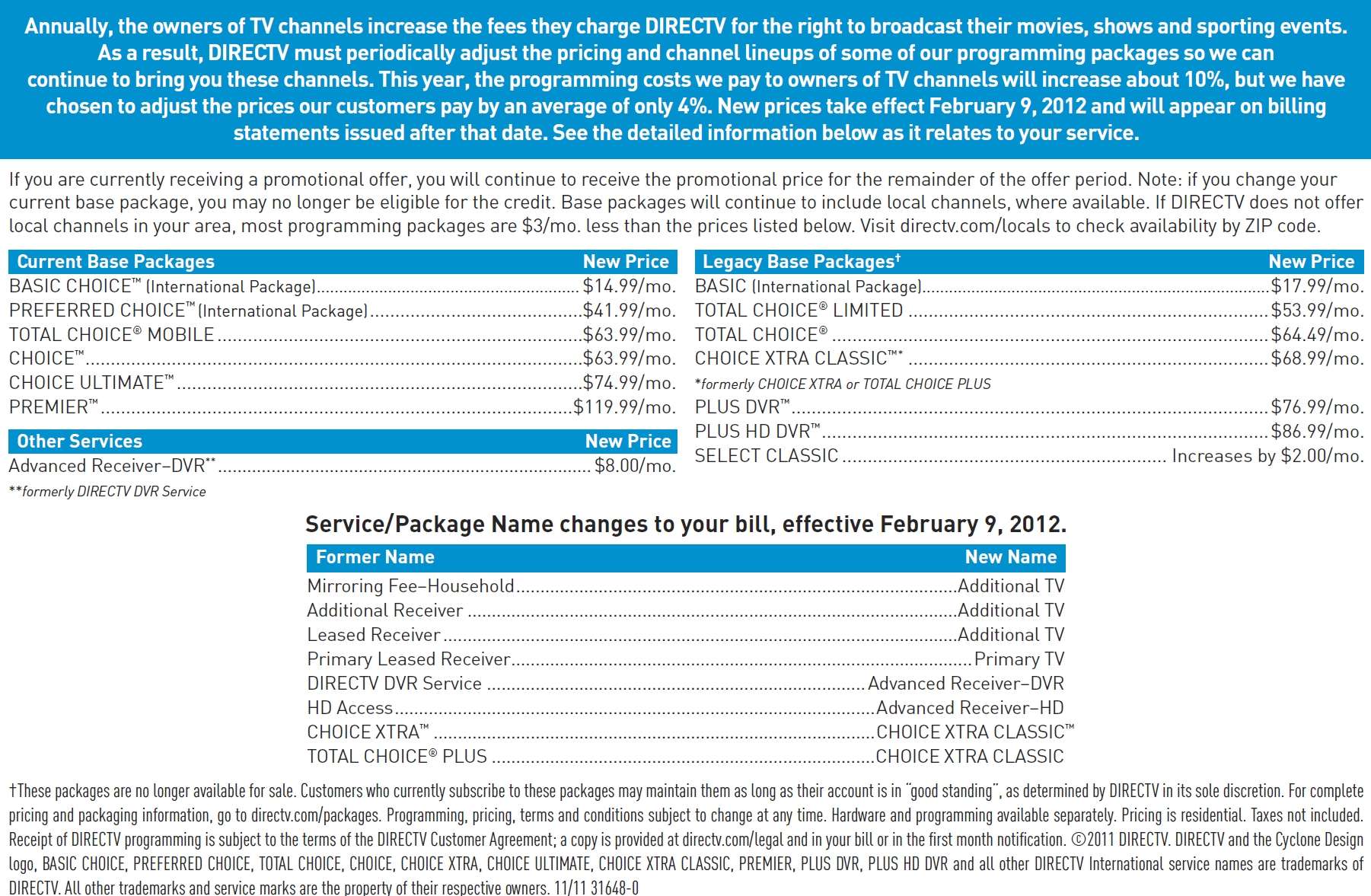
The satellite TV provider will raise rates on Feb. 9 by 4 percent on average. Its costs are going up by more than that, the company said on its website: “The programming costs we pay to owners of TV channels will increase by about 10 percent.”

DirecTV defends its rate increase, noting it will introduce new features in 2012 that include more than 170 HD channels and the most 3D viewing options of any television provider.  The full breakdown is provided from DirecTV:

Rate increases effective February 2012. Click image to enlarge.

Consumer Tips

  1. Customers who subscribe to bundled services will see the fewest rate increases.  The more services you bundle, the lower the typical cost of each component within the bundle.  It rarely pays to have one company as a TV provider and another delivering your broadband because standalone service pricing is increasingly the most expensive option.
  2. Ask for an extension of your introductory or promotional rate.  Request pricing from the competition and be prepared to summarize it with your current provider when arguing for a lower rate.  If your current provider thinks you are serious about jumping to another provider, they may lower your rates to keep your business.
  3. Be prepared to switch.  Cable companies base their retention offers on several factors: what the competition offers, how long you have been a customer (2+ years guarantees a better retention deal) and how you pay your bill.  If you are a late payer, expect a much more difficult time negotiating a lower rate.  You may encounter a brick wall if you are labeled a “flipper” that jumps between providers’ introductory pricing offers.  But even these customers will be welcomed back, with lower rates, when they inevitably return.  They just won’t get their promotional offer renewed.
  4. Some companies reserve their most aggressive pricing for customers who actually schedule a disconnect or turn in their equipment.  Cable companies have gotten wise to empty threats from negotiating customers.  If you schedule a complete service disconnection two weeks in advance, some companies will take you seriously and call you with the most aggressive “win back” offers available, especially if you turned in your cable equipment.
  5. Dump extras overboard.  Premium channel pricing has skyrocketed recently after remaining relatively stable for nearly two decades.  HBO is now at or above $15 a month in many areas.  As customers try to economize, premium movie channels are usually the first to go, and many cable operators are starting to lose preferred wholesale volume pricing discounts.  They are passing along new, higher prices to the dwindling number of premium customers left.  Scrutinize your cable bill carefully for potential savings.  Look for mini-pay tiers of HD channels you never watch, consider downgrading your “digital phone” package to local-only calling if you rarely make long distance calls, and consider tossing “Turbo” broadband speed packages that only incrementally increase download speed.  Many customers originally signed up to obtain higher upload speeds, but as cable companies boost speeds for all of their customers, the extra boost may no longer be worth the money.

Wall Street Encourages Verizon to Get Completely Out Of Landline/FiOS Business

Wall Street is encouraging Verizon Communications to sell off its landline telephone operations to clear a path for a potentially-profitable merger with British mobile phone company Vodafone Group Plc.

Analysts at Goldman Sachs Group are behind the research report, which suggests Verizon’s recent non-aggression treaty with Comcast and Time Warner Cable makes the sale of Verizon’s landline phone and FiOS fiber to the home network more likely. Verizon will earn a percentage of every cable TV/phone/broadband subscription sold, effectively making Verizon’s own wired network redundant. Potential buyers could include Frontier Communications, CenturyLink, or Windstream, which all have business plans that depend on landline networks fewer Americans are using.

Should Verizon clear away its legacy landline and FiOS networks, Goldman Sachs suggests, a merger with Vodafone would be a “clear fit” for the two companies.

“The remaining wireless and enterprise businesses would have faster growth and a clear fit with Vodafone’s assets and strategy, making it a more attractive merger partner,” Bloomberg News quotes from the report.

“Given that it no longer faces the threat of integrated cable competitors, Verizon could potentially spin off its remaining [landline] assets,” along with “large” pension and benefit liabilities, the Goldman analysts added.

Verizon would also eliminate its ongoing dispute with the two largest unions representing its landline workers — Communications Workers of America and the International Brotherhood of Electrical Workers.  Both unions are still trying to negotiate a new contract with Verizon after a brief, but contentious, summer strike. Verizon Wireless is almost entirely non-unionized.

Vodafone’s share price has been rising recently, perhaps anticipating a potential merger that would give Vodafone a stronger hand in the U.S. marketplace.

Verizon’s investment in its landline network, along with interest in expanding its well-regarded FiOS fiber to the home service, has remained stalled for the past few years.  Recently, the company indicated an interest in moving away from fiber optics to serve broadband customers, and rely on its wireless LTE 4G network instead.

Verizon’s new CEO Lowell McAdam comes from Verizon’s wireless division, and has not shared his predecessor’s enthusiasm for fiber upgrades.

Merger Partner?

While the prospect of an all-wireless future for Verizon may seem good for shareholders, consumers are likely to pay the price:

  1. The Justice Department is reviewing the antitrust implications of the non-aggression treaty between Verizon and its cable competitors;
  2. The sale of Verizon’s landline network to an independent provider could doom the company’s fiber optic network and limit rural Verizon customers to 1-3Mbps DSL;
  3. Verizon Wireless’ prices reflect its market share and lack of strong competition.  The company’s LTE wireless network, although fast, has suffered from reliability problems and is heavily usage-limited.  It may prove unsuitable as a home broadband replacement for rural customers;
  4. Reduced competition for telephone, video, and broadband will likely result in higher prices for existing cable subscribers, too.

Verizon is hardly the first phone company to ponder getting out of the phone business.  AT&T has been lobbying to rescind rural universal service requirements for years.  If successful, AT&T could abandon its rural landline network and provide customers with higher-priced cell phone service instead.

[flv width=”640″ height=”380″]http://www.phillipdampier.com/video/CWA Parody of Verizon Video.flv[/flv]

Verizon’s unionized workers are still fighting for a new contract, and released this parody video in response to a company-produced DVD mailed to union workers’ homes.  (3 minutes)

Broadcasters Outmaneuver White Space Broadband Advocates; Lawyers Will Benefit the Most

Phillip Dampier January 5, 2012 Competition, Editorial & Site News, Public Policy & Gov't, Wireless Broadband Comments Off on Broadcasters Outmaneuver White Space Broadband Advocates; Lawyers Will Benefit the Most

Static isn't just for the UHF dial, it's for powerhouse lobbying groups, too.

While surface reporting on “white space” broadband and “super Wi-Fi” seem to suggest the United States is on the cusp of opening up much of the UHF television dial to wireless broadband, behind the scenes broadband advocates are fretting about being outmaneuvered by the powerful broadcast lobby.  The theory behind “white space” broadband seems simple enough.  Anyone who has flipped channels up and down the UHF dial sees a lot of unused real estate.  While most cities receive 5-10 UHF TV channels, there are dozens of apparently empty channels filled with what seems to be nothing at all. Can’t we make more efficient use of the UHF dial and open the excess to other uses?

The FCC has been studying just that, with the proposition that broadcasters could be relocated closer together or agree to sell their broadcast license and sign off the air for good.  Theoretically, the UHF dial would be reduced to channels 14-30.  Stations on channels 31-51 would have to relocate down the dial to make way for broadband.

That was the plan anyway

Naturally, the National Association of Broadcasters (NAB), the broadcast industry lobbying group, was not happy to learn of this plan, which is still heavily promoted by wireless telecommunications companies.  They quickly argued there were not enough UHF channels left to accommodate every TV station on the air today, and some cities bordering Canada faced losing major stations if the plan was adopted.

In the clash of the lobbying titans, it appears broadcasters have at least temporarily won the upper hand.  Legislation authored by the powerful House Communications Subcommittee Chairman Greg Walden (R-Ore.), would grant the FCC authority to conduct spectrum horse-trading and auctions, but only if the sales take “all reasonable efforts to preserve” the coverage area of impacted broadcast stations.

In the minds of several wireless broadband advocates, “reasonable efforts” kills it. That key passage is open to wide interpretation, which in Beltway language means a full employment program for Washington law firms who will end up letting a judge decide what “reasonable” really means.

Blair Levin

Blair Levin, an attorney who served as chief of staff to FCC Chairman Reed Hundt from 1993 to 1997, where he oversaw the implementation of the disastrous 1996 Telecom Act, is all sour grapes about the latest developments in Congress.  That is to be expected — he was once considered the Obama Administration’s chief “broadband czar.”

“The legislation ties the FCC’s hands in a variety of ways,” Levin tells TVNewsCheck. “It opens it up to litigation risk, which then, in conjunction with the other handcuffs, makes it difficult to pull off a successful auction. The nature of the bill dramatically increases the probability that there will be less spectrum recovered and less money for the [U.S.] Treasury.”

Broadcasters have been legitimately worried about where they might fit within the new, slimmed-down UHF dial.  The more broadcasters packed closer together, the greater the chance of interference and reduced signal coverage for those who happen to live between two cities sharing the same channel number.  The NAB has consistently opposed forcing station-owners’ hands and wants stations compensated for their costs and inconvenience.

Before the first “white space” broadband signal takes to the airwaves, the government will have to set aside at least $3 billion to defray expenses incurred by television stations moving down the dial.  With language that guarantees broadcasters won’t have to suffer from an interference nightmare, FCC engineers will have a much harder time finding enough channels for the number of stations that need to move.  That could mean fewer channel positions up for auction.

Blair believes stations can extract even more by playing the litigation threat card.

“Nobody wants to go to an auction when there is the threat of a judge anywhere having the ability of holding it up,” Blair said. “I believe a good lawyer could find a way to get the question of  whether the FCC took all reasonable efforts in front of a judge. If you are designing the auction and a big law firm shows up and says, ‘If you don’t take care of my single broadcaster, we are going to find a way to get to court.’ That’s a real threat.’’

The Lady Gaga problem

Lady Gaga's wireless microphone malfunction.

Assuming Washington can fling enough cash to soothe the nerves of worried broadcasters, impediments to white space broadband don’t stop with the local Fox station.  The next complication is the wireless microphone issue.  When you see Lady Gaga in her latest outrageous outfit, you probably are not noticing her wireless microphone.  Performers of all kinds use these low power devices that often work over unused UHF spectrum.  Only it may not be unused for long.

Spectrum Bridge, a “white space” database administrator charged with coordinating who is using what frequency for what purpose, understands the challenges of trying to keep track of TV reporters, bands on tour, and other wireless microphone users, who all expect an interference-free experience.  Electric companies and municipalities also plan to utilize white space spectrum to manage smart city and smart grid communications.  A year later, Super Wi-Fi applications that deliver longer distance Wi-Fi service are expected to arrive.

It’s becoming a crowded neighborhood.

Congress’ NAB-friendly, Republican-sponsored bill may be modified substantially in a Democratic-controlled Senate, and there is still plenty of time for lobbyists to work their magic.  But it’s safe to say that those who have waited at least seven years for white space broadband to become a reality will have to wait a little longer.


Search This Site:

Contributions:

Recent Comments:

Your Account:

Stop the Cap!