Home » Competition » Recent Articles:

LightSquared Sunk by FCC; Shared Spectrum Interference to GPS Devices Cited

Phillip Dampier February 15, 2012 Competition, LightSquared, Public Policy & Gov't, Video, Wireless Broadband Comments Off on LightSquared Sunk by FCC; Shared Spectrum Interference to GPS Devices Cited

A billionaire who invested enormous sums to purchase airwaves for a new national wireless broadband network learned Tuesday ruled he cannot use them to launch LightSquared.

The Federal Communications Commission said yesterday Philip Falcone’s vision for competitive wireless service cannot go forward on the frequencies he acquired because tests show they create significant interference to other nearby spectrum users, especially GPS.

Falcone’s hedge fund poured nearly $3 billion into LightSquared, which the company still claims would not create significant problems for GPS users including aircraft, cars, and ships.

Falcone

But when tests were conducted in early 2011, significant interference problems were reported, some that could jeopardize the safety of American air travel.  The FCC decided it preferred to be safe instead of sorry.

The announcement by the FCC calls into question the future of the company and the value of its airwave assets, which are now likely worth a fraction of the price paid.

The company’s agreements with at least 30 wholesale customers are also at risk, and one of its largest partners, Sprint-Nextel, has spent the last few months distancing itself from the project, anticipating the decision the FCC announced yesterday.

The rejection has upset the FCC’s plans to increase wireless competition for AT&T and Verizon, which dominate American wireless.  The agency hoped the spectrum LightSquared obtained would open the doors to a new national player, but that appears unlikely for now.

LightSquared executives said in October they would sue the FCC in court if the agency blocked their network from operating.

The only new player on the horizon may be Dish Network, which earlier acquired wireless spectrum from two bankrupt companies, and now seeks to use them as mobile phone spectrum.  Separately, Clearwire is working with Sprint to construct a new national 4G network, while still operating Clear’s existing WiMAX 4G service.

[flv]http://www.phillipdampier.com/video/CNBC LightSquared Faces Prohibition Following Interference Report 2-14-12.flv[/flv]

CNBC discusses LightSquared’s new troubles and where the company can go from here.  (3 minutes)

HissyFitWatch: Fox News’ Shepard Smith: ‘AT&T is Full of Crap;’ Lies About Unlimited Data

[flv width=”640″ height=”380″]http://www.phillipdampier.com/video/Fox News Shepard Smith Hates ATT’s Data Plans 2-14-12.flv[/flv]

Fox News’ Shepard Smith launched into an off-script tirade against AT&T after sending him a text message he was one of the “5%’ers” about to have their data service throttled.  “I’m gonna pay more for this crap, because it -is- crap,” Smith said.

Smith just discovered the reality of Internet Overcharging.  Get customers hooked on unlimited use plans that soon become a part of their daily lives, and then allow an uncompetitive marketplace to turn data into a “limited resource” that can be monetized for all it’s worth.

“I signed up for this [unlimited] plan, I bought this phone, [and] they told me I could do this, and now that I’ve signed up… and I’ve done everything the way they tell me to do it, now I gotta pay more.”

“It’s like all you can eat crack, until you like a lot of crack, and then you gotta pay more.”  (2 minutes)

Thanks to reader Mileena for alerting us.

Time Warner Cable Support to Customer: “What Did You Do That Was Wrong?”

Phillip Dampier February 14, 2012 Competition, Consumer News, Video 4 Comments

Time Warner Cable dropped the ball… right on the heads of temporary customers Alice and Dan Beissel, who signed up for service and canceled just ten days later.

The Corpus Christi, Texas couple decided to cancel service from AT&T and give the cable company a try and, according to them, it was trouble right from the start.

The Beissels say the cable service never worked right, with picture outages and other equipment troubles that came and went.  Frustrations mounted when a service call found nothing wrong, until the Time Warner truck pulled out of the driveway and the picture again went blank.

But the final straw was a conversation Dan Beissel had with the company’s customer service support center.

“What did you do that was wrong,” the representative asked Beissel.

Beissel must have thought the answer was ‘signing up for cable service,’ because the family decided to cancel after that call ended.

Now the couple has been forced to turn to KZTV’s Troubleshooter consumer reporter in an effort to collect an overdue refund check for their service.  The station ran into the same kind of frustration the Beissel family did:

We’ve made several calls to Time Warner Cable in an attempt to speak with anyone who can help the couple.

Unfortunately, there is no customer service contact in Corpus Christi.

Time Warner Cable says refund checks are normally processed within four weeks and mailed from a California office.  A local employee working for the cable company in the Corpus Christi area said he would look into the missing refund check.


KZTV in Corpus Christi is helping one family find a missing refund check owed to them by Time Warner Cable.  (2 minutes)

AT&T’s 2GB Speed Trap: “I’m Almost Scared to Use the Phone,” Says Frustrated Customer

An increasing number of wireless data users are getting some tough love courtesy of AT&T.

“Your data use this month places you in the top 5% of users,” the text message reads. “Use Wi-Fi to avoid reduced speeds.”  Our regular reader Earl hopes we’ll keep spreading the word.

AT&T’s speed throttle has now moved beyond the pages of tech blogs and into USA Today, where the newspaper explores the trials and tribulations of wireless data management policies at the nation’s largest wireless companies.

Mike Trang, along with at least 200,000 other AT&T customers, has been caught in AT&T’s wireless speed trap.  The result can be speeds punitively reduced to dial-up for the remainder of a billing cycle, leaving customers on AT&T’s “unlimited use” plan waiting up to two minutes for a single web page to load.

While AT&T tells the newspaper it only throttles the speeds of unlimited customers who use an average of 2GB or more per month to ease congestion (if that), the company’s “congestion problems” seem to disappear when customers switch to a usage-billing plan that charges fees based on different usage allowances:

Trang’s iPhone was throttled just two weeks into his billing cycle, after he’d consumed 2.3 gigabytes of data. He pays $30 per month for “unlimited” data. Meanwhile, Dallas-based AT&T now sells a limited, or “tiered,” plan that provides 3 gigabytes of data for the same price.

Users report that if they call the company to ask or complain about the throttling, AT&T customer support representatives suggest they switch to the limited plan.

“They’re coaxing you toward the tiered plan,” said Gregory Tallman in Hopatcong, N.J. He hasn’t had his iPhone 4S throttled yet, but he’s gotten text-messages from AT&T, warning that he’s approaching the limit. This came after he had used just 1.5 gigabytes of data in that billing cycle.

Many customers who have received the text message warning about their usage now think twice about everything they do with their phone, which may be part of what AT&T intended for its remaining customers grandfathered on a now-discontinued unlimited use plan.

John Cozen, a Web and mobile applications designer in San Diego, told USA Today he’s now “almost scared to use the phone.”

Cozen’s complaints to AT&T have been ignored and now he’s shopping for a new carrier.

AT&T’s warning-and-throttle system is the strictest among America’s largest wireless carriers. When customers exceed AT&T’s arbitrary declaration of being among the “top 5% of users,” their speeds are subject to severe slowdowns until their next bill is issued. This leaves customers who may have needed their phone at the beginning of the month for a business trip or vacation suddenly throttled for weeks because of what AT&T calls “congestion,” even if nobody else is using the cell tower.  Even worse, customers not yet deemed to be offending AT&Ts usage manners, or who pay per gigabyte, can overload a cell tower and create the very congestion AT&T claims it hopes to manage.  But only “unlimited use” customers get “time out” in the usage penalty corner.

Among other carriers:

  • Verizon Wireless also uses a network management system that can throttle speeds for exceptionally heavy users, but their speed throttle is engaged only when individual cell towers are overloaded with traffic, and the speed reduction level will vary with the amount of traffic on that tower.  When congestion eases, speeds return to normal for everyone;
  • T-Mobile throttles customers after a maximum of 5GB of usage per month, unless other arrangements are made with the company;
  • Sprint Nextel does not have usage limits or a throttle on smartphone data plans at this time.

Telco’s Ethernet Over Copper Can Deliver Faster Speeds, If You Can Afford It

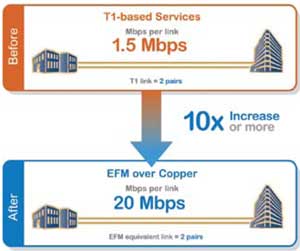
Ethernet over Copper is becoming an increasingly popular choice for business customers stuck in areas where companies won’t deploy fiber broadband (Graphic: OSP Magazine)

With Verizon and AT&T effectively stalling expansion of their respective “next generation” fiber and hybrid fiber/coax networks, and independent phone companies fearing too much capital spent improving their networks will drive their stock prices down, telephone companies are desperately seeking better options to deliver the faster broadband service customers demand.

The options over a copper-based landline network are not the best:

  • ADSL has been around for more than a decade and is highly distant dependent. Get beyond 10,000 feet from the nearest switching office and your speeds may not even qualify as “broadband;”
  • DSL variants represent the second generation for copper-broadband and can deliver faster speeds, but usually require investment to reduce the amount of copper between the customer and the switching office;
  • Fiber networks are more expensive to build, and some companies are using it to reduce, but not eliminate copper wire in their networks. But companies traditionally avoid this solution in rural/suburban areas because the cost/benefit analysis doesn’t work for shareholders;
  • Ethernet Over Copper (EoC) is increasingly the solution of choice for independent phone companies because it is less expensive to deploy than fiber and can quickly deliver service at a cat 5e speed of up to 50Mbps.

Unfortunately for consumers, EoC is typically way above the price range for home broadband.  Most providers sell the faster service to commercial and institutional customers, either for businesses that have outgrown T1 lines or where deploying fiber does not make economic sense.  Some companies have tried to improve on DSL by bonding multiple connections together to achieve faster speeds, but Ethernet is quickly becoming a more important tool in the broadband marketing arsenal.

With phone companies pricing EoC service from several hundred to several thousand dollars a month, depending on the speed of the connection, they hope to remain competitive players against a push by the cable industry to more aggressively target business customers.  In more rural areas, phone companies lack cable competition, so they stand a better chance of success.

Fierce Telecom‘s Sean Buckley published an excellent series of articles outlining the current state of EoC technology and what phone companies are doing with it:

  • AT&T: Inherited EoC from its acquisition of BellSouth, and barely markets it. Instead, AT&T uses it as a quiet solution for challenging customers who cannot affordably be reached by fiber.  AT&T will either deliver the service over copper, copper/fiber, or an all-fiber path depending on the client’s needs.
  • CenturyLink: No phone company is as aggressive about EoC as CenturyLink. When CenturyLink acquired Qwest, interest in the technology only intensified. EoC is a CenturyLink favorite for small businesses that simply cannot get the speeds they need from traditional DSL.  Most EoC service runs up to 20Mbps.
  • Verizon: Verizon’s network is the most fiber-intense among large commercial providers, so EoC is not the first choice for the company. However, it does use it to reach multi-site businesses who have buildings and offices outside of the footprint of Verizon’s fiber network/service area.
  • Frontier: In the regions where Frontier acquired Verizon landlines, EoC has become an important component for Frontier’s backhaul traffic. EoC has been deployed to reach cell tower sites and handles broadband traffic between central office exchanges and remote D-SLAMs, used to let the company sell DSL to a more rural customer base.  Frontier looks to EoC before considering spending money on fiber service, even for commercial and institutional users.
  • Windstream: EoC is the way this phone company gets better broadband speeds to business customers without spending a lot of money on fiber. Small and medium-sized customers are often buyers of EoC service, especially when DSL can’t handle the job or the company requires faster upstream speeds.  Windstream markets upgradable EoC capable of delivering the same downstream and upstream speeds and can deliver it more quickly than a fiber project.
  • FairPoint: Much of this phone company’s EoC efforts are in territories in northern New England acquired from Verizon.  FairPoint targets small and medium sized companies for the service, especially those who have remote offices or clinics that need to be interconnected. FairPoint has also gotten more aggressive than many other companies working with ADSL2+ or VDSL2 to deliver faster broadband to office buildings and complexes more economically than fiber.
  • SureWest: This company is strong believer in fiber to the premises service, so its interest in EoC has been limited to areas where deploying fiber makes little economic sense. In more out-of-the-way places, EoC is becoming a more common choice to pitch businesses who need more than traditional broadband.
  • Hawaiian Telcom: HawTel uses copper-based EoC to provide connectivity across the diverse Hawaiian Islands.  Speeds are generally lower than in mainland areas, partly because HawTel still relies heavily on traditional copper-based service. But fiber-based EoC is increasingly available in more densely populated areas.

Search This Site:

Contributions:

Recent Comments:

Your Account:

Stop the Cap!