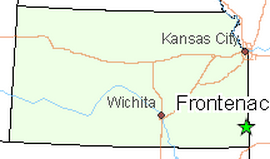
One of Kansas’ fastest and most innovative gigabit fiber broadband projects will be built in a community originally bypassed by AT&T.
Earlier this month the Frontenac City Council approved Craw-Kan Telephone Cooperative’s plan to build a fiber optic network in the city that will sell 1,000Mbps service for $70 a month.
“It’s just superior to anything out there,” said Craig Wilbert, general manager of Craw-Kan. “We’ve been doing fiber for several years. We have well over 2,000 customers, and I think we just finally asked ourselves why are we restricting the use of this fiber optic cable when it can do so much more than what most people are receiving?”
Craw-Kan Telephone Cooperative Association, Inc., began in March 1954 serving 14 subscribers in southeastern Kansas, very close to the borders of both Missouri and Oklahoma. After a series of acquisitions, the cooperative grew to more than 24 community exchanges, all bringing direct dialing to customers starting in the mid-1950s with plans to bring gigabit fiber to customers in the mid-2015s.
Construction of the network starts this summer with a completion date of next year.
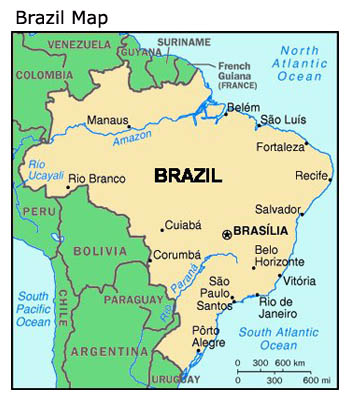
Brazil’s plans to bring at least 25Mbps fiber broadband to 45 percent of Brazilian households by 2018 are on hold after private providers balked about spending the money.
The Ministry of Communications’ ambitious Broadband for All program is a public-private partnership. Public broadband expansion funding would be matched by generous tax credits to encourage private matching investments to improve Brazil’s telecommunications infrastructure. Telephone customers already pay a tax on their telecom bills to fund Brazil’s version of the Universal Service Fund, which helps subsidize expenses in high cost service areas.
The plan derailed after investment markets saw little opportunity for big profits from a fiber upgrade. Brazil’s president Dilma Vana Rousseff embarrassed her Minister of Communications Ricardo Berzoini, who had already publicly announced plans to get the upgrades started last month.
A source close to the president told Reuters the government has sided with commercial providers and is slowing the project down for now.
“We have to adjust the timing of investments to adapt to the appetite of the market and public finances,” said the source, who spoke on condition of anonymity.
A less ambitious expansion program is tentatively scheduled to start in mid-October, but is only likely to incrementally improve broadband in larger cities.
At least one company balked about poor revenue and profit opportunities serving economically challenged regions in Brazil. It argued the population lacked enough income to pay the prices they intended to charge for fiber service.
Community and broadband activists complain critics have demagogued the effort from the beginning with stories of wiring fiber across vast expanses of the Amazon Rain Forest that would ultimately serve few, if any customers. After years of sub-standard service, many believe broadband should be provided and regulated like an essential utility. Currently, only landline-based broadband is regulated in the public interest.
For the consumer protection agency PROTEST, fast broadband is essential to society and where private providers have dropped the ball, the Brazilian government should pick it up and build broadband networks itself, using the proceeds of the Universal Service Fund.
“This deference to big telecom companies to decide Brazil’s online future is a huge mistake,” complained Carlos Filho, an Internet user in Cuiabá, the capital city of the state of Moto Grosso. “I cannot even get 1Mbps DSL in my downtown apartment. You have to use wireless, which is very expensive, to get anything done. The government should be building broadband like it builds roads.”
This afternoon, officials from the Ministry of Communications will meet with Russian Deputy Communications Minister Rashid Ismailov in St. Petersburg to seek Russian investment in Brazil’s wireless and rural broadband ventures.
A Prattsburgh, N.Y. family-owned company has picked up where Verizon left off and is busily wiring up small communities across western New York and the Southern Tier with fiber to the home service, giving both Verizon and Time Warner Cable some competitive headaches.
Empire Access is concentrating its service in areas where Verizon FiOS will never go and Time Warner Cable maxes out at 50/5Mbps. The company recently launched service in downtown Batavia in Genesee County and will be launching serving in Big Flats later this year.
Empire promises no data caps or usage-based billing and offers 100/20Mbps at introductory prices ranging from between $45-65/mo. Gigabit broadband speed is also available.
Where it has franchise agreements with local communities, Empire also offers cable television packages ranging from $31.45-73.40, with up to 130 channels. The packages are not as comprehensive as those from Time Warner Cable, but customers may not mind losing a dozen or two niche cable channels to save up to $30 a month off what Time Warner charges. Nationwide home phone service is also an option.
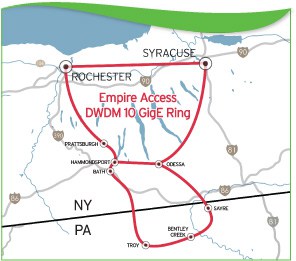
Empire relies heavily on two public/non-profit fiber backbone networks to deliver service. The Southern Tier Network comprises a 235-mile long fiber backbone that runs through Steuben, Chemung and Schuyler counties. Further north, Axcess Ontario provides backbone connectivity across its 200+ mile fiber ring around Ontario County.
With the help of public and non-profit broadband infrastructure, residents in small communities across a region extending from Sayre, Pa., north to Batavia, N.Y., will have another choice besides Verizon or Frontier DSL, Comcast or Time Warner Cable.
Residents in some communities, like Hammondsport and Bath — south of Keuka Lake, love the fact they have a better choice than Time Warner Cable. Empire has reportedly signed up 70 percent of area businesses and has more than a 20% residential market share in both villages after a year doing business in the Finger Lakes communities.
Empire targets compact villages with a relatively affluent populations where no other fiber overbuilder is providing service. It doesn’t follow Google’s “fiberhood” approach where neighborhoods compete to be wired. Instead, it provides service across an entire village and then gradually expands to nearby towns from there.
Most western New York villages are already compact enough to attract the attention of cable companies, predominately Time Warner Cable, which has an effective broadband monopoly. Verizon and Frontier offer limited slowband DSL, but Verizon has stopped expanding the reach of its broadband service and will likely never bring FiOS fiber to the home service to any western N.Y. community outside of a handful of suburbs near Buffalo.
The arrival of Empire reminds some of the days when the first cable company arrived to wire their village. Word of mouth is often enough to attract new customers, but a handful of local sales agents are also on hand to handle customer signups. From there, one of the company’s 80+ employees in New York handle everything else.
Bryan Cummings, who shared the story of Empire Access with us, “is pretty stoked.”
“Bye, bye Time Warner Cable,” Cummings tells Stop the Cap!.
Time Warner has treated most of western New York about as well as its service areas in Ohio, often criticized for not keeping up with the times. With fiber overbuilders Empire Access in the Finger Lakes region and Southern Tier and Greenlight Networks in Rochester, the fastest Internet options are not coming from the local phone and cable company anymore.
WSKG in Binghamton explores fiber broadband developments in the Southern Tier of upstate New York. Empire Access is providing the fast fiber broadband Verizon, Frontier, and Time Warner Cable won’t. (3:54)
You must remain on this page to hear the clip, or you can download the clip and listen later.
Boroughs of Sayre, Athens, and South Waverly (Pa.)
Borough of Troy (Pa.)
Communities on Empire’s radar for future expansion include Urbana, Dansville, Wayland and Cohocton. Further out, there is some consideration of larger cities like Corning and Elmira, as well as other towns in far northern Pennsylvania. With Empire’s expansion into Naples, the company also has many options in affluent and growing communities in Ontario County, south of Rochester.
Phillip DampierJune 10, 2015Broadband Speed, Comcast/Xfinity, Consumer NewsComments Off on Comcast Tells Customers Gigabit Pro Service Will Likely Arrive “Sometime in July”
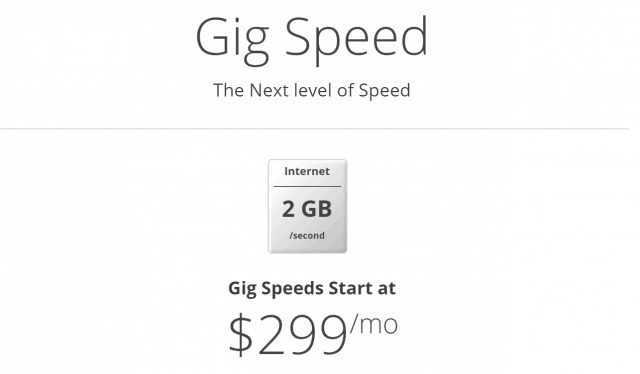
Comcast initially announced its 2Gbps broadband service would be available in May.
Three Comcast customers have told Stop the Cap! the cable company has informed them their wait to sign up for 2Gbps service will be a bit longer than planned.
“First it was May, then June, and now I’m being told ‘sometime in July,’ at least for Comcast’s central division, and even then they were not sure,” reports our reader Bruce Nuñez in Atlanta. That same answer was also received by Tom Davis who contacted Comcast this morning about the service.
“They still won’t release any information about anticipated installation costs, although the representative was fairly certain there would be a charge, and they won’t tell anyone the monthly price either,” said Davis. “The representative did tell me it was safer to assume the service will premiere in July and not hold out for June.”
A third potential customer in Miami was also given a vague availability date of “sometime in July” after being told there was no longer a scheduled launch date in June because Comcast wanted to simultaneously launch the service in several cities at once, and there were unspecified delays.
Comcast had previously announced the service would launch sometime in May. While not ready to actually provide the service, Comcast has been busy promoting markets where Gigabit Pro will eventually be available:
(Image: DSL Reports)
California: Chico, Fresno, Marysville/Yuba City, Merced, Modesto, Monterey, Sacramento, Salinas, San Francisco Bay Area, Santa Barbara County, Stockton, Visalia
Colorado: Colorado Springs, Denver, Fort Collins, Longmont, Loveland
Florida: Jacksonville, Miami
Georgia: Atlanta
Illinois: Chicago
Indiana: Northwest Indiana suburbs near Chicago
Minnesota: Minneapolis, St. Paul
Oregon: Portland
Tennessee: Chattanooga, Knoxville
Texas: Houston
Utah: Salt Lake City
Washington: Everett, Seattle, Spokane, Tacoma
Customers will have to live within one-third of a mile of existing Comcast fiber infrastructure to qualify for the service.
Initially leaked price information seemed to indicate Comcast was planning to sell the service for $300 a month. At that price, Comcast will likely limit customer demand. Comcast’s Metro Internet service, offering 505Mbps, has been priced at around $400 a month. But to sign up, one must agree to pay a $250 installation and $250 activation fee. The service also is provided on contract, with a very steep $1,000 early termination fee.
Customers of Lithuania’s Teo are getting a free speed upgrade — from 500Mbps before to 600Mbps now — on the company’s fiber to the home network. They are also paying less than half the price of what you pay for 15Mbps.
“Internet bandwidth is constantly increasing and high-speed becomes a market norm,” said Teo’s Nerijus Ivanauskas. “Therefore, we see that the added value that customers receive from purchasing a basic service becomes an increasingly important factor when choosing a service provider.”
Lithuanians have several choices for broadband service and price competition has kept broadband speeds faster than what North Americans typically receive, at a fraction of the price. Fiber to the home service is increasingly common in populated areas and is very affordable. Budget-minded customers happy with 100/100Mbps Internet access can get it from Teo for less than $13.50 a month.
Teo’s fiber network passes 837,000 households as of the first quarter of this year. That represents almost 70% of Lithuania. Lithuania was already well ahead of the United States and Canada, with an average broadband speed of 45.11Mbps — 4th place in the European Union and 9th fastest country in the world. Teo also leads the world in fast Wi-Fi. More than 3,000 Teo hotspots serve up speeds averaging 15.4Mbps to every connected client.
As broadband speeds continue to soar in Lithuania, Internet Service Providers have been forced to offer extras to customers to compete. Teo offers 300GB of free cloud storage space, free anti-virus protection, and special parental controls to help protect children from adult content.
[flv]http://www.phillipdampier.com/video/Teo Internet Speed Lithuania 6-2015.mp4[/flv]
A Teo advertisement showing off its fiber broadband speeds, ubiquitous free Wi-Fi network, anti-virus and child protection features. (0:45)
Be Sure to Read Part One: Astroturf Overload — Broadband for America = One Giant Industry Front Group for an important introduction to what this super-sized industry front group is all about. Members of Broadband for America Red: A company or group actively engaging in anti-consumer lobbying, opposes Net Neutrality, supports Internet Overcharging, belongs to […]
Astroturf: One of the underhanded tactics increasingly being used by telecom companies is “Astroturf lobbying” – creating front groups that try to mimic true grassroots, but that are all about corporate money, not citizen power. Astroturf lobbying is hardly a new approach. Senator Lloyd Bentsen is credited with coining the term in the 1980s to […]
Hong Kong remains bullish on broadband. Despite the economic downturn, City Telecom continues to invest millions in constructing one of Hong Kong’s largest fiber optic broadband networks, providing fiber to the home connections to residents. City Telecom’s HK Broadband service relies on an all-fiber optic network, and has been dubbed “the Verizon FiOS of Hong […]
BendBroadband, a small provider serving central Oregon, breathlessly announced the imminent launch of new higher speed broadband service for its customers after completing an upgrade to DOCSIS 3. Along with the launch announcement came a new logo of a sprinting dog the company attaches its new tagline to: “We’re the local dog. We better be […]
Stop the Cap! reader Rick has been educating me about some of the new-found aggression by Shaw Communications, one of western Canada’s largest telecommunications companies, in expanding its business reach across Canada. Woe to those who get in the way. Novus Entertainment is already familiar with this story. As Stop the Cap! reported previously, Shaw […]
The Canadian Radio-television Telecommunications Commission, the Canadian equivalent of the Federal Communications Commission in Washington, may be forced to consider American broadband policy before defining Net Neutrality and its role in Canadian broadband, according to an article published today in The Globe & Mail. [FCC Chairman Julius Genachowski’s] proposal – to codify and enforce some […]
In March 2000, two cable magnates sat down for the cable industry equivalent of My Dinner With Andre. Fine wine, beautiful table linens, an exquisite meal, and a Monopoly board with pieces swapped back and forth representing hundreds of thousands of Canadian consumers. Ted Rogers and Jim Shaw drew a line on the western Ontario […]
Just like FairPoint Communications, the Towering Inferno of phone companies haunting New England, Frontier Communications is making a whole lot of promises to state regulators and consumers, if they’ll only support the deal to transfer ownership of phone service from Verizon to them. This time, Frontier is issuing a self-serving press release touting their investment […]
I see it took all of five minutes for George Ou and his friends at Digital Society to be swayed by the tunnel vision myopia of last week’s latest effort to justify Internet Overcharging schemes. Until recently, I’ve always rationalized my distain for smaller usage caps by ignoring the fact that I’m being subsidized by […]
In 2007, we took our first major trip away from western New York in 20 years and spent two weeks an hour away from Calgary, Alberta. After two weeks in Kananaskis Country, Banff, Calgary, and other spots all over southern Alberta, we came away with the Good, the Bad, and the Ugly: The Good Alberta […]
A federal appeals court in Washington has struck down, for a second time, a rulemaking by the Federal Communications Commission to limit the size of the nation’s largest cable operators to 30% of the nation’s pay television marketplace, calling the rule “arbitrary and capricious.” The 30% rule, designed to keep no single company from controlling […]
Less than half of Americans surveyed by PC Magazine report they are very satisfied with the broadband speed delivered by their Internet service provider. PC Magazine released a comprehensive study this month on speed, provider satisfaction, and consumer opinions about the state of broadband in their community. The publisher sampled more than 17,000 participants, checking […]


 Subscribe
 One of Kansas’ fastest and most innovative gigabit fiber broadband projects will be built in a community originally bypassed by AT&T.
 “It’s just superior to anything out there,” said Craig Wilbert, general manager of Craw-Kan. “We’ve been doing fiber for several years. We have well over 2,000 customers, and I think we just finally asked ourselves why are we restricting the use of this fiber optic cable when it can do so much more than what most people are receiving?”
 Brazil’s plans to bring at least 25Mbps fiber broadband to 45 percent of Brazilian households by 2018 are on hold after private providers balked about spending the money.
 A less ambitious expansion program is tentatively scheduled to start in mid-October, but is only likely to incrementally improve broadband in larger cities.
 A Prattsburgh, N.Y. family-owned company has picked up where Verizon left off and is busily wiring up small communities across western New York and the Southern Tier with fiber to the home service, giving both Verizon and Time Warner Cable some competitive headaches.
 With the help of public and non-profit broadband infrastructure, residents in small communities across a region extending from Sayre, Pa., north to Batavia, N.Y., will have another choice besides Verizon or Frontier DSL, Comcast or Time Warner Cable.
 The arrival of Empire reminds some of the days when the first cable company arrived to wire their village. Word of mouth is often enough to attract new customers, but a handful of local sales agents are also on hand to handle customer signups. From there, one of the company’s 80+ employees in New York handle everything else.
 Customers of Lithuania’s Teo are getting a free speed upgrade — from 500Mbps before to 600Mbps now — on the company’s fiber to the home network. They are also paying less than half the price of what you pay for 15Mbps.