Subscribe
 The Federal Communications Commission should redefine broadband as speeds of at least 50/20Mbps, according to the New America Foundation’s Open Technology Institute.
The advocacy group argues that the FCC’s current definition of 25/3Mbps is too slow to support the growth of high-bandwidth online applications including high-definition video, cloud computing, and online gaming.
“People use their connections for many reasons, and often multitask,” the group writes in a filing submitted to the FCC this month. “It is easy to see how multiple people with multiple devices engaging in multiple online activities on the same residential connection can quickly lead to buffering, slow load times, and frustration even with a 25/3 connection.”
In general, consumer groups want the FCC to push providers to offer faster speeds, particularly telephone companies still relying on ADSL, a technology that first became widely available in the 1990s. There are millions of consumers still reliant on DSL technology on copper wire phone networks that can only support speeds of 6Mbps or less. Many of those are Verizon and AT&T customers, particularly in suburban and rural areas bypassed by Verizon FiOS or AT&T U-verse. Almost no AT&T or Verizon ADSL customers come close to achieving the FCC’s current minimum definition of broadband: 25/3Mbps.
The OTI argues that it isn’t just the speed required by applications, it is also the number of concurrent connections. As emerging technology like the Internet of Things introduces new devices that will share a user’s home broadband connection, faster internet speeds may be needed.
“The general consensus around IoT is that, with potentially billions of new devices connecting to the Internet via Wi-Fi or cellular signals, capacity will need to increase,” the organization writes.
But the OTI will have to contend with provider opposition to redefining broadband speeds upwards. The NCTA – the Internet and Television Association, the nation’s largest cable lobbying group, wants the current definition maintained by the FCC.
“The current benchmark accommodates the expected needs of even those households using an atypically large amount of bandwidth, accounting for multiple streams of bandwidth intensive applications like HD streaming video, in addition to web browsing, email, and other applications,” the NCTA wrote. “The Commission should reject the notion of adopting a future-oriented, ‘aspirational’ benchmark, which would be necessarily divorced from the realities of the marketplace.”
Many NCTA members already offer speeds in excess of 50Mbps, although many cable companies also cap their customers’ usage.
 The cable industry’s broadband Achilles’ heel has always been upstream speeds that are set much lower than download speeds. But the days of asymmetric cable broadband may soon be a thing of the past if CableLabs successfully defines a new Full Duplex extension for DOCSIS 3.1 — bringing symmetrical broadband speeds to cable companies across the country.
 Stop the Cap! reader Gabe, a Time Warner Cable customer, recently decided to upgrade his service to Charter’s fastest internet plan in his area — Ultra/100Mbps. That upgrade stopped dead in its tracks when Charter Communications informed him there is a mandatory $200 “activation” fee for customers selecting 100Mbps service.
 Only half of CenturyLink’s customers in well-populated areas formerly served by Qwest can buy broadband service at 40Mbps or higher, while rural customers fare considerably worse with less than 25% able to get High Speed Internet at those speeds.
 CenturyLink attempts to cover their claims with fine print attached to their FCC submission: “The numbers shown in this chart reflect the percentages of households served by DSLAMs that are capable of providing the specified broadband speeds.” (A DSLAM is a network device typically used to extend faster DSL speeds to customers by reducing the amount of copper wiring between the telephone company’s central office and the customer’s home. Customers in a neighborhood typically share space on a DSLAM, in effect sharing a single connection back to the phone company.)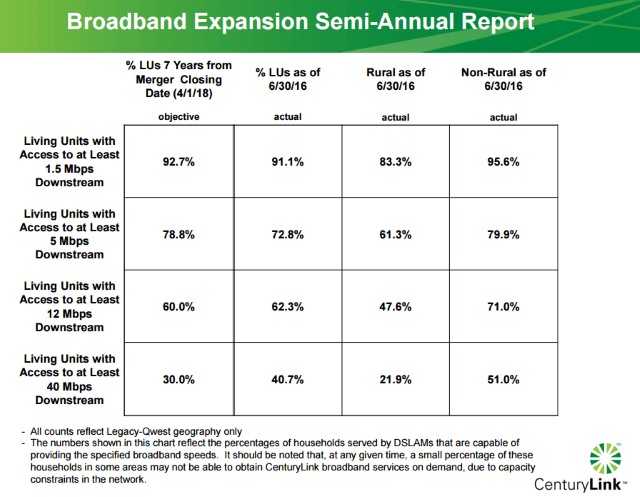
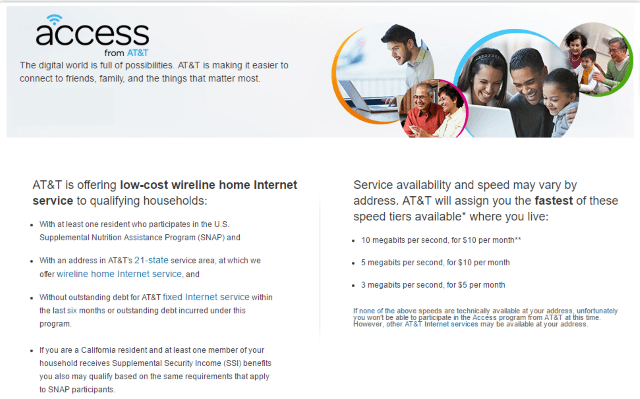
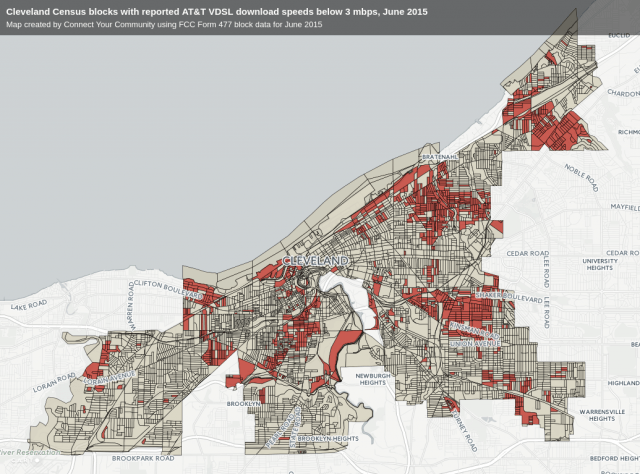
 AT&T is adding insult to injury by telling tens of thousands of eligible urban households they do not qualify for the company’s new low-cost internet access program because the company cannot deliver at least 3Mbps DSL in their service-neglected neighborhood.