Home » Broadband Speed » Recent Articles:

Comcast Introduces Gigabit DOCSIS 3.1 Broadband in 7 New Cities: $70-109.99/Month

Comcast may be undercutting its own fiber broadband aspirations by introducing a cheaper way for customers to get gigabit broadband service over their existing Comcast cable connection.

Customers in seven new areas, including most of Colorado, Oregon, southwest Washington State, and the cities of Houston, Kansas City, San Francisco and Seattle now have access to Comcast’s DOCSIS 3.1-powered gigabit downloads. (Upload speeds are limited to a much less impressive 35Mbps.)

Comcast announced the new communities as part of their gradual rollout of DOCSIS 3.1 — the standard that powers cable broadband — across their national footprint. These communities join Utah, Detroit, Tennessee, Chicago, Atlanta, and Miami where Comcast has already introduced the new speeds.

It is Comcast’s latest foray into gigabit speed broadband, and it is decidedly focused on the cities outside of the northeast (except Boston) where Comcast has not faced significant competition from Google Fiber or AT&T Fiber, both delivering gigabit speed internet access. Verizon FiOS, predominately in the northeast, only recently introduced gigabit speed options for its residential customers. Comcast continues to be among the most aggressive cable operators willing to boost broadband speeds for its customers, in direct contrast to Charter Communications, the second largest cable operator in the country that is predominately focused on selling 60-100Mbps internet packages to its customers.

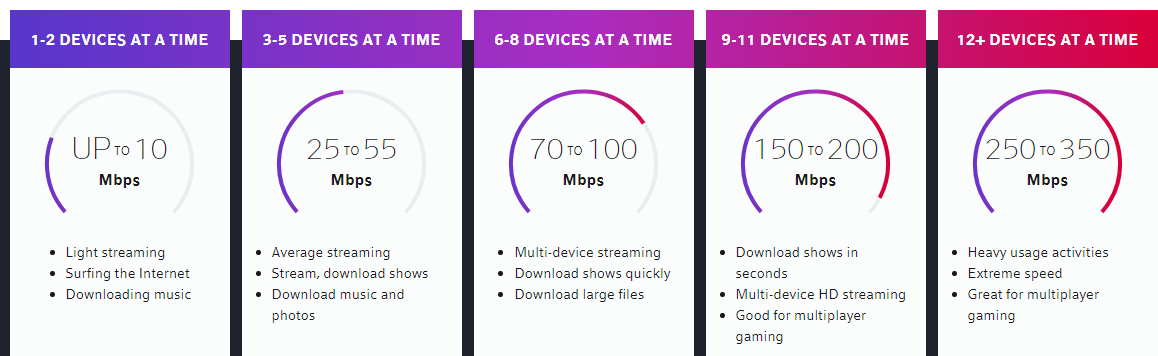
Comcast sells multiple broadband speed tiers to its customers.

Comcast’s efforts may undercut its own fiber-on-demand project, which wires fiber to the home service for some Comcast customers seeking up to 2Gbps service. That plan comes with a steep installation fee and term commitment, making it a harder sell for customers. Comcast’s DOCSIS-powered gigabit will retail for $159.95 a month, but Comcast is offering pricing promotions ranging from $70-109.99 a month with a one-year term commitment in several cities. The more competition, the lower the price.

In Kansas City, where Google Fiber premiered and AT&T is wiring its own gigabit fiber, Comcast charges $70 a month, price-locked for two years with a one-year contract. Customers who don’t want a contract will pay dearly for that option — $160 a month, which is more than double the promotional price.

In Houston, where AT&T has not exactly blanketed the city with gigabit fiber service and Comcast has been the dominant cable operator for decades, gigabit speed will cost you $109.99 — almost $40 more a month because of the relative lack of competition. Customers who bundle other Comcast services will get a price break however. Upgrading to gigabit service will cost those customers an additional $50 to $70 a month, depending on their current package.

“Additional prices and promotions may be tested in the future,” the company said in a news release.

Comcast does not expect many customers will want to make the jump to gigabit speeds and a higher broadband bill. Rich Jennings, senior vice president of Comcast’s Western/Mountain region, told the Colorado Springs Gazette that gigabit service was a “niche product for people who want that kind of speed.”

Comcast does suspect a number of signups will be from broadband-only customers who don’t subscribe to cable television.

Mike Spaulding, Comcast’s vice president of engineering, thinks the service will appeal most to those who rely entirely on a broadband connection for entertainment and communications.

“There’s not a lot of need for gigabit service for one customer to do one thing,” Spaulding told the Denver Post. “But what it does is enable an even better experience as more devices in the home are streaming, whether it’s video or gaming or whatever they are doing in the home. Most of our customers subscribe to the 100Mbps package today. Less than 10 percent of our customers are in the 200-250Mbps. We’ll see where one gig takes us.”

One place a gig may take customers is perilously close to Comcast’s notorious 1TB usage cap, which is currently enforced in Alabama, Arizona, Arkansas, California, Colorado, Florida, Georgia, Idaho, Illinois, Indiana, Kansas, Kentucky, Louisiana, Michigan, Minnesota, Mississippi, Missouri, New Mexico, Western Ohio, Oregon, Tennessee, Texas, South Carolina, Utah, Southwest Virginia, Washington, and Wisconsin, even for this premium-priced internet tier. Customers exceeding it will automatically pay a $10 overlimit fee for each 50GB of excess usage, up to a maximum of $200 a month. An unlimited ‘insurance plan’ is also available for $50 a month, which removes the 1TB cap.

Customers will have to use a new modem if they upgrade to gigabit service, either renting one from Comcast for around $10 a month or buying a compatible DOCSIS 3.1 modem. Two of the most recommended: the Arris Surfboard SB8200 ($189) or the Netgear CM1000 ($171.99) (prices subject to change).

Kansas’ Double-Down on Trickle-Down, Deregulation Flops as Residents Leave the State

We will mail it to you on floppy disks because your internet connection is too slow to download it.

While FCC Chairman Ajit Pai and Sen. Ron Johnson (R-Wisc.) decry government regulation as responsible for destroying capital and incentives to invest, the state of Kansas this week ended its all-out experiment with deregulation and trickle-down economics on steroids, with a Republican-dominated state legislature calling it a giant flop.

In charge of the Grand Experiment in Trickle-Down, Doubled-Down is Gov. Sam Brownback, who has systematically hobbled the state’s social spending and investment programs since becoming governor in 2011. He adopted his ‘vision thing’ from Reaganomics proponent Art Laffer, who apparently forgot the Reagan Administration’s penchant for all things deregulation was not all sweetness and light and had to be tempered by President George H.W. Bush after he was elected in 1988.

But what if history could have a second chance? What if a state kept its pledge of no new taxes and slashed regulation and oversight to the bone. Would it result in a free market paradise where government got out of the way for the public good? Would lower taxes result in more tax revenue as Kansas businesses boomed? Would infrastructure take care of itself?

To find out, Brownback slashed the state’s income tax, eliminated the top income tax bracket and delivered a disproportionate share of the tax cut benefits to the economic motivators (also known as Kansas’ richest families) who would supposedly use the surplus to invest in businesses and jobs. At the urging of the powerful small business lobby, backed by the Koch Brothers and their octopus of astroturf anti-tax groups demanding reform, Brownback zeroed out taxes on “pass-thru” income, which effectively allowed anyone running a LLC or small business to evade taxes.

There were moderate Republicans in Kansas that warned about the prospects of Brownback’s questionable assertion that low taxes and low funding of the state government would bring a new era of growth and prosperity. But dark money and Koch’s political machine saw to it those politicians were “de-elected” and replaced with Brownback’s army of minions.

In addition to creating budgetary ruin with tax revenue cratering, essential digital infrastructure crashed and burned. Deregulation and a mediocre state broadband expansion effort didn’t make internet service in Kansas better. In fact it got worse, along with the finger-pointing over who was responsible.

Last fall, Kansas Sen. Pat Roberts brought then FCC commissioner Ajit Pai to the community of Allen to meet with executives working for a dozen small telephone companies who were having trouble upgrading their networks across the great expanse of rural Kansas.

Brownback

Roberts wasn’t ready to claim federal government regulation was responsible for the mess. But Pai’s reflexive claims that deregulation incentivizes for-profit companies to invest in better broadband simply wasn’t working in Kansas either. The only solution for The Free Marketeers in rural Kansas turns out to be handing out government money to expand rural broadband, except in Kansas, there was very little money to be had after Brownback took an ax to the state budget.

The Wichita Eagle unintentionally drew a contrast between the thinking of providers that want to blame everyone else for the problem and plain reality for Brian Thomas, who works for the Blue Valley Tele-Communications Company.

“It really all comes down to a quality of life perspective,” Thomas told the newspaper. “I think we all live that. That’s our jobs, to provide that.”

The newspaper noted that without government money, the only way private companies could afford to pay to replace thousands of miles of ancient copper phone wiring in favor of fiber would be to make internet service so expensive that only businesses and the ultra-wealthy would be able to afford it.

So while Brownback’s great social experiment carried on, internet expansion and upgrades stalled in many communities across Kansas. In Allen, where Pai met to extol the virtues of private investment, the town librarian at Allen’s public library got some help from the Manhattan (Kansas) library system to install an inexpensive Wi-Fi hotspot that, once switched on, almost immediately filled its parking lot day and night with what the newspaper called “internet-starved townspeople.”
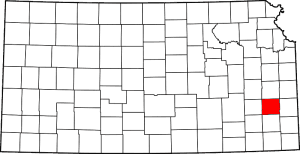
Allen County, Kan.

“There are several people who will watch movies outside” after hours, town librarian Nikki Plankington said. “The kids use it for the Pokemon Go thing. I don’t know what that’s all about, but the kids use it.”

While the public library did its part, Kansas’ for-profit private internet providers are going in a different direction – complaining a lot and asking for handouts with no strings attached.

The Eagle reported Pai’s meeting with rural telecom executives turned into a ‘whine and cheese’ reception. The phone companies had a laundry list of dislikes they wanted the deregulation-minded Pai to fix for them while they pondered upgrades:

  • The Universal Service Fund/Connect America Fund, financed by ratepayers through surcharges on their phone bills, was “obsolete” and didn’t provide enough money.
  • The federal government didn’t allow ISPs to chase after the deepest pockets to pay for their upgrades — popular online websites like Netflix and Amazon.com.
  • The FCC’s definition of broadband as 25Mbps ignored the fact Kansas phone companies wanted to deliver considerably lower speed service, claiming customers don’t want more than 10Mbps.

If the government could be lobbied to lower standards, eliminate regulation, and deliver or at least compel a cash welfare infusion from content providers and ratepayers, there was no need to ask rich Kansans to stop counting their money long enough to invest some of it in better broadband.

Catherine Moyer from Pioneer Communications claimed it was unfair to ask companies and customers to pay for upgrades when those internet titans like Netflix, Amazon, and Google make countless billions in profits using Pioneer’s network with absolutely no compensation for doing so.

“My customers and the customers here in Allen and all the customers in Wichita for that matter that have voice service pay a proportion of their bill,” she said. But, “there’s a whole group of people and companies utilizing the network that don’t pay into the fund in any meaningful way … so they haven’t helped build out this network.”

When the newspaper suggested she was effectively asking for higher taxes and paid lanes for internet content companies like Netflix that Moyer claimed was consuming 35% of Pioneer’s available bandwidth, she didn’t seem to have any objections.

“It’s not necessarily what people want to see, but in the same light, if you want these networks and you want these speeds, you have to somehow fund that. And who should fund it?” Moyer asked.

The next issue that doesn’t work for Kansas telecom companies is the FCC’s standard that broadband service be at least 25Mbps, and if a phone or cable company wants public dollars to build out their networks, they better choose a technology capable of delivering that kind of speed.

“One thing that kind of concerns me a little bit is having the FCC dictate, or Washington dictate, the level of speed I’m required to have in order to maintain a certain level of funding,” said Archie Macias of Wheat State Telephone, which serves rural communities in Butler, Cowley, Chase and Lyon counties. Macias is upset because his system uses fiber optics that can easily handle 25Mbps, but his customers only want to pay for 10Mbps.

“I’m not going to build a network that’s like having 500 channels on a TV that you’re going to watch 12 or 13,” he told the newspaper.

Wheat State currently offers four broadband plans in areas where fiber service is available:

  • $39.99 Pro (10/2Mbps)
  • $49.99 Multi-Pro (15/3Mbps)
  • $69.99 Power-Pro (25/5Mbps)
  • $79.99 Mega-Pro (50/20Mbps)
  • $10 discount when bundled with other services

What customers choose for broadband service is often an issue of pricing, not speed.

In more populated parts of Kansas, customers are still trying to cope with DSL service that has not seen significant upgrades for a decade. Since Brownback isn’t doing much to help, and tax cuts and deregulation have failed to inspire the kind of robust broadband expansion “light touch” regulation is supposed to provoke, a lot of Kansans are leaving the state for good.
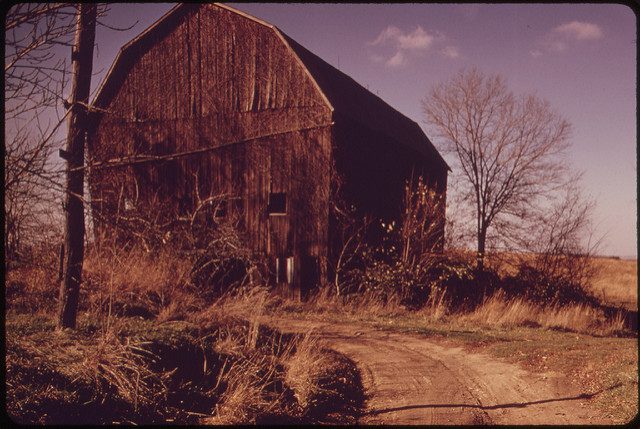
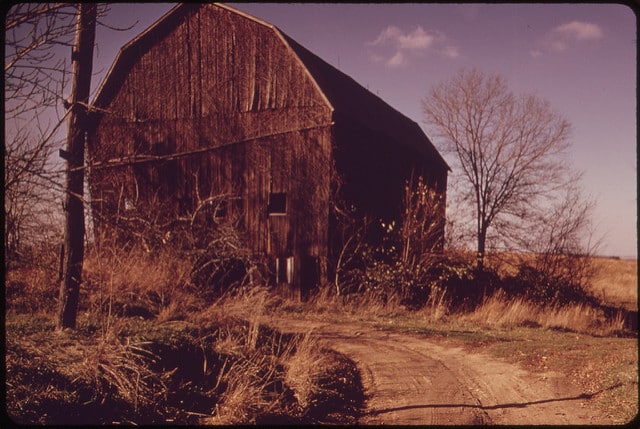
An abandoned farm.

One of those threatening to flee is Christianne Parks, who lives in Allen and endures not-even-close-to-being-broadband.

“Eventually, I probably would get bored out of my mind and leave,” 19-year old Parks told the newspaper when asked what she would do if her broadband situation did not change.

Last fall, the newspaper pinpointed some of the real problems afflicting the state’s economy and missing from the list were taxes and regulation. Deregulation-inspired consolidation in the state’s critical agribusiness sector decimated rural farms and the local economies that depended on them. When the farmers leave, Main Street businesses soon follow. The 1970s and 1980s was the era of the Rust Belt in the northeast and midwest. Now parts of the midwest including Kansas risk being labeled a Wheat Belt of economic deterioration.

Since 2000, 81 of Kansas’ 105 counties have lost population, according to the U.S. Census Bureau. The consensus is that trend will get worse, according to the newspaper – especially among young people – until and unless someone can find a way to get better internet service to the outlands. Brownback’s hands-off policies favoring providers are in contrast to New York’s more aggressive rural broadband funding program that seeks to achieve near 100% penetration of broadband service in the state over the next few years. New York regulators also compel companies doing business in the state to share some of their wealth from mergers and acquisitions, most recently requiring Charter Communications and Altice to expand their broadband networks to improve service and reach customers they don’t serve today.

The free-market-solves-everything concept celebrated by Pai and the Koch Brothers has now been tested and failed in Kansas. Among the few bright spots for broadband in Kansas are civic-minded telephone or cable providers that look beyond return on investment formulas in their community, and more commonly community-owned broadband networks or co-ops with a motive beyond profit — delivering decent broadband to maintain, sustain, and grow their local economies.

Recovery from the “free market miracle” train wreck started last fall, when a wave of moderate Democrats and Republicans were elected with a pledge to do everything possible to kill Brownback’s vision of paradise. This week, the Republican-dominated legislature had enough of living in Brownback’s PretendLand and overrode his veto of their plan to raise income taxes across the board and kill his legalized tax evasion scheme for business owners to bring in an additional $1.2 billion over the next two years to invest in Kansas.

The improved broadband that could result may give something for the state’s wealthiest citizens to do in their free time besides count their money.


Charter to N.Y.: Life After Time Warner Cable is Great for You

Charter Communications this afternoon submitted its annual update to the New York Public Service Commission, a condition of its approved merger with Time Warner Cable.

The cable company argues the merger has already delivered substantial pro-consumer benefits, including faster internet speeds, a low-income broadband program, no loss of New York jobs, and more upgrades to come.

Some highlights for customers in New York State:

All-Digital Conversion

  • The handful of Charter legacy cable systems in New York have already been converted to all-digital service.
  • Former Time Warner Cable systems in New York City, Syracuse, and the Hudson Valley are now all-digital.
  • Albany will be converted to all-digital service in late 2017.
  • Rochester and Buffalo will be converted to all-digital service in early 2018.

Broadband Speed Upgrades

  • As of March 14, 2017 all Charter customers in New York can subscribe to at least 100Mbps service. ($105/mo, $199 setup fee)
  • Charter has been actively rebuilding its Chatham system in Columbia and Rensselaer counties to provide broadband service. Project completion dates: In Rensselaer County, Berlin and Petersburgh expected to be done by the end of the third quarter 2017. In Columbia County, construction is scheduled to begin in May 2017, with a target completion date set for the end of first quarter 2018.

Cable Expansion

Since the last build-out update was filed on February 17, 2017, Charter has completed build-out to an additional 5,039 passings and has now completed build-out to a total of 15,164 passings across 56 counties and approximately 1,018 municipalities. Major areas of completed passings include, but are not limited to, the following:

  • Albany County for approximately 1,330 passings, including the Village of Menands, Towns of Colonie, Cohoes, Bethlehem, Voorheesville, Selkirk, and New Scotland, and the City of Albany.
  • Broome County for approximately 151 passings, including areas such as the Barker, Binghamton, Conklin, Endicott, Lisle, Marathon, Vestal, and Whitney Point.
  • Cortland County for approximately 154 passings, including areas such as the Towns of Cincinnatus, Cortland, Cortlandville, Homer, Virgil, and Truxton.
  • Erie County for approximately 2,029 passings, including areas such as the Towns of Amherst, Boston, Clarence, Colden, East Concord, Depew, Grand Island, Holland, Orchard Park, Derby, Lancaster, Eden, Springville, Williamsville, West Seneca, and the City of Buffalo.
  • Genesee County for approximately 157 passings, including areas such as the Towns of Batavia, Elba, and Alexander.
  • Kings County for approximately 390 passings in Brooklyn.
  • Livingston County for approximately 196 passings, including areas such as the Towns of Honeoye Falls and Dansville.
  • Monroe County for approximately 1,797 passings, including areas such as the City of Rochester, Town of Perinton, Greece, Penfield, North Chili, Webster, Pittsford, Ontario, Spencerport, and Gates.
  • New York County for approximately 575 passings in the City of New York.
  • Niagara County for approximately 297 passings, including areas such as the Towns of Cambria, Lockport, Lewiston, Niagara Falls, Newfane, North Tonawanda, Sanborn, Pendleton, Youngstown, and Wilson.
  • Oneida County for approximately 221 passings, including areas such as the Towns of Utica, Rome, Clinton, Camden, Cassville, and Marcy.
  • Onondaga County for approximately 787 passings, including areas such as the City of Syracuse, Village of Camillus, and Towns of Cicero, Baldwinsville, Liverpool, Chittenago, Clay, Homer, Manlius, and Marcellus.
  • Ontario County for approximately 442 passings, including areas such as the Towns of Clifton Springs, Canandaigua, Phelps, and Victor.
  • Orange County for approximately 429 passings, including areas such as the Towns of New Windsor, Middletown, Salisbury Mills, Montgomery, Goshen and Woodbourne.
  • Oswego County for approximately 146 passings, including areas such as the Towns of Pulaski, Fulton, Parish, Albion, Altmar, Camden, and Central Square.
  • Rensselaer County for approximately 376 passings, including areas such as the Towns of Castleton on Hudson, Cropseyville, Brunswick, Hoosick Falls, Nassau, Johnsonville, Sand Lake, East Greenbush, and Wyantskill, the City of Rensselaer, and the City of Troy.
  • Saratoga County for approximately 1,854 passings, including the Towns of Milton, Stillwater, Clifton Park, Ballston Lake, Ballston Spa, Halfmoon, Round Lake, Mechanicville, Malta, Waterford, and Wilton, and the City of Saratoga Springs.
  • Schenectady County for approximately 218 passings, including areas such as the Village of Delanson, Towns of Esperance, Niskayuna, Duanesburg, Glenville, and Rotterdam, and Burnt Hills, and the City of Schenectady.
  • Schoharie County for approximately 106 passings, including areas such as the Towns of Middleburgh, Cobleskill, Jefferson, and Schoharie.
  • St. Lawrence County for approximately 171 passings, including areas such as the Towns of Canton, Massena, Potsdam, and Gouverneur.
  • Sullivan County for approximately 639 passings, including the Towns of Fallsburg, Liberty, Monticello, Victor, Thompson, Loch Sheldrake, Swan Lake, Bethel, and White Lake, and the Villages of Woodridge and Wurtsboro.
  • Tompkins County for approximately 303 passings, including areas such as the Towns of Ithaca, Slaterville Springs, Groton, and Newfield, and the City of Ithaca.
  • Ulster County for approximately 537 passings, including the Towns of Accord, Hurly, Rochester, Ulster, Kerhonkson, New Paltz, Greenfield Park, Woodstock, and Saugerties, and the City of Kingston.
  • Warren County for approximately 107 passings, including areas such as the Towns of Lake George, Warrensburg, Queensbury, and Glens Falls.
  • Wayne County for approximately 192 passings, including the Towns of Palmyra, Ontario, Macedon, Walworth, Newark, Sodus, and Williamson.

Ed. Note: Nothing precludes Charter from including new housing developments and similar projects in these numbers where it would have provided service regardless of the Order from the PSC.

The Availability of Time Warner Cable’s Unrestricted $14.99 Everyday Low Price Internet Tier

Charter has continued to offer new subscribers in TWC’s New York territory the TWC standalone Everyday Low Price $14.99 broadband service, at speeds no less than those being offered at the time of the merger order, and will continue to offer this to new subscribers for up to two years after close (until May 17, 2018). Any customer is qualified to subscribe to this service, which provides around 2Mbps of internet speed.

Ed. Note: This service is not advertised or mentioned in any way on Charter/TWC’s marketing website and many Stop the Cap! readers in New York have told us Charter sales representatives have repeatedly told them the service is not available, so this claim is in dispute.

Existing customers with the Everyday Low Price tier at the time of closing will be allowed to retain this product for a minimum of three years, which the Commission has set to “run concurrently with the two-year period in which Charter must continue to offer the service to new customers.” New subscribers will be able to retain the product until at least May 17, 2019.

$14.99 Low Income Broadband Service “Spectrum Internet Assist”

First available in the Plattsburgh area in November, 2016, Spectrum Internet Assist has now expanded to former Time Warner Cable territories in New York.

For $14.99 a month, qualified customers get 30/4Mbps broadband service. Wi-Fi service is available for an extra $5 a month. Customers must qualify for at least one of these low-income benefit programs:

  • The National School Lunch Program (NSLP); free or reduced cost lunch
  • The Community Eligibility Provision (CEP) of the NSLP
  • Supplemental Security Income (SSI) ( ≥ age 65 only)

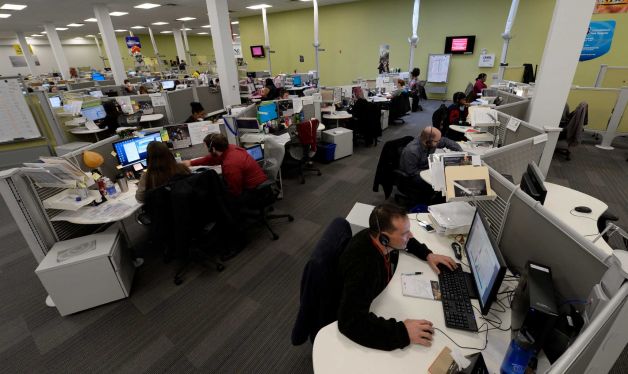
A former Time Warner Cable call center.

Charter Tells N.Y. Regulators It Will Prioritize Upgrades for Central N.Y. Region This Year

Just days before the finalizing of the acquisition of Time Warner Cable by Charter Communications, customers in Central New York were a week away from the completion of Time Warner Cable’s Maxx upgrade program targeting Syracuse and other communities in the region. But once Charter took over, all upgrades were put on hold, leaving some customers with Maxx speeds of 300Mbps while others languished with top speeds of 50Mbps.

Good news for those customers, at least. In a communication with the New York State Public Service Commission, Charter told regulators it intends to focus its efforts on completing those upgrades over the course of 2017. In fact, it will likely be the only region of New York targeted for speed upgrades of up to 300Mbps this year. For other upstate cities including Buffalo, Rochester, and Binghamton, Charter has upgraded its top speed to 100Mbps for those willing to pay approximately $105 a month and a one-time upgrade fee of $199.

Sometime this year, those New York communities still not able to buy 300Mbps will commence a full transition to all digital and encrypted cable television service, a prerequisite for the faster broadband speeds. Charter has a deadline of 2019 to introduce up to 300Mbps service across all areas it services in New York State. The company seems to hint it will achieve that well before the deadline, which likely means sometime in 2018.

In February, the cable company also reported it had completed building out new service to an additional 2,860 homes across 49 counties and approximately 250 municipalities. But the company is committed to expanding service to approximately 145,000 New York households, which means it has a long way to go. This week, Charter formally applied for an extension of the deadline, blaming utility pole owners for taking too long to “make-ready” utility poles for cable service and admitting it will fall short of regulator expectations.

The areas where Charter has most recently managed to complete expanded service areas include:

  • Albany County for approximately 281 passings, including the Village of Menands, Towns of Colonie, Bethlehem, and New Scotland, and the City of Albany.
  • Erie County for approximately 336 passings, including areas such as the Towns of Amherst, Boston, Orchard Park, Derby, and the City of Buffalo.
  • Kings County for approximately 285 passings in Brooklyn.
  • New York County for approximately 553 passings in the City of New York.
  • Saratoga County for approximately 373 passings, including the Towns of Milton, Northumberland, Stillwater, Clifton Park, Ballston Lake, Halfmoon, and Wilton, and the City of Saratoga Springs.
  • Sullivan County for approximately 84 passings, including the Towns of Fallsburg, Liberty, Victor, Thompson, and the Village of Woodridge.
  • Ulster County for approximately 143 passings, including the Towns of Rochester, Ulster, and Saugerties, and the City of Kingston.
  • Wayne County for approximately 78 passings, including the Towns of Macedon, Walworth, Newark, and Williamson.

WOW Goes Public; At High Risk of Acquisition as Cable Industry Consolidates

Phillip Dampier May 16, 2017 Broadband Speed, Competition, Consumer News, WOW! 1 Comment

WideOpenWest, better known to subscribers as WOW!, has filed with the Securities and Exchange Commission to become a publicly traded company as it seeks to raise funding and make itself an attractive proposition for investors and potential buyers.

The company will initially remain under the control of Avista Capital Partners (44%), which has been an investor in WOW! from the beginning, joined by Crestview Partners (29%), which invested $125 million in the cable company in 2015.

WOW! is currently the sixth largest cable operator in the United States and an attractive takeover target for cable operators like Altice USA, Charter Communications or Comcast. In fact, WOW! provides direct cable competition for Charter and Comcast in the midwest and southeastern United States. Should either of those operators acquire WOW!, that competition will cease. The most likely buyer, however, is Altice USA, which is expected to offer its own IPO to raise funds specifically to acquire American cable companies. Altice currently owns Cablevision and Suddenlink.

WOW! has 772,300 subscribers, but is available to up to three million homes.

The cable company has also ditched its traditional logo and adopted a new one:

Old Logo

Old Logo

New Logo

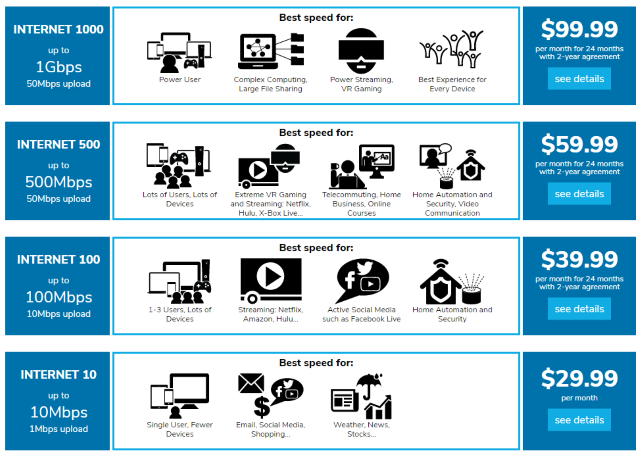
WOW! is known for high quality customer service and aggressive service plans. Here is their current broadband offer:

Search This Site:

Contributions:

Recent Comments:

Your Account:

Stop the Cap!