

 Subscribe
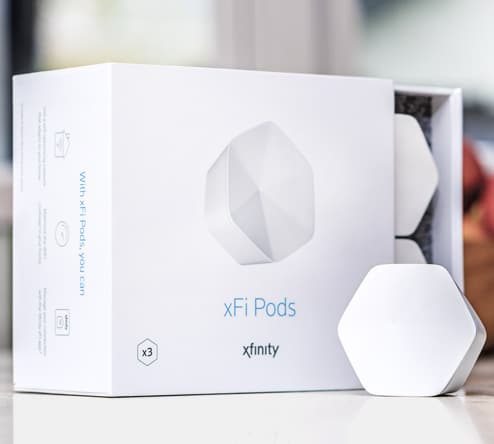 Comcast customers receiving inadequate Wi-Fi coverage while using a company-provided wireless gateway can now buy a mesh-style wireless solution starting at $119.
XFINITY xFi Pods work only with Comcast’s internet service and provide extended Wi-Fi coverage when paired with either the xFi Wireless Gateway or the xFi Advanced Gateway — both available in Comcast store locations.
“Our gateway devices are incredibly powerful, but we know that some homes have a unique layout or are constructed of materials that can disrupt Wi-Fi coverage in some rooms,” said Eric Schaefer, senior vice president and general manager, Broadband, Automation and Communications, Comcast Cable. “Wi-Fi is the oxygen for the digital home and our xFi Pods can blanket a home with great coverage and are simple to install and easy to use.”
Comcast claims its xFi Pods continually evaluate local signal environments to adjust Wi-Fi channels and bands to assure a superior signal. By creating a mesh network, Comcast claims the Pods help eliminate Wi-Fi dead spots in a larger home.
Customers use the xFi mobile app to get new Pods up and running and continually monitor the in-home mesh network. Each individual Pod plugs into a standard home electrical outlet. Customers who do not need to use all of them in a home or apartment setting can share the extras with friends and family, as long as they also have Comcast internet service and the appropriate gateway.
The hexagon-shaped, xFi Pods are sold in three-packs for $119, or in six-packs for $199, plus shipping and handling. They can be purchased online at www.xfinity.com/xfipods, from the xFi app, or from some XFINITY retail stores. Some purchases can be added to the customer’s Comcast bill. Later this year, customers will also be offered a monthly payment plan for the Pods.
SPECS
Color: White
WiFi Capacity: AC1200
Size: D:2.05in./L:2.52in./H:2.227in.
Ethernet: Single GbE Ethernet
Power supply: 100-240VAC, 50-60Hz, 5W Max
Comcast claims xFi Pods are superior to traditional Wi-Fi extenders because they communicate with each other and pass traffic between them, allowing for multiple areas of enhanced Wi-Fi coverage around a home.
But there are some caveats:
- The Pods have a maximum throughput of 200 Mbps, and that was in a lab setting. Comcast said its Pods are intended to expand in-home coverage, not deliver speed to every corner of the home. That means while connected to a xFi Pod, expect maximum download speeds between 100-175 Mbps.
- The Pods only work with Comcast’s app and gateway. If you own your own modem or router (for Wi-Fi), the Pods will not work. If you switch providers, the xFi Pods will stop working.
- Your Wi-Fi network must share a single Wi-Fi network name and password. You cannot have Wi-Fi guest networks or different SSIDs for 2.4 and 5 GHz channels.

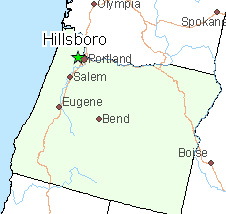
 Three years after Hillboro’s city council accepted the recommendation of a consultant that warned the city away from running its own residential fiber network, local officials have changed their mind and plan to extend the city’s institutional fiber network to homes and businesses, offering affordable $10 a month internet access, as well as gigabit speed for $50 a month.
 Despite the cost, more than 77% of respondents to a phone survey held at the time were interested in switching to the city’s municipal fiber network, if it was priced at least 10% less than the competition. Hillsboro’s fiber aspirations face significant cost challenges other communities don’t, because 80% of buildings in Hillsboro are served by buried cables, which cost much more to install over aerial cable strung between utility poles.
 The head of T-Mobile USA claims a merged T-Mobile and Sprint will be the best positioned to quickly deliver 5G wireless service to Americans, despite claims from industry insiders Legere’s claim is little more than vaporware.
 “Legere is swearing to Washington the T-Mobile 640 MHz 5G NR network will be many times faster than LTE,” Burstein said. “That isn’t true, of course. It’s far more likely to be only 25%-50% faster, or perhaps less. It may even be slower than the 500 MHz LTE/LAA T-Mobile already has in Manhattan.”