Home » Broadband Speed » Recent Articles:

Throw the Money Away: $350 Million for Broadband Mapping “Ridiculous”

Phillip Dampier September 14, 2009 Broadband Speed, Public Policy & Gov't, Rural Broadband 2 Comments
chickcoop

(Courtesy: Lab squad)

The broadband stimulus package advocated by the Obama Administration may become a feeding frenzy for waste, fraud, and abuse.  That’s the attitude of several public interest groups concerned about how public tax dollars are being used to study, map, construct, and deploy broadband networks to reach the underserved, and those without any broadband service at all.

Now the story has drawn the attention of the Associated Press’ technology reporter Peter Svensson, who along with Joelle Tessler, have written a piece exploring just where American taxpayer dollars are going on broadband mapping.

The $787 billion stimulus bill championed by the Obama administration set aside up to $350 million to create a national broadband map that could guide policies aimed at expanding high-speed Internet access. That $350 million tag struck some people in the telecommunications industry as excessive, compared with existing, smaller efforts. The map won’t even be done in time to help decide where to spend much of the $7.2 billion in stimulus money earmarked for broadband programs.

Svensson and Tessler talked to a variety of industry experts, as well as companies that often find themselves at a major disadvantage when trying to bid for mapping funds and discover the lowest bid for the best work isn’t always the determining factor.

The consensus is that the government is at risk for overspending up to 90% of the money set aside for mapping, and has vastly overestimated the actual costs:

Rory Altman, director at telecommunications consulting firm Altman Vilandrie & Co., which has helped clients map broadband availability in some areas, said $350 million was a “ridiculous” amount of money to spend on a national broadband map.

Even $100 million might be high. The firm could create a national broadband map for $3.5 million, and “would gladly do it for $35 million,” Altman said.

More concerning is the fact that some of the interests that have successfully won mapping contracts are infested with self-interested telecommunications company executives who have a vested interest in steering the findings of the mapping projects, as well as defending common industry practices of withholding data for “customer privacy” and “competitive” reasons.  Allowing the telecommunications industry to provide the raw data (considerably redacted), a practice defended by telecommunications executives sitting on the boards of some mapping firms winning bids, is a recipe for the production of industry-favorable maps.

Public Knowledge, a public interest group, has been particularly critical of broadband mapping strategies, essential to measuring the current availability and very definition of what is broadband service in the United States.  Art Brodsky, communications director of the group, has reported extensively on the issue for months.

Art Brodsky, for Public Knowledge:

It would be a shame if the stimulus mapping/grant program and the broadband plan were considered in isolation, because they are, together, pieces of the same puzzle. Certainly the telephone and cable industries are considering them together, and using the leverage on one to influence the other to reach the inevitable conclusion that no new broadband policies are needed and that everything will be just fine if we leave the companies in control. Ignore our slumping world rankings for broadband. Ignore the lack of choice. Let’s try to connect the dots into a long silver thread.

The first dot is broadband mapping. If the maps show there is no problem with broadband coverage, then there should be no need for legislation, regulation or any other policies that would immediately be branded a “solution in search of a problem” by the telecom industries. Connected Nation plays a key role here, because their maps will be constructed in at least a dozen states, perhaps more, under the broadband stimulus plan.

Unfortunately, the way the stimulus mapping program is going, that piece is falling nicely into place. By agreeing to the telephone and cable industry’s request – some might say caving into the industry’s demand – that broadband speeds not be reported, the National Telecommunications and Information Administration (NTIA) opened the door for all kinds of mischief. In public comments, NTIA officials said such an agreement was necessary to gain the cooperation of the telephone and cable companies. That’s one way to look at it. Another way is that by requiring the carriers to report broadband speeds – even if their reports were inaccurate – at least there would be something on the record that could be corrected, criticized or cited. Without speed data, the value of the program diminishes. Even under the old rules, all the carriers had to show was “advertised” speeds, so the carriers started advertising. The speeds agreed to by NTIA as “broadband” in the first place are relatively slow anyway.

Mark Seifert, oversees the broadband grant and mapping programs at the NTIA defends the spending proposals by the federal government.  Seifert told the AP that since much of the data will come from the providers’ themselves, NTIA plans to “independently verify” the veracity of the data it receives, which he claims could include door-to-door verification with individual residents and other unspecified verification procedures.

Meanwhile, critics of some of the industry-connected broadband mapping efforts say the groundwork may be laid for future challenges by the nation’s largest broadband providers (large telephone and cable companies) who almost uniformly avoided participating in the first round of stimulus grant applications.

Michael Tattersall, founder of the mapping company Stratsoft is concerned.  He told Public Knowledge incomplete or false map data could be used by providers to have other groups’ stimulus applications thrown out.

If the maps show there is more coverage in rural areas than there actually is, then Tattersall said, the “smaller, in-state broadband providers that are applying for funds that will be directly affected by the quality and integrity of state-commissioned broadband maps.” There could be challenges by the larger carriers, which didn’t apply for stimulus funds, to broadband grants from smaller rural, municipal or neighborhood based on already existing Connected Nation maps.

Disqualified applications based on discredited map data could throw the entire stimulus program into doubt, allowing telecommunications lobbyists for the big providers to argue the stimulus program is a failure and needs to be started over, with recommendations those large providers get the bulk of the money.

Indeed, several providers are already concerned with the prospect that stimulus funds could be used to bring competition to their areas — start-ups and projects funded by government money that could eventually directly compete against their existing offerings, designated as too slow or backwards for 21st century broadband.

With providers already trying to downplay expectations for what defines fast, robust broadband, it leaves incumbent providers keeping their communities in a perpetual slow lane in a much better position not to stick out like a sore thumb.  Brodsky again:

In addition to using the maps, telecom carriers are also trying to freeze the idea of advancing broadband into what exists today.

AT&T led the charge on this, in a remarkable filing that would, in essence, freeze broadband where it is now because that’s what the stimulus law directs the FCC to do when it formulates a broadband plan. AT&T said, “In other words, the definition of broadband must comprise services that can practicably be deployed in unserved and underserved areas—and must comprise services that today’s unserved Americans can and will actually adopt.”
When Broadband Service Is Slower Than Carrier Pigeons: Africa Struggles With Capacity Issues

Phillip Dampier September 14, 2009 Broadband Speed, Video 4 Comments

Speedy internet connections have yet to take off in many parts of South Africa because of a shortage in bandwidth.

One leading internet provider says it is not to blame for the slow connection, but frustrations have led one IT group to adopt an unusual method of delivery.

Al Jazeera’s Haru Mutasa reports on the pigeon that beat the internet in Johannesburg.

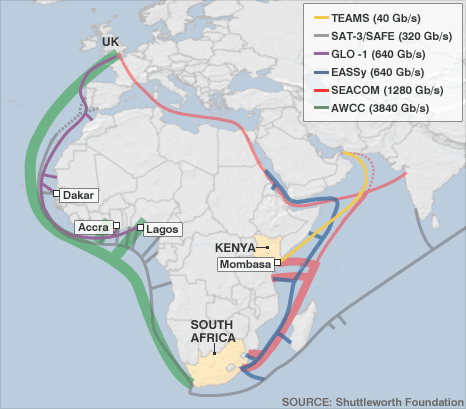
Service providers across the continent blame the expensive and slow Internet reality for much of Africa on a shortage of connectivity, particularly between Africa and the rest of the world. One African-owned firm, Seacom hopes to change that with the introduction of a new fiber optic cable that went live in July. The new connection enhances service between much of East Africa, including South Africa, Tanzania, Kenya, Uganda and Mozambique. The cable also provides a new path to reach Europe and Asia at speeds superior to what used to be common across Africa.

But while bandwidth may slowly be on the increase, savings are much harder to find. Businesses routinely pay $600 per month for 1Mbps service. But some providers suggest that does represent savings. Satellite service at the same speed is priced at an average of $3,000 per month.

Consumers in South Africa find broadband pricing very high, with most relying on Telkom, the nation’s primary phone company, for DSL service. Usage caps are prevalent across the continent as well, stifling the development of African broadband services and making services like online video all but unaffordable.

Africa's Internet Connectivity

Africa's Internet Connectivity

Thanks to Stop the Cap! readers Jeff, Bones, Terry, and a few others who let us know about this story.

Broadband Speed — It’s All About Where You Live & What Provider You Live With

Phillip Dampier August 27, 2009 Broadband Speed, Recent Headlines, Rural Broadband 11 Comments

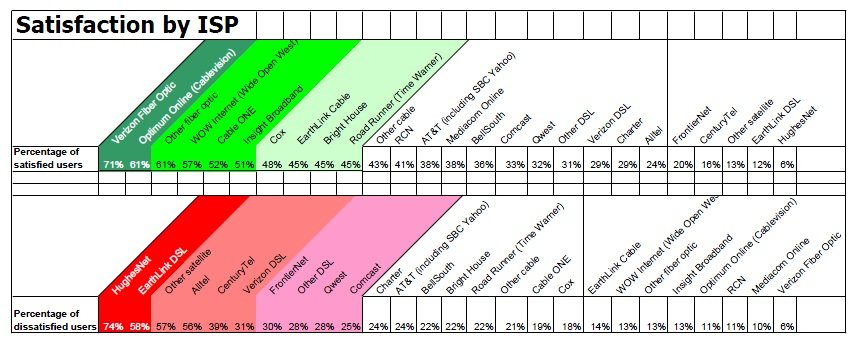
Less than half of Americans surveyed by PC Magazine report they are very satisfied with the broadband speed delivered by their Internet service provider.

PC Magazine released a comprehensive study this month on speed, provider satisfaction, and consumer opinions about the state of broadband in their community.

The publisher sampled more than 17,000 participants, checking their actual broadband speeds, and questioned them about their overall satisfaction with their online access.

The findings indicate consumers live with what provider they can get.  Even lower rated providers scored “satisfactory,” in part because consumers don’t have many choices with which to compare.

ispsatis

Click to enlarge

In the war between coaxial cable modem vs. copper wire DSL technology-of-the-1990s battle, PC Magazine declared the cable industry the winner, consistently delivering faster speeds more reliably than possible with telephone company DSL.  Overall, the average cable speed was “688 Kbps, while the average DSL lets you surf at just 469 Kbps—cable connections, on average, are 47 percent faster.”  Those speed measurements are based on actual web page and content delivery, not on marketed available speed.

In fact, users rated DSL an unsatisfying service, with only 20% of rural and suburban customers very impressed with DSL.  But for many who have no other choice, 50% think it’s good enough.

Or better than nothing.

One DSL provider did extremely well speed-wise in PC Magazine‘s survey, however.  Frontier Communications was rated as the fastest DSL provider in the nation, averaging “real-world” speeds of 724 Kbps, according to the survey.  But even they could only score a 20% customer satisfaction rating, with 30% dissatisfied.

There was one technology that did much, much worse.  Satellite broadband, the last possible choice for many Americans between dial-up and going without, is provided by companies like HughesNet and WildBlue, and they are unmitigated disasters in consumers’ eyes.

Just 6% of Hughes customers were satisfied, with a whopping 74% dissatisfied.  That’s because satellite broadband is extremely slow, averaging just 145 Kbps, heavily capped, and very expensive.  But for some rural Americans who live too far away from their local phone company central office, and will never see cable television, it’s likely their only choice.  Even mobile broadband signals won’t reach many of these consumers.

So what is the good news from all of this?  There is one technology that, hands-down, beats all of the rest — fiber optics to the home.  The nation’s top-rated ISP in PC Magazine’s survey is Verizon FiOS, with 71% satisfied, and just 6% dissatisfied.  Other fiber optic providers, mostly smaller local, regional, or municipal systems, scored 61% satisfaction.  Just one cable company matched that rating – Cablevision’s Optimum Online.

AT&T, with a combination of DSL and their newer U-verse platform, did considerably worse, with 38% satisfied and 24% dissatisfied.

Clearly, subscriber satisfaction comes highest from fiber optic broadband.

Click to enlarge

Click to enlarge

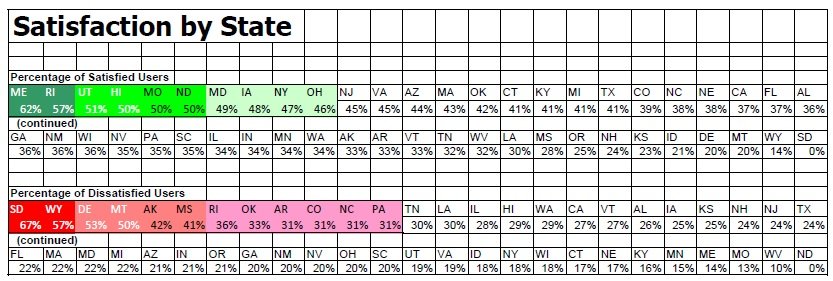
In statewide rankings, it all boils down to where you live.  The more populated states and those with large cities often scored higher than those with lots of wide open rural areas.  The larger the community you live in, the better the chance for fast, quality service.  In states like Wyoming or South Dakota, where more than 57% of customers reported dissatisfaction, it’s more about living with what you’re stuck with.


America’s Mediocrity in Broadband Continues – Now Down to 28th in the World in Speed Ranking

Phillip Dampier August 25, 2009 Broadband Speed, Public Policy & Gov't 4 Comments

The Communications Workers of America released their 2009 Report on Internet Speeds in All 50 States, and the results show the United States continuing to lag well behind other nations in providing citizens with advanced, fast, and affordable connections to the Internet.  Little improvement has been made in the past year, when CWA released its 2008 findings. (Stop the Cap! reader Dave passed along word the report was in.)

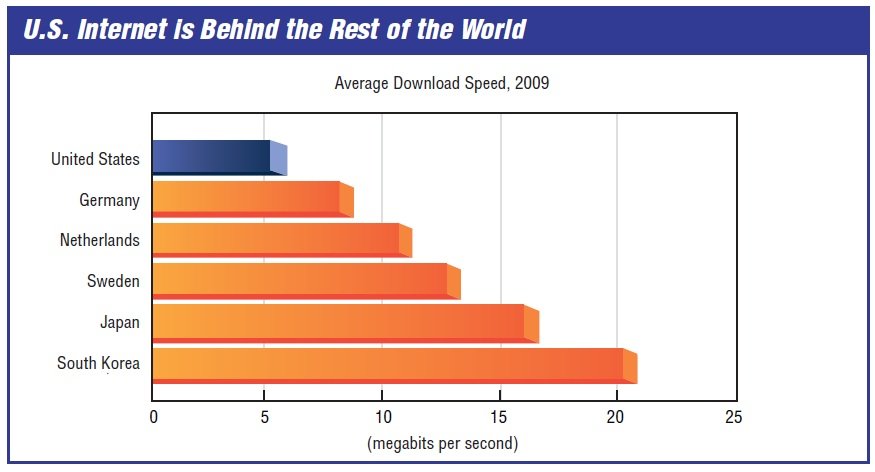
The average download speed for the nation was 5.1 megabits per second (mbps) and the average upload speed was 1.1 mbps. This was only a nine-tenths of a megabit per second increase (from 4.2 mbps to 5.1 mbps) since last year. At this rate, it will take the United States 15 years to catch up with current Internet speeds in South Korea. And when compared to the rest of the world, the United States ranks 28th in average Internet connection speeds.

behind

The CWA does have an interest in this fight.  It’s a labor union whose members work for many of the nation’s telecommunications providers.  CWA seeks a national broadband strategy that just happens to fall in line with the interests of consumers — increased speeds, more rural broadband expansion, more affordable access, and Net Neutrality protections.  CWA doesn’t take a formal position on Internet Overcharging schemes like usage caps, at least not yet.

The report measured broadband speed based on more than 400,000 Americans who voluntarily participated in a speed test offered on the Speed Matters website.  The results were collected and covered a significant part of the country, illustrating real world results of ordinary consumers, not simply the speeds touted by broadband providers in marketing materials.

The CWA report calls out the inadequacy of the deregulated free market approach to deliver broadband service consistently to all Americans.  In fact, the disparity of access and the tiny incremental upgrades in speed suggest it will take at least 15 years for the United States to match the speeds enjoyed today in South Korea, which can rightly be called a world leader in broadband even while this country cannot.

South Koreans enjoy an average connection speed of 20.4Mbps (four times faster than the United States).  Japan provides residents with 15.8Mbps, Sweden offers 12.8Mbps, the Netherlands 11Mbps, and 24 others who do a better job at delivering speedy broadband than their American counterparts.

Broadband remains too expensive for the slow service we enjoy today.  That promotes a digital divide between those affluent enough to afford broadband service and those who are struggling to make ends meet (88% of those earning more than $100,000 a year have service in their homes, while just 35% of those earning under $20,000 subscribe).

Another problem highlighted in the report is the ongoing problem of rural broadband access.  While 67% of urban and suburban residents subscribe to broadband, only 46% of rural households do, assuming they can even obtain service.

Rural areas are by far the most likely to encounter slow service, typically 1-3Mbps provided by DSL from the local phone company.

speed state

Until 2009, the United States was the only industrialized country in the world without a national broadband plan.  The Federal Communications Commission is expected to release one shortly, but only time will tell whether the plan will primarily benefit consumers or the special interests, including providers seeking to protect their monopoly or duopoly market position, and get taxpayer dollars to finance broadband projects that provide slow and expensive service to consumers.

apps

The CWA has some recommendations:

Governmental action — in partnership with the private sector — is essential to stimulate broadband investment and adoption. Other countries are far ahead of us. It is time for the United States to take action.

  • Universality.  Just as government policies helped bring affordable telephone service to everyone, our policies should ensure that every individual, family, business, and community has access to and can use high speed Internet at a price they can afford — regardless of their income or geographic location.
  • High Speed.  Speed matters on the Internet. U.S. policies should promote higher Internet speeds and higher capacity networks. The United States should adopt policies to get us to 10 megabits per second upstream and 1 megabit per second downstream by 2010. New benchmarks in succeeding years should expand the number of households capable of sending and receiving multiple channel high-definition video and reach the global standard of 100 mbps.
  • Open Internet.  We must protect free speech on the Internet so that people are able to go to the websites they want and download or upload what they want when they want on the Internet. There should be no degradation of service or censoring any lawful content on the Internet. At the same time, reasonable network management is necessary to preserve an effective and open Internet. Most important, building high-capacity networks will ensure that all Americans have fast, open access to all content on the Internet.
  • Consumer Protections and Good Jobs.  Public policies should include consumer and worker protections, should support the growth of good, career jobs, and require the public reporting of deployment, actual speed, price, and service.

Below the jump, we’ve assembled a selection of maps and graphics showing where broadband is today in three of states with our largest reader base — New York, Texas, and North Carolina.

… Continue Reading

Cox Unveils ‘Ultimate Internet’ 50/5 Service in Rhode Island

Phillip Dampier July 30, 2009 Broadband Speed, Cox, Data Caps 25 Comments
Cox Cable DOCSIS 3 modem

Cox Cable DOCSIS 3 modem

Cox Cable’s ‘Ultimate Internet’ broadband tier is now available to Cox customers in Rhode Island.  Offering 50Mbps downstream and 5Mbps upstream, the premium speed service sells for $109.99 a month with an annual contract.  The service comes as a benefit from the recent upgrade to DOCSIS 3 technology in Cox Cable’s Rhode Island service area.  Cox Cable has generally unenforced usage allowances on all of their broadband service tiers.  Theoretically, the ‘Ultimate Internet’ tier is limited to 300GB downstream and 100GB upstream traffic per month, but very few Cox Cable customers have ever been contacted about their usage, regardless of the amount.

Joel Evans, a Cox Cable customer living in Rhode Island, posted a review of his experience with the new Cox Cable broadband tier on Geek.com:

Before the upgrade I was peaking around 21 Mbps download and 4 Mbps upload. These were actually great speeds considering that the promised speed was really more around 20 Mbps and 3 Mbps, respectively. After the upgrade, however, I noticed an incredible speed bump. Instead of the promised 50 Mbps down and 5 Mbps up, I received 65 Mbps down and 6 Mbps up. I can only imagine that these will probably fluctuate over time.

It wasn’t until I was recently asked by Cox how my experience has been that I noticed how much of a difference more bandwidth makes. For example, I stream Hulu to my Apple TV (thanks to boxee) and usually there’s a bit of lag with the stream. Nowadays it streams right away as if I’m watching live television.

A mandatory service call by Cox Cable is required for installation, because technicians will check line quality and also swap out a customer’s older cable modem with one capable of handing DOCSIS 3 “channel bonding,” which allows multiple cable channels to be connected together to permit faster broadband speeds.

Cox plans to expand availability of the ‘Ultimate Internet’ tier to more than two-thirds of its systems by the end of 2010.

Search This Site:

Contributions:

Recent Comments:

Your Account:

Stop the Cap!