Home » Broadband Speed » Recent Articles:

Municipalities: If You Threaten to Build It Yourself, Your Faster Speeds Will Come

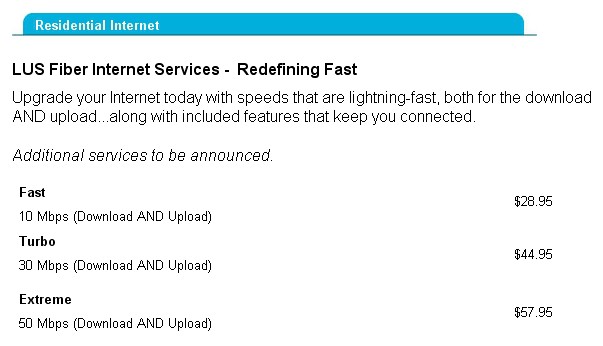
LUS Fiber - Lafayette, Louisiana's public utility municipal broadband provider, offers fast speeds with great rates

LUS Fiber - Lafayette, Louisiana's public utility municipal broadband provider, offers fast speeds with great rates

Frustrated communities across America, take note.

If your town or city government starts making serious noises about constructing your own, municipally-owned broadband network (especially one built with fiber optics to the home), existing providers who have repeatedly said “no” to requests for faster service at more reasonable prices have a track record of quickly turning around and saying, “yes — why didn’t you ask us before?”

Big existing telecommunications players loathe the thought of facing a new competitor in their midst.  They are accustomed to the usual arrangement of one cable operator and one phone company.  Cable companies provide cable modem service, phone companies mostly provide DSL.  In smaller cities, and where a competitor is missing (or provides a lower quality service), there is almost no drive to upgrade.  Cable will set speeds just above what the phone company is offering, and both will co-exist happily ever after.

For communities being bypassed by the fiber revolution now underway by Verizon, and to a lesser degree AT&T, requests from civic leaders, businesses, and consumers for upgraded service fall on deaf ears.  ‘What you have now is good enough for this market, so be quiet and be lucky we give you what you’ve got now.  Oh, and we’re raising rates, too.’

In Rochester, the one upstate New York city not on the “to-do” list of Verizon (which is merrily wiring urban and suburban communities across their service areas with fiber optic cable FiOS), Time Warner Cable sees little incentive to raise speeds or upgrade to DOCSIS 3 with a phone company competitor that has no apparent plans to move beyond traditional old school DSL service.  Where FiOS does threaten, Time Warner Cable is in a hurry to provide “wideband” broadband as quickly as possible.

In Wilson, North Carolina, years of pleading from local officials to provide something beyond anemic broadband in their community was met with yawns from Time Warner Cable and Embarq, the local phone company.  Wilson decided to build their own municipal fiber network, offering faster speeds at better pricing.  Time Warner and Embarq did what most existing competitors do — they moved through the Four Stages of Telecommunications Competition Grief:

1) Behind the Scenes Threats and Anger: Companies work the phones with local officials trying to browbeat them into dropping the plans to construct municipal broadband, try to gin up partisan opposition, issue overinflated cost estimates, issue warnings about the trouble they’ll cause local politicians who support such initiatives, and snow a blizzard of documents illustrating how wonderful and reasonable their existing service is;

2) Stall Tactics Through Negotiation: Once home office is notified, a series of negotiations to attempt to forestall the project begins, such as throwing crumbs for incrementally better service, offers to build showcase mini-projects that represent a “win” for local politicians, or “looks good on paper” concessions that end up amounting to far less.  Most of these discussions are designed simply to stall to allow the company to prepare for stage three.

3) PR and Legal Blitzkrieg: Assuming local officials haven’t been discouraged away from their idea, or dropped it after starring in a company-sponsored press event – ribbon cutting a small wi-fi or school connectivity project, the next stage is a multi-front battle involving company legal teams filing lawsuits to delay or kill projects, public relations and astroturf lobbying efforts to distort issues and build public opposition, legislative maneuverings to make such projects untenable through industry-friendly laws, and often vague promises about impending upgrades making the entire project unnecessary.

4) Acceptance, Competition, and Better Service: The final stage is the realization consumers don’t always get suckered by astroturf groups and company scare tactics.  They accept the project is moving forward, and send out the press release saying they welcome the competition and are announcing their own significant service upgrade because “customers asked for it.”  Price increases slow, speeds increase, and service improves, all because of the reality that an aggressive competitor is in their future.

Wilson city officials tried negotiations for better service, got nowhere, and had to fight back against a blizzard of nonsense from the telecommunications industry trying to legislate such projects out of existence with changes to state law.  Americans for Prosperity, an astroturf group, even hassled residents in other nearby communities with robocalls to try and stop similar projects.

The arrival of Wilson’s Greenlight service, which offers speeds far faster than Time Warner and Embarq ever did, at lower prices, was a shock to Time Warner’s call centers.  As customers canceled, representatives taking those calls were in denial residents were actually achieving the speeds Time Warner failed to deliver.

[flv]http://www.phillipdampier.com/video/Chattanooga Builds Fiber Network.flv[/flv]

Chattanooga’s public power utility fought back against telecommunication company propaganda to construct fiber to the home service across the city, which launched this year. (5 minutes)

In Monticello, Minnesota, local telephone company TDS had spent years refusing requests to improve service in the city.  Speed and access issues plagued the community, northwest of Minneapolis.  Local officials had enough and voted to construct their own fiber to the home municipal network.

Enter the four stages.  TDS started by telling city officials the company’s network was state of the art for Monticello, and couldn’t be immediately improved because there was insufficient return on investment.  Companies want to be assured they are paid back for investments they make, and because Monticello is a relatively small city, there were questions whether the costs for a fiber network would be paid back quickly enough through revenues.

When that didn’t work, the company sued the city as a stalling tactic.  Despite the fact Monticello won case after case, TDS kept filing.  A full assault by large telecommunications interests also began, trying to gin up public opposition.  While the project was approved by voters, and Monticello was tied up in court, TDS quickly moved to stage four and started rapidly building their own fiber network in Monticello, actually putting down fiber the city was prohibited to wire themselves as the lawsuits dragged through the courts.

The company told Ars Technica that despite its earlier refusals to provide fiber service, TDS didn’t act earlier because it didn’t actually know that people really, really wanted fiber; once the referendum was a success, the company moved quickly to give people what it now knew they wanted.

Then, in June, the company said with the advent of its own fiber network, the city of Monticello should back away from constructing theirs, because its economic viability report was partly premised on the fact TDS refused to provide that service.

To underline that, TDS’ new fiber network doubled customer speeds to 50Mbps, trying to keep customers from taking their business to  FiberNet Monticello.

[flv]http://www.phillipdampier.com/video/Vote Yes on Fiber.mp4[/flv]

Lafayette staged a multi-year battle with Cox and other providers to bring municipal fiber broadband to it’s corner of Louisiana.  This 30 second ad promoted a “yes” vote on the project.

In Louisiana, Cox Cable is facing accusations it’s engaged in predatory pricing to kill Lafayette Utility System’s fiber to the home network and EATel’s fiber network in Ascension Parish.  Cox Cable froze rates and moved in with DOCSIS 3 upgrades, delivering up to 50Mbps service.  Cox chose to upgrade Lafayette before any other Cox-served community.

The Lafayette Pro-Fiber Blog found this EATel billboard taunting Cox

The Lafayette Pro-Fiber Blog found this EATel billboard taunting Cox

EATel, an independent phone company that wired fiber across Ascension Parish, also faced down Cox.  When the cable company began promoting cut-rate pricing in Ascension, EATel took out advertising promoting Cox’s special prices — in other cities, much to Cox’s consternation.  EATel’s ads, much like those run by Novus against Shaw in British Columbia, tell Cox’s customers to call the company and ask for the lower price they are advertising elsewhere.

“Cox came in with an incredibly aggressive promotion for TV service with every bell and whistle you could imagine. We couldn’t figure out how they could even make money on it. So we took out an ad in the Lafayette newspaper that basically said, ‘Hey Lafayette, look at the great prices you are going to get from Cox.’ Cox was not amused,” Trae Russell, communications manager for EATel told Telephony Online.

<

p style=”text-align: center;”>Joey Durel, Jr., president of Lafayette parish, testifies before the House Committee on Energy and Commerce on Lafayette’s municipal fiber network on February 27, 2008. (7 minutes)
You must remain on this page to hear the clip, or you can download the clip and listen later.

<

p style=”text-align: center;”>

Lesson learned — just threatening to bring in a municipal competitor is often all it takes to turn a persistent “no” from the local cable and phone companies into “yes, Yes, YES!”

Of course, not every project is successful.  Some, such as Burlington Telecom Stop the Cap! reported on yesterday face political and cost challenges.  Others are killed through stage managed opposition and astroturf campaigns paid for by the telecommunications industry before they even get started.

In North St. Paul this year,  “PolarNet,” a planned fiber optic broadband network to stimulate the local economy was killed by an astroturf propaganda campaign undertaken by Qwest, Comcast, and other telecommunications companies that would have to deal with PolarNet as a competitor.  The telecommunications companies claimed it would result in higher local taxes and “more government” where it wasn’t needed.  Citizens defeated the proposal 67-33%.

Windom, Minnesota faced similar challenges and their fiber project was shot down in 1999, but with lessons learned, proponents brought it back up and won in 2000.  To this day, the community of 4500 in western Minnesota face considerable envy from adjacent communities — they want service from the fiber-to-the-home system as well.

Almost universally, opponents to municipal broadband systems claim they are financial failures and saddle communities with debt.  In reality, most have forced those opponents to provide improved service in their competitive communities, or those companies will become the financial failure.

[flv width=”427″ height=”240″]http://www.phillipdampier.com/video/Terry Huval of Lafayette Utility System April 2009.flv[/flv]

Terry Huval of Lafayette Utility System talks with the Fiber Revolution blog about the challenges Lafayette experienced building their own municipal fiber network.  Huval offers excellent advice for other municipalities exploring similar projects.  (April, 2009 – 10 minutes)

<

p style=”text-align: left;”>Thanks to Stop the Cap! readers Tim and Matt who suggested this story idea.

Shaw Introduces 100 Mbps “Nitro” Broadband in Vancouver, Calgary, and Edmonton for $149/Month (With 400GB Allowance)

Phillip Dampier October 27, 2009 Broadband Speed, Canada, Data Caps, Shaw 7 Comments

shawShaw Communications, western Canada’s largest cable company, has expanded its High-Speed Nitro DOCSIS 3 broadband service in British Columbia and Alberta.  Offering speeds of 100Mbps downstream and 5Mbps upstream, Shaw charges customers $149 per month for the new plan, assuming you also subscribe to other Shaw services.  The three latest cities to obtain upgraded service join Victoria in British Columbia, Saskatoon in Saskatchewan, and Winnipeg, Manitoba, where upgrades were unveiled earlier this year.

“The expansion of High-Speed Nitro into the cities of Calgary, Edmonton and Vancouver demonstrates Shaw’s commitment to continually enhancing our Internet services to meet our customers’ changing needs,” said Peter Bissonnette, President, Shaw Communications Inc.

Paying $150 a month doesn’t buy you unlimited broadband, however.  Despite the premium price, Shaw insists on slapping a usage allowance of 400 gigabytes per month.  While at first glance that limit seems generous, particularly compared with Comcast’s 250GB limit, paying $150 a month for Internet access apparently is not enough to spare their most generous customers from a pesky Internet Overcharging scheme.

Jeff from Calgary, a Stop the Cap! reader writes, “exactly how much profit does Shaw need to earn from customers before they turn the damn meter off?”

“It’s bad enough with a 100GB limit on their so-called High-Speed Extreme plan, which gives my family up to 15Mbps service for $45 a month.  If I am going to pay them $100 more a month for service, there shouldn’t even be a limit,” he adds.

The High-Speed Extreme plan seems to be the pricing “sweet spot” for Shaw, because the next step up in Calgary is High-Speed Warp, which brings 25Mbps service for the warped high price of $96 a month.  For nearly twice the price, Shaw only throws another 50GB towards customers’ usage allowances, limiting service to 150GB per month.

Time Warner Cable Announces Wideband 50Mbps in New York’s Hudson Valley

Phillip Dampier October 21, 2009 Broadband Speed, Competition 2 Comments
The Hudson Valley region of New York State

The Hudson Valley region of New York State

Liberty, New York

Liberty, New York

The Hudson Valley of New York, home to a mix of several cities and rural communities between northern New York City and Albany will see Road Runner speed upgrades from DOCSIS 3 early next spring.

Time Warner Cable continues to expand DOCSIS 3-capable broadband service in areas where Verizon is aggressively moving forward with FiOS fiber to the home broadband service.  The company previously announced service upgrades have become available in certain areas of New York City, with an aggressive deployment schedule to expand service to upstate communities of Syracuse, Buffalo, and Albany in the coming months.

The expansion into the Hudson Valley brings expanded speeds into comparatively rural communities between metropolitan New York and the state capital, Albany.

The company expects service, with speeds up to 50Mbps, to begin on March 30, 2010 in these areas:

  • Walden – Orange County (population 6, 164)
  • Wurtsboro – Sullivan County (population 1,234)
  • Rhinebeck – Dutchess County (population 3,077)
  • Saugerties – Ulster County (population 19,868)
  • Poughkeepsie – Dutchess County (population 29,871)
  • Port Ewen – Ulster County (population 3,650)
  • Kingston – Ulster County (population 23,456)
  • Liberty – Sullivan County (population 9,632)
  • Monticello – Sullivan County (population 6,512)

Rochester, with a population of 219,773 is not on the upgrade list.

A new online tool on the New York City Time Warner Cable website allows customers to enter their zip codes and determine when the new speeds will be available in their areas.  In the boroughs of Queens and Brooklyn, more details have emerged:

Borough of Queens

Maspeth, Middle Village, Ridgewood (Available October 30)
Elmhurst, Corona, East Corona, Jackson Heights, Long Island City, Sunnyside, Woodside (Available November 15)

Borough of Brooklyn

Greenpoint, Brownsville, Williamsburg, Bushwick, Brooklyn Heights, Red Hook, Clinton Hill (Available November 15)

Opposition Mounts to Verizon-Frontier Deal: Employee Unions Express Concern Consumers Will Get a Raw Deal

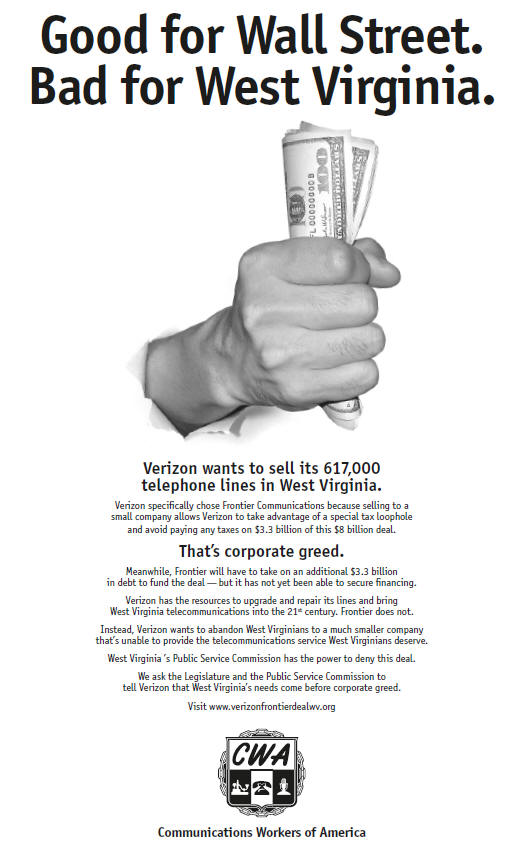
This newspaper ad is running across West Virginia opposing the sale of the state's phone business to Frontier Communications

This newspaper ad is running across West Virginia opposing the sale of the state's phone business to Frontier Communications

Opposition to the sale of Verizon’s landline business to Frontier Communications in 13 states continues to increase, particularly in Ohio and West Virginia, where several employee unions have argued the deal represents a win for Wall Street and company executives, but a raw deal for millions of consumers.

The Communications Workers of America and the International Brotherhood of Electrical Workers, who also warned state regulators in New England about the consequences of approving the sale of Verizon’s operations in Maine, New Hampshire, and Vermont to FairPoint Communications, continue to warn consumers and state officials that a similar deal between Verizon and Frontier Communications could spell major problems for telephone customers.  They call on state officials to reject the deal and force Verizon to invest some of their substantial profits earned in these communities into providing better service instead of dumping customers overboard.

The CWA says the sale would put $3.3 billion dollars into Verizon’s coffers — tax free — and leave Frontier buried in debt, which could impact both new and existing Frontier Communications customers, including hundreds of thousands of those in Rochester, New York, Frontier’s biggest service area.

“Verizon Communications has been divesting assets to smaller, less stable corporations in order to reap large, tax-free, profits,” CWA International Representative Elaine Harris said. “Verizon proposes to repeat that formula, and its disastrous effects, with the sale of all of its wireline operations here in West Virginia to Frontier.”

The CWA considers the transaction based primarily on corporate greed, not the best interests of phone customers.

“The only winner in all of these deals has been Verizon Communications and especially Verizon’s corporate executives,” Harris said. Verizon CEO Ivan Seidenberg is the highest paid executive in the telecom industry, with $24.31 million dollars in annual compensation from Verizon.

“His salary could have funded the entire network of senior services in West Virginia last year and he still would have had $8 million in his pocket,” Harris said.

The deal will leave Frontier Corporation with a total of $8 billion dollars in debt. “The West Virginia consumers will experience the effects of converting more than 617,000 aging access lines to a smaller, debt-ridden company,” Harris said. “The public will be forced to pick up the pieces if Frontier follows Verizon’s other buyers and files for bankruptcy.”

“We’ve closely watched the failures of the companies that purchased Verizon’s assets and we don’t need a crystal ball to figure out what will happen if Verizon tries the same scheme in West Virginia. There’s absolutely no reason to gamble West Virginia’s telecommunication’s future just to increase Verizon’s bottom line,” Harris added.

The CWA is running radio ads across the state of West Virginia opposing the deal.

Audio Clip: Communications Workers of America Radio Ad (1 minute)
You must remain on this page to hear the clip, or you can download the clip and listen later.

Verizon spokesman Harry Mitchell said Verizon wants to sell its access lines so the company can focus on its wireless and broadband business. Mitchell told The Charleston Gazette the union has opposed the deal from day one.

“They’re spending their members’ dues on advertising in an effort to cloud the issue,” he said.

Frontier Communications has protested accusations that their purchase of Verizon assets will result in the same kinds of colossal failures impacting other Verizon sell-offs.  Company officials claim Frontier already has a successful customer support operation in DeLand, Florida, and billing and operating systems in place.

In West Virginia, those existing operations serve 144,000 Frontier customers.  If the deal is approved, Frontier will take on the responsibility of serving 1.3 million landlines across the southeastern U.S. alone.

The International Brotherhood of Electrical Workers, integrally involved in fighting the FairPoint transaction in New England, says the Frontier deal is reminiscent of what happened with FairPoint:

Regulators in the 14 states where Verizon now proposes to sell its landlines to Frontier face an almost identical situation as New England regulators did last year. Frontier Communications is proposing to buy Verizon’s entire wire line operation in West Virginia – as well as Verizon’s scattered landlines across 13 other states – in a similarly structured deal.

In both cases, Verizon chose a much smaller company in order to take advantage of an obscure tax loophole. With the Frontier sale, Verizon will avoid paying any taxes on the $3.3 billion it will receive from Frontier. Frontier will have to cope with three times more employees, three times more access lines and a 75 percent increase in its debt from $4.5 to $8 billion.

Verizon has a very poor track record in these sales. Verizon sold its Hawaii operations to Hawaiian Telcom in 2005 and it filed for bankruptcy. Customers, service and employees have suffered as a result.

Frontier – just like FairPoint – is a making promises that it may not be able to meet. Like FairPoint, state regulators are being asked to approve a deal where a small company will attempt to simultaneously run a much larger operation, pay off billions of dollars more in debt, integrate Verizon’s computer systems and spend more money to expand broadband.

In the end Verizon will profit but consumers, workers and communities are put at real risk.

Expanding broadband access is an especially critical factor for all rural areas. But Frontier has failed to make any specific commitments, set any timeline or offer a plan for its broadband buildout.

Union leaders believe that states shouldn’t risk their telecommunications’ future just so Verizon can fatten its bottom line. Regulators shouldn’t approve this sale because the risks are too great. Instead, our legislators, regulators and the Governor should require Verizon to meet its service responsibilities. Verizon shouldn’t be allowed to walk away with $3.3 billion tax free, and leave the fate of its customers in the hands of a company with a lot less resources. If Frontier should falter, customers and the public would be required to pick up the pieces – not Verizon!

The track record for Verizon spinoffs has hardly been one of success.

FairPoint Communications, the company to which Verizon sold its Maine, New Hampshire and Vermont operations in 2008, is foundering as it tries to integrate operations and is choking on the debt it incurred to finance the transaction Since the deal was announced, FairPoint’s stock price has declined by about 95%, and the company has been forced to suspend dividend payments.

Hawaiian Telecom, the company to which Verizon sold its Hawaii operations in 2005, filed for bankruptcy. Verizon sold its 715,000 access lines in Hawaii. Since then, Hawaiian Telcom has experienced significant transition issues that resulted in major financial and customer service problems. In three years, the company lost 21% of its customers. In December 2008, Hawaiian Telcom filed for bankruptcy.

The yellow pages company that Verizon spun off also filed for bankruptcy. In November 2006, Verizon spun off its yellow pages directory business to Verizon shareholders, loading the new company, Idearc, with about $9.5 billion in debt and extracting a cool $9 billion in cash and debt reduction. Last year, interest payments alone on Idearc’s debt accounted for almost one-quarter of its total revenues! Representing something of a Verizon failing company “hat trick,” Idearc filed for bankruptcy in March 2009.

[flv]http://www.phillipdampier.com/video/WSAZ Huntington Frontier CWA Fight 10-14-09.flv[/flv]

WSAZ-TV Huntington, West Virginia reported on the growing opposition to the Frontier sale by employee groups on October 14th. (3 minutes)

In Washington State, IBEW Local 89, outside Seattle, says the sale could cripple one of America’s most tech-savvy regions.

“We’ve always been a leader in communications in this part of the country,” said Ray Egelhoff, business manager of IBEW Local 89. “If this happens, we’re afraid businesses won’t move in, and some may even move out.”

Egelhoff, along with more than 1,500 Verizon workers who may become Frontier employees, deluged officials with letters and e-mails expressing their concerns. More than 500 have gone out so far to senators, house members, governors and business leaders. The workers worry Frontier —at about the a third the size of Verizon—won’t be able to absorb the huge Verizon assets, won’t be able to keep customers happy and, eventually, will have to shed staff.

Robert Erickson, International Representative in the IBEW’s Telecommunications Department said, “The deal poses risks to consumers and employees. Frontier is making all kinds of promises about synergy and how they’ll expand broadband. FairPoint Communications made the same grand claims and now they can’t meet their commitments and fulfill the promises they made. It’s clear that Frontier will be in a similar situation and not have the resources to fulfill the commitments they are making.”

Consumer groups are also raising objections to the sale.

The National Association of State Utility Consumer Advocates urged the Federal Communications Commission, which is reviewing the proposed transaction, to reject the deal.

“The merger proposed by Frontier and Verizon is not in the public interest,” said David Springe, president of the consumer advocate group. “The failure of the companies to offer adequate consumer benefits or protections puts customers at risk of being served by a company without enough financial strength to make necessary improvements to local telephone facilities and widen the deployment of broadband access.”

Free Press, a nonpartisan group that works to reform the media, also raised concerns about the sale in a filing with the FCC. Free Press cited Verizon’s sale of lines in New Hampshire, Maine, and Vermont to FairPoint, which subsequently acquired substantial debt, was unable to accommodate the increased service area, and is now on the edge of bankruptcy.

“This trend has the potential to leave rural areas with ill-equipped companies offering inadequate service at high prices,” says the Free Press report. “This is in direct contrast to the stated intent of Congress and the Obama Administration to foster universal broadband to all Americans.”

[flv]http://www.phillipdampier.com/video/WCHS Charleston Verizon Sale Fight 10-14-09.flv[/flv]

WCHS-TV in Charleston, WV talked with the CWA and company officials about the sale of Verizon operations to Frontier Communications. (1 minute)

Sacred Wind Communications Voted Most Inspiring Small Business in America, But Rural Broadband Remains Uninspired

Phillip Dampier October 19, 2009 Broadband Speed, Editorial & Site News, Public Policy & Gov't, Rural Broadband, Video, Wireless Broadband Comments Off on Sacred Wind Communications Voted Most Inspiring Small Business in America, But Rural Broadband Remains Uninspired
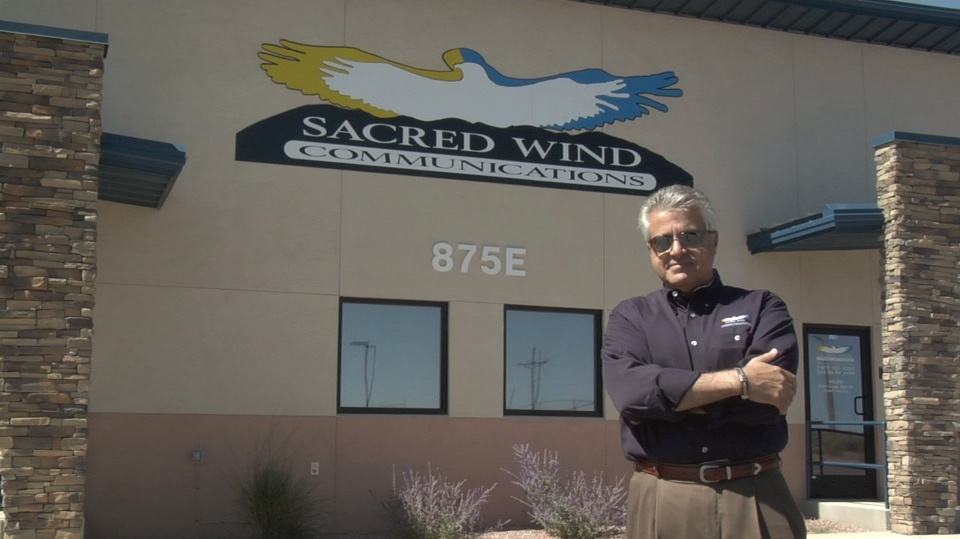
John Badal, CEO of Sacred Wind Communications

John Badal, CEO of Sacred Wind Communications

NBC Universal and American Express today announced Sacred Wind Communications (Albuquerque, N.M.) as the winner and most inspiring small business in the “Shine A Light” program, determined by public vote.

Sacred Wind Communications will receive $50,000 in grant money and $50,000 in marketing support from American Express, and will be featured on MSNBC’s small business show, “Your Business.”

John Badal, described by the Shine A Light Foundation as an entrepreneur, founded Sacred Wind to provide service across the largely ignored Navajo Reservation in New Mexico.  Fewer than 40% of the homes had access to even basic telephone service, provided by Qwest on what the foundation describes as a “dilapidated telephone system.”

Badal, along with a few others, thought Qwest’s turtle-like-speed to provide basic telephone service was not acceptable.

Badal should know — he was the former president of Qwest New Mexico from 2000-2004, overseeing that phone network.

During his involvement with Qwest, the frustration to wire the economically challenged Native American community in his area was daunting.  He told Fierce Broadband Wireless that laying copper cable throughout a rugged, rural desert area to reach a small number of customers who couldn’t afford to pay much for service wasn’t economically feasible for Qwest.

In four years, Qwest only managed to bring phone service to 42 new customers–out of thousands. “It took us two years to get through the rights of way process. Six of those homes had moved by the time the process was completed. It would have taken 45 years to reach 70 percent of the homes in our territory,” Badal said. “We needed a different technology altogether. We needed to go wireless.”

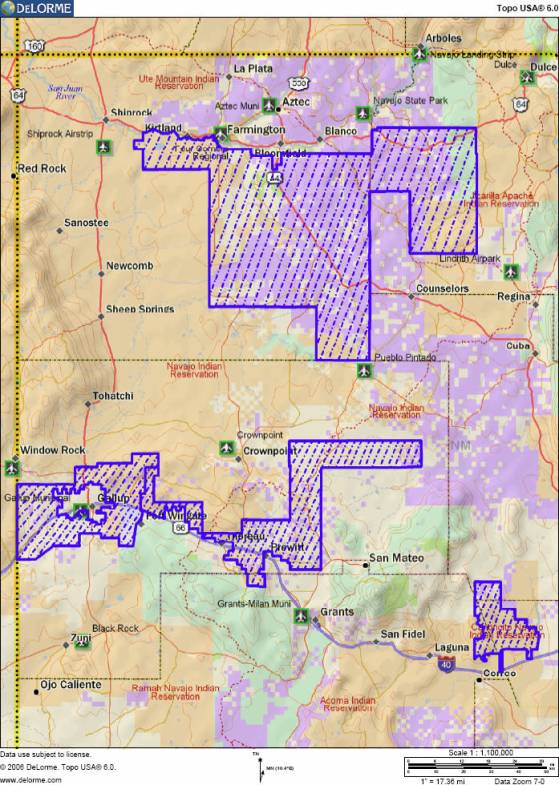
Sacred Wind's service areas (click to enlarge)

Sacred Wind's service areas (click to enlarge)

Badal decided to build a for-profit telecommunications company with a business plan that would depend on funding from the government.

“The only way any company could hope to provide service to the Navajo Nation is with the help of the Federal Communications Commission’s Universal Services Fund,” Badal told New Mexico Business Weekly in 2005.

“We can make this affordable, where Qwest cannot,” says Badal, who expects half of the cost to be picked up by government funding. “That is a necessary part of this equation. Without that, the Navajo cannot be served.”

Virtually every American pays into the Universal Services Fund through a charge levied on telephone bills.  The funding underwrites the expense of providing rural America with access to basic telecommunications services.

In 2004, the same year Badal left Qwest, the company agreed to sell its telephone business on the Navajo Reservation to Badal’s new company.  Sacred Wind, which the company says “evokes a sense of connection between what we do – to send communications over the air – with a larger-than-life purpose for starting this business,” launched service two years later in 2006.

Sacred Wind uses recently developed wireless technology to provide phone service to 2,700+ customers, using both point-to-point wireless and fixed WiMAX to reach as many customers as possible in the sparsely populated desert region.  It’s a challenging proposition for any company, considering most of their service area has less than one home per square mile.  Even when finished constructing their network, Badal estimates there will only be two or three homes served per square mile.

One third of Sacred Wind’s customers live in Navajo or federal government sponsored public housing, another third live in small clusters of a half dozen homes separated by several miles, and the last third live at least a half mile from the nearest neighbor.  Most are economically disadvantaged and have household incomes below $15,000 a year — 57.9% living below the poverty level.  More than two-thirds of reservation homes have no telephone, with some driving up to 30 miles to reach the nearest pay phone.  Several lack access to electricity, which makes wireless phone service and broadband even more challenging.  Sacred Wind is exploring solar options to serve these unpowered homes.

The benefits achieved from Sacred Wind’s focus on their service area are obvious – they know the landscape, the culture, the economics, and the people.  The company will work on problems that a large multi-state carrier like Qwest would not.  Technicians trying to reach one customer five miles away from the nearest wireless base station could not get service until a technician experimented with bouncing the three gigahertz wireless signal off a granite cliff face to extend coverage, which worked.

A company specializing in providing service to rural Native Americans, that also has a non-profit arm dedicated to computer training, provides scholarships, and e-commerce opportunities for Native Americans, is a natural for recognition, and the public responded, calling Sacred Wind’s mission inspiring.

“It’s a real honor to be voted most inspiring small business in the Shine A Light program,” Badal said. “It’s so exciting and rewarding to start your own business and be able to make an impact on the community. Through the support we will receive from American Express as winner of this program, we will be able to further extend our commitment to serving the Navajo people with advanced technology and educational resources.”

Since August, people across the country have nominated thousands of small businesses for the “Shine A Light” program. Three finalists were ultimately selected with the help of host and entrepreneur Ellen DeGeneres, fashion designer and entrepreneur Diane von Furstenberg and MSNBC’s small business expert and host JJ Ramberg.

[flv width=”480″ height=”320”]http://www.phillipdampier.com/video/sacred wind intro.flv[/flv]

A one minute introduction to Sacred Wind Communications

Sacred Wind Broadband Speed/Pricing

Sacred Wind Broadband Speed/Pricing

In addition to telephone service, Sacred Wind also provides Internet access to its customers, and here is where the story becomes considerably less inspiring.

Sacred Wind’s “broadband” service for most affordable tiers fails to qualify as “broadband” at all, using the FCC standard of 768kbps.  Pricing is exorbitant and speeds are slow.

It self-describes its dial-up option as “stable, fast, and affordable.”  The “affordable” claim may be true when comparing pricing with the first broadband tier that actually meets the minimum definition of broadband – $49.95 a month for 768kbps service.  Paying $79.95 a month will bring you their maximum speed offering — just 3Mbps.

The company also sells customers annual contracts to avoid the $99 installation and $65 equipment fees.

Still, for those who have never had telephone service, much less Internet access, it’s considered by many residents to be a good beginning.  The company is amenable to the idea of raising those speeds when technically and financially feasible.

[flv width=”480″ height=”320″]http://www.phillipdampier.com/video/Fujitsu Sacred Wind.mp4[/flv]

Fujitsu showcases Sacred Wind Communications and how it approached the technological challenges involved in providing service to the Navajo Reservation [8 minutes]

Unfortunately, like its bigger telephone brethren, Sacred Wind is not entirely free from the telephone industry politics that often lobbies for anti-consumer policies.  A concerning document on Sacred Wind’s website promotes a questionable legislative agenda, including support of legislation that would permit providers to “create fair compensation in network use by identifying traffic on our networks,” which is a Net Neutrality no-no if it applies to their broadband network.  Another mysterious bullet point, not well explained, objects to “video programming and broadcasting practices that make it difficult to provide an affordable product to our customers.” That could apply to wireless frequency allocations or traffic on their broadband network — it’s not well defined.

While the FCC works on its goal of providing broadband access to underserved Americans, actual case studies illustrating “successes” like Sacred Wind that only manage to bring 3Mbps service to rural areas underline the need for Universal Services Fund reform.  Dedicating additional economic assistance to construct considerably more advanced networks to meet the needs of an increasingly high bandwidth Internet is essential to correct the urban-rural digital divide.  The original purpose of the USF to guarantee basic phone service in rural areas was a noble idea a decade ago, but that was then and this is now.

As the pile of money in the USF continues to grow from Voice Over IP and mobile phone surcharges, it was only a matter of time before waste, fraud, and abuse also turned up.  The administrators of the USF have often wasted considerable amounts of that money on questionable projects in decidedly un-rural areas.  Redirecting, reforming, and broadening USF resources to cover broadband deployment in areas like the Navajo Reservation may be one of the only ways to build sustainable and equitable broadband access networks that are scalable and affordable, even for the most financially-challenged communities.  Providing 256kbps service for $30 a month doesn’t come close to cutting it in poverty-stricken communities.

Additional video coverage of Sacred Wind can be found below the jump.

… Continue Reading

Search This Site:

Contributions:

Recent Comments:

Your Account:

Stop the Cap!