Home » Broadband Speed » Recent Articles:

Frontier DSL: “Slow, Low Quality, and Priced Significantly Higher Than Verizon” Says Expert Hired By WV Consumer Advocate

One of the promised benefits of permitting the Verizon-Frontier spinoff is that Frontier will bring more and better broadband service to areas Verizon has ignored for years.  The company has been running television ads in West Virginia promoting Frontier’s promised “next generation” of broadband.  But what does that mean?

[flv]http://www.phillipdampier.com/video/Frontier Verizon Deal Advertisement West Virginia.flv[/flv]

Frontier Communications is running this advertisement in West Virginia.

The West Virginia Consumer Advocate Division of the Public Service Commission brought in Trevor R. Roycroft, PhD., former Associate Professor at the J. Warren McClure School of Communication Systems Management, Ohio University, to examine the details behind the marketing and public relations push to promote the deal.

He was not impressed.

After an extensive review of confidential and public documents from Frontier, his conclusion was that Frontier’s DSL service is just plain bad, and for plenty of West Virginians who may only have one choice for broadband in the foreseeable future, being stuck with Frontier’s idea of broadband is particularly bad.

Indeed, Frontier’s idea of what defines “next generation broadband” would be true, if this was the year 1992.

“Frontier has made no commitment regarding improved broadband deployment in West Virginia. Frontier, while achieving higher levels of DSL availability in West Virginia, generally offers its broadband services at higher prices and provides lower quality than those associated with Verizon’s DSL. Frontier’s ability to increase broadband deployment in West Virginia will depend on the condition of the outside plant that it has acquired, which may negatively impact Frontier’s costs of deployment. Furthermore, Frontier must upgrade substantial numbers of customer locations outside of West Virginia, and West Virginia will be competing with this larger priority,” Roycroft writes in his testimony to the West Virginia Public Service Commission.

The infrastructure Frontier utilizes to deliver its broadband service is revealing even to those Frontier customers not directly impacted by this transaction.  Some of the documents Roycroft reviewed laid bare the nonsense the company has used to defend its Acceptable Use Policy language defining an “acceptable amount” of monthly broadband usage at just five gigabytes.  Company officials have said for more than a year that they were concerned about the growth of usage on their network, and its potential to slow service for other customers.  But company documents, included within the scope of Roycroft’s testimony, tell a very different story:

Frontier plans to increase its core backbone from its current level of 10 Gbps to a capacity of 20 Gbps (should the spinoff be approved). With regard to the capacity of its existing backbone, Frontier states:

Frontier expanded the backbone from OC 48 to 10 Gigabit Ethernet during the first half of 2009. Because of this network expansion we do not have peak usage for the past 12 months. No backbone link has peaked above 2.8 Gigabit/second or 28% of the capacity of a link since the augment was completed in 2009.

Thus, Frontier’s current backbone configuration appears to have excess capacity. With the expansion of its backbone network to 20 Gbps, the company’s current data traffic load results in about 14% of capacity being utilized at peak.

Potentially limiting customers to just five gigabytes of usage is so unjustified, in Roycroft’s analysis, its potential imposition on West Virginian customers should be a deal-breaker.

Roycroft ponders whether Frontier will invest enough resources to make sure capacity is not an issue. The only way Frontier’s network will show signs of strain is if the company makes a conscious decision not to sufficiently upgrade their network as they take on millions of new Verizon customers, or they dramatically underestimate the average Verizon customer’s usage.

Roycroft was also asked to evaluate whether Frontier’s claims of 90% broadband availability in its overall service area and 92% in its West Virginia territory rang true.

Roycroft writes that Frontier’s numbers don’t tell the whole story.  In five states, Frontier admits the percentages are notably lower, so no guarantee can be inferred for West Virginia based on Frontier’s talking points.

Frontier’s “Advanced” Broadband Network Is Hardly Advanced and Barely Qualifies As Broadband

Heavy criticism was leveled at Frontier for its “advanced” broadband service.  Roycroft compared Frontier DSL with several other providers and was unimpressed with the company’s broadband speeds.
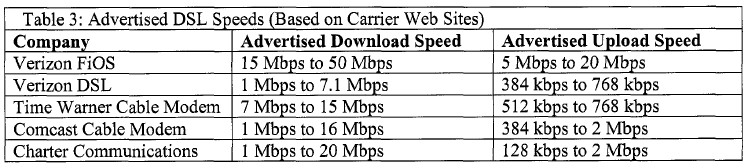
Roycroft's table illustrates what's on offer from the competition

Roycroft's table illustrates what's on offer from the competition

“Frontier’s advertised DSL speeds are generally much lower than those available from Verizon and other carriers. Based on a location-based search of Frontier DSL service offerings, it appears that Frontier’s most prevalent DSL speeds are 3 Mbps and 768 kbps (for download),” Roycroft said.
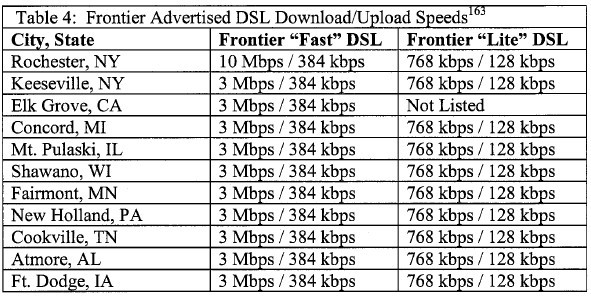
Frontier's DSL Speeds in Selected Cities

Frontier's DSL Speeds in Selected Cities

Although the expressed upload speed for Rochester should be listed at a higher rate (I managed around 512kbps myself), Roycroft is correct when he says, “it can be seen that outside of Rochester, NY, the DSL speeds associated with Frontier offerings cannot be considered ‘cutting edge.'”

Even while noting Rochester’s potential DSL speeds, real-world speeds are another matter entirely.

[flv width=”640″ height=”405″]http://www.phillipdampier.com/video/Real World Frontier vs Road Runner Speeds.flv[/flv]

One New York customer provided real world evidence of the significant differences in speed offered by Road Runner from Time Warner Cable and Frontier’s DSL (courtesy: 1ComputerSavvyGuy) (1 minute)

Frontier’s DSL offerings in West Virginia are of even lower quality. Frontier indicates that it offers three grades of DSL service in West Virginia:

Up to 256 kbps download/128 kbps upload;
Up to 1 Mbps download/200 kbps upload;
Up to 3 Mbps download/200 kbps upload.

These data transmission speeds, especially upload speeds, are at the very low end of commercial offerings that I have observed.

Comparing Verizon DSL vs. Frontier DSL Pricing & Gotchas, Contracts, and Internet Overcharging Schemes

Roycroft’s study found Frontier’s pricing significantly higher than Verizon for DSL service.

Frontier’s DSL prices, either with telephone service, or on a stand-alone basis, are significantly higher than are Verizon’s. For example, the entry-level Frontier plan has a nominal price that is 100% higher than Verizon’s.

However, when considering the per Mbps price, Frontier’s price is 160% higher. It is also notable that Frontier’s upload speeds are also low when compared to Verizon’s.  Consumers are increasingly relying on upload capabilities to share large files, such as videos. Overall, Frontier’s DSL products are low quality.
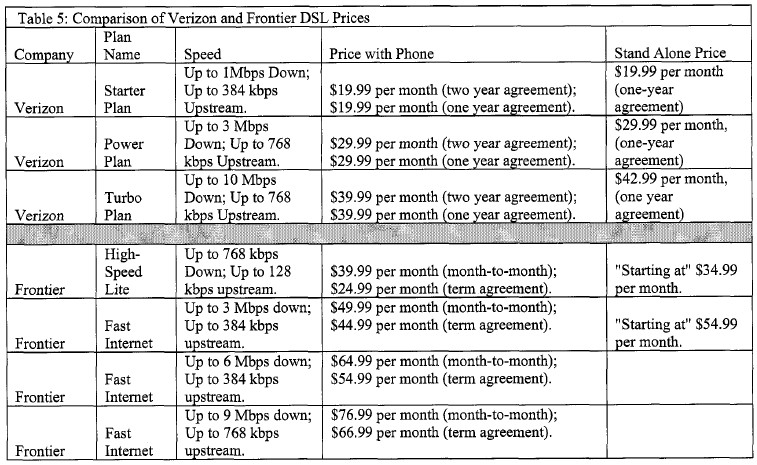
Comparing Prices

Comparing Prices

Roycroft also gave special attention to Frontier’s infamous 5GB Acceptable Use Policy, which he suggested was a major negative for West Virginia’s online experience.

Frontier indicates that it monitors network usage if “it receives a complaint of slow service or if it discovers that network bandwidth utilization is unusually high in a particular area.

Frontier was asked to identify any action taken against a customer associated with its acceptable use policy and, in response, the company stated that it has not “terminated a customer’s service based on exceeding the 5 GB threshold identified in the AUP.” However, the restriction on usage further raises the relative cost of Frontier’s service. Frontier indicates that consumers may face action by the company if they exceed the usage cap, thus indicating that the prices reflect both speed and volume. Verizon’s DSL service does not include a similar limit.

Frontier’s DSL pricing policies and usage restrictions will represent a significant negative impact on West Virginia consumers, should these policies be implemented in Verizon’s service area in West Virginia.

Even more importantly, Roycroft considered the argument for imposing such Internet Overcharging schemes as unwarranted.

“While DSL provides dedicated bandwidth to the customer in the last mile, DSL subscribers will share network capacity in the ‘middle mile.’ For example, shared data networks will carry consumer traffic from the telephone company central office to an Internet gateway. I believe that Frontier’s policy is more likely to reflect an unwillingness on Frontier’s part to invest in ‘middle mile’ Internet access facilities that would require capacity additions as customer demand increases, and choose to restrict customer usage instead of investing in the capacity needed to meet customer demand,” Roycroft writes.

“Furthermore, Comcast’s download-cap policy includes limits that are dramatically higher than Frontier’s. Comcast’s acceptable use policy identifies 250 gigabytes as the threshold at which Comcast may take action against a customer, which is fifty times the usage associated with Frontier’s policy,” he added.

Roycroft was also concerned about the many ‘gotchas’ that are part of Frontier’s marketing efforts which bring even higher prices to consumers choosing to have DSL service installed.

“To receive the services of Frontier’s technician, the consumer will incur a $134 fee unless the consumer signs up for a term service contract. Even with the term service contract, the customer must pay a $34 fee for the on-site set-up. Furthermore, the technicians that Frontier dispatches to new broadband customers’ homes are also sales agents. Thus, while it may be that these individuals can help with system set-up and the like, they also are part of Frontier’s overall up-selling strategy,” said Roycroft.

Frontier markets a variety of services to customers as part of their promotions and service offerings.  For instance, recent Dell Netbook promotions required customers to sign multi-year contracts for service, with an early termination fee up to $400 if the consumer chooses to cancel service.  Such promotions do not come out of the goodness of Frontier’s heart.  Indeed, such promotions provide even more revenue potential by pitching customers on its “Peace of Mind” services, which include computer technical support, backups, and inside wire maintenance for an additional monthly fee.

Customers don’t even qualify for many Frontier promotions unless they accept a bundled service package combining broadband with traditional phone service and a multi-year service contract.

Roycroft says West Virginia should demand modifications to Frontier’s proposal before it should even consider accepting it.  Among the changes:

  • Frontier should be required to make broadband services available in 100% of its wire centers, and to 90% of its West Virginia customers by the end of 2013. Frontier should expand broadband availability to 100% of its customers by 2015.
  • Frontier should be required to deploy and promote broadband services in West Virginia so that, by the end of 2013, at least 90% of its customers can achieve download speeds of 3 Mbps; 75% of its customers can achieve download speeds of 6 Mbps; and 50% of customers can achieve download speeds of 10 Mbps.
  • To achieve these broadband objectives, Frontier should be required to exceed Verizon’s baseline level of capital investment by at least $117 million during the period ending December 31, 2013, or by an amount sufficient to meet the broadband objectives.
  • Frontier should be required to offer broadband services at prices that do not exceed those currently offered by Verizon for 1 Mbps and 3 Mbps services, i.e., Frontier should offer services at Verizon’s advertised prices for 1 Mbps and 3 Mbps service (respectively, $19.99 per month and $29.99 per month) for a period of 24 months following the merger.
  • Frontier should be prohibited from imposing its broadband “download cap” in West Virginia.
  • Frontier should be required to provide individual written notice to its customers regarding the merger, and should notify customers of any change in services that result from the merger. Changes in billing format should also be clearly explained to customers, both in writing, and through a web-based tutorial.
  • Frontier should be prohibited from migrating any Verizon customer to a Frontier plan that either increases the customer’s rates, diminishes the level of service, or has a materially adverse impact on any of the terms and conditions of the customer’s service. West Virginia customers should experience a rate freeze for a period of 24 months.
  • Frontier should be required to allow former Verizon customers to take a “fresh look” at their purchases, including those customers who have term contracts with Verizon. All early termination charges should be waived for a period of 90 days following the merger, and the long distance PIC charge should also be waived for Verizon long-distance customers who select a long-distance provider other than Frontier.

Verizon Can Engage In FiOS Internet Overcharging Because It Can: Heavy Users Are A Potential Profit Windfall

Brian Whitton, Verizon's Executive Director of Access Technologies

Brian Whitton, Verizon's Executive Director of Access Technologies

At least Verizon is honest about it.  As providers contemplate slapping customers with usage limits, overlimit fees, and other tiered pricing systems, they’ve typically said they’re justified because of the strain they claim heavy users place on their broadband networks.  One network that doesn’t face that problem is Verizon’s robust fiber optic FiOS network, which is on the way to upgrading from the ridiculously fast current speeds to the “next generation” of FiOS speed: delivering 10 Gbps downlink and 2.5 Gbps uplink, shared among 32 locations.  That makes the cable modem competition, which shares slower speeds among many more customers wilt at the prospect.  DSL instantly becomes the dial-up service of the decade in comparison.

Make no mistake, Verizon tells all who ask: Fiber to the Home is near-infinitely upgradeable for decades to come, simply by swapping out some hardware at each end of the pipe.

Yet Verizon began making noises about ending its all-you-can-eat broadband buffet this past September, when Verizon Chief Technology Officer Dick Lynch said Verizon was in favor of consumption-based billing, too.

But why should Verizon FiOS, often priced higher than the cable competition, opt for Internet Overcharging schemes when it has a network that is nowhere near capacity and will increase its speeds even further next year?

As GigaOm’s Stacey Higginbotham found out, the answer is – because they can:

Brian Whitton, executive director of access technologies at Verizon did acknowledge how valuable broadband has become—precious enough that people will pay for premium access to it, especially those using up a disproportionate amount of network assets. “Ultimately this is the fairest cost-recovery model, and with a tiering plan or a meter everyone is paying their fair shares to finance the network,” Whitton said. Unlike other ISPs, Verizon doesn’t view heavy bandwidth users as hogs, but it does view them as potentially high-end customers.

Yet Verizon already does charge users a fair share to finance their network, based on the speed tier that customer chooses.  Those high-end customers are already paying Verizon premium prices for the fastest available speeds on Verizon’s fiber optic system.  Verizon’s ability to recoup their investment becomes easier and easier as costs decline to construct the fiber optic systems that will protect Verizon’s viability for decades to come, unlike those traditional phone companies sticking with copper wire lines until the last customer out the door turns the lights out for good.  Verizon’s average revenue per subscriber has never been higher with its ability to market video programming, speeds that make most cable operators blush, and an infinitely more reliable telephone network, all on one bill.  That helps achieve subscriber loyalty, particularly when offering service that keeps customers happy.

Creating Internet Overcharging schemes for your broadband service simply to monetize consumption does not keep customers happy.  Verizon sees the cream rising to the top — charging broadband enthusiasts more while promising nothing for customers who use the service less.  With average consumption per broadband user rising, there’s going to be a lot more cream to skim, charging an increasing number of customers more money for the exact same level of service.

No consumption billing scheme to date has ever provided customers with a “fair share” system, because none of them result in no charge for no consumption or charge a flat fee per gigabyte.  Instead, customers are allocated a pre-determined allowance for usage, charged whether they use it or not.  If they exceed it, punishing overlimit fees are always the result, unless a provider takes another step towards monetizing broadband by inventing overpriced “insurance plans” to protect consumers from overage fees.  The cost of delivering that data is already built-in to the price of today’s broadband plans, and those costs continue to decline.

Higginbotham adds another factor in the equation: with insufficient competition, those “fair share” schemes can inflate prices and lower allowances at a whim, as most customers lack a wide variety of competitors to choose from, which could help keep the greed factor in check.

Most places have two providers that offer slightly different sets of services and plans, making it hard to compare prices. I don’t mind paying more for a better network (I do so for my cell phone), but most consumers lack that option when it comes to wired access. Comcast—which competes against Verizon in about 12% of its footprint—is rolling out faster broadband to ensure that customers don’t leave the cable provider for Verizon’s fiber. But in other areas of the country, such as here in Austin, Tex., folks must choose between DSL (with some U-verse) and cable that hasn’t been upgraded to the faster DOCSIS 3.0 speeds.

Austin was one of the test markets for Time Warner Cable’s reviled “consumption billing experiment” this past April.  In other test cities, it’s more of the same.  In Rochester, New York broadband service is realistically available from two major players — Time Warner Cable and Frontier Communications.  The former has apparently passed over Rochester for DOCSIS 3 upgrades because the cable operator sees little need to upgrade service in an area whose only primary competitor believes DSL service is good enough, one that has stubbornly kept an Acceptable Use Policy defining an appropriate amount of usage at a piddly five gigabytes per month, and thinks fiber is for breakfast cereals, not for Flower City residents.

Verizon’s words help call out the fiction that some providers have used to peddle Internet Overcharging schemes on their customers.  It’s not about “fairness,” it’s not about “exafloods and Internet brownouts,” nor is it about “expanding networks.”  It’s about profit, pure and simple.  When you have a duopoly in place for broadband and almost no regulation governing that service, the sky is the limit for price increases and limits on usage.

[flv width=”480″ height=”284″]http://www.phillipdampier.com/video/Verizon Whitton On Telecom Delivery 2-25-09.flv[/flv]

Verizon’s Executive Director of Access Technologies Brian Whitton speaks about the future of telecommunication delivery technologies with Kimberlie Dykeman of Web2point0.tv at The Future of Television East conference in New York (February 25, 2009 – 11 minutes)

Adding Insult to Injury: Verizon Wireless Further Pummels AT&T in New Round of Holiday Ads

Phillip Dampier November 17, 2009 AT&T, Broadband Speed, Competition, Verizon, Video, Wireless Broadband 2 Comments

AT&T Mobility wanted Verizon Wireless to stop showing ads that call out the differences between the two wireless competitors’ national 3G networks.  When Verizon didn’t, AT&T sued.  This week Verizon Wireless doubles down with three new holiday season ads that are guaranteed to enrage AT&T even further.

Anyone who has seen a Rankin/Bass holiday special will instantly recognize at least one of the ads is a play on the Island of Misfit Toys, seen in the 1964 holiday classic Rudolph, the Red-Nosed Reindeer.

[flv width=”620″ height=”380″]http://www.phillipdampier.com/video/Verizon Wireless Verizon Misfit Toys Ad.flv[/flv]

Verizon Wireless – “The Island of Misfit Toys” (30 seconds)

AT&T accuses Verizon Wireless of misrepresenting its national data coverage by showing non-3G areas in white, a color AT&T says traditionally represents no service at all.  AT&T says its wireless data network, in its entirety, is more expansive than Verizon’s.  Verizon counters its ads only compare 3G coverage, and clearly label the maps as such, including a fine print disclaimer indicating “voice and data services available outside 3G coverage area.”

AT&T further argues watching frustrated consumers shaking their phones or sitting alone because they were unable to meet up with their friends would suggest to a casual viewer they weren’t able to access any service.

[flv width=”620″ height=”380″]http://www.phillipdampier.com/video/Verizon Wireless Blue Christmas Ad.flv[/flv]

Verizon Wireless – “Blue Christmas” is sure to draw the ire of AT&T as a frustrated father visibly shakes his iPhone and never seems to be able to use it. (30 seconds)

Verizon Wireless’ attorneys officially responded to the AT&T request for a temporary restraining order to pull the ads off the air with a direct opening: “AT&T did not file this lawsuit because Verizon’s ‘There’s A Map For That’ advertisements are untrue; AT&T sued because Verizon’s ads are true and the truth hurts.”

The attorneys argue, “Remarkably, AT&T admits that the 3G coverage maps — the one thing that is common to all five ads — are accurate and that the ads’ express statement that Verizon has ‘5X More 3G Coverage’ than AT&T is true.”

AT&T has been one of the loudest voices in this advertising battle, spending many millions of dollars to market its 3G network as the “Nation’s Fastest 3G Network” and, with its exclusive partner Apple, naming the latest iPhone (only available on AT&T’s network) the “iPhone 3GS.”

The stark truth, as revealed by the concededly accurate coverage maps in Verizon’s advertising, is that the geographic reach of AT&T’s 3G network is far less extensive than AT&T would have the public believe — and far less extensive than Verizon’s 3G network. Consumers who are interested in smartphones have a strong interest in knowing the comparative 3G coverage offered by Verizon and AT&T.  Cutting off the free flow of information about Verizon’s more extensive 3G coverage would harm consumers in a way that could not be redressed.  And because injury to First Amendment rights is by definition irreparable, suppressing Verizon’s speech on an “emergency” basis before a definitive and fair adjudication would irreparably injure Verizon and its goodwill in addition to costing Verizon customers. Any harm to AT&T, in contrast, is merely speculative.

In the final analysis, AT&T seeks emergency relief because Verizon’s side-by-side, apples-to-apples comparison of its own 3G coverage with AT&T’s confirms what the marketplace has been saying for months: AT&T failed to invest adequately in the necessary infrastructure to expand its 3G coverage to support its growth in smartphone business, and the usefulness of its service to smartphone users has suffered accordingly. AT&T may not like the message that the ads send, but this Court should reject its efforts to silence the messenger.

[flv width=”620″ height=”380″]http://www.phillipdampier.com/video/Verizon Wireless Elves Ad.flv[/flv]

Verizon Wireless – “Elves” includes the line “good luck browsing the web with that one.” (30 seconds)

AT&T has gone all out to find confused consumers to back up their request for a temporary restraining order, running a survey asking ordinary cell phone users what they thought Verizon Wireless’ ads meant.  But Verizon Wireless answers the survey wasn’t limited to smartphone customers, who are already well aware of the differences between 3G and older, slower speed data networks, and for that reason the results are invalid.

Verizon Wireless says it will continue the aggressive campaign beyond the all-important holiday season, when cell phone handset sales are at some of their highest traditional levels.

Special Comment: Telecom Industry & Their Friends Attack Net Neutrality

Phillip Dampier

Phillip Dampier

Lobbyists, corporate executives, and several interest groups are busy lobbying the newest additions to the Federal Communications Commission in an all-out effort to stop Net Neutrality.

The Hill newspaper today reports Mignon Clyburn, daughter of House Majority Whip James Clyburn (D-S.C.), is particularly under pressure to reject Net Neutrality.  The Hill reports industry lobbyists believe that if her father is amenable to their position, his daughter might also be.  To date, several hundred letters from minority groups and organizations, many opposed to Net Neutrality, have been filed with the FCC.

After reviewing dozens of those letters, it’s readily apparent many are the fruits of AT&T and Verizon lobbying labor, because several adopt both companies’ anti-Net Neutrality talking points, often word for word.

Even the newest Republican commissioner, Meredith Attwell Baker, is under a lobbying assault.

The thinking on K Street is that Baker’s views on net neutrality may not be set. Lobbyists and corporate executives have sought out Baker before the FCC votes on a final rule sometime next year.

“They are trying to get in there and remind her where she comes from to shore up her vote for the anti-net neutrality camp,” said one lobbyist working on the issue.

While the special interest blitz attempts to kill Net Neutrality, one pro-Net Neutrality advocate got into a dispute with some of the minority interest groups opposing Net Neutrality, which was gleefully covered by the broadband industry trade press. Public Knowledge got a bit too close to a nerve of several of these groups who put their logos on a letter sent to the FCC opposing Net Neutrality.  The letter represents the groups’ concerns that broadband for many in America is simply not available, especially for the economically disadvantaged.  They’ve been swayed by industry propaganda to characterize Net Neutrality as a threat to addressing the digital divide by making service ultimately even more expensive.  Some of those groups fired back against Public Knowledge, offended by some of the language used on their blog they felt suggested minority groups were naive and possibly even “selling out” the people they represent.  A few public exchanges later led to an apology from Public Knowledge if feelings were hurt and a plea from Free Press to put aside some of the personal disputes and rhetoric and argue the merits of the issue pro or con.

We agree with Free Press that personality disputes and pointless name calling don’t work and serve only to distract from the issues at hand. These groups advocating against Net Neutrality should be open to receiving additional information that doesn’t come from the broadband industry, particularly arguments that debunk those fear-mongering industry talking points.  Perhaps those groups will be amenable to changing their position once they gather additional facts.

But we also feel the first rule of politics must always be to “follow the money” and that is true for non-profits, for-profits, and government interests.  There must be full disclosure of the financial support and board membership of all of the groups claiming to represent consumer and minority interests.  Consumers, and more importantly members of the groups themselves, deserve to know where the money is coming from and if their boards have members working for or with the telecommunications industry or its friends.

For example, in our own research of the background of 100+ members of Broadband for America, we found instances of telecommunications industry involvement in virtually every single group.  If one chooses to believe that is a coincidence and still feels comfortable with that organization, so be it.  However, if one is concerned to learn that in several cases those ties were being scrubbed from interest groups’ websites, or were not openly disclosed to members, learning about that could be a cause of concern.  People should have the right to make an informed decision.  Some of the groups complaining about Public Knowledge are also members of Broadband for America and have telecommunications industry money backing them.  There is nothing wrong, in my judgment, in making sure that information is out there for readers to consider.

Be aware that while pro-Net Neutrality groups ring their hands over potentially offending one another, opponents are wasting no time mass mailing anti-Net Neutrality correspondence to the FCC.  Let’s remember our first priority is to fight for Net Neutrality.  If a group is offended, send them flowers, apologize quickly if you must, and be done with it.  Don’t entertain the trade press.

Navarrow Wright on BlackWeb 2.0 called proponents of Net Neutrality “digital elites” and then condensed many of the industry talking points that are common to many of the anti-Net Neutrality letters heading to the FCC:

  • The risk that a regressive pricing mandate that net neutrality rules could impose will shift online costs to the poor is real.
  • The risk that over-regulation will depress deployment and access is real.
  • The risk that restrictions on network management will reduce the quality and reliability of Internet service for light users — students, the poor on fixed incomes, the elderly, and community organizers who rely on Internet access to reach their communities – is real.

Wright doesn’t bother to provide any evidence to back up these claims.  Underlining the word real does not make it reality.

We recognize these talking points from the broadband industry’s lobbying efforts against Net Neutrality.  The industry scare tactic about raised prices is exactly the same one they use to justify Internet Overcharging schemes like forced consumption billing and usage caps, despite earning healthy profits and enjoying a decline in their traffic costs.  Read the financial reports from the major players about broadband profits for yourself.  Don’t take our word for it.

Net Neutrality simply demands the status quo — open and equal access to everyone, including the economically disadvantaged Wright is concerned about.  If Wright is concerned about the cost of broadband services for the economically disadvantaged, giving the providers the right to monetize content delivery in new ways, it will lead to even higher prices than we cope with today.

Industry rate hikes come in spite of Net Neutrality, and we call on Wright to join our effort to demand increased competition so these kinds of price increases become untenable.  Time Warner Cable, the nation’s second largest provider, is busily increasing prices for Road Runner service right now in several regions, even without the “imminent threat” of Net Neutrality.

Net Neutrality is hardly “over regulation,” and the empty rhetoric about it depressing investment, deployment, and access has been made every time this industry has faced the prospect of some oversight.  Wright should remember the industry used the same arguments to resist universal wiring requirements made in franchise agreements to guarantee that income challenged neighborhoods had the same access to cable and telephone broadband services as wealthy suburbs.  In their fight to obtain quick and simple statewide video franchising, they argued that without it, it would discourage investment, deployment, and access to competition.  Regulating rates?  Same argument.  The Discovery Institute, which has produced suspect studies on demand for the industry, paid for by the industry, provides an excellent example of “we’ve heard this song before” in comments they made to the FCC back in 2006 to try and reform cable franchising:

V. LEVEL-PLAYING-FIELD REQUIREMENTS ARE ANTICOMPETITIVE

Build-out requirements were an appropriate quid pro quo for the telephone, cable and wireless companies who received an exclusive franchise. An exclusive franchise ensured the viability of average pricing by eliminating the risk of cherry-picking by a competitive entrant, and allowed providers to serve the most profitable customers first who could then, in turn, subsidize the cost of serving everyone else.

Competitive entrants already have an incentive to expand their networks: They must produce consistent revenue gains, and the cost of adding additional users declines as a network grows. But unless flexibly and intelligently applied, a build-out requirement threatens the entire undertaking by creating the possibility that the initial investment will be effectively lost if, for whatever reason, it just isn’t possible to meet the deadline. The evidence that cities possess the inclination to perform this thoughtful and delicate task is entirely conjectural.

Build-out is typically not required of competitive entrants, because it imposes costs that may not be recoverable in a competitive market. Exceptions are Personal Communications Service (PCS) providers and Eligible Telecommunications Carriers (ETCs). However, these examples are clearly distinguishable. As the Commission has noted in another context, the grant of a PCS license confers on the licensee an exclusive right to use a designated portion of the electromagnetic spectrum. In that decision, the Commission rejected a Texas build-out requirement applicable to competitive entrants in the local exchange market.

ETCs are required to provide service and advertise their rates throughout the area for which they seek Universal Service support, but an ETC has the right to resell another carrier’s services. There is no suggestion in the current proceeding that telephone companies seeking to offer video services should have the right to resell the services of the incumbent cable operator, nor should there be. However, in view of the fact that telephone companies cannot be assured of the capital needed to build out their advanced services networks, a resale requirement would probably be the only practical way ensure that a competitive entrant could serve every household.

Build-out is not the same thing as redlining. Redlining is illegal, but by its terms, 47 U.S.C. 621(a)(4)(A) does not require build-out. It merely imposes a reasonableness requirement on the amount of time locally-enacted build-out requirements provide for the competitive entrant to serve every household. There is no Congressional mandate for build-out.

Since cable operators are not required to offer voice services to every household, it is not clear why telephone companies should be required to offer video services throughout their service area. There is no way to predict whether competitive entrants will have access to sufficient capital or be able to gain enough market share to make build-out requirements objectively reasonable. These risk factors suggest that build-out requirements would be anticompetitive.

It is also utter nonsense to suggest network management restrictions will reduce the quality and reliability of Internet service for light users.  In fact, the industry’s proposed “light user” solution is a consumption billing scheme that includes usage allowances and limits, overlimit penalties for exceeding them, and consumers forced into limited use plans, often for little or no savings over existing under-marketed “lite” plans.

Most providers currently tier broadband based on speed.  If a consumer wants to get “light service,” they can purchase a discounted lower speed package perfectly adequate for most web use, and never have to worry about how much they choose to use it.  They want to continue offering speed tiers, but also limit customers’ use of their accounts, giving them a paltry usage allowance and then subjecting them to steep penalties for exceeding it.  Residents in Rochester, New York fought back against two such schemes advocated by Time Warner Cable and Frontier Communications, the local phone company.  It is under the guise of “network management” that these Internet Overcharging schemes were born.  A word to the wise – this price gouging hurts the economically disadvantaged far more than wealthy suburbanites.

I also point Wright’s attention to the broadband situation in Canada, which has adopted the viewpoint of our provider friends.  There, Internet usage is limited by allowances, with fees of $1-5 per gigabyte for exceeding them.  Net Neutrality is not protected, and certain Internet services are “network managed” with speed throttles, reducing their speed by 90% or more, making their use untenable.  Yet, Canadian broadband dropped in global broadband rankings, service providers increased prices anyway, and the digital divide Wright is worried about has not been addressed.  In fact, it’s arguably worse, because the industry won efforts to also limit and ration wholesale broadband access used by independent service providers to create competitive, lower-priced alternatives.

Does that make Wright stupid or a “sell-out?”  Of course not.  It means we have a lot of information to share with Mr. Wright and others like him.  As consumers ourselves, we believe in getting affordable broadband access to disadvantaged communities, and support Universal Service Fund reform and appropriate stimulus funding, or providing municipally built networks to introduce needed competition to get quality, affordable broadband service into urban and rural homes that are woefully underserved.  The industry advocated “don’t regulate us” approach has been in place since the 1990s and has not come close to solving the problem.

It’s our view broadband service is rapidly becoming as important as water, gas and electric, and telephone service, and must be provided to every American that wants a connection, at an affordable price.  When private providers won’t do that, it’s time to follow the same path we took to assure electrification of this country decades earlier, with public projects to get the job done.

We think every person should check out these issues for themselves.  As a consumer, confronting Internet Overcharging schemes was what got this site started, and once I examined the facts about the profitable state of broadband, and the quest to make it even more profitable at consumer expense, I got angry and involved.  That doesn’t make me an “elitist.”  It makes me an informed and involved citizen.

We have always told providers this isn’t personal and we respect the work done by the employees to serve their customers.  Most of us are customers ourselves.  We will debate policy matters and advocate for our position, and try and bring supporting evidence to the table, and let the best argument win.  Along the way, disclosing who represents who and where they money comes from is part of that debate.

It will remain our policy to expose industry connections in organizations that purport to advocate for consumer interests, particularly when those connections are not routinely disclosed.  Consumers have a right to know whether the industry is writing checks to ostensibly independent groups, or have executives seated on their governing boards, potentially influencing their public policy positions.  To not provide this needed information would sell out our readers, and not living up to the standards we set for ourselves.

For the record, Stop the Cap! has zero industry money backing us.  We are 100% consumer-funded and have no involvement in any online business or telecommunications company.

Alarmism In The Media: Flu Outbreak Could Crash Internet, Unless Provider-Suggested Throttles and Rationing Are Authorized

America's Broadband Emergency Plan Allows Up to Three Cat-Chasing-Laser-Pointer videos per day

America's Broadband Emergency Plan Allows Up to Three Cat-Chasing-Laser-Pointer videos per day

The mainstream media loves a scare story.  Suggestions that a national H1N1 pandemic could bring the Internet as we know it to its knees is a surefire way to get plenty of attention.

The Chicago Tribune, among others, reports that a nationwide outbreak of virus forcing 40% of American workers to remain housebound could result in too many people sitting at home watching Hulu, bringing the entire Internet to a screeching halt.

The answer? Shut down video streaming sites and throttle users during national emergencies.

Of course, even more interesting is what never turns up in these kinds of stories — the news behind the sensationalist headlines.

The report on which this story is based comes courtesy of the General Accounting Office.  The GAO doesn’t simply issue reports willy-nilly.  A member or members of Congress specifically request the government office to research and report back on the issues that concern them.  In this instance, the report comes at the request of:

  • Rep. Henry Waxman
  • Rep. John D. Dingell
  • Rep. Joe Barton
  • Rep. Barney Frank
  • Rep. Bennie G. Thompson
  • Rep. Rick Boucher
  • Rep. Cliff Stearns
  • Rep. Edward J. Markey

The congressmen weren’t worrying exclusively about your broadband interests.  The GAO notes the study came from concern that such a pandemic could impact the financial services sector (the people that brought you the near-Depression of 2008-09).  The Wall Street crowd could be left without broadband while recovering from flu, and that simply wouldn’t do.

“Concerns exist that a more severe pandemic outbreak than 2009’s could cause large numbers of people staying home to increase their Internet use and overwhelm Internet providers’ network capacities. Such network congestion could prevent staff from broker-dealers and other securities market participants from teleworking during a pandemic. The Department of Homeland Security (DHS) is responsible for ensuring that critical telecommunications infrastructure is protected. GAO was asked to examine a pandemic’s impact on Internet congestion and what actions can be and are being taken to address it, the adequacy of securities market organizations’ pandemic plans, and the Securities and Exchange Commission’s (SEC) oversight of these efforts,” the report states.

Putting aside my personal desire that a little less broadband for deal-making, bailout-demanding “kings of the world” might not be a bad idea, the GAO’s report concludes what we already know — the business model of residential broadband is based on sharing connections and when too many people stay home and use them, it’s slow and doesn’t work well.

Providers do not build networks to handle 100 percent of the total traffic that could be generated because users are neither active on the network all at the same time, nor are they sending maximum traffic at all times. Instead, providers use statistical models based upon past users’ patterns and projected growth to estimate the likely peak load of traffic that could occur and then design and build networks based on the results of the statistical model to accommodate at least this level. According to one provider, this engineering method serves to optimize available capacity for all users. For example, under a cable architecture, 200 to 500 individual cable modems may be connected to a provider’s CMTS, depending on average usage in an area. Although each of these individual modems may be capable of receiving up to 7 or 8 megabits per second (Mbps) of incoming information, the CMTS can transmit a maximum of only about 38 Mbps. Providers’ staff told us that building the residential parts of networks to be capable of handling 100 percent of the traffic that all users could potentially generate would be prohibitively expensive.

In other words, guess your customer demand correctly and 200-500 homes can all share one 38Mbps connection.  Guess incorrectly, or put off expanding that network to meet the anticipated demands because your company wants to collect “cost savings” from reduced investment, and everyone’s connection slows down, especially at peak times.

One way to dramatically boost capacity for cable operators is to bond multiple channels of broadband service together, using the latest DOCSIS 3 standard.  It provides cable operators with increased flexibility to meet growing demands on their network without spending top dollar on wholesale infrastructure upgrades.  Many operators are already reaping the rewards this upgrade provides, by charging customers higher prices for higher speed service.  But it also makes network management easier without inconveniencing existing customers with slowdowns during peak usage.

The GAO didn’t need 77 pages to produce a report that concludes broadband usage skyrockets when people are at home.  Just watching holiday shopping traffic online spike during deal days like “Cyber Monday,” after Thanksgiving would illustrate that.  Should 40 percent of Americans stay home from work, instead of browsing the Internet from their work machines, they’ll be doing it from home.  That moves the bottleneck from commercial broadband accounts to residential broadband networks.

The GAO says such congestion could create all sorts of problems for the financial services sector, slowing down their broadband access.

Providers’ options for addressing expected pandemic-related Internet congestion include providing extra capacity, using network management controls, installing direct lines to organizations, temporarily reducing the maximum transmission rate, and shutting down some Internet sites. Each of these methods is limited either by technical difficulties or questions of authority. In the normal course of business, providers attempt to address congestion in particular neighborhoods by building out additional infrastructure—for example, by adding new or expanding lines and cables. Internet provider staff told us that providers determine how much to invest in expanding network infrastructure based on business expectations. If they determine that a demand for increased capacity exists that can profitably be met, they may choose to invest to increase network capacity in large increments using a variety of methods such as replacing old equipment and increasing the number of devices serving particular neighborhoods. Providers will not attempt to increase network capacity to meet the increased demand resulting from a pandemic, as no one knows when a pandemic outbreak is likely to occur or which neighborhoods would experience congestion. Staff at Internet providers whom we interviewed said they monitor capacity usage constantly and try to run their networks between 40 and 80 percent capacity at peak hours. They added that in the normal course of business, their companies begin the process to expand capacity when a certain utilization threshold is reached, generally 70 to 80 percent of full capacity over a sustained period of time at peak hours.

However, during a pandemic, providers are not likely to be able to address congestion by physically expanding capacity in residential neighborhoods for several reasons. First, building out infrastructure can be very costly and takes time to complete. For example, one provider we spoke with said that it had spent billions of dollars building out infrastructure across the nation over time, and adding capacity to large areas quickly is likely not possible. Second, another provider told us that increasing network capacity requires the physical presence of technicians and advance planning, including preordering the necessary equipment from suppliers or manufacturers. The process can take anywhere from 6 to 8 weeks from the time the order is placed to actual installation. According to this provider, a major constraint to increasing capacity is the number of technicians the firm has available to install the equipment. In addition to the cost and time associated with expanding capacity, during a pandemic outbreak providers may also experience high absenteeism due to staff illnesses, and thus might not have enough staff to upgrade network capacities. Providers said they would, out of necessity, refrain from provisioning new residential services if their staff were reduced significantly during a pandemic. Instead, they would focus on ensuring services for the federal government priority communication programs and performing network management techniques to re-route traffic around congested areas in regional networks or the national backbone. However, these activities would likely not relieve congestion in the residential Internet access networks.

It’s clear some broadband providers are not willing to change their business models to redefine congestion from measurements taken during peak usage when speeds slow, to those that anticipate and tolerate traffic spikes.  That means making due with what broadband providers are delivering today and developing technical and legal means to ration, traffic shape, or simply cut access to high bandwidth traffic during ‘appropriate emergencies.’  Right on cue, the high bandwidth barrage of self-serving provider talking points are on display in the report:

Providers identified one technically feasible alternative that has the potential to reduce Internet congestion during a pandemic, but raised concerns that it could violate customer service agreements and thus would require a directive from the government to implement. Although providers cannot identify users at the computer level to manage traffic from that point, two providers stated that if the residential Internet access network in a particular neighborhood was experiencing congestion, a provider could attempt to reduce congestion by reducing the amount of traffic that each user could send to and receive from his or her network. Such a reduction would require adjusting the configuration file within each customer’s modem to temporarily reduce the maximum transmission speed that that modem was capable of performing—for example, by reducing its incoming capability from 7 Mbps to 1 Mbps. However, according to providers we spoke with, such reductions could violate the agreed-upon levels of services for which customers have paid. Therefore, under current agreements, two providers indicated they would need a directive from the government to take such actions.

Shutting down specific Internet sites would also reduce congestion, although many we spoke with expressed concerns about the feasibility of such an approach. Overall Internet congestion could be reduced if Web sites that accounted for significant amounts of traffic—such as those with video streaming—were shut down during a pandemic. According to one recently issued study, the number of adults who watch videos on video-sharing sites has nearly doubled since 2006, far outpacing the growth of many other Internet activities. However, most providers’ staff told us that blocking users from accessing such sites, while technically possible, would be very difficult and, in their view, would not address the congestion problem and would require a directive from the government.

Enjoy up to one Hogan's Heroes episode per day during the H1N1 flu pandemic

Enjoy up to one Hogan's Heroes episode per day during the H1N1 flu pandemic

You have to love some of the players in the broadband industry who trot out their most-favored “network management” talking points to handle a national emergency.  It’s interesting to note providers told the GAO they were concerned with violating customer agreements regarding speed guarantees, when most providers never guarantee residential service speeds.  Their first solution is the Net Neutrality-busting traffic throttle, to slow everyone down to ration the “good enough for you” network in your neighborhood.  Shutting down too-popular, high bandwidth websites like Hulu (no worries – you can watch your favorite shows on our cable TV package) is apparently someone’s good idea, but considering providers admit it wouldn’t actually solve the congestion problem, one’s imagination can ponder what other problems such a shutdown might solve.

One provider indicated that such blocking would be difficult because determining which sites should be blocked would be a very subjective process. Additionally, this provider noted that technologically savvy site operators could change their Internet protocol addresses, allowing users to access the site regardless. Another provider told us that some of these large bandwidth sites stream critical news information. Furthermore, some state, local, and federal government offices and agencies, including DHS, currently use or have plans to increase their use of social media Web sites and to use video streaming as a means to communicate with the public. Shutting down such sites without affecting pertinent information would be a challenge for providers and could create more Internet congestion as users would repeatedly try to access these sites. According to one provider, two added complications are the potential liability resulting from lawsuits filed by businesses that lose revenue when their sites are shutdown or restricted and potential claims of anticompetitive practices, denial of free speech, or both. Some providers said that the operators of specific Internet sites could shut down their respective sites with less disruption and more effectively than Internet providers, and suggested that a better course of action would be for the government to work directly with the site operators.

A very subjective process indeed, but one many providers have sought to keep within their “network management” control as they battle Net Neutrality.  One would think “potential claims of anti-competitive practices” would represent an understatement, particularly if cable industry-operated TV Everywhere theoretically kept right on running even while Hulu could not.  As long time net users already know, outright censorship or content blockades almost always meet resistance from enterprising net users who make it their personal mission to get around such limits.

Expanding broadband networks to provide a better safety cushion during periods of peak usage is looking better and better.

Providers could help reduce the potential for a pandemic to cause Internet congestion by ongoing expansions of their networks’ capacities. Some providers are upgrading their networks by moving to higher capacity modems or fiber-to-the-home systems. For example, some cable providers are introducing a network specification that will increase the download capacity of residential networks from the 38 Mbps to about 152 to 155 Mbps. In addition to cable network upgrades, at least one telecommunications provider is offering fiber-to-the home, which is a broadband service operating over a fiber-optic communications network. Specifically, fiber-to-the-home Internet service is designed to provide Internet access with connection speeds ranging from 10 Mbps to 50 Mbps.

Hello.

Sounds like a plan to me, and not just for the benefit of the Wall Street crowd sick at home with the flu.  Such network upgrades can be economical and profitable when leveraged to upsell the broadband enthusiast to higher speed service tiers.  During periods of peak usage, such networks will withstand considerably more demand and provide a better answer to that nagging congestion problem.

The alternative is Comcast or Time Warner Cable, in association with the Department of Homeland Security, having to appear on Wolf Blitzer’s Situation Room telling Americans they have a broadband rationing plan that will give you six options of usage per day.  Choose any one:

  • Up to three videos of cats chasing laser pointers on YouTube
  • One episode of Hogan’s Heroes
  • Up to six videos of your friends playing Guitar Hero on Dailymotion
  • Unlimited access to Drugstore.com to browse remedies
  • Five MySpace videos of your favorite bands
  • Up to 500 “tweets” boring your followers with every possible detail of your stuck-at-home-sick routine

Search This Site:

Contributions:

Recent Comments:

Your Account:

Stop the Cap!