Home » Broadband Speed » Recent Articles:

Rogers Ripoff: Will Double Maximum Overlimit Fee to $50 for Broadband Customers

Just like the credit card companies, once a broadband provider wedges its foot in the door with Internet Overcharging schemes like consumption billing and usage allowances, they can push it open further and further, allowing your money to fly out the door into their pocket.

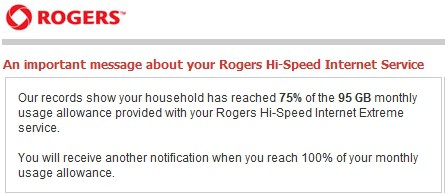
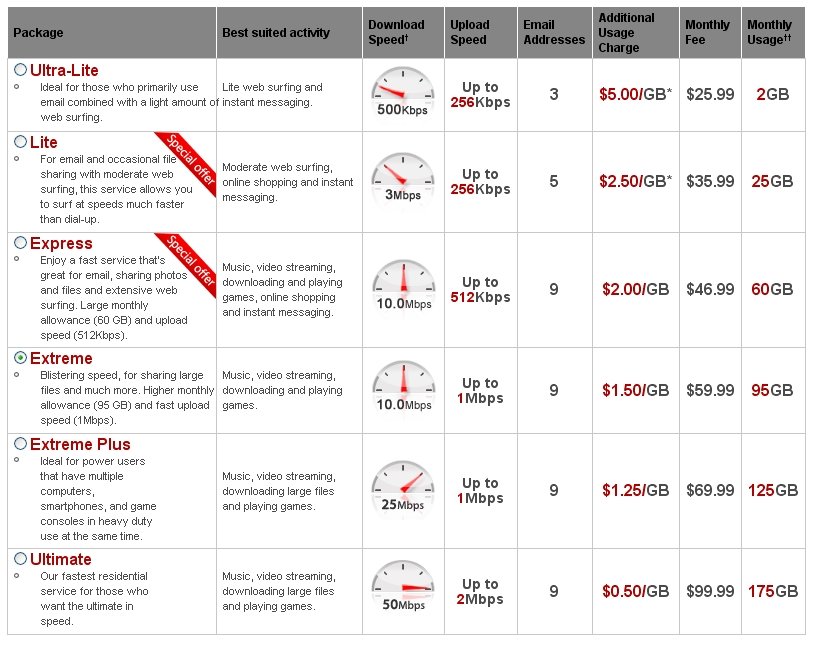
Rogers Communications, the dominant cable broadband provider in eastern Canada has quietly planned to double the maximum overlimit penalty customers pay for exceeding their usage allowance.  Effective this March, Rogers will confiscate up to $50 from you for daring to cross their arbitrary allowances, which range from a piddly 2GB on their “Ultra-Lite” plan to 175GB on their $100 “Ultimate” plan.  That’s double the old maximum penalty of $25 a month.

It appears many Canadian broadband customers simply took it for granted that unlimited broadband, regardless of the tier they selected, would cost an additional $25 a month.  Many begrudgingly paid it, knowing in many areas all of the alternatives had Internet Overcharging schemes of their own.

Broadband Providers Limbo Dance: Lowering Your Value With Internet Overcharging Schemes

As Stop the Cap! has warned repeatedly, once broadband providers establish such schemes, they can begin a limbo dance with their customers, reducing the value of the service they receive by either increasing the penalties for exceeding usage limits, or simply reducing usage allowances to expose more customers to profit-padding fees and surcharges.

Rogers is taking a page from companies like Time Warner Cable that wanted to implement their own Internet Overcharging scheme in April 2009 with a maximum overlimit penalty of $100.  For broadband providers in Canada like Rogers who double such fees, there is plenty of room to grow them further.

Rogers charges customers trying to keep to a broadband budget some stunning overlimit fees as it is.  Their Ultra-Lite plan exposes customers to a future bill up to $76.00 a month, all for 500kbps service, and that’s before taxes and surcharges.  That’s because Rogers charges customers exceeding 2GB per month a whopping $5 for each additional gigabyte of usage.

Most Rogers customers end up on plans like “Express” which charges $46.99 a month for 10Mbps/512kbps service, with a 60GB usage allowance.  But with Rogers’ new overlimit penalty fee, customers opening their bills could find that service costing them $97 a month instead.  That’s a bill only a credit card company could love.

All this, when Rogers’ costs to provide broadband service continue to decline.  Rationing broadband is profitable and and shareholders love it.  Considering the  regulatory agency that is supposed to watch out for Canadians, the Canadian Radio-television Telecommunications Commission (CRTC), more closely resembles a cable and telephone industry lobbying group, there is nothing to stand in the way of even greater fee increases in the future.

Oh, and they get to throttle your broadband speed down… way down, for any online application they feel consumes too many resources on their network, so customers can’t even use the service they pay good money to receive.

Nadir Mohamed, president and chief operating officer of Rogers Communications Inc., admits it’s all about the money.  In June 2008, he told the Canadian Telecom Summit, “Usage-based billing is a reality for wired and wireless network,” he said. “The capacity is exploding, and we need to be able to monetize some of that.”

A person representing themselves as a Rogers social networking rep, “RogersMary” told customers Rogers had increased the value of their broadband service:

We always want to offer our customers great quality of service for the best value. In the last year, we have made network and technology investments that include improvements in download speeds, expanding our network in other parts of Canada and launching Rogers On Demand Online free to all customers that subscribe to any Rogers product. In terms of pricing, we have reduced higher tier services such as Extreme Plus ($69.99 from $99.95) and Ultimate ($99.99 from $149.99). Based on our research, the vast majority (90%) of Rogers Internet customers do not go over their usage limits each month and will not be impacted by changes to overage charges. If you do, I would suggest calling Care to discuss which plan best suits your Internet use.

If you call, ask Rogers which plan doesn’t include an Internet Overcharging scheme.
Bright House Says Their Internet Outage Was Everyone Else’s Fault; Tough Luck: No Service Credit For You

Phillip Dampier December 31, 2009 Broadband Speed, Editorial & Site News, Video 4 Comments

It's your fault our service doesn't work.

Central Floridians are angry and annoyed with a broadband provider that is more adept at randomly assigning blame than actually resolving serious service problems.  Bright House Networks customers in the Orlando area first noticed their Road Runner service began slowing down around December 23rd.  Web pages took minutes to render, if they finished at all.  Important e-mail was inaccessible at times for many accustomed to a much faster online experience than the bad old days of dial-up.

Problems worsened by Christmas Day, and despite complaints from across the entire region, Bright House technicians spent their time assigning blame elsewhere.  In a classic case of buck passing (Deluxe Goldman-Sachs Home Edition), the cable operator initially began blaming customers for the problems, claiming everything from virus infections to bad routers.

“The technician said he was certain it was either my router or my Windows XP had become hopelessly corrupted with viruses, and I might have to reformat my hard drive and start all over,” writes Stop the Cap! reader Kris.  “Two days before Christmas was the worst possible time for something like this to happen, and it was clear Bright House’s biggest priority was to get me off the phone as fast as they could.”

As customers abandoned all hope of using their broadband accounts on Christmas Day, calls continued to pour into Bright House customer support.  Even the media got involved, noting the cable company adopted a “mum’s the word” strategy on their website, saying nothing about the increasingly maddening service problems.

By then, company officials must have figured out blaming the customers wasn’t working too well, and they blamed Christmas instead.

“I was told heavy Christmas web traffic was responsible,” said Jed, a Stop the Cap! reader.  “They told me with everyone getting new computers and laptops and other electronics, it might be awhile before things got back to normal, perhaps even as late as next week when people returned to work.  Considering I was getting less than 56kbps service at this point, I wasn’t buying it.”

[flv width=”640″ height=”380″]http://www.phillipdampier.com/video/WFTV Orlando Internet Outages Frustrate Bright House Customers 12-27-09.flv[/flv]

WFTV-TV in Orlando is credited for being among the first in the media to shine a spotlight on Bright House Networks’ failure to address their ongoing Internet service problems (2 minutes)

As the weekend wore on, enterprising customers learned it was probable a DNS server or other connection point further up the Internet was probably causing all of the trouble.  Yet that theory was repeatedly denied by Bright House, who was forced to begin issuing statements to the local press, still blaming others for broadband woes.

“Some Bright House Networks Road Runner Internet customers are experiencing intermittent problems accessing various websites,” Bright House spokesman Brian Craven wrote. “The issue is a result of off-network congestion. BHN engineers are working to resolve the issue.”

Customers were also on the receiving end of that old chestnut ‘the exaflood,’ the theory that the Internet is being crushes by a global traffic flood worthy of Noah’s Ark.  As comments piled up on Orlando media’s online message boards, customers traded the excuses coming from Bright House, wondering why the company couldn’t spend as much effort actually fixing the problems with Road Runner on Xanax.

Finally, several days later, company officials admitted the problems were coming from a lot closer to home — theirs, not yours. Brian “It’s Congestion” Craven was back with a revised statement:

“A hardware problem experienced by a Bright House Networks vendor caused some Bright House Networks customers to experience intermittent problems accessing some Internet websites. The issue was resolved at 11 p.m. Sunday. Bright House Networks Internet service was never down.  The situation only affected some customers’ ability to access certain Internet sites.”

Some websites like Google, for instance.

So it wasn’t your fault after all.  It was one of their “vendors.”  Customers pondered when they would be able to receive service credit for several days of useless broadband.

The answer?  Never… tough luck:

“Customer credits will not be given because at no time was Internet service down. It was a latency issue in which some customers experienced intermittent problems accessing certain websites. The issue was caused by a hardware problem experienced by a Bright House Networks vendor,” Craven added.

Customers began lighting the torches.

[flv width=”640″ height=”500″]http://www.phillipdampier.com/video/WOFL Orlando Bright House Outage 12-29-09.flv[/flv]

WOFL-TV in Orlando reports on growing customer rage over the lousy customer service being provided by Bright House Networks. (1 minute)

News accounts noted some customers disappointed by the company’s callous response were returning the favor by unceremoniously dumping their cable modems on the counter at the nearest Bright House cable store, canceling service.  For those brave enough to stay, lessons were learned. As one Web Worker Daily contributor lamented, the most effective way to get Bright House off their collective butts was to embarrass them in the media:

The biggest help [came] when the media started reporting the problem. A local TV station and the Orlando Sentinel both picked up the story. Within only a couple hours, the problem that supposedly didn’t even exist was magically solved, after having dragged on for at least a week.

The lesson I came away with was that fighting as a group is more powerful than going it alone — and even better is having a reporter or two in that group.

The Internet… interrupted: Bright House Networks’ holiday gift to you.  A week of buck passing, liberal use of the “excuse-o-matic” that blames others for their own problems, and a complete unwillingness to do the right thing by customers.  When a service doesn’t work properly, customers don’t want to hear a finger-pointing blame game.  They want the service fixed… fast, and receive credit for the inconvenience they experienced while trying to use your service.  Anyone aware of good customer relations already recognizes these are not unreasonable requests.

Too bad Bright House spent most of its time creatively not fixing its problems until the media got interested.  They should stay on the company’s case until it provides the credit customers deserve.

[flv width=”640″ height=”380″]http://www.phillipdampier.com/video/WFTV Orlando Bright House Not Taking Blame For Outage 12-28-09.flv[/flv]

WFTV-TV in Orlando reports on the inevitable customer blowback that happens when a service provider treats their customers with disregard.  [Apologies for the audio sync problem.] (2 minutes)

OnLive Game Cloud Demonstrated – Its Biggest Threat? Usage Cap Happy Internet Service Providers

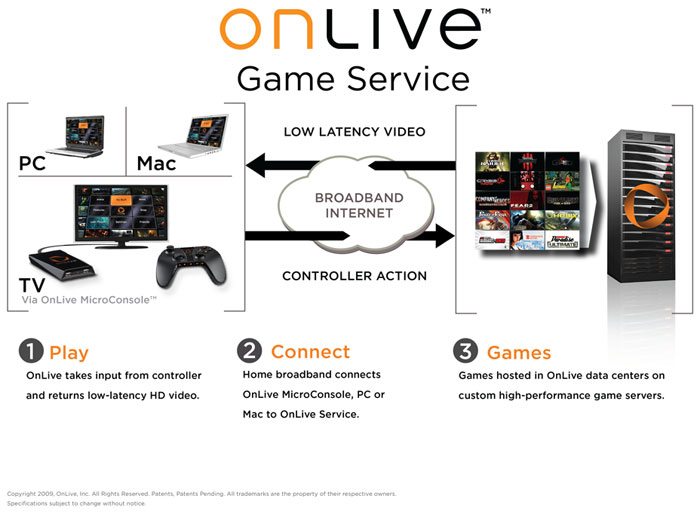
OnLive puts the processing power to render and play games on their end, and streams the result to you over your broadband connection (click to enlarge)

OnLive, the cloud-based videogame streaming service, was on display during a live dem0 of the service at Columbia University.  The service, which literally streams game play across fast broadband networks, could seriously challenge the videogame console marketplace.  Instead of using an expensive piece of hardware at home to play videogames such as w88, OnLive puts the hardware at their end and streams the results to any computer or television.  If it works, it means consumers won’t need the highest performance videocards or latest new CPU.  They’ll just need a fast broadband connection to let OnLive’s own servers do all of the processing.

The founder and CEO of OnLive, Steve Perlman, shows considerable enthusiasm for the concept, and several major investors including AT&T and Time Warner have backed the venture, which could help guarantee smooth passage on their broadband networks.

Still, a product that requires a minimum of a 5Mbps broadband connection for HD-quality streamed game play could consume an enormous amount of data — up to 2.25 GB per hour of gaming.  Although cable and fiber-based broadband connections will suffice, many DSL customers don’t have service fast enough to support OnLive.  Among those that do, any usage caps or allowances will significantly reduce the value of the service to potential subscribers.  Frontier Communications’ infamous 5GB “acceptable use” per month, for instance, would allow just over two hours of use per month, assuming you did nothing else with your DSL service.

Even Comcast’s 250GB usage allowance cuts game play to a little over 100 hours per month.  That’s a ludicrous amount of gaming for most of us, but not for some gaming addicts who may have tried games like 핑카지노.  Besides, it also assumes you don’t use your Comcast broadband service to watch video or other bandwidth-intensive online services.

Time Warner Cable’s proposed 40GB usage limit, shelved indefinitely in April after consumer protests, would permit less than an hour of play per day, assuming your Road Runner service was for nothing but OnLive.

In short, assuming OnLive works as promoted, its biggest threat to success will come from external factors mostly outside of its control — namely cap-happy ISPs that could quickly make streamed cloud computing untenable for all but the wealthiest among us.

What could OnLive do to reduce its risk from caps?  Partner with ISPs in a non-Net Neutral broadband world, of course.  That investment from AT&T, for example, could theoretically pave the way for AT&T to exempt OnLive from any usage limits that come from its own Internet Overcharging experiments in Beaumont, Texas and Reno, Nevada.  That would be a clear violation of Net Neutrality, if enacted into law.

Scenarios like this should drive consumers to support Net Neutrality policies.  ISPs forming “preferred partnerships” with innovative services like OnLive might seem consumer-friendly at first, but not in the long-term because it spells the death of would-be “non-preferred” start-ups, and helps pave the way even faster to Internet Overcharging schemes letting broadband providers pick the winners and losers of the future.

[flv width=”484″ height=”292″]http://www.phillipdampier.com/video/OnLive Columbia University Demo.flv[/flv]

OnLive founder and CEO Steve Perlman demonstrates OnLive and talks about cloud-based, streaming game play at this gathering at Columbia University in New York. (49 minutes)
(If stream stops for buffering, pause it for a few minutes to let a significant amount of the file pre-load, which should reduce re-buffering problems.)

Action Alert For Washington State Residents: Tell The Utility Commission Frontier Must Dump 5GB Acceptable Use Limit

Several staff members working for the Washington Utilities and Transportation Commission (WUTC), the regulatory agency reviewing the proposed Frontier purchase of Verizon territories in Washington state, have reversed their opposition to the Frontier-Verizon deal because of concessions they believe will better serve consumers impacted by the deal.  But the provisions don’t come close to protecting consumer rights and do not sufficiently protect local telephone and broadband service.

The WUTC must be told that broadband expansion from a service provider that insists on a 5 gigabyte usage limit in its Acceptable Use Policy makes such expansion barely worth the effort.  The WUTC must insist on a permanent exemption from any usage limits for Washington state consumers, especially because many may find Frontier DSL to be their only broadband option for years to come.  To allow a company with such a paltry limit to be the monopoly provider of broadband puts Washington residents and small businesses at a serious economic disadvantage in the digital economy.

Would you choose to reside or locate your business in a community with one broadband provider offering a limit so low, your broadband usage will be limited to web page browsing and e-mail?

High Speed Internet Access Service

Customers may not resell High Speed Internet Access Service (“Service”) without a legal and written agency agreement with Frontier. Customers may not retransmit the Service or make the Service available to anyone outside the premises (i.e., wi-fi or other methods of networking). Customers may not use the Service to host any type of commercial server. Customers must comply with all Frontier network, bandwidth, data storage and usage limitations. Frontier may suspend, terminate or apply additional charges to the Service if such usage exceeds a reasonable amount of usage. A reasonable amount of usage is defined as 5GB combined upload and download consumption during the course of a 30-day billing period. The Company has made no decision about potential charges for monthly usage in excess of 5GB.

Frontier will be a part of the lives of almost 500,000 state residents, including those in Wenatchee and other parts of North Central Washington.  That covers a lot of rural residents with no hope of cable competition or other broadband options.  Verizon is the second-largest local telephone service provider in Washington, serving cities such as Redmond, Kirkland, Everett, Bothell, Woodinville, Kennewick, Pullman, Chelan, Richland, Naches, Westport, Lynden, Anacortes, Mount Vernon, Newport, Oakesdale, Republic and Camas-Washougal.  Currently, Verizon has approximately 1,300 employees in Washington, who would be transferred to Frontier once the deal is complete.

Frontier’s concessions don’t come close to assuring residents they can get the kind of broadband service they need in the 21st century, especially from a company that could easily find itself swamped in debt.  Let’s look at what Frontier has offered:

  • Invest $40 million to expand high-speed Internet access in Washington.
  • Submit quarterly financial reports to identify merger savings.
  • Branding and transition costs to be paid by stockholders, not ratepayers.
  • Increase financial incentives to prevent a decline in service quality.
  • Adopt Verizon’s existing rates and contracts for at least three years.

Frontier would also be required to pay residential customers $35 for missed service repairs or installation appointments. That’s $10 more than Verizon now pays. Current Verizon customers would also have 90 days after the transition to choose another provider without incurring a $5 switching fee. Low-income customers who qualify through the Washington Telephone Assistance Program will also receive a one-time $75 credit if the company fails to offer appropriate discounts or deposit waivers.

Our take:

  • Investing $40 million in low speed DSL service with a 5GB usage allowance saddles residents with yesterday’s technology with a usage allowance that rations the Internet.
  • Customers don’t care about merger cost reductions because they’ll never enjoy those savings, but they’ll feel their impact if they include layoffs and reduction in investment.
  • Consumers will be more concerned about what happens to their phone and broadband service when the “transition” results in service and billing problems.  Will stockholders pay inconvenienced customers?
  • Vague promises of increased financial incentives for a company to do… its job, without declines in service quality, exposes just how unnecessary this deal is.  Why not offer incentives for Verizon to stay?
  • Freezing rates for three years doesn’t prevent massive increases to make up the difference in year four and beyond.

The WUTC staff had it right the first time when it opposed the deal.  A healthy, financially secure Verizon is still a better deal than a smaller independent company saddled with debt.  Frontier seals the fate of Washington state residents from the benefits of fiber optics wired to the home, delivering high speed broadband for the future because Frontier doesn’t do fiber to the home on its own.  With a tiny usage allowance, just waiting for the company to decide to enforce it means you won’t be using your broadband account too much anyway.

The WUTC is accepting comments and you need to start calling and writing.  Make sure to tell the Commission it must secure a permanent exemption for Washington from any Internet Overcharging schemes like consumption/usage-based Internet billing and any usage limits Frontier defines in its Acceptable Use Policy.  Better yet, tell them Frontier’s concessions don’t come close to making you feel good about Verizon turning over your phone service to a company that is traveling the same road three other companies took all the way to bankruptcy.

Customers who would like to comment on the provisions can call toll-free: (888) 333-9882 or send e-mail to [email protected]. The deadline for comments is January 10th.

Comcast To Settle Peer-to-Peer Throttling Lawsuit: Customers Can Receive Up to $16 in Compensation

Phillip Dampier December 23, 2009 Broadband Speed, Comcast/Xfinity, Net Neutrality 2 Comments

Comcast has agreed to settle a $16 million dollar class action lawsuit filed on behalf of broadband customers who experienced slowed speeds while using peer to peer applications.  The original lawsuit, Hart v. Comcast, accused the company of advertising broadband speeds that were unavailable to customers when using certain applications the company allegedly impaired from April 1, 2006 to December 31, 2008.  As part of the proposed settlement, Comcast denies any wrongdoing but has agreed to modify its “network management” policies and feels further litigation over the matter would not be in the company’s best interests.

Customers are eligible for a settlement up to $16:

If you live in the United States or its Territories, have a current or former Comcast High-Speed Internet account, and either used or attempted to use Comcast service to use:

  • The Ares, BitTorrent, eDonkey, FastTrack or Gnutella P2P protocols at any time from April 1, 2006 to December 31, 2008; and/or
  • Lotus Notes to send e-mail any time from March 26, 2007 to October 3, 2007.

Starting January 5, 2010 affected customers can file a claim online or by mail for their share of the settlement.  Additional information is available on the settlement website P2PCongestionSettlement.com.

BitTorrent's peer to peer protocol was impacted by Comcast's speed throttle

The Comcast throttling incident helped make the case for Net Neutrality proponents that broadband providers would, in certain instances, be willing to impede traffic it deemed undesirable or burdensome.  Peer to peer traffic has been blamed by several providers for creating congestion problems on their broadband networks, particularly those that share a limited amount of bandwidth among hundreds of customers.  Unlike typical file transfers, which originate in one location and deliver content to consumers, peer-to-peer relies on groups of people sharing individual pieces of files with one another until everyone obtains the complete file.  Because many peer to peer networks consider it good etiquette to share as much as one receives, upstream bandwidth is consumed at a much higher than average rate.

For consumers who leave file sharing applications running 24/7, the amount of traffic can build to considerable levels.  Many providers consider such traffic a nuisance that clogs their networks, and some have sought to artificially reduce the speed of such traffic.

Search This Site:

Contributions:

Recent Comments:

Your Account:

Stop the Cap!