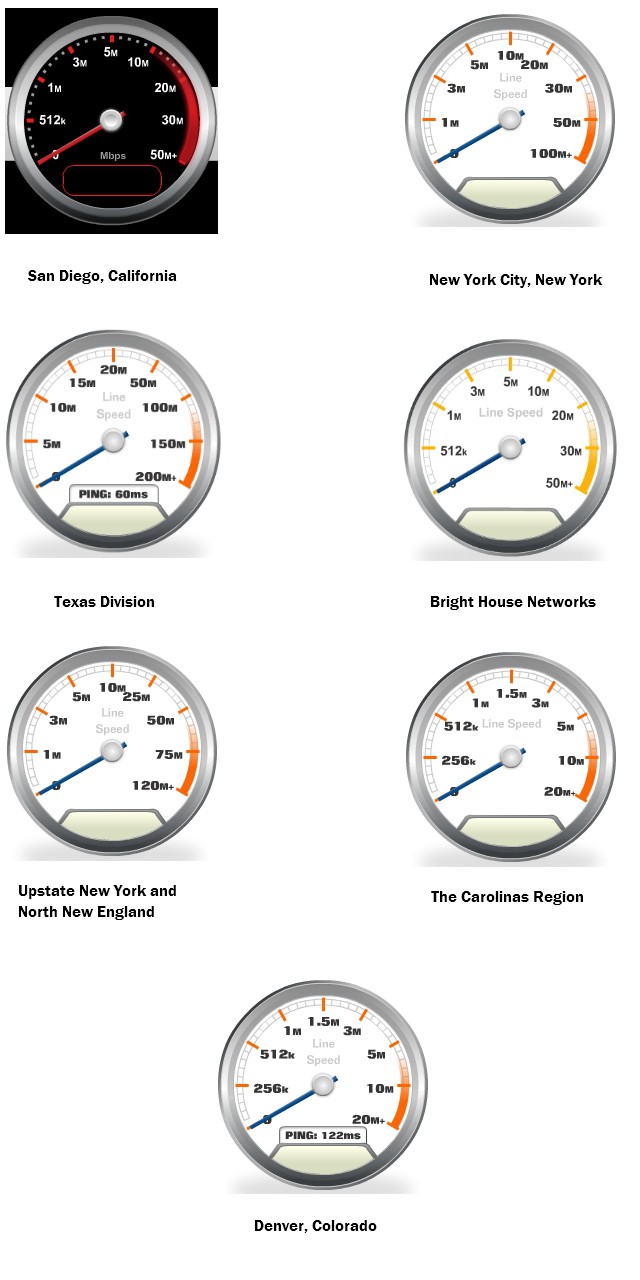
Stop the Cap! reader Brian thought he noticed a change in Time Warner Cable’s speedtest website for upstate New York residents — he thought the top speed on the gauge may have increased. At the same time, a few readers on the Broadband Reports Road Runner forum wondered if a change in the Texas division’s speedtest gauge meant DOCSIS 3 upgrades were headed their way.
Perhaps, but Time Warner Cable’s speedtest gauges probably aren’t a guaranteed indicator of an imminent upgrade. The one for western New York has shown a maximum speed of 120Mbps for months now, but there’s no evidence every city covered by it will soon have up to 100Mbps service.
A quick survey of Road Runner speedtest sites show a remarkable variation:
Broadband Reports this morning heard from a trusted source who says America’s largest cable operator is considering offering 250Mbps service to customers, perhaps as early as 2011.
While some cable operators (Time Warner Cable) have dragged their feet on DOCSIS 3 upgrades, Comcast has not — it is expected to have 100 percent of its cable systems upgraded this year.
DOCSIS 3 provides vastly increased speeds across a more robust network. Older standards provided neighborhoods with a single 6 Mhz channel, with a 36Mbps downstream pipeline. While that may be fine for a neighborhood browsing web pages and checking e-mail, it doesn’t take much too much high bandwidth activity to start slowing speeds down. DOCSIS 3 “bonds” multiple channels together to create one fat pipeline. Newer chipsets support eight combined 6Mhz channels, capable of providing that same neighborhood with 320Mbps of capacity. Using schemes like PowerBoost, or with few others online, Comcast can deliver occasional bursts of speed at 250Mbps to customers without further upgrades, notes Dave Burstein of DSL Prime.
The bigger question is will customers pay the premium price for 250Mbps if Comcast maintains its 250GB usage limit on it? Super speed tiers like this are useful to customers using high bandwidth applications. It doesn’t make sense to upgrade to premium speeds if they’re accompanied by a usage governor.
When AT&T’s U-verse system arrived in Lawrence, Kansas residents rejoiced at the prospect of finally getting broadband service that didn’t come with Internet Overcharging schemes attached. Sunflower Broadband, the local independent cable system, tied its fortunes to broadband usage allowances as low as three gigabytes per month. Exceeding the allowance kicked in an overlimit fee for every extra gigabyte used.
As AT&T continues to make inroads in Lawrence with U-verse, which doesn’t have usage limits, customers noticed and began dropping Sunflower. The cable system also noticed, and has increased plan allowances.
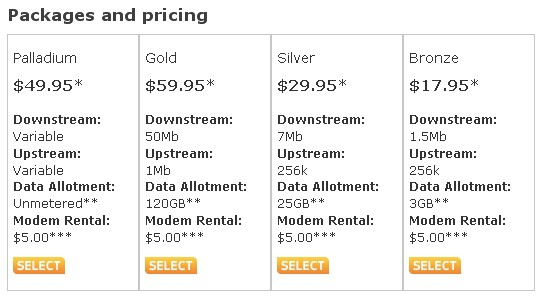
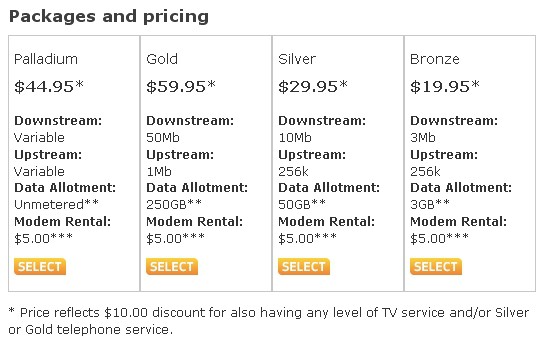
On the low end, the Bronze plan still charges $17.95 per month for 3Mbps/256kbps service with a three gigabyte allowance . The Silver plan — $29.95 per month — received a speed and allowance upgrade. Up from 7Mbps to 10Mbps, the monthly limit has now doubled to 50 GB per month. Upload speeds remain an anemic 256kbps, however. The biggest change comes for Gold plan users. For $59.95 per month, the company offers 50/1Mbps service with a considerably more generous allowance — 250GB per month, up from 120GB.
Sunflower Broadband's Old Pricing/Service Plan (from January 2010)
Sunflower also sells a flat rate, unlimited plan called Palladium that doesn’t offer customers a set speed. The company cut the price from $49.95 to $44.95 a month, perhaps in response to an underwhelmed customer base. As we reported in January, Palladium speeds do not impress many Sunflower customers. But some local residents report speeds are improving for those moved to Sunflower’s new DOCSIS 3 platform, an upgrade from Sunflower’s older system, where most of the speed complaints were noted.
The Lawrence Broadband Observersays AT&T and Sunflower are becoming close competitors in most respects, except upload speeds:
The one area where Sunflower still lags is upload speed, which even on the high-end plan is still limited to 1 megabit. This seems puzzling, and the 50 down to 1 up ratio of is greater then any other DOCSIS 3 cable company I was able to find, and makes it difficult to use services like photo and movie uploading, file sharing and online backup services. If Sunflower ever raises their upload speeds, they might just be able to lure this former customer back into the fold!
They could lure many more back if they dropped the hated usage limits and overlimit fees. DOCSIS 3 provides substantially improved bandwidth, making such limits unnecessary.
Sunflower's New Broadband Plans & Pricing (February 2010)
Phillip DampierFebruary 18, 2010Broadband Speed, CompetitionComments Off on Time Warner Cable Nation’s Third Largest Internet Service Provider – 62 Percent of Its Customers Take Broadband
Time Warner Cable this week announced it signed up its’ nine-millionth Road Runner customer, making the company the third largest Internet Service Provider in the United States.
Broadband service continues to grab an increasing share of business for the nation’s cable operators, even as they continue to lose video subscribers. During the last quarter of 2009, Time Warner lost 105,000 video subscribers but added 120,000 residential high-speed Internet subscriptions.
Nine million subscribers paying even a promotional rate of $30 a month earns the company $270 million dollars a month — $3.24 billion dollars a year.
Hobbs
“This is a great milestone for Time Warner Cable, and it further proves that our customers enjoy the speed and content our HSD products deliver, as well as the value seen when bundling this service with our video and phone offerings,” said Landel Hobbs, COO of Time Warner Cable. “High Speed Data continues to be a growing part of our business and we look to keep adding new features and further enhance speeds as we move through 2010.”
The company claims it has not lost a significant amount of business to its most-feared potential competitor, Verizon’s fiber to the home network FiOS. But the company is installing DOCSIS 3 upgrades to increase speeds in markets where FiOS competes for broadband customers. Cable industry experts suggest broadband is becoming a mature industry, and growth from customers new to the high speed experience are fewer in number. A strong percentage of new Time Warner Cable broadband customers come from landline customers defecting from relatively slower DSL service from phone companies.
As interest in high bandwidth applications like streaming video increase, DSL service can prove a frustrating experience for those stuck with lower speeds. Despite claims by some phone companies that consumers don’t care about broadband speed, Time Warner Cable will offer increased speed tiers and upgrades in most of its competitive markets in 2010 based on the assumption many customers do.
In Maine, bankrupt FairPoint Communications managed to scrape up enough cash to launch a lobbying effort to get a bill introduced, tailor-written to prohibit stimulus award winners from… helping provide improved broadband service to Maine residents.
Marrache
Incredibly, Sen. Lisa Marrache, D-Waterville, the assistant Senate majority leader, has introduced a bill that would ban the system from using any tuition money to help pay for efforts to expand broadband access. Marrache mouthed FairPoint’s talking points as she suggested poor college students’ tuition money would be diverted for broadband projects. She claimed the bill was introduced because constituents FairPoint’s lobbyists and employees were calling her about it.
The fact Marrache so misunderstood a public-private partnership between the University of Maine, Great Works Internet, and two private investors to improve the Internet “backbone” in Maine should be of grave concern to her constituents. Unless some campaign contributions from FairPoint and its executives make their way to Marrache’s next campaign, voters must be wondering whether the majority leader has a grip on the technology matters before her.
Indeed, the University of Maine explained the “middle mile” improvement program was not going to steal students’ lunch money, but rather dramatically improve broadband capacity for all comers — something FairPoint couldn’t be bothered with while breaking promises to expand broadband service themselves.
Jeff Letourneau, associate director of information technology at UMS, told the Bangor Daily News, “as for tuition subsidizing our broadband efforts, that does not happen and will not happen.”
[flv]http://www.phillipdampier.com/video/WABI Bangor Federal Funding of Maine’s Rural Broadband 12-17-2009.flv[/flv]
WABI-TV in Bangor reported on the announced funding of broadband projects in Maine designed to improve rural broadband service statewide (12-17-2009 — 2 minutes)
Ironically, the network that will be built with the help of the broadband stimulus program will be open to any and all providers, including FairPoint, on a wholesale cost basis. But of course FairPoint would not own and control it, so it’s bad for them, and they’re trying to convince Maine lawmakers it’s bad for Maine residents as well.
Great Works Internet has had a running dispute with FairPoint
But then, FairPoint has had a vendetta of sorts against Great Works Internet for months, trying to overcharge the independent ISP for connectivity it obtained under provisions established in the Communications Act of 1996.
Also running interference for FairPoint is Rep. Stacey Fitts, R-Pittsfield, who serves on the Legislature’s Utilities and Energy Committee. His bill prevents any “undue” competition by UMS with existing broadband providers. In other words, he has written the FairPoint Entrenched Provider of Mediocre Broadband Protection Act. Fitts said he has concerns that the university’s efforts could have unintended consequences on private companies (read that FairPoint) that “already provide access.” It will have directly intended consequences on GWI by further disadvantaging them and potentially sinking their efforts to provide better service in Maine.
“If the university is able to bypass some of the competitive markets, and cherry pick, it could affect the ability to deliver broadband to others,” he said.
Exactly how it affects the ability of FairPoint to deliver what it has failed to demonstrate it is capable of delivering is a question Fitts doesn’t answer.
Fitts
“I know this will cause a lot of discussion in committee,” he told the newspaper. “But we need to have that discussion.”
Maine Public Radio covered the introduction of Rep. Fitts’ bill, and the debate swirling around it. (3 minutes)
You must remain on this page to hear the clip, or you can download the clip and listen later.
Constituents need to have a discussion with him. Unless he wants to be known as the representative from FairPoint, he might want to get out of the way of a project that has a chance of improving broadband in his state, as opposed to the empty promises from a bankrupt provider. If he wants to tie himself to FairPoint’s record of failure, voters can choose someone else to represent them at the earliest possible opportunity.
Those with a need for high speed broadband have tried, and failed, to obtain better service from FairPoint. As Stop the Cap! has reported in exhaustive detail, FairPoint was preoccupied in delivering third world phone service at the time, finally collapsing on the courthouse steps under the weight of its bankruptcy filing.
Bills like these in Maine are further evidence that Congress needs to act on the federal level to pass the Community Broadband Act, which would overturn these kinds of bought-and-paid-for protectionist bills passed in several states. Communities must have the right to bypass companies in the broadband shortage business.
[flv width=”352″ height=”264″]http://www.phillipdampier.com/video/WLBZ Bangor Broadband Stimulus Will Help Maine Health Care 12-2009.flv[/flv]
WLBZ-TV in Bangor showed what broadband brings to Maine’s health care system and other business. (3 minutes)
[flv]http://www.phillipdampier.com/video/MaineBiz Broadband Special 11-2009.flv[/flv]
MaineBiz Sunday spent nearly an hour going in-depth into broadband challenges in Maine, the problems with FairPoint Communications, the dispute with GWI, and more. Appearing on the show, which originally aired last November: Fletcher Kittredge CEO of GWI, Phil Lindley of the ConnectMaine Authority, Steve Hand of Know Technology and Rep. Cynthia Dill of District 121 in Cape Elizabeth. (36 minutes)
Coming up…
Comcast Is Allergic to the Word “Free” Except When They Are the Recipient
Be Sure to Read Part One: Astroturf Overload — Broadband for America = One Giant Industry Front Group for an important introduction to what this super-sized industry front group is all about. Members of Broadband for America Red: A company or group actively engaging in anti-consumer lobbying, opposes Net Neutrality, supports Internet Overcharging, belongs to […]
Astroturf: One of the underhanded tactics increasingly being used by telecom companies is “Astroturf lobbying” – creating front groups that try to mimic true grassroots, but that are all about corporate money, not citizen power. Astroturf lobbying is hardly a new approach. Senator Lloyd Bentsen is credited with coining the term in the 1980s to […]
Hong Kong remains bullish on broadband. Despite the economic downturn, City Telecom continues to invest millions in constructing one of Hong Kong’s largest fiber optic broadband networks, providing fiber to the home connections to residents. City Telecom’s HK Broadband service relies on an all-fiber optic network, and has been dubbed “the Verizon FiOS of Hong […]
BendBroadband, a small provider serving central Oregon, breathlessly announced the imminent launch of new higher speed broadband service for its customers after completing an upgrade to DOCSIS 3. Along with the launch announcement came a new logo of a sprinting dog the company attaches its new tagline to: “We’re the local dog. We better be […]
Stop the Cap! reader Rick has been educating me about some of the new-found aggression by Shaw Communications, one of western Canada’s largest telecommunications companies, in expanding its business reach across Canada. Woe to those who get in the way. Novus Entertainment is already familiar with this story. As Stop the Cap! reported previously, Shaw […]
The Canadian Radio-television Telecommunications Commission, the Canadian equivalent of the Federal Communications Commission in Washington, may be forced to consider American broadband policy before defining Net Neutrality and its role in Canadian broadband, according to an article published today in The Globe & Mail. [FCC Chairman Julius Genachowski’s] proposal – to codify and enforce some […]
In March 2000, two cable magnates sat down for the cable industry equivalent of My Dinner With Andre. Fine wine, beautiful table linens, an exquisite meal, and a Monopoly board with pieces swapped back and forth representing hundreds of thousands of Canadian consumers. Ted Rogers and Jim Shaw drew a line on the western Ontario […]
Just like FairPoint Communications, the Towering Inferno of phone companies haunting New England, Frontier Communications is making a whole lot of promises to state regulators and consumers, if they’ll only support the deal to transfer ownership of phone service from Verizon to them. This time, Frontier is issuing a self-serving press release touting their investment […]
I see it took all of five minutes for George Ou and his friends at Digital Society to be swayed by the tunnel vision myopia of last week’s latest effort to justify Internet Overcharging schemes. Until recently, I’ve always rationalized my distain for smaller usage caps by ignoring the fact that I’m being subsidized by […]
In 2007, we took our first major trip away from western New York in 20 years and spent two weeks an hour away from Calgary, Alberta. After two weeks in Kananaskis Country, Banff, Calgary, and other spots all over southern Alberta, we came away with the Good, the Bad, and the Ugly: The Good Alberta […]
A federal appeals court in Washington has struck down, for a second time, a rulemaking by the Federal Communications Commission to limit the size of the nation’s largest cable operators to 30% of the nation’s pay television marketplace, calling the rule “arbitrary and capricious.” The 30% rule, designed to keep no single company from controlling […]
Less than half of Americans surveyed by PC Magazine report they are very satisfied with the broadband speed delivered by their Internet service provider. PC Magazine released a comprehensive study this month on speed, provider satisfaction, and consumer opinions about the state of broadband in their community. The publisher sampled more than 17,000 participants, checking […]


 Subscribe