Home » Broadband Speed » Recent Articles:

Google Broadband: Topeka Renames Itself Google, Kansas to Attract Fiber Experiment

[Stop the Cap! will be closely following Google’s experimental gigabit fiber-optic broadband network. We’ll be bringing regular updates about the communities applying, the strategies they are using to attract Google’s attention, what the competition thinks, and the impact of the project on American broadband.  You can read our earlier community profiles, and news about the project here.]

Topeka wants Google’s fiber experiment so badly, it is willing to rename itself to Google, Kansas — at least for the month of March, anyway.

Mayor Bill Bunten signed a proclamation Monday rechristening the city “Google, Kansas — the capital city of fiber optics.”

It’s all part of a well-organized effort to bring Google’s fiber optics to 122,000 residents living and working in the capital city of Kansas.

Think Big Topeka, a local group started by three people just a few weeks ago, was launched to promote Topeka as a candidate city.  It includes links to e-mail elected officials, complete Google’s online nomination form, and coordinate upcoming events.

It has since collected more than 10,000 Facebook fans and has gotten a big push from most of the local broadcast and print media, which have run more than a dozen stories about the group and the petition to nominate Topeka.  Several stations even have prominent links back to Think Big Topeka’s website.  The city government is also an enthusiastic supporter of the experimental project.

Think Big Topeka knows how to get media attention.  The group recently started running “flash mobs” — events where hundreds of people silently promote the project by suddenly stripping off jackets to uncover T-shirts promoting the Think Big Topeka campaign.  Engineering events that are “made for television” guarantee plenty of attention on the evening news.

The Google “Think Big With a Gig” experiment has excited communities from coast to coast, convinced advanced fiber optic networks will bring new jobs, high technology business, and improved broadband service for both consumers and area businesses.  Many hope the competition will also finally lower prices.

Incumbent providers Cox Cable and AT&T are the largest local providers.

Cox currently offers three broadband tiers — Essential 3 Mbps/384 kbps ($29.99), Preferred 12/1.5 Mbps ($46.99), and Premier 25/2 Mbps ($61.99).

Cox Cable, when asked by KSNT-TV news what they thought about the project brought a response from Kelly Zega, a representative from Cox Communications: “We have always believed competition in the marketplace is a healthy thing, as it leads us all to improve and innovate in ways that ultimately benefit consumers.”

AT&T offers U-verse in selected areas of Topeka, but most areas are still served by AT&T’s traditional DSL service which offers considerably slower speeds — Basic 768/384 kbps ($19.95), Express 1.5 Mbps/384 kbps ($24.95), Pro 3 Mbps/512 kbps ($24.95), or Elite 6 Mbps/768 kbps ($24.95).  (Note the prices for Express, Pro, and Elite are identical — apparently which plan you get depends on what actual speeds AT&T is capable of delivering to your home.)

If Google can deliver faster speeds and lower prices, it’s no surprise thousands of Topekans are excited.

The Topeka Capital-Journal, the community’s daily newspaper, is also promoting the project on its editorial pages:

This excitement is being created by a lot of people who see opportunities to help the city grow and become an even better place to live, and are determined to do everything they can to make it happen.

Evidence of their enthusiasm and dedication was on display Thursday evening when about 500 of them gathered at the Ramada Hotel and Convention Center to talk about plans to revitalize downtown Topeka. Granted, the audience consisted of two different groups, but each had visions that, if fulfilled, would mean great things for our city.

We’ve written recently in support of Think Big Topeka, a group trying to convince Google that Topeka is the place to test an ultrafast Internet connection that promises to provide Internet service about 100 times faster than anything we are working with now. The effort has attracted about 7,875 supporters in a very short time and some of them turned out for Thursday’s meeting, sponsored by Heartland Visioning, to encourage others to jump on the bandwagon.

Supporters of the Google project and those interested in revitalizing downtown meshed during the evening as the discussion flowed between both issues.

Such a confluence of people and organizations with visions, dreams or plans — call them what you will — is a healthy, and welcome, development itself that bodes well for the city’s future. Most good things start with someone’s vision or dream, and they aren’t to be scoffed at or dismissed out of hand.

Think Big Topeka has more than 10,000 fans on its Facebook page

Dreams can come true… if a city actually applies.  The city of Topeka will.

“The city of Topeka welcomes the opportunity to participate in this unique technological experiment, if selected as Google trial community, to benefit our citizens in providing all opportunities to access Internet technologies,” city officials wrote on the city’s Facebook page.

The city’s information technology department has been tasked with working on what they characterized as a very long and detailed application.  Mark Biswell, IT director for Topeka city government, said his department has been hard at work on the application from the moment Google announced the project.

Shawnee county, which includes Topeka, is conducting an online  survey running until Saturday asking residents about their interest in the Google fiber project.  They are seeking input on what kinds of broadband speeds residents actually obtain, instead of relying on marketing promises made by the incumbent providers.  They also want to learn how satisfied residents are with Cox and AT&T.

For Topeka, a city coincidentally working on its own revitalization plan for downtown development, the prospect of Google gigabit fiber could be the crown jewel of a complete city makeover.

[flv width=”640″ height=”500″]http://www.phillipdampier.com/video/KTKA Topeka Google Fiber 3-1-2010.mp4[/flv]

KTKA Topeka aired three reports about the Google fiber experiment, including an interview with one of the founders of the Think Big Topeka group. (3 minutes)

[flv width=”640″ height=”500″]http://www.phillipdampier.com/video/WIBW Topeka Group Wants Google’s Blazingly-Fast Internet To Come To Topeka 2-17-10.flv[/flv]

WIBW Topeka has these two reports featuring the Think Big Topeka group and how the city government is involved in the project.  (4 minutes)

[flv]http://www.phillipdampier.com/video/KSNT Topeka City Renames Itself Google for March 3-1-10.flv[/flv]

KSNT Topeka has several reports about the organizing effort, a “flash mob” and Topeka city government’s strong belief in the project.  (6 minutes)

[flv]http://www.phillipdampier.com/video/Think Big Topeka.flv[/flv]

Finally, Think Big Topeka has some of its own videos on offer, answering residents’ questions and cheerleading the effort to bring better broadband to Topeka.  (3 minutes)
Frontier-Verizon Deal Wins Approval in Oregon; Consumer Protections Part of Deal to Gain Approval

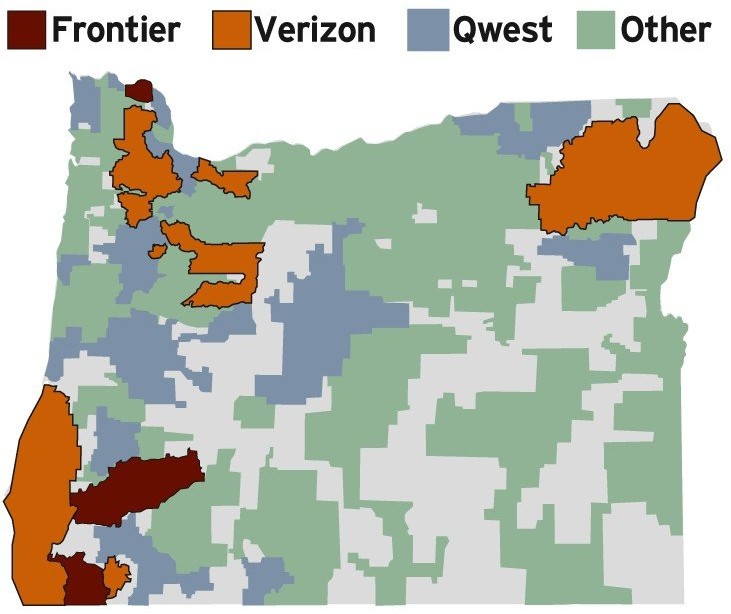
Oregon's telephone company service areas

Frontier Communications has won approval to assume control of telephone lines serving 310,000 Oregonians.

The Oregon Public Utilities Commission Friday unanimously approved the transfer of service from Verizon to Frontier as part of a 14-state transaction.

“First and foremost we want to ensure that customers are not harmed by this transaction.  That’s why we are requiring more than 50 conditions, all aimed at making sure customers are not harmed by this sale,” Chairman Lee Beyer said. “In addition, we are requiring Frontier Communications to spend $25 million on expanding high-speed internet access to its Oregon customers by July 2013.”

In return for approval, Frontier agreed to PUC demands for customer service protections:

  • A commitment that Frontier spend at least $25 million to expand high-speed broadband in Oregon by July 2013;
  • No changes in “commission-regulated” retail service plans for at least three years;
  • Costs of the transition must not be paid by customers in the form of rate increases;
  • 90-day window to change long distance carrier without any fees;
  • An independent audit, paid for by Verizon, to ensure Frontier can handle service for those customers affected by the deal;
  • An opt-out provision letting Oregon’s FiOS subscribers terminate their contracts without penalty if Frontier reduces Internet speeds or drops any of its television channels.

What is missing from Oregon’s agreement?

  • A prohibition of Internet Overcharging schemes like Frontier’s 5 gigabyte “acceptable use” policy that potentially limits customer’s broadband use.  Expanded broadband that customers can only use for basic web browsing and e-mail, without fear of exceeding the limit, indefinitely punishes rural Oregonians with no broadband alternatives;
  • A specific definition of what constitutes “broadband” speeds.  Frontier can continue to deliver the 1-3 Mbps it routinely provides to its less urban service areas.  While better than nothing, Oregon regulators could have used the deal as leverage to win 21st century broadband speeds from Frontier, not yesterday’s ‘barely broadband;’
  • Fines and penalties that will punish a provider that does not invest appropriately in high service standards to provide quality service, and a trigger to permit automatic cancellation of operating certificates should Frontier go bankrupt.

Too many of these deals offer upsides for Wall Street and little benefit to consumers, especially those dependent on their landline phone company for basic communications services.  By forcing requirements that prove costly for a provider to renege on, investors will understand their gains will only happen when they are assured Frontier is doing right by their customers, as well as their shareholders.

Oregon is the sixth state to approve the sale.

Frontier currently serves only 12,000 customers in the state, mostly in southwest Oregon, including the communities of Azalea, Canyonville, Cave Junction, Days Creek, Glendale, Myrtle Creek, O’Brien, Riddle, Selma, and Wolf Creek.

The company’s new customers will come mostly from Washington County, east Multnomah County, and from several pockets of customers in the northwestern part of the state.  Oregon’s largest telephone provider is Qwest Communications, but the state has numerous smaller independent providers as well.

Charter Cable Says No to Usage-Based Billing & Caps, Increases Speeds

Charter customers thank the company for the speed increases

Charter Cable has made it clear — no metered billing and no enforcement of its “soft usage caps.”

“We have no plans to introduce metered billing,” Ketzer told Broadband Reports, adding no trials were forthcoming either.

But Charter Cable did say bandwidth consumption is a concern for the company, and a measurement tool to educate customers about their current usage was on the way.

“Right now we are gathering requirements to develop a resource so that customers can monitor and control their bandwidth resources,” said Ketzer. “This was something that our customers have been requesting and we want to meet that need.”

Separately, Charter also announced speed upgrades for many of its broadband customers.  Starting this morning, customers can briefly unplug their cable modems to reset them and enjoy some increased speeds at no additional cost.

Charter's old speed tiers (shown above) got an upgrade this morning. Prices quoted are for new customers. Existing customers: add $15 -- Internet Only customers: add $25

The new speed increases impact three of their broadband plans.  Only “Lite” speeds remain unchanged:

  • Lite: Remains the same at “up to” 1 Mbps/128 kbps
  • Express: Increases from 5/1 Mbps to 8/1 Mbps
  • Plus: Increases from 10/2 Mbps to 16/2 Mbps
  • Max: Increases from 20/2 Mbps to 25/3 Mbps

Charter advises Max customers will need to exchange their current cable modem to receive the new speeds.  They come as a result of DOCSIS 3 upgrades, which requires a modem that supports that standard.

Some Charter customers can go even faster with the company’s Ultra60 plan delivering 60/5Mbps service for $139.99 a month.  Customer promotions, typically running six months, can cut the cost to $109.99 during the promotional period.

Increasing speeds and shelving Internet Overcharging schemes like usage limits and usage-based billing build customer loyalty and bring new customers, particularly at the expense of telephone company DSL plans, which cannot compete on speed.  Most DSL providers have stopped increasing speeds beyond the maximum 6-10 Mbps they have advertised for years.  Many barely deliver 3 Mbps.

AT&T, which provides service in many Charter markets, has raised the stakes for competition as it rolls out U-verse, an advanced type of DSL service that can support video, telephone, and faster broadband.  In Reno, where AT&T has conducted usage cap experiments for more than a year, the news that Charter won’t comes as welcome news.

Stop the Cap! reader David canceled AT&T service when he found out the company was testing a usage cap in Reno.

“When we found out they were limiting us (after we signed up), we not only canceled AT&T broadband, but also disconnected our two phone lines as well,” David writes.  “We won’t do business with a company that wants to limit our broadband use and we resented being guinea pigs in the first place.”

David adds a “retention specialist” offered to waive his participation in the trial, but he wasn’t interested and is not looking back.

“Unless you deliver a clear message these ripoffs are unacceptable in a way they understand – money – they will just come back for more once the ‘experiment’ is over,” he said.

David is happy with his Charter Cable service, and estimates AT&T’s experiment cost them nearly $200 a month in revenue they used to earn from his family.

“Their cost control program certainly worked — for me.  I’m saving more money with Charter than what I was paying AT&T,” he adds. “I wouldn’t have switched except for their usage cap.”

Charter itself has some broadband usage limits, but they are almost never enforced.

Charter currently defines “normal” residential usage at around 15 gigabytes per month.  Charter’s usage allowances appear in its “excessive use” clause in the Acceptable Use Policy:

Residential service usage will not exceed 100GB of bandwidth per month for Customers subscribing to Services of 15 Mbps or less per month and 250GB of bandwidth per month for Customers subscribing to Service over 15 Mbps and up to 25 Mbps. Charter reserves the right to revise usage limits or to implement additional usage limits. In the event residential usage exceeds the above-described limits Customer will be notified and required to either limit Customer’s bandwidth consumption to permitted levels/limits or subscribe to a Service with a higher monthly bandwidth limit if a higher limit subscription is available.

Since these limits have not been aggressively enforced, they are known as “soft usage caps.”  Most Internet Service Providers have provisions for such limits in their customer agreements, although they are usually only enforced only when a customer’s usage reaches into the stratosphere (often terabytes of usage are involved) or creates a problem for the provider.

Still, some customers dropped Charter Cable even over the defined “soft caps,” switching to competitors who had no such provisions in their usage policies.  Consumers hate Internet Overcharging schemes, and will readily change providers to avoid them.

[flv width=”500″ height=”380″]http://www.phillipdampier.com/video/Charter Thank You Ad 3-1-2010.flv[/flv]

Charter Cable created this ad from customer recorded submissions sent over their Internet service (1 minute)

Google Broadband: Faster Internet May Reach Mid-Missouri

[Stop the Cap! will be closely following Google’s experimental gigabit fiber-optic broadband network.  We’ll be bringing regular updates about the communities applying, the strategies they are using to attract Google’s attention, what the competition thinks, and the impact of the project on American broadband.]

Columbia, Missouri is excited about the prospect of being chosen as a test city for Google gigabit broadband.

It’s just one of tens of communities seeking to apply for Google’s new experimental fiber to the home network delivering super fast broadband to residents and businesses.

Columbia is the fifth largest city in the state, with 100,000 residents who call the heart of mid-Missouri home.  Columbia is a classic college town, supporting the University of Missouri.  It’s uniquely known as one of the most-educated communities in the country, with over half of its residents holding college degrees.  Columbia residents are quick to embrace new technology, and this drive to adopt the latest and the greatest has fueled interest in Google’s fiber network.

Columbia’s Regional Economic Development, Inc. (REDI), promoting local business and economic development, has been coordinating what to do next.  They’ve been joined by ComoFiber, which is working to generate public interest in the project and help devise a strategy to win Google’s attention.

courtesy: me5000

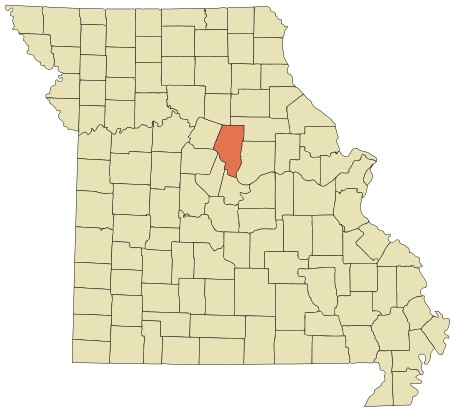
Columbia, Missouri

Mike Brooks, from REDI, said the city has seen a great deal of interest from the community to apply for Google’s plan.

Last week, both groups met to educate the public and start identifying why Columbia poses an attractive place for Google’s project.

Some believe Columbia would be the ideal city to build such a network.  ComoFiber explains:

The reasons are numerous, but the biggest reason is really quite simple: Columbia is on the knife’s edge: the sweet spot between big, highly-developed cities and small, under-served towns.

The reason this is so important is because it’s easy to see why Google might want to deploy its fiber in either a big city or a small town, but it’s equally easy to see why they wouldn’t. The big cities have high-tech industry, universities, highly educated populae and other capabilities that allow them to produce the kind of applications and creative products that Google wants to research. On the other hand, major cities already have a great deal of fiber infrastructure, and their broadband prices are generally reasonable. So really, they’re already enabled; adding marginally-faster service to those markets won’t be the kind of sea-change that the plan is designed to study.

ComoFiber compiled a list of strengths from both the “big city” and “small town” perspective:

Columbia/Boone County, Missouri

Columbia as Big City:

  1. Multiple colleges and universities, including world-class research facilities.
  2. A major life sciences epicenter. Life-science is perhaps the most data-intensive industry in the world.
  3. A highly-educated, technically-skilled populace. Thirteenth-most educated in America, to be exact.
  4. Many high-tech small businesses, including Internet-centric outfits such as Newsy.
  5. Several major hospitals and health care businesses, including some at the forefront of technological advancement.
  6. Small-business incubators run in cooperation with universities and the city.
  7. The world’s foremost journalism school and the Donald W. Reynolds Journalism Institute, which houses a state-of-the-art Technology Testing Center.
  8. Several existing Internet service providers who can take advantage of this new open network.
  9. Excellent data backhaul capability due to our position on the I-70 corridor.
  10. With over 100,000 people, the population is high enough to meet Google’s goal for project scale.

Columbia as Small Town:

  1. Sub-par broadband performance with high prices.
  2. Very little existing fiber-to-the-home infrastructure.
  3. High tariffed rates for enterprise-class data products (T1, DS3, etc.)
  4. Midrange population density should be a good microcosm for suburbia nationwide.
  5. Smaller building development (no high-rises) makes infrastructure deployment simpler.
  6. ”The District” contains the kind of mom-and-pop small-town businesses that can innovate unencumbered by corporate imperatives.
  7. Frequently listed in “best places to live” compilations, such as that of Money Magazine.
  8. Location in the heart of middle America sends a powerful symbolic message.
  9. Low cost of living will be nice for the employees Google will need to move in.
  10. With only a bit over 100,000 people, the population is low enough not to dwarf Google’s goal for scale.

The incumbent cable operator, Mediacom, can’t understand why there is such excitement over Google’s fiber project.

“Google is going to be in select markets, and it’s kind of a test that they’re rolling out,” Mediacom director of operations Bryan Gann told KOMU-TV in Columbia. “It may be limited to some commercial applications in the beginning.”

Mediacom is Columbia's incumbent cable company

Mediacom doesn’t think most residents have any need for super fast broadband.

“I think when you get up to those higher speeds that fast, it’s a select group that would even be interested in it going at that speed,” Gann said.

Despite that remark, Gann quickly added Mediacom was already providing the fastest broadband access in town.  In early February, Mediacom boosted its top broadband speed to 50Mbps, and Gann says the company already has plans to boost that speed to 100Mbps in the future.

“We’re already supposed to go to 100, so we can press on the accelerator anytime we want to,” Gann said.

When a new fiber-based competitor threatens to arrive in town, most cable companies downplay the competitive threat.  Mediacom was no exception.

Gann told KOMU Mediacom was used to competition in broadband service and doesn’t see Google Fiber as a threat.

“With the technology that the cable industry put into Columbia, we’re ready to increase our speed to match competition,” Gann said.

[flv]http://www.phillipdampier.com/video/KOMU Columbia Faster Internet May Reach Mid-Missouri 2-16-10.flv[/flv]
KOMU-TV talks about Columbia’s prospects as a chosen city for Google’s new fiber-to-the-home experiment. (2/16/10 – 1 minute)

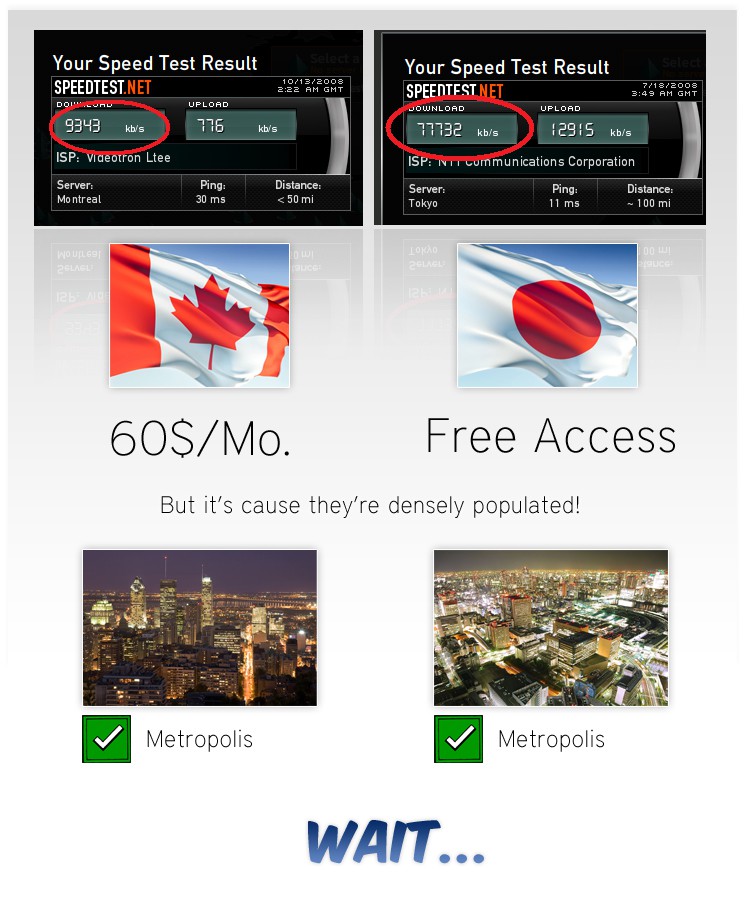
Canada’s Broadband Lag: Canadians Becoming the Guest Workers of the Digital Economy

A handful of large sized Internet Service Providers threaten to strangle Canada’s transition to a digital-ready economy.

The Globe & Mail, Canada’s largest national newspaper, this week called out the country’s broadband conditions.  The country is falling behind, says the editorial, and without fast action to change things, “the innovations that could employ our future work force could well pass us by.”

One passage should puncture Canada’s complacency: “Canada … is often thought of as a very high performer, based on the most commonly used benchmark of penetration per 100 inhabitants. Because our analysis includes important measures on which Canada has had weaker outcomes – prices, speeds and 3G mobile broadband penetration … it shows up as quite a weak performer, overall.”

The newspaper was particularly critical of current providers, and the regulatory body that oversees them — the Canadian Radio-television and Telecommunications Commission (CRTC).  Recent CRTC policies and rulings have allowed a handful of providers to place a strangehold on the Canadian broadband marketplace, reducing competition and controlling wholesale pricing and access policies.  Bell, Canada’s largest telecommunication company, was awarded approval of a policy to implement usage-based billing on the company’s wholesale accounts.  Many independent service providers obtain broadband access from wholesale accounts with Bell.  When they themselves face usage-billing, so shall customers, who now have fewer reasons to choose an alternative provider in the first place.

There is no magic recipe, but some prescriptions are worth heeding as Canada develops its Internet strategy. The report recommends open access policies, in which companies that build infrastructure for mobile and fixed broadband access are encouraged or required to lease that infrastructure to the competition.

But in Canada, limits on foreign ownership and inconsistent CRTC decisions have lowered the amount of competition needed to spur new and better offerings. There was less stimulus spending on projects to support more widespread Internet access in Canada than there was elsewhere. Decisions on related policy issues, such as copyright reform, have been delayed. A national conference on the digital economy generated buzz – ministers Tony Clement and James Moore are reputed to “get it” – but yielded few results. Our best hope to lead on Internet innovation, the Long-Term Evolution platform being developed by Nortel as a successor to 3G, is now largely in foreign hands.

The editorial provoked a response from Jay Innes, vice-president-public affairs, at Rogers Communications, one of Canada’s largest cable and wireless operators.  He sought to change the subject:

For Canada to win in a global digital economy, our country needs to establish a national vision that looks beyond the often-flawed statistical rankings of broadband infrastructure. What we need to understand is why so many Canadian households still don’t have computers, why Canada is lagging in scientific research, and how we should best promote the development of Canadian content and applications.

Internet providers called out for offering slow service at high prices routinely attack surveys that measure broadband speed as beside the point, and then just as quickly blame something else for their problems.

Innes fails to recognize that Canadian broadband service, speed, and access policies are directly on point when answering his question about the dearth of Canadian content and applications.  The fact is, with near-universal Internet Overcharging schemes like usage caps and usage-based billing, no innovative high bandwidth developer is going to plunge headfirst into the Canadian market.  When that developer realizes Canadian ISPs also have the right to artificially impede their content using “network management” speed-throttling techniques, they won’t even dip a toe in the water.

Canadian media websites, for example, contain dramatically less multimedia content for visitors to explore than their American counterparts.  Multimedia eats into your monthly usage allowance, so Canadians think twice before watching.  Hulu and other online video enterprises don’t bother to license content for Canada because usage limits and overlimit amounts discourage viewing.  Canadians who don’t want even higher telecommunications bills may simply decide the Internet is not for them, and they can get by without a computer.

If Innes wants to get in touch with his fellow Canadians, who are already well aware of his industry’s pricing and usage schemes, he can read Canadian bloggers like Éric St-Jean, who calls out Vidéotron and Bell:

It’s funny how we hear about Vidéotron‘s Ultimate Speed 50 Mbps access, and now Bell‘s Fibe 25 Mbps access and we’re told how great they are. They’re actually both humongous ripoffs, if you have even basic math skills and five minutes ahead of you. Why? They both advertise great speeds, but hidden behind those figures, in very small print, behind two or three clicks from the product pages, you’ll find abysmal monthly transfer caps. This means that, yes you have a very fast connection. But if you were to use it fully, you’d very quickly fall into a lot of debt.

Vidéotron’s transfer cap for their 50 Mbps service is at 100GB/month combined up/down – this means you will bust your cap within 5 *hours* if you were to fill your pipe. In turn, this means that you simply CANNOT reasonably use this service.  If you were to use your service fully – at 50Mbps – for the whole month, you would get a bill for $24,132.50. Granted, that’s a lot of data. But I just want to point out how ridiculous the terms of that offer are – it should not be legal.

Bell’s 25Mbps service has – get this – a 20GB transfer cap on it. They offer an extra 40GB for 5$/month. The base rate is $64.95/month (after 12 months).  The overage is charged at the whopping rate of $2.50/GB. So, if we take the base service + the extra 40GB, we’ll get to that limit within about 5.3 hours.

All I have is a 5Mbps (DSL) connection from Teksavvy. But for $43.95 I have no transfer cap at all, a fixed IP, and immediate access to support techs who’ll know what I’m talking about.  But they can’t offer more than 5Mbps.

I honestly don’t understand how the media isn’t picking up on Bell and Vidéotron’s tactics, and how this can be legal. To me it’s completely false advertising: they advertise great speeds (barely on par with the international market, though), which you can’t reasonably use. All this needs is a lawsuit.

When will we get decent Internet access in Canada?

That’s a question Innes is not prepared to answer because, for him and his provider friends, “decent” access is already here.

Innovation requires freedom to innovate.  Rationed broadband service guarantees “stick to the basics” thinking.  But as long as providers can live comfortably off the proceeds, why should they change the winning formula that provides them with financial success?

from Digg

Search This Site:

Contributions:

Recent Comments:

Your Account:

Stop the Cap!