Home » Broadband Speed » Recent Articles:

Broadband.gov Testing America’s Broadband Speeds, But Questions Arise About Accuracy of Test

Phillip Dampier March 15, 2010 Broadband Speed, Public Policy & Gov't 5 Comments

The Federal Communications Commission wants to know how fast your broadband connection is.  The federal agency is now offering consumers and businesses a chance to test broadband speeds to raise awareness about broadband.  But the test results also help illustrate the wide variation between speeds promised by providers and those actually experienced by customers.

The FCC wants to collect this information because broadband providers have often refused to provide it themselves, citing customer privacy or an unwillingness to release potentially useful information to competitors.  By asking visitors to supply their street address and general location, the agency can at least develop anecdotal information about the range of speeds Americans experience.

However, the agency is likely to discover wide variations in the accuracy of the results based not on what service providers deliver, but instead what the speed test itself reports.

The FCC is relying on two speed test providers, randomly assigned to those taking the test.

  • Measurement Lab (M-Lab), which provides researchers with Internet measurement tools on a collaborative basis, and
  • Ookla, a private company that provides web-based network diagnostic applications.

Stop the Cap! used both providers to conduct three individual speed tests from Broadband.gov.  There were dramatic differences in results.  M-Lab consistently reported far slower speeds than Ookla.  Ookla’s results were closest to the advertised speeds from our broadband provider — Time Warner Cable.
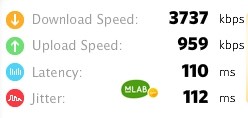
This speed test result from M-Lab was the closest to the average of all three speed tests conducted with this service
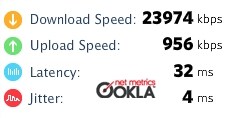
Ookla's speed test came closest to achieving the marketed speeds for Rochester, New York Time Warner Cable Road Runner Turbo customers. The download speeds reported also include the effects of "PowerBoost," a temporary burst of additional downstream speed.

Both speed test providers rely on different regional servers to deliver potentially more accurate speed test results, less impacted by the additional “hops” traffic must take when traveling outside of a nearby region.  But considering the enormous disparity between the two tests, these real-world results may not actually represent reality.

Which test comes closest to the actual speeds available here?  Ookla.  But even then, your results may vary.  Ookla provides speed tests for both Time Warner Cable and Frontier Communications, our local phone company.  The downstream speeds reported were widely different, despite both test servers being located within a 50 mile radius.
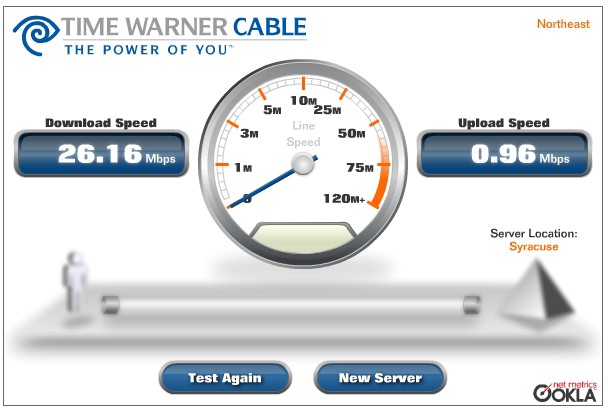
Time Warner Cable's speed test application is also provided by Ookla. (This result comes from a server in nearby Syracuse -- the Rochester location was not working properly)
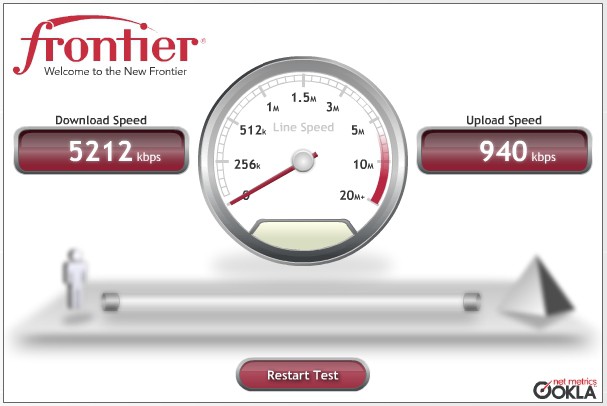
Ookla's speed test for Frontier Communications delivered dramatically different results for downstream speeds

The FCC seems to acknowledge the potential disparity in results on their disclaimer page:

Please note that the Consumer Broadband Test in its current software based form may not be an accurate representation of connection quality provided by your broadband provider. The results can be impacted by a range of factors — for instance, the test can vary based on the geographical distance of the user from the testing server, end-user hardware, network congestion, and time of day. However, this application can provide a helpful indicator in comparing consumers’ relative broadband connection quality and in understanding the performance metrics of broadband connections.

What results do you get from Broadband.gov’s provided speed tests?  Share your findings in our comment section.

Biggest Problem With South Pacific Broadband: “Restrictive Data Caps” — New Fiber Project Helps Eliminate Them

Phillip Dampier March 11, 2010 Broadband Speed, Competition, Data Caps Comments Off on Biggest Problem With South Pacific Broadband: “Restrictive Data Caps” — New Fiber Project Helps Eliminate Them

Flag of New Zealand

Despite broadband provider propaganda designed to convince Americans restrictions on broadband usage were “commonplace” and well tolerated overseas, a group of New Zealand and Australian broadband entrepreneurs propose to spend just under $900NZ million to build new fiber capacity to help eliminate them once and for all.

A team of businessmen from the South Pacific today announced they are part of “an early stage” venture to construct a brand new underseas fiber optic cable to connect Australia and New Zealand with the United States, providing five times the capacity of existing service provided by the Southern Cross system.

The new group, Pacific Fibre, went public today and is talking with potential partners about the plan to construct a 13,000 kilometer cable by 2013.

Mark Rushworth, former Vodafone chief marketing officer, told TV New Zealand a full 90 percent of New Zealand Internet traffic is bound for the United States.

“It is using the most direct route. It is one hop from New Zealand to the US, which from a technical perspective is very important because it means it is a lower latency cable, that is, it is faster than other cables,” he said.

Flag of Australia

The primary impetus for the project was the common practice in New Zealand and Australia to limit customers’ usage of broadband service with Internet Overcharging schemes like usage-based billing or restrictive data caps which can throttle speeds just above dial-up for customers for weeks, if they exceed their usage allowance.

Rushworth

Private providers have lived happily on the revenue earned from such schemes and have done little to relax usage limits on their customers, so Pacific Fibre decided to undertake a game-changing new fiber cable themselves to drive prices down and eliminate the caps.

“We desperately need a cable that is not purely based on profit maximization, but on delivering unconstrained international bandwidth to everybody, and so we’ve decided to see whether we can do it ourselves,” said partner Sam Morgan.

“We hope to bring in extra capacity at a low price, which our carriers and ISP customers can end up passing on to their customers,” Rushworth said.

“We all know that in any market as soon as you introduce competition prices tend to drop and volume goes up,” he told TVNZ.

The current proposed cable configuration would have two fiber pairs with 64 wavelengths (lambdas) each at 40 gigabits per second per lambda. The maximum lit capacity initially would be 5.12 terabits per second, but would be upgradeable to over 12 terabits per second as emerging technology became a reality.

Upstate/Downstate: More Cities in New York Getting Time Warner Cable Wideband Service

Phillip Dampier March 11, 2010 Broadband Speed, Competition 2 Comments

Although residents of Rochester will have to wait, other cities in upstate and downstate New York are now getting Time Warner Cable’s Wideband broadband service, which provides faster upstream and downstream speeds thanks to DOCSIS 3 service upgrades.

Time Warner in Buffalo yesterday signed its first Wideband customer, according to Broadband Reports.

The Hudson Valley will be the next:

  • Walden Available March 30, 2010
  • Wurstsboro Available March 30, 2010
  • Rhinebeck/Saugerties Available March 30, 2010
  • Poughkeepsie Available March 30, 2010
  • Port Ewen/Kingston Available March 30, 2010
  • Liberty/Monticello Available March 30, 2010

Time Warner Cable is deploying Wideband first in communities where they face competition from Verizon FiOS or AT&T U-verse.  Communities like Rochester, which face only token competition from slower-speed DSL service, are pushed way back on the upgrade list.

Customers in Albany, Buffalo and Syracuse who live near, but not in a FiOS-upgraded community, will also benefit from the DOCSIS 3 upgraded-Wideband service.

Two types of Wideband service are commonly available according to BR:

  • 30 Mbps downstream 5 Mbps upstream tier that costs $25 over Time Warner Cable’s standard Road Runner plan (which can vary in price and speed by market depending on competition).
  • 50 Mbps downstream 5 Mbps upstream tier for $99 a month.

50/5 Mbps ‘Wideband’ Service Arrives in Dallas for Time Warner Cable Customers Later This Month

Phillip Dampier March 9, 2010 Broadband Speed, Competition 2 Comments

Time Warner Cable customers with deep pockets and a need for speed will find Time Warner Cable’s new Wideband Internet service arriving in certain North Texas neighborhoods on or around March 19th.

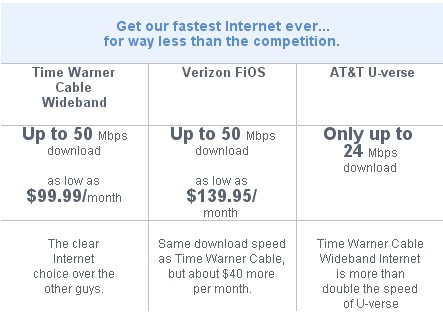
Made possible by DOCSIS 3 upgrades, the new service will provide 50/5 Mbps service for as low as $99.99 per month.

As has been the case in other cities getting TWC’s Wideband service, self-install kits are not yet available and a formal service call is required.  You will also need a new DOCSIS 3-capable cable modem.

Interested customers in the Dallas area can call Time Warner Cable after March 19th at (972) 742-5892 to determine if service is available yet in your neighborhood.

Time Warner Cable competes with both AT&T and Verizon across its North Texas division.

AT&T U-verse maxes out at 24 Mbps currently, and although Verizon FiOS can match Time Warner Cable’s speed, the phone company’s current price is $40 higher for the service.

Customers who need this level of speed should call Verizon or Time Warner Cable and inquire about any promotional pricing that could lower your bill for several months.  In New York City, some customers received discounted Time Warner Cable Wideband service for six months.

Eventually, competition should result in lower prices for super fast broadband connections.  DOCSIS 3 upgrades offer a win-win for both customers and the cable company providing the service.  Increased capacity resolves neighborhood congestion issues and also permits higher speed, premium-priced tiers to deliver additional profits to providers.  In return, customers who need ultra-fast speeds get them, and are only to happy to pay for them, as long as they are not usage-capped.  Nothing destroys the value of premium-priced tiers better than unjustified usage limitations.

Comcast Selling “Unlimited Internet” Over A Fiber Network That Isn’t (And No Speed Guarantees Either!)

Phillip Dampier March 2, 2010 Broadband Speed, Comcast/Xfinity, Data Caps 5 Comments

Broadband providers love to tout their Internet services as “unlimited, always on access at blazing fast speeds.”  Increasingly, their service isn’t unlimited, it’s not always working, and those blazing fast speeds are doused in a shower of asterisks leading to fine print indicating “speeds are not guaranteed.”

Take Comcast, for example.

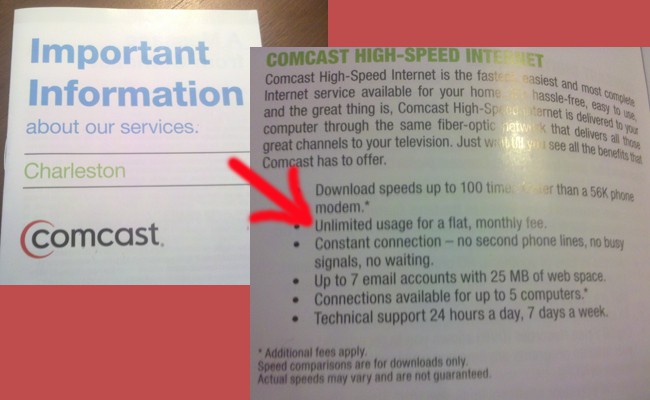
The Consumerist‘s reader Matt received a brochure from America’s largest cable operator filled with inaccuracies, falsehoods, and fine print.  In order of appearance, let’s fact check:

Source: The Consumerist

Fiber Fiction: “Comcast High Speed Internet is delivered to your computer through the same fiber-optic network that delivers all those great channels to your television.”

Fiber Fact: Comcast does not operate an all-fiber network.  Their distribution system uses a mix of fiber and standard copper coaxial cable.  The fiber network is only a backbone, which connects to the same coaxial cable companies like Comcast have used since the 1970s.  If you want a true fiber-optic network, you’ll need to sign up with Verizon FiOS or a municipally-run fiber provider.  No national cable operator runs one.  It’s part of their marketing rhetoric to try and capitalize on the benefits of fiber without actually spending the money to actually build a fiber system.

Speed Trap: “Download speeds up to 100 times faster than a 56K phone modem.”

Autobahn: This one has one of those asterisks attached — “actual speeds may vary.”  Comcast doesn’t guarantee speed, and relies on the familiar “up to” disclaimer that phone companies love to use with their DSL service.  If your neighborhood is clogged with users, the websites you visit run slowly, or Comcast has a problem somewhere, your speed will suffer.

Unlimited That Isn’t: “Unlimited usage for a flat, monthly fee.”

Unlimited Reality: Comcast has a usage limit of 250 GB per month.  Exceed it and you potentially will get a call from Comcast lecturing you about your usage.  Ignore them and you may be without your broadband service for a year.

Consumerist reader Matt was a victim of Comcast’s marketing doublespeak when he exceeded the limit and got a phone call from the company.  Instead of being browbeaten by Comcast customer service, he was ready and armed with the brochure the company sent him:

I was told I used more data than they allow (250GB). I do not argue that I used over 250GB, in fact I went quite a bit over. Though I did want to ask for proof that affected their network, I figured it wasn’t the nicest way to start the interaction. I informed them that I used this because it was sold as “Unlimited usage for a flat, monthly rate.” He then told me it said “access.”

I had the brochure right next to me and quoted, “Unlimited usage for a flat, monthly rate.” He told me their website says something different, and my local franchise overstepped its bounds, and their website overrules the “Important Information about our services, Charleston SC” sales brochure sent to me. If I went over again (It goes by calender month, not billing cycle) I would be disconnected for 1 year without giving me a call.

I asked if Comcast had a tool to help me monitor bandwidth. “Not in your market” he told me. “Download something from Google that will do it for you.”

As consumers continue to expand their broadband usage to take advantage of services like online video and file backup, services Comcast itself offers, more and more will run up against Comcast’s monthly usage limit.  Although your Comcast bill increases year after year, their usage limit has not.  It was 250 GB in 2008 and remains the same in 2010. Thanks to Stop the Cap! readers Dave and Michael who sent word our way.

Search This Site:

Contributions:

Recent Comments:

Your Account:

Stop the Cap!