Some odds and ends regarding Bright House Networks you may have missed over the past several weeks:
Hernando County, Florida Ticked Off About Bright House Rate Hikes
Hernando County commissioners were united in their opposition to a recent $3 rate increase from Bright House Networks that spiked bills for standard service to $55.49 a month. They voted unanimously for a resolution condemning the rate increase, noting it comes as a result of insufficient cable competition.
The commissioners want local consumers to shop around for alternative providers, but outside of satellite, Bright House is the only cable television provider for local residents. Despite tough economic times, the rate increases just keep on coming.
“This, for lack of better words, really frosts me,” County Commissioner Dave Russell told Hernando Today. “As a retailer and a business owner in Hernando County, we’ve done what we can to keep our prices down.”
Bright House, he said, should do the same and “suck it up just like the rest of us have,” he said.
Additional rate increases of $2 per month for HBO and $1 a month each for digital phone, voicemail, and DVR service are also now in effect.
Vandals cut fiber optics on Bright House Networks in Birmingham area
Vandalism can result in major service disruptions for cable customers, especially when a fiber optic link is cut. The Birmingham, Alabama area suffered a major outage in late February when vandals sliced an important fiber link. Service was knocked out on the west side of Birmingham, including Five Points West, Ensley, and part of Ross Bridge for almost a day.
Customers generally have to call and request service credit for outages — most cable companies don’t automatically credit accounts.
Make Room for More HD Channels
Bright House Networks has been aggressively adding new HD channels to its lineups across the country. In central Indiana, Bright House customers can spend even more time channel surfing through these additions:
BBC America HD – Channel 847 on December 14
Fuse HD – Channel 840 on December 16
G4 HD – Channel 810 on December 16
HLN HD – Channel 726 on December 14
IFC HD – Channel 794 on December 11
Investigation Discovery HD – Channel 804 on December 18
MAV TV HD – Channel 753 on December 18
NBA TV HD – Channel 862 on December 18
NHL Network HD – Channel 863 on December 11
Outdoor Channel HD – Channel 865 on December 11
Style HD – Channel 860 on December 14
Tennis Channel HD – Channel 864 on December 11
TV One HD – Channel 866 on December 16
BET HD – Channel 736
Cinemax HD – Ch. 228
CMT HD – Ch. 743
Comedy Central HD – Ch. 725
Crime & Investigation Network HD – Ch. 852
Game HD – Ch. 904
Hallmark Channel HD – Ch. 757
HD Pay Per View Events – Ch. 304
History International HD – Ch. 817
MTV HD – Ch. 775
Nickelodeon HD – Ch. 744
Spike TV HD – Ch. 724
Team HD – Ch. 886
The Movie Channel HD – Ch. 262
VH1 HD – Ch. 741
Wayde Klein, vice president of marketing and customer operations for Bright House Networks Indiana, said “In October, we announced that Bright House Networks had a goal of offering more than 100 high-definition channels in early 2010. We started by launching 17 HD channels in 17 consecutive days in November and then launched 13 new HD channels in December. Our launch of 15 HD channels this week is one step closer to our goal.”
In Orlando, Bright House added these networks in March:
Hallmark Channel HD at channel 1315
Nickelodeon HD at channel 1333
Comedy Central HD at channel 1366
Spike HD at channel 1368
BET HD at channel 1367
CMT HD at channel 1371
VH1 HD at channel 1372
MTV HD at channel 1374
Questions Answered from Bright House Customers
The St. Petersburg Times tackled this one from a Bright House customer:
Why doesn’t Bright House tell their customers that they have to pay for faster connection?
-Stephen, St. Petersburg
Like Big Mama always said, “you can’t get something for nothing.”
Bright House says customers are informed that the faster connections cost more. The higher speed Internet connections are not automatically given to customers.
“You have to request it,” says Joe Durkin, a spokesman for Bright House Networks.
Standard roadrunner Internet service is about $48. Then you can get Roadrunner turbo for $15 more or the fastest, Roadrunner lightning, for $30 above the standard.
The additional charges are listed, even online.
Bright House serves a large part of central Florida. Comcast Cable serves territories further south.
[flv width=”576″ height=”409″]http://www.phillipdampier.com/video/Bright House Ad Campaign Spring 2010.mp4[/flv]
Bright House launched a new ad campaign this spring emphasizing bright colors and product bundles.
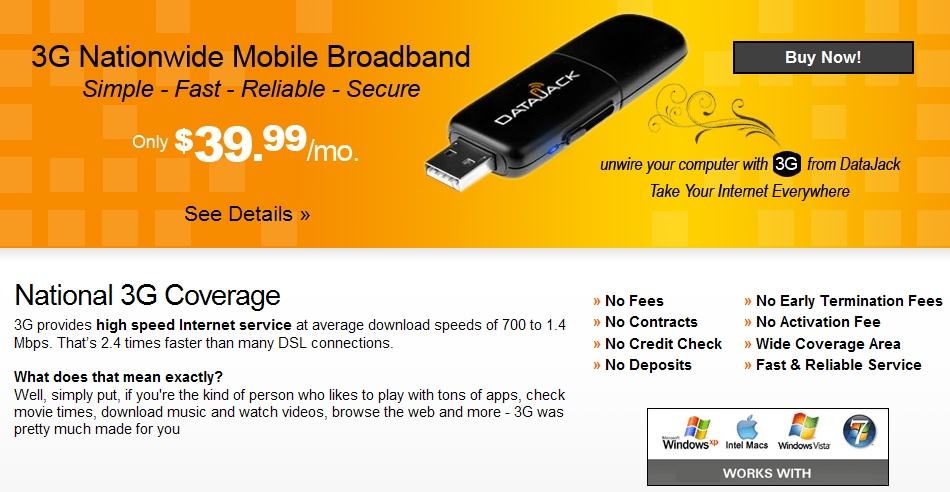
Here is how DataJack was marketing themselves back in January
DataJack, the 3G mobile broadband service that was promising unlimited wireless broadband service for $39.99 a month is back — with an all-new 5GB monthly usage cap, a new provider, and hassles for existing customers who must swap out their existing wireless modem.
Stop the Cap! first covered DataJack back in January, when customers were howling about the company’s lousy customer service and its tendency to “stretch the truth” about its coverage area, speeds, and even the availability of the product itself.
Rumors about a major spat between its original data service provider, presumably T-Mobile (based on the fact DataJack and T-Mobile had identical coverage maps back in January) and DataJack led the company to stop signing up new customers. Since January, DataJack’s website has told would-be customers that the wireless modem necessary to use it was “out of stock.”
DataJack remained in limbo until the first week of April, when the company began e-mailing updates to dealers and customers about major changes to the company and its marketing:
“Unlimited” service is history, not that DataJack ever really offered it. Many customers who used the service in excess of 5GB per month were notified their account would be closed at the end of the month’s billing cycle. “Companies like DataJack have an English language comprehension problem,” writes Stop the Cap! reader Kevin. “The word ‘unlimited’ means ‘without limit,’ — a concept DataJack routinely ignored when throwing people off their service.” New customers will be subject to a formal 5 GB usage cap.
Customers who did manage to get modems from DataJack may find they may no longer work after this Thursday. The company is dropping GSM-based network service and moving to a CDMA network (either Sprint or Verizon — most believe the former), which means obtaining a new modem. At least that will be offered free of charge to inconvenienced current customers.
The price for new customers is going up $10 per month — to $49.99 for 5 GB of service. Existing customers get to retain service for $39.99 a month, albeit with the new usage cap. The DataJack website has still not been updated to reflect the new pricing.
Kevin is taking a walk far away from DataJack:
“These people don’t have the first clue how to run a business. Their entire marketing plan just a few months earlier was based on the premise of unlimited service. They apparently got into trouble with their provider, another sign that doesn’t inspire confidence, and now they’re e-mailing customers telling them they literally have days to complete an equipment swap or lose service? In the end, they were punishing people for actually believing their marketing nonsense about “unlimited” service and now they want people to believe a $10 price hike for less service is good news? After everything that has happened with these people since January, who knows what will happen next month. I’m not about to wait around to find out.”
Dealers were the first to be notified about the company changes. Stop the Cap! obtained this copy of a message sent to DataJack retailers:
Dear DataJack Dealer,
Please note that Effective April 2, 2010, the following changes were made to our terms and conditions:
Service Usage. We reserve the right to safeguard our network from abuse, excessive bandwidth consumption or any activity that compromises the performance of our network. We may limit throughput speeds, control the amount of data transferred, and suspend, modify or terminate service, without notice, if your usage adversely impacts our network or exceeds 5 GB in a given month. We may monitor your compliance with the above but will not monitor the content of your transmissions except as otherwise expressly permitted or required by law.
Prohibited Uses. The service may not be used in a manner that violates any law (including without limitation, copyright and intellectual property laws); or the Service Usage clause.
We have found it necessary to implement these measures to ensure our DataJack customers are given the opportunity to access reliable, high speed, wireless internet service at a reasonable price.
95% of our customers will not be impacted by these new provisions; however, if a customer who is impacted visits your store and requests a refund due to no longer having access to the service, please direct them to the DataJack customer support team at 1-888-693-4522. Our team will work directly with the customer to resolve the issue.
Additionally, we are in the process of rolling out a new and improved Dealer Portal. Benefits of this portal include a more user friendly interface, virtual training videos, and enhanced functionality. Our systems will be down for a short period of time while making the transition. Please refer to customer service to process pins and activations for your customers.
If you have any questions, please feel free to contact [email protected].
The "unlimited service" so prominently mentioned in January is gone from today's marketing of DataJack (click to enlarge)
Existing customers were next to be notified by this e-mail message sent last week:
Dear Valued Customer,
To address recent quality and connectivity issues, DataJack is migrating our service on April 15, 2010 to a new Tier 1 network which delivers faster data speeds and an expanded coverage area. The move to this new network means that DataJack must replace your existing device by April 15th to ensure uninterrupted service. Realizing this could be an inconvenience to you, DataJack is offering our customers a FREE MIFI unit for use as your replacement device at absolutely no extra charge (M.S.R.P. $299.00).
To ensure we get your replacement device to you in a timely manner, it is imperative that you verify the name and address we have on file for you as soon as possible by replying to this email. The name and address on file is as follows:
(address removed)
Upon verifying your address, we will send your new WIFI unit and a postage paid return envelope so you may mail back your current DataJack device. We ask that you please return the used device within 10 business days. South Florida customers also have the option of exchanging their device on April 14th, 15th, and 16th from 10AM – 9PM EST at the following location: 6365 NW 6th Way Suite 160 Fort Lauderdale, FL 33309.
If you do not want to take advantage of the FREE MIFI unit offer, please contact customer service at 1-888-693-4522 to discuss alternative equipment options.
Please note that new customers will be required to pay $49.99 per month for service. This price increase will not affect you, your service fee will continue to be $39.99 per month. Additionally, we have changed our terms and conditions to include service usage and prohibited uses clauses. The terms and conditions apply to all customers.
Again, time is of the essence. We must get your new unit to you by April 15th to avoid service interruption. Thank you for your patience and we look forward to serving you on our new and improved network.
Best Regards,
The DataJack Team
Here is how DataJack dispenses with customers who use their “unlimited” service “too much”:
Dear DataJack Customer,
In accordance with our terms and conditions, more specifically the Service Usage and Prohibited Usage clauses, we are unable to renew your service upon expiration.
We regret that we can no longer provide service and wish you the best in finding a new provider for your wireless internet access needs. Our customer service representatives are available 8AM – 5PM Monday through Friday to address any questions you may have.
Best Regards,
DataJack, Inc.
888-693-4522
Under Terms & Conditions
Effective April 2, 2010
Service Usage. We reserve the right to safeguard our network from abuse, excessive bandwidth consumption or any activity that compromises the performance of our network. We may limit throughput speeds, control the amount of data transferred, and suspend, modify or terminate service, without notice, if your usage adversely impacts our network or exceeds 5 GB in a given month. We may monitor your compliance with the above but will not monitor the content of your transmissions except as otherwise expressly permitted or required by law.
Verizon FiOS has upped the ad war against Comcast, one of its competitors in several northeastern cities. In a new series of ads, Verizon is taking on Comcast’s “name change” to Xfinity, implying it’s the same old Comcast just using a new name.
Comcast may be fighting back, but not with a response ad. Today, Broadband Reportshears word from a Comcast insider the company is planning on boosting broadband speeds later this year.
According to the source, the new Comcast tiers will be 12/2 Mbps, 20/4 Mbps, 50/10 Mbps, and 100/25 Mbps. Current 22/5 customers will be grandfathered, according to the source, and Comcast apparently hopes to get that 100 Mbps tier into about 20% of their footprint this year.
Comcast’s current speeds differ depending on whether you’re in a DOCSIS 3.0 upgraded market or not. Non DOCSIS 3.0 market customers currently have the choice of three tiers: 6/1 Mbps, 8/2 Mbps, and 16/2 Mbps. DOCSIS 3.0 upgraded markets have their choice of 12/2 Mbps, 16/2 Mbps, 22/5 Mbps, or 50/10 Mbps. Much later this year it looks like Comcast users will also start seeing some faster upstream speeds.
Verizon FiOS has the capability to beat Comcast’s broadband speeds over its entirely-fiber-based network, but not everyone can sign up for FiOS. Comcast may not want to give away the broadband speed store in areas where the now indefinitely-grounded FiOS service will never go.
[flv width=”640″ height=”500″]http://www.phillipdampier.com/video/FiOS Takes On Xfinitiy.flv[/flv]
Comcast’s new Xfinity brand is the target of a new round of advertising from Verizon FiOS. (2 minutes)
The 'Prince of Wales,' one of Inter-Island Ferry Authority's boats that connect the island to the mainland (Courtesy: Inter-Island Ferry Authority)
Providing broadband to 6,000 residents of Prince Wales Island, located along the western strip of Alaska that borders on British Columbia, Canada is the ultimate challenge. Parts of the island don’t even have access to traditional landline phone service, relying instead on fixed wireless service.
Residents have complained loudly about the poor quality of phone service on the island for years, particularly when it is provided to the 1,000 residents of Klawock, Craig, and several adjacent communities served by Alaska Communications Systems (ACS). Ten percent of ACS customers are stuck with fixed wireless, which guarantees no Internet access, and sub-standard phone service. What perturbs many of them is the fact another phone company’s landlines are within the sight of their homes and communities, but they can’t get service from that company. Those lines are owned by ACS competitor Alaska Power & Telephone (AP&T), an employee owned utility that serves many areas ACS doesn’t.
Friends and neighbors served by AP&T are happy with their telephone service. Residents served by ACS are not.
The Alaska Dispatch tells the story:
Every three months Ron Fitch drives five miles down a state highway so he can use a friend’s telephone to monitor his pacemaker.
Fitch, who lives on Price of Wales Island, has a phone at home, but he gets his service via fixed wireless, which is similar to a cell phone signal but is routed through a box mounted in the house. Since you can’t recalibrate a pacemaker over a wireless signal, Fitch makes the drive four times a year.
“Times have changed, and it doesn’t seem right that we can’t get Internet or a fax or anything over our phones,” said Eric Packer, a builder who lives outside Klawock. “It’s like living in the dark ages.”
ACS customers on the island have been complaining about their phone service for years, and for some the frustration is sharpened by the view of lines — owned by ACS competitor Alaska Power and Telephone — running near their homes. Two years ago the Regulatory Commission of Alaska opened an investigation into ACS service on the island, citing numerous customer complaints and a request from Sen. Lisa Murkowski.
With all of the negative press focused on ACS, the company relented, telling the Regulatory Commission it will offer to connect those fixed wireless customers to landline service, but will only pay for up to 1,000 feet of wiring between the nearest ACS junction box and the customer’s home. ACS will bill customers the balance of costs beyond 1,000 feet if a customer insists on landline service.
ACS is a major recipient of universal service funds which subsidizes phone service in rural areas to keep it affordable. ACS receives about $4 million a year. ACS fixed wireless customers on the island pay about $26 a month.
ACS customers perennially without broadband have complained to the Regulatory Commission, according to the Dispatch, suggesting it hurts the island’s economic development. Some customers have managed to switch to cell phone service and dropped landline/fixed wireless service, and a select few are trying to rely on satellite Internet service, which customers characterize as expensive and slow.
Pricing for landline DSL service from either ACS or AP&T is itself slow and expensive, and AP&T service is usage limited:
3 Mbps / 512 Kbps
$89
1 Mbps / 320 Kbps
$69
320 Kbps / 240 Kbps
$49
ACS promotes the fact their service is unlimited. Includes local and long distance telephone service. One year contract term required. Pricing may be higher in rural areas not specified on the ACS website.
64 kbps with 2GB of data transfer per month
$29.95
256 kbps with 10GB of data transfer per month
$49.95
512 kbps with 20GB of data transfer per month
$59.95
1 Mbps with 30GB of data transfer per month
$79.95
The 1Mbps service tier is currently available in select areas dependent upon local infrastructure. Each additional gigabyte of usage is pro-rated at $5.00/GB. AP&T provides wireless broadband in selected rural areas.
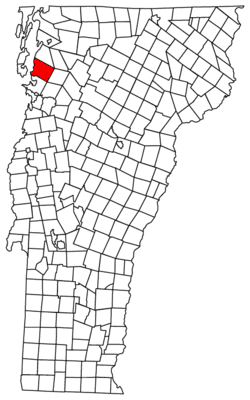
Jesse and his nearby neighbors on the west side of Milton are frustrated. They live just 20 minutes away from Burlington, the largest city in the state of Vermont. Despite the proximity to a city with nearly 40,000 residents, there is no cell phone coverage in western Milton, no cable television service, and no DSL service from FairPoint Communications. For this part of Milton, it’s living living in 1990, where dial-up service was one’s gateway to the Internet.
Jesse and his immediate neighbors haven’t given up searching for broadband service options, but they face a united front of intransigent operators who refuse to make the investment to extend service down his well-populated street.
“After many calls to Comcast, they eventually sent us an estimate for over $17,000 to bring service to us, despite being less than a mile from their nearest station,” Jesse tells Vermont Public Radio. “They also made it very clear that there was no plan at any point in the future, 2010 or beyond, to come here unless we paid them the money.”
Jesse and his neighbors want to give Comcast money, but not $17,000.
For at least 15 percent of Vermonters, Jesse’s story is their story. Broadband simply remains elusive and out of reach.
Three years ago, Vermont’s Republican governor Jim Douglas announced the state would achieve 100 percent broadband coverage by 2010, making Vermont the nation’s first “e-State.”
Vermont Public Radio reviewed the progress Vermont is making towards becoming America’s first e-State. (January 20, 2010) (30 minutes)
You must remain on this page to hear the clip, or you can download the clip and listen later.
<
p style=”text-align: center;”>
Gov. Douglas
In June 2007 the state passed Act 79, legislation that established the Vermont Telecommunications Authority to facilitate the establishment and delivery of mobile phone and Internet access infrastructure and services for residents and businesses throughout Vermont.
The VTA, under the early leadership of Bill Shuttleworth, a former Verizon Communications senior manager, launched a modest broadband grant program to incrementally expand broadband access, often through existing service providers who agreed to use the money to extend service to unserved neighborhoods.
The Authority also acts as a clearinghouse for coordinating information about broadband projects across the state, although it doesn’t have any authority over those projects. Lately, the VTA has been backing Google’s “Think Big With a Gig” Initiative, except it promotes the state as a great choice for fiber, not just one or two communities within Vermont.
Vermont used this video to promote their bid to become a Google Fiber state. (2 minutes)
Some of the most dramatic expansion plans come from the East Central Vermont Community Fiber Network. ECFiber, a group of 22 local municipalities, in partnership with ValleyNet, a Vermont non-profit organization, is planning to implement a high-capacity fiber-optic network capable of serving 100% of homes and businesses in participating towns with Internet, telephone and cable television service. In 2008, the group coalesced around a proposal to construct a major fiber-to-the-home project to extend broadband across areas that often don’t even have slower speed DSL.
The ECFiber project brought communities together to provide the kind of broadband service private companies refused to provide. Vermont Public Radio explores the project and the enthusiasm of residents hopeful they will finally be able to get broadband service. (March 8, 2008) (24 minutes)
You must remain on this page to hear the clip, or you can download the clip and listen later.
<
p style=”text-align: center;”>
ECFiber's Partner Communities
The Vermont towns, which together number roughly 55,000 residents, decided to build their own network after FairPoint Communications and local cable companies refused to extend the reach of their services. Providers claim expanding service is not financially viable. For residents like sheep farmer Marian White, interviewed by The Wall Street Journal, that means another year of paying $60 a month for satellite fraudband, the speed and consumption-limited satellite Internet service.
White calls the satellite service unreliable, especially in winter when snow accumulates on the dish. Unlike many broadband users who vegetate for hours browsing the web, White actually gets an exercise routine while trying to get her satellite service to work.
“I open a window and I take a pan of water and, a cup at a time, I launch warm water at the satellite dish until I have melted all the snow off the dish,” Ms. White says. “It works.”
Other residents treat accessing the Internet the same way rural Americans plan a trip into town to buy supplies.
Kathi Terami from Tunbridge makes a list of things to do online and then, once a week, travels into town to visit the local public library which has a high speed connection. Terami downloads Sesame Street podcasts for her children, watches YouTube links sent by her sister, and tries to download whatever she thinks she might want to see or use over the coming week.
A fiber to the home network like ECFiber would change everything for small town Vermonters. The implications are enormous according to project manager Tim Nulty.
“People are truly afraid their communities are going to die if they aren’t on the communications medium that drives the country culturally and economically,” he says. “It’s one of the most intensely felt political issues in Vermont after health care.”
Despite the plan’s good intentions, one obstacle after another has prevented ECFiber from making much headway:
The VTA rejected the proposal in 2008, calling it unfeasible;
Plans over the summer and fall of 2008 to approach big national investment banks ran head-on into the sub-prime mortgage collapse, which caused banks to stop lending;
An alternative plan to build the network with public debt financing, using smaller investors, collapsed along with Lehman Brothers on September 14, 2008;
An attempt by Senator Pat Leahy (D-Vermont) to insert federal loan guarantees into the stimulus bill in February 2009 was thwarted by partisan wrangling;
Attempts to secure federal broadband grant stimulus funding has been rejected by the Commerce Department;
Opposition to the plan and objections over its funding come from incumbent providers like FairPoint, who claim the project is unnecessary because they will provide service in those areas… eventually.
For the indefinite future, it appears Ms. White will continue to throw warm cups of water out the window on cold winter mornings.
Vermont Edition takes a comprehensive look at where the state stands in broadband and wireless deployment. (April 8, 2009) (46 minutes)
You must remain on this page to hear the clip, or you can download the clip and listen later.
<
p style=”text-align: center;”>
For every Tunbridge resident with a story about life without broadband, there are many more across Vermont living with hit or miss Internet access.
Take Marie from Middlesex.
Most residents in more rural areas of Vermont get service where they can from FairPoint Communications
“I am in Middlesex, about a half-mile off Route 2, and five minutes from the Capitol Building. Yet up until just recently, we had no sign of high-speed Internet. I understand that my neighbors just received DSL a few weeks ago, but when I call FairPoint, they tell me it’s still not available at my house, which is a few hundred yards up the hill. Hopefully, they’re wrong and I’ll see DSL soon,” she says.
Marie is pining for yesterday’s broadband technology — FairPoint’s 1.5Mbps basic DSL service, now considered below the proposed minimum speeds to qualify for “broadband” in the National Broadband Plan. For Marie, it’s better than nothing.
Geryll in Goshen also lacks DSL and probably wouldn’t want it from FairPoint anyway.
“We have barely reliable landline service. A tech is at my house at least three times per year. I was told the lines are so old they are decaying. Using dial-up is impossible. I use satellite which is very expensive and is in my opinion only one step up from dial-up. I am limited to downloads and penalized if I reach my daily limit,” he says.
Many Vermonters acknowledge Douglas’ planned 100-percent-broadband-coverage-by-2010 won’t come close to achievement and many are highly skeptical they will ever see the day where every resident who wants broadband service can get it.
Chip in Cabot is among them, jaded after six years of arguments with FairPoint Communications and its predecessor Verizon about obtaining access to DSL. It took a cooperative FairPoint engineer outside of the business office to finally get Chip service. His neighbors were not so lucky, most emphatically rejected for DSL service from an intransigent FairPoint:
“I laughed when Governor Douglas announced his e-State goal “by 2010” three years ago. Now I’m thinking I should have made some bets on this claim. It took years of legal battles and a zoning variance to obtain partial cell coverage here in Cabot. Large parts of the town still do not have any cell coverage. Governor Douglas can perhaps be forgiven – he has no technical knowledge, and as a politician would be expected to be wildly optimistic about such “e-State” claims. The Vermont Telecommunications Authority and the Department of Public Service should know better however. We’re talking about rural areas where there is no financial incentive to provide either DSL or cell service. It will take a huge amount of money to provide service to those remaining parts of the state. I’m not optimistic.”
[flv width=”512″ height=”308″]http://www.phillipdampier.com/video/Wall Street Journal Vermont Broadband Problems 03-02-09.flv[/flv]
The Wall Street Journal chronicled the challenges Vermonters face when broadband is unavailable to them. ECFiber may solve these problems. Some of the stories in our article are reflected in this well-done video. (3/2/2009 — 4 Minutes)
Be Sure to Read Part One: Astroturf Overload — Broadband for America = One Giant Industry Front Group for an important introduction to what this super-sized industry front group is all about. Members of Broadband for America Red: A company or group actively engaging in anti-consumer lobbying, opposes Net Neutrality, supports Internet Overcharging, belongs to […]
Astroturf: One of the underhanded tactics increasingly being used by telecom companies is “Astroturf lobbying” – creating front groups that try to mimic true grassroots, but that are all about corporate money, not citizen power. Astroturf lobbying is hardly a new approach. Senator Lloyd Bentsen is credited with coining the term in the 1980s to […]
Hong Kong remains bullish on broadband. Despite the economic downturn, City Telecom continues to invest millions in constructing one of Hong Kong’s largest fiber optic broadband networks, providing fiber to the home connections to residents. City Telecom’s HK Broadband service relies on an all-fiber optic network, and has been dubbed “the Verizon FiOS of Hong […]
BendBroadband, a small provider serving central Oregon, breathlessly announced the imminent launch of new higher speed broadband service for its customers after completing an upgrade to DOCSIS 3. Along with the launch announcement came a new logo of a sprinting dog the company attaches its new tagline to: “We’re the local dog. We better be […]
Stop the Cap! reader Rick has been educating me about some of the new-found aggression by Shaw Communications, one of western Canada’s largest telecommunications companies, in expanding its business reach across Canada. Woe to those who get in the way. Novus Entertainment is already familiar with this story. As Stop the Cap! reported previously, Shaw […]
The Canadian Radio-television Telecommunications Commission, the Canadian equivalent of the Federal Communications Commission in Washington, may be forced to consider American broadband policy before defining Net Neutrality and its role in Canadian broadband, according to an article published today in The Globe & Mail. [FCC Chairman Julius Genachowski’s] proposal – to codify and enforce some […]
In March 2000, two cable magnates sat down for the cable industry equivalent of My Dinner With Andre. Fine wine, beautiful table linens, an exquisite meal, and a Monopoly board with pieces swapped back and forth representing hundreds of thousands of Canadian consumers. Ted Rogers and Jim Shaw drew a line on the western Ontario […]
Just like FairPoint Communications, the Towering Inferno of phone companies haunting New England, Frontier Communications is making a whole lot of promises to state regulators and consumers, if they’ll only support the deal to transfer ownership of phone service from Verizon to them. This time, Frontier is issuing a self-serving press release touting their investment […]
I see it took all of five minutes for George Ou and his friends at Digital Society to be swayed by the tunnel vision myopia of last week’s latest effort to justify Internet Overcharging schemes. Until recently, I’ve always rationalized my distain for smaller usage caps by ignoring the fact that I’m being subsidized by […]
In 2007, we took our first major trip away from western New York in 20 years and spent two weeks an hour away from Calgary, Alberta. After two weeks in Kananaskis Country, Banff, Calgary, and other spots all over southern Alberta, we came away with the Good, the Bad, and the Ugly: The Good Alberta […]
A federal appeals court in Washington has struck down, for a second time, a rulemaking by the Federal Communications Commission to limit the size of the nation’s largest cable operators to 30% of the nation’s pay television marketplace, calling the rule “arbitrary and capricious.” The 30% rule, designed to keep no single company from controlling […]
Less than half of Americans surveyed by PC Magazine report they are very satisfied with the broadband speed delivered by their Internet service provider. PC Magazine released a comprehensive study this month on speed, provider satisfaction, and consumer opinions about the state of broadband in their community. The publisher sampled more than 17,000 participants, checking […]


 Subscribe
 Some odds and ends regarding Bright House Networks you may have missed over the past several weeks: