Home » Broadband Speed » Recent Articles:

AT&T To Settle Lawsuit Over DSL Speeds – Customers Get Up to $2.90 a Month, Law Firm Gets $11 Million

Phillip Dampier May 5, 2010 AT&T, Broadband Speed, Consumer News Comments Off on AT&T To Settle Lawsuit Over DSL Speeds – Customers Get Up to $2.90 a Month, Law Firm Gets $11 Million

AT&T has agreed to settle a class action lawsuit that accused the company of selling DSL service at speeds it often never provided to customers.

The case, Robert Schmidt, individually and on behalf of all others similarly situated vs. AT&T and SBC Internet Services, Inc., (d/b/a AT&T Internet Services), was filed in 20o9 when AT&T customers learned the company was configuring some customers’ DSL modems at maximum speed rates below those advertised by AT&T.

AT&T has agreed to settle the lawsuit for a maximum of nearly $100 million, or less depending on the total number of claims received nationwide.

The amount customers are entitled to receive will vary depending on how much of an impact AT&T’s speed limiting configuration had on a their service.  The settlement is also retroactive back to April 1, 1995 meaning longtime AT&T DSL customers could be entitled to several hundred dollars in compensation.  For those dissatisfied with the speeds they received from AT&T’s DSL service, their compensation will be limited to a one-time payment of $2.00.

For some others, the settlement will provide more generous compensation.  The law firm that brought the case, Dworken & Bernstein, will receive up to $11 million in compensation and also get to hand out $3.75 million dollars of AT&T’s money to no less than 20 charities.

Some Background

AT&T provides DSL service to the vast majority of its customers.  This technology works over traditional copper wire phone lines.  Unfortunately, that infrastructure was never designed to carry data, but after years of development engineers found a way to make Ma Bell’s wires work for broadband service.  Unfortunately, the service has never been able to provide consistent speeds to every customer.  The further away you are from the phone company’s central office (where your phone line ultimately ends up), the slower the speed your line can support.  Someone a block away from the phone company office can easily achieve the speeds AT&T promised its customers in its marketing.  But if you are a few miles away, chances are you cannot.

For those more distant, or who live in areas with bad phone lines, your DSL modem won’t be able to maintain a consistent connection at the speeds AT&T sold you.  That will cause the modem to reset itself regularly, trying to re-establish an appropriately fast connection.  That can drive customers crazy because your service will often stop working while the modem tries to renegotiate the connection.  Some phone companies stop the constant reconnection battle by configuring the modem to work at a lower, more stable speed that will work with an individual’s phone line.

For instance, here in Rochester Frontier Communications advertises 10Mbps DSL service.  But for me, more than 10,000 feet away from Frontier’s central office for my area, the line simply couldn’t support that speed.  So Frontier locked the modem to deliver just 3.1Mbps, not the 10Mbps the company markets to customers in this area.

While that practice may seem technically smart, it’s obviously not legally smart, as AT&T has discovered.  Even using the traditional weasel words of “up to” when marketing broadband speeds, AT&T felt it was exposed to charges of false advertising and defrauding customers, and decided to settle the case.  It should be noted AT&T strongly denies any allegations of wrongdoing, but has agreed to settle to avoid the burden and cost of further litigation.

AT&T now faces the prospect of paying compensation to every DSL customer it speed limited in this fashion, and has also agreed to stop the practice.

The Details

Who Gets the Settlement? — Potentially any AT&T DSL customer paying for service after March 31, 1994.  This also includes customers of companies acquired by AT&T:

  • SBC Internet Services, Inc., d/b/a AT&T Internet Services
  • BellSouth Telecommunications, Inc.
  • Pacific Bell Internet Services
  • Southwestern Bell Internet Services, Inc.
  • Ameritech Interactive Media Services, Inc.
  • SNET Diversified Group, Inc.
  • Prodigy Communications Corporation
  • Oklahoma Internet Online

Many AT&T customers may have already been notified about this settlement through postcards or other mailers sent by AT&T based on customer records.

What Kind of Settlement Will I Get? — For longstanding AT&T DSL customers, the amount could be substantial, so it’s worth your while to participate, even if you are no longer a customer.  For most everyone else, it’s probably worth $2.00.

There are three types of benefits that will be paid to those who submit valid claims under the settlement once it becomes final. Payments will be made by check or by credits on a customer’s bill.

  • Group A Benefit. If AT&T’s Records indicate that AT&T configured the downstream speed of your DSL service, for one month or more during the Settlement Class Period, at a level lower than the Maximum DSL Speed for the plan you purchased, you may be eligible to receive $2.90 for each month your service was so configured.  This could add up to hundreds of dollars.
  • Group B Benefit. If you are not eligible for the Group A Benefit and AT&T’s Records show that your DSL service may have performed, for one month or more during the Settlement Class Period, at downstream speeds below the following levels, you may be eligible to receive $2.00 for each such month:
    • 200 Kbps, if you purchased a plan with a Maximum DSL Speed of 768 Kbps;
    • 384 Kbps, if you purchased a plan with a Maximum DSL Speed of 1.5 Mbps before October 2008;
    • 769 Kbps, if you purchased a plan with a Maximum DSL Speed of 1.5 Mbps after October 2008;
    • 1.5 Mbps, if you purchased a plan with a Maximum DSL Speed of 3.0 Mbps; or
    • 3.0 Mbps, if you purchased a plan with a Maximum DSL Speed of 6.0 Mbps.

    Because the settlement provides for monthly credits, you could also receive hundreds of dollars in refunds or service credits, making participation in the settlement worthwhile.

  • Group C Benefit. If AT&T’s records do not show that either you fall within Group A or Group B but you nonetheless believe that your DSL service has not performed at satisfactory speeds based upon the plan that you purchased, you may still be eligible for a one-time payment or bill credit of $2.00. In other words, if at anytime you were underwhelmed by AT&T’s DSL speeds, you can file a claim and get two dollars back.

AT&T has also agreed to monitor customers’ DSL speeds over a period of 12 months and if service cannot achieve the speeds promised, the company will either make repairs to boost speed or adjust billing.

For AT&T customers in Missouri, Oklahoma, Kansas, Arkansas, and Texas, AT&T’s settlement would replace a similar class action case filed in St. Louis.  Ford and Dunne v. SBC Communications, Inc. and SBC Internet Services, Inc., would have only covered customers after December 31, 2000.

Customers who believe they are entitled to participate in the settlement can get additional information and file an online claim at the DSL Speed Settlement website.
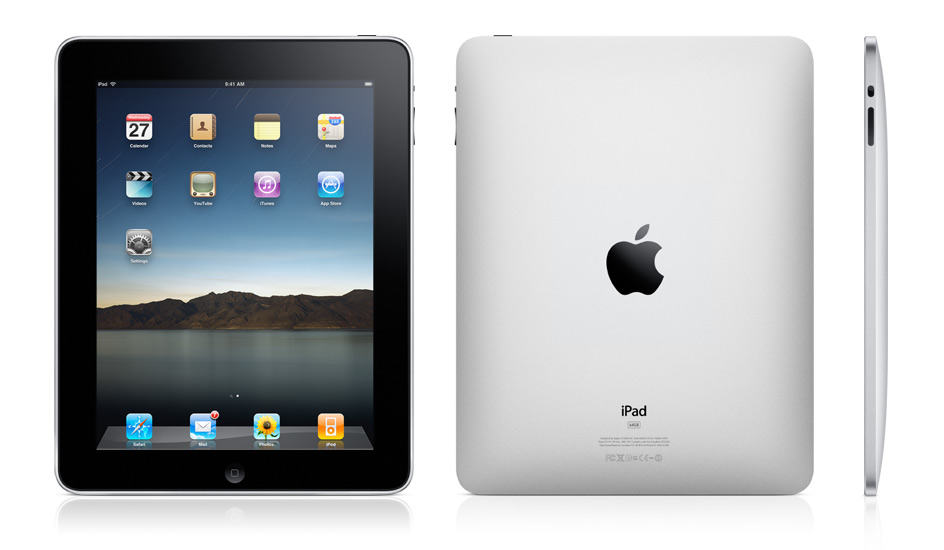

Sorting Out the Apple iPad 3G Controversy: Is AT&T Throttling iPad 3G Owners?

New Apple iPad 3G owners launched a small controversy over the weekend about their discovery that certain video streaming services are showing lower resolution video (or no video at all) when using Apple’s new iPad 3G over AT&T’s wireless 3G network.

A range of sites pounced on the news.  It’s not easy to sort through who broke the story first, but by the end of the weekend, it developed a small life of its own.

iLounge was among the first to note serious video quality degradation when using the iPad over a cellular network, while it worked just fine over Wi-Fi:

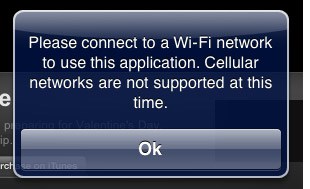
…some video delivery applications act differently over the 3G network than they do on Wi-Fi. The iPad’s built-in YouTube application strips both standard and HD videos to a dramatically lower resolution over the cellular data connection, something that iTunes Store video previews notably do not do, instead staying at a higher quality and consuming a greater amount of data. Other third-party applications, such as the ABC Player, refuse to work at all over the cellular connection, producing a notification pop-up that states, “Please connect to a Wi-Fi network to use this application. Cellular networks are not supported at this time.”

YouTube streamed over AT&T's 3G Network on an iPad defaults to very low resolution. (Image: iLounge)

Electronista also jumped on the story, at first speculating AT&T may have had a hand on the speed throttling noting Sling Media ran into a similar blockade with AT&T before the wireless company relented and the software became available from the App Store.  PC Magazine quoted from the Electronista story (before Electronista’s editors modified their original piece) to build on the story.

By the end of the weekend, Electronista pulled back on some of their language in their original report and included a cryptic denial from AT&T, which claimed it was “a question for Apple.”

Stories of reported throttling and content walls will not take long to reach the public policy debate over Net Neutrality.  Is this an example of AT&T throttling Apple iPad customers and blocking them from accessing web content?

The answer, based on current evidence, is probably not.

There are technical issues behind the scenes which play a larger role here, but let’s begin with the average consumer and how a 3G network impacts on their “user experience.”

When designing a device like the iPad, engineers have to factor in usability and the overall impression customers will have using the product with a wireless network.  For many original iPad owners reliant on a Wi-Fi connection, pages render quickly, videos play properly, and applications that require higher bandwidth generally work fine.  Unfortunately, for those who lined up outside of Apple stores looking for the 3G wireless mobile broadband version of the iPad, the same may not always be true using AT&T’s 3G network.

AT&T promotes its 3G network as fast and capable of handling most any web application, including video.  But even the best 3G experience from AT&T is often much slower than a wired or Wi-Fi connection.  Despite the PR from AT&T, its 3G network frustrates many customers, especially in areas where cell sites are jammed with traffic or signals aren’t great.  Apple made sure larger-sized, streamed multimedia content seemed to work equally well on wireless by using adaptive video quality that can sense the speed of a connection, and reduce the quality of a video in order to make it play properly.  The theory is that a consumer using a handheld device probably wouldn’t notice the quality reduction on a small screen and would appreciate quick, uninterrupted playback.  Without such technology, a high quality video file can take longer to send over AT&T’s 3G network than it will take you to watch it.  That triggers the annoying “buffering content” pauses you see on slower networks.

AT&T officials told inquiring media “it’s a question for Apple,” which seems to confirm the reduced video quality is a function of the video player trying to adapt to AT&T’s speed.

Even with this in mind, some accused AT&T of employing social engineering to get customers to instinctively rely on Wi-Fi connections for higher bandwidth applications, reducing the demand on AT&T’s 3G network.

There is no need for a conspiracy theory like that when the simple, naked truth is far easier to grasp — AT&T has inadequate capacity and needs to upgrade their wireless networks to handle more traffic and sustain the speeds customers expect from a 3G-capable network.  AT&T is not purposely throttling the speeds of iPad 3G owners — their insufficient capacity results in a de facto speed throttle for all of their customers.  Unfortunately for those outside of the United States, the implications of AT&T’s slower 3G network can impact them as well.  Jesse Hollington in Toronto noted:

Unfortunately, these limitations don’t seem to be triggered by AT&T’s network, but rather in the iPhone OS or apps themselves, and the restrictions (at least on the iPhone) exist in every country where the iPhone is sold. There’s a general feeling outside of the U.S. that Apple’s kowtowing to AT&T’s “requirements” is actually ruining the experience for the rest of the world.

For instance, I can perhaps understand why YouTube videos need to be downsampled on AT&T’s slow 3G network, which even at peak performance is only 1.8mbps in most places.  As I noted above, however, Rogers up here provides 7.2mbps just about everywhere and provides better 3G performance than I get on some Wi-Fi networks. Yet we have to live with the same 3G restrictions as AT&T users do because they’re built into the iPhone OS.

That prompts the question what limits would have been “built-in” had AT&T’s own 3G network consistently delivered 7.2Mbps performance across its service areas.

As for ABC, and certain other content producers that restrict iPad owners to Wi-Fi viewing, that turns out not to be clear cut either.  ABC’s video streaming evidently exceeds a speed threshold that triggers the player to tell the user to use a Wi-Fi connection instead.  Licensing restrictions may also prevent the content from playing across a 3G network.

One of the most common arguments Net Neutrality opponents use to argue Net Neutality’s “unintended negative consequences” comes from bans on such adaptive speed controls.  Providers claim that by prioritizing or favoring certain traffic, they can maximize a consumer’s online experience so that they can use high bandwidth applications, as long as an intelligent network shaped the delivery of that traffic.

ABC restricts iPad owners to streaming its videos over Wi-Fi connections. (Image: iLounge)

So one might ask, because adaptive video quality lets people watch their favorite online videos over AT&T’s 3G network, wouldn’t a ban on speed throttles make it difficult or impossible to provide a customer with access to that video?  Isn’t Net Neutrality a bludgeon that kills intelligent traffic management tools?

There is no shortage of techie-speaking, industry-funded Net Neutrality opponents that argue it regularly.  Unfortunately, it doesn’t hold up to scrutiny.

Net Neutrality does not ban software that can sense the speed of your connection and request an appropriate web stream that will assure uninterrupted playback.  Even ancient RealPlayer technology can adaptively adjust streaming quality based on what your connection will support, if the content producer supports it.  Such technology directly benefits the consumer (who can also often shut it off), whereas the kinds of traffic shaping providers advocate really only benefits them.

That’s an important distinction.  Too often, the kinds of “intelligent networks” providers speak of are designed to protect providers from “costly upgrades” and opens up new revenue streams by manipulating or limiting traffic and then charging users and producers to be exempted from them (for the right price).

Sky Dumps Usage Limits for Most UK Customers, Gives Away Free, Limited Broadband Service to Others

More evidence arrived this week that Internet Overcharging schemes are becoming a thing of the past for many global broadband users.

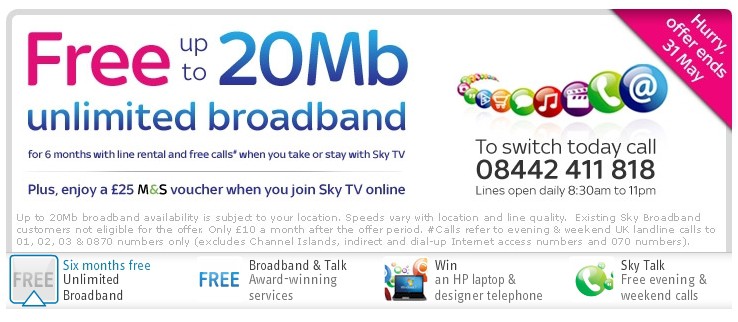
Sky has announced it is getting rid of its usage limits and speed throttles for most of its broadband customers.  It’s also giving away a free speed upgrade to up to 20Mbps for its DSL-provisioned broadband service.

“It comes with no usage caps, fair use policies or traffic management, making it ideal for those who want the freedom to download emails, photos, TV programs, movies and games. It’s also ideal for those who want to access live and on-demand TV through Sky Player,” Sky said.

That may be part of the plan.  Sky, a satellite television company serving the United Kingdom, is preparing to launch new video on demand features that will work in conjunction with its broadband service.  Delivering faster access, without limits, could be part of the equation of making their video on demand service a success.

For occasional broadband users who don’t exceed 2 gigabytes of use per month, Sky is giving free usage-limited broadband service to customers who also subscribe to Sky’s telephone service.  For those that don’t, the 2 gigabyte-capped service costs £5 ($7.59US) per month.

For those looking for unlimited service, Sky Unlimited is available for £7.50/$11.38 per month for Sky customers with Sky Talk or £12.50/$18.97 per month for those without.  In the United Kingdom, line charges for the phone line are broken out from broadband pricing and have to be considered towards the total monthly cost for broadband service.  Line rental from BT costs £12.50/$18.97 a month for customers who pay by direct debit and receive paper billing (£11.25/$17.08 with paperless billing).

Sky requires a 12 month service commitment.  These prices and plans take effect June 1st.  New customers can get a promotion offering six months of free broadband service, including line rental, when signing a 12-month service commitment.

New customers can get six months of broadband service for free when signing up

Is there a downside to this offer?  Not as far as usage limits are concerned.  However, the service is dependent on BT-provisioned DSL phone lines, which can create great variability in the maximum actual speeds customers receive.  The further away from a BT exchange office, the slower the maximum speed a customer will achieve.

But for existing Sky satellite customers looking for a discount on bundled service and an end to worries about monthly usage or speed throttles, Sky Broadband is a welcome relief for those tired of Internet Overcharging schemes.

It’s also one fewer example North American providers can point to as an excuse to attempt Internet Overcharging schemes of their own.

T-Mobile Dumps Overlimit Fees, Reduces Speeds for Customers Exceeding 5GB Per Month

Last year I participated in an online focus group about wireless broadband pricing.  The subject was consumption billing vs. usage limits — do consumers value unlimited broadband plans with overlimit fees more than strict usage caps that cause speeds to plummet for customers who reach them.  Also under consideration were various usage allowances sold at different price points.  Focus group members could rate the plans’ acceptability from a scale of “extremely interested” to “would not consider this plan.”  It took me mere minutes to work my way through dozens of combinations, rating them all unacceptable.  Participants were next directed into an online forum to discuss the different plans amongst ourselves, with a moderator focusing and encouraging discussions.

Inevitably, I was asked why I rated every plan on offer as not worthy of my consideration.  My short answer was that while I understand wireless was not presently a limitless resource, the plans suggested all included overlimit fees or plan allowances that would-be customers had to choose, many with no insight into what their monthly usage could or would be.  Not on offer was a true consumption plan that charged wireless customers only for what they used during a month.  If they didn’t use it at all, no bill would result.  My bottom line — customers should not have to take a crash course in data consumption to predict their usage or face steep penalties when they guessed wrong.

T-Mobile has found a third way, although Cricket’s wireless broadband service beat them to it well over a year ago.

The company’s new 5GB wireless broadband plan offers a traditional usage cap every mobile broadband customer is familiar with, but imposes no overlimit fees on customers that exceed it.  Instead, they reserve the right to dramatically reduce your speed until the next billing cycle begins.  T-Mobile representatives tell Stop the Cap! the company won’t automatically impose the speed throttle unless customers have a history of regularly exceeding their usage allowance (or dramatically exceed it.)  T-Mobile also may forgive a customer for an occasional breach, dropping the speed throttle for those who contact customer service and ask.

This effectively matches Cricket’s pricing and usage plan, which may cause that carrier to consider increasing usage allowances or reducing the price to compete.

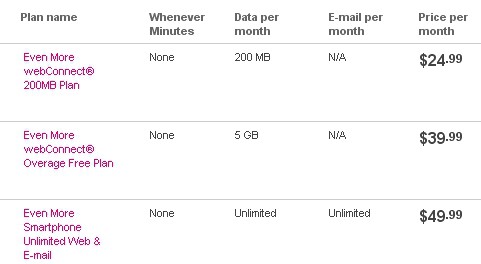
T-Mobile's data plans for mobile broadband and smartphones

Broadband Reports notes that the 200 megabyte plan still requires overlimit fees, but they’ve been cut in half from 20 cents per megabyte to 10 cents.

Larger carriers like AT&T and Verizon still impose overlimit fees on their usage-capped wireless broadband accounts.  Cricket sells a $50 10 gigabyte usage allowance plan through Wal-Mart as well.

North Carolina State Senator David Hoyle: Fiber Could Be Dead Within Five Years So We Shouldn’t Bother

Back in 2006, Alaska Senator Ted Stevens emphatically declared that the Internet was not a truck, but rather a series of tubes.  That’s why Net Neutrality was such a bad idea, get it?

[flv]http://www.phillipdampier.com/video/Senator Ted Stevens on Net Neutrality.mp4[/flv]

Senator Ted Stevens Infamous “Series of Tubes” Speech from 2006.  (11 minutes)

Fundamentally misunderstanding technology and the Internet is not exclusively the domain of an ex-senator from the State of Palin, however.

North Carolina State Senator David Hoyle (D-Gaston County) managed to illustrate he didn’t know what he was talking about either.

Hoyle’s pretzel-like logic, in opposing municipal fiber broadband projects in the state, is that fiber optics could be obsolete within five years, so we shouldn’t even bother with them:

“You know the technology’s changing daily. Five years, ten years from now … wireless could replace most of fiber optics of coaxial cable or, or copper even. Might become not totally obsolete, but their ability to, uh, you know, to fund the debt service from the hard assets they had to put into the ground.”

If one extends that reasoning to his good friends in the cable and telephone industry — if fiber is potentially obsolete in five years, what about the phone company’s copper wires and the cable company’s coax?  Copper wiring was used for telegraphy starting in the 1830s and is still the backbone of today’s telephone networks.  Coaxial cable was invented in 1880 and still runs into virtually every cable subscriber’s home.  The first commercial application for a fiber optic communications system came in 1977.  In fact, most experts believe fiber optics will be the platform for America’s telecommunications network for at least the next quarter century.  The cable industry promotes its own use of fiber, and forward thinking phone companies like Verizon are relying on fiber to the home networks to stay relevant for the future.

Sen. David Hoyle (D-NC)

Fiber optic has all of the advantages:

SPEED: Fiber optic networks operate at high speeds – up into the gigabits and still rising
BANDWIDTH: large carrying capacity, and growing larger as advances continue
DISTANCE: Signals can be transmitted further without needing to be “refreshed” or strengthened.
RESISTANCE: Greater resistance to electromagnetic noise such as radios, motors or other nearby cables.
MAINTENANCE: Fiber optic cables costs much less to maintain, and upgrades can occur without disturbing existing cable — just switch the laser technology used.

The costs to construct fiber networks, which used to be in the thousands of dollars per household, is now well under $1,000 for companies like Verizon.  Keeping happy customers and having the ability to market phone, broadband, and television services across an all-fiber network open new revenue streams which help defray initial expenses.  Fiber is an investment in the future.

Why isn’t wireless going to make fiber networks obsolete?

Allocating sufficient spectrum to support today’s high bandwidth applications is a practical impossibility, especially considering the politics and in-fighting from current spectrum holders to keep their allocations.  Spectrum is a limited resource, which guarantees limited competition, limited bandwidth, and higher prices.  While wireless applications will continue to be an important part of our communications future, it is unlikely they’ll be the favored method to support high bandwidth content in the near term.  Considering the implications of all of the new cell sites required to provide blanket coverage, it may never survive the inevitable howls of protest from neighborhoods who have to live with the eyesores.

Senator Hoyle opened his mouth and stupid fell out.  He’s not just wrong — his comments also carry implications for his constituents.

The City of Gastonia, along with Gaston County jointly filed an application alongside 35 others here in North Carolina seeking to get Google’s 1 Gigabit Fiber Optic to the Home Network.

How do city officials feel about their representative in the state legislature actively trashing fiber networks?  I will have that answer for you soon.

[flv width=”640″ height=”380″]http://www.phillipdampier.com/video/fiber_obsolete_DS_You_Tube_HQ.mp4[/flv]

Senator David Hoyle (foreground, with back to camera) tells meeting fiber could be obsolete within five years.  (25 seconds)

Search This Site:

Contributions:

Recent Comments:

Your Account:

Stop the Cap!