Home » Broadband Speed » Recent Articles:

Malaysians Beat Back Internet Overcharging Scheme 24 Hours After Broadband Provider Announced It

Phillip Dampier May 13, 2010 Broadband Speed, Data Caps, Telekom Malaysia, Video Comments Off on Malaysians Beat Back Internet Overcharging Scheme 24 Hours After Broadband Provider Announced It

Telekom Malaysia

A scheme to impose usage limits and speed throttles on Telekom Malaysia’s broadband customers was beaten back just a day after the plan was announced.

Malaysia’s largest telecommunications company announced the limitations at the same time in introduced new speed tiers and new pricing for them.

Customers were not pleased when they discovered TM’s UniFi broadband service came with high prices and usage caps:

TM UniFi Broadband Packages

  • 5/5Mbps Service RM149/$46.73 now capped at 60GB per month.
  • 10/10Mbps Service RM199/$62.41 now capped at 90GB per month.
  • 20/20Mbps Service RM249/$78.09 now capped at 120GB per month.

In comparison, residents in nearby Singapore can buy 100Mbps service, with no limit, for RM200/$62.73 per month.

Those who exceed the limits would find their speeds throttled to about 10 percent of the speed they purchased, for the rest of the month.

Telekom Malaysia CEO Datuk Zamzamzairani Mohd Isa said the measures were part of its Fair Usage Policy.

Dato’ Zamzamzairani

“This policy is a standard industry practice to ensure that all subscribers get to enjoy the same web surfing quality,” he said.

Only it’s not standard industry practice, despite that often-heard excuse.  In countries where usage limits are common, those limits are being eased or discontinued as broadband expansion and competition drives the unpopular usage limits out of the market.

Malaysians weren’t willing to wait.

The social media firestorm of protest that followed the announcement forced the company to back down just one day after announcing the Internet Overcharging scheme.

An announcement on Twitter, noting customer feedback, stated “no volume cap 4 all #unifi packages 4 now.”  The company did say it would continue to “reserve the right to enforce a download limit to ensure all UniFi subscribers receive equal service quality,” but that type of language has been standard in service provider agreements for years.

Company officials told The Malaysian Insider customers “may abuse” the service, which is why they wanted the cap.

But customers feel they deserve value for money — the price being charged can be considered high for many countries in Asia even without the cap.

The Star newspaper notes:

With the latest announcement by Telekom Malaysia, many people are rejoicing. Among them is communications consultant Justin Then, who said he’s happy to note that Telekom Malaysia listens to consumers.

“Capping our high speed Internet access doesn’t make sense, if the Government wants Malaysians to seek out knowledge and be innovative,” he said.

A Twitter user, who asked to be identified only as Flo, said she’s glad Telekom Malaysia has decided not to employ the cap for now.

“We are paying a premium for technology that offers super high bandwidth, so a daily cap shouldn’t be applied. There’s no value in that; we would be better off with regular broadband,” she said.

One caveat.  As has been the case with a handful of U.S. providers seeking to monetize your broadband usage, rescinding usage caps today doesn’t guarantee they won’t be back tomorrow.  Indeed, TM has yet to remove them from their website, instead inserting in the fine print, “The monthly download volume policy will not be implemented until further notice.”

[flv]http://www.phillipdampier.com/video/Malaysia Telekom UniFi Promotional Video.flv[/flv]

TM’s slick promotional video unveiling the faster UniFi broadband packages asks y0u to “imagine.”  We did… imagining how in the world we can accomplish all of the things they show in the video with the company’s proposed arbitrary usage limits and speed throttles.  Imagine actually getting the service you paid to receive without a provider imagining how much use = “abuse.”  (6 minutes)

North Carolina Phone & Cable Companies Decry Municipal Broadband While Living Large on Public Tax Breaks Themselves

Sen. David Hoyle (D-NC)

Retiring North Carolina state senator David Hoyle wants to save North Carolina cities from themselves.  Proclaiming that “cities are getting into the broadband business with little or no experience and competing with private enterprise who pay the taxes,” Hoyle continues his push to put a stop to municipal broadband projects in North Carolina.

A week after Hoyle and a few allies on the Revenue Laws Study Committee pushed forward a draft bill that would require public referendums that could be triggered even when making basic repairs to community-owned fiber networks, IndyWeek reports Hoyle doesn’t exactly come to the debate with clean hands.

Rebekah Cowell, in a piece called “Hoyle to municipal broadband: Drop Dead,” notes Time Warner Cable’s PAC contributed $6,000 to Hoyle’s final campaign in 2009.

Hoyle told Cowell he is not swayed by Time Warner Cable’s deep involvement in pushing the legislation forward, despite the generous contribution to his campaign coffers.

“The lobbyists don’t influence me,” he said. “I’m in the pocket of the people that provide jobs for this state, and Time Warner Cable employs 8,500 in this state, and I can’t imagine any one that would want to compete with that.”

Time Warner Cable told IndyWeek it doesn’t philosophically oppose municipal broadband projects, and claims Hoyle’s bill would only apply to a city that chooses to take taxpayer money to build a competing network as if it were a private provider. “We just believe that they should have to operate under the same rules as the private provider,” Melissa Buscher, director of media relations at Time Warner Cable told Cowell. “We do believe people in the community should have a say-so in how large amounts of public monies are spent.”

Buscher

Yet the legislation proposed by Hoyle actually impacts projects that receive no public taxpayer dollars.  Under his proposal, any municipal project seeking private bondholders has to endure an endless series of referendums on everything from initial system approval, construction, refinancing debt, extending service, upgrading the network, and even when basic system repairs are needed.

Time Warner Cable’s concern for public tax dollars only seems to extend to their potential competitors.  The cable operator itself gratefully accepted public tax dollars from the state Department of Commerce, the city of Charlotte, and the county of Mecklenburg to construct a $29 million dollar headquarters building in Charlotte.  Even in smaller communities, the cable operator enjoyed benefits from taxpayers who didn’t have a “say-so in how public monies are spent.”  In December, Marble Cliff Village Council approved an economic development agreement with Time Warner Communications including a five-year tax abatement worth $100,000.

North Carolina’s phone companies also benefit from state taxpayers.  As IndyWeek reports:

A 2009 analysis by Democracy North Carolina [shows] two telecommunications companies, AT&T and Embarq, both benefited from tax breaks on the purchases of telephone equipment that costs the state an estimated $31 million annually in lost revenue. In 2008, political action committees for AT&T and Embarq contributed $140,500 and $151,250, respectively, to legislative candidates, statewide candidates and party committees.

Hoyle apparently has no problem with losing that tax revenue.

Hoyle’s claims that municipal broadband projects hurt North Carolina consumers are untrue in cities like Wilson, the only community in North Carolina that successfully avoided a Time Warner Cable rate increase this year.

Time Warner customers in Wilson are benefiting from Greenlight’s competition. According to a December 2009 presentation before the House Select Committee on High Speed Internet Access in Rural and Urban Areas, Time Warner raised its prices for basic service in the Triangle—as much as 52 percent in Cary—but did not impose any rate hike in Wilson. Nor did the company increase prices in Wilson for the digital sports and games tier, while Triangle customers paid 41 percent more.

Cable and broadband consultant Catharine Rice of Action Audits gave the presentation; she advocates for municipalities that want to build their own networks.

The bill could hurt Wilson’s Greenlight service, even though it’s been installed. “The way the legislation is worded, and how I interpret it,” says Ovittore, “is that if the city of Wilson … had a resident who was digging in their yard—let’s say putting a new mailbox in—and accidentally damaged a strand of fiber, before that strand could be repaired the city would have to go through a referendum and vote, spending endless taxpayer dollars.”

A public referendum could also be required if Wilson wanted to connect an additional household to their existing system, Ovittore said.

Hoyle says that of the $30 million to build the network, Wilson used $12 million of it from the utility account. “People there are raising hell about their electricity bill, and it’s just not right,” he said.

Brian Bowman, Wilson’s public affairs manager, said the city borrowed the $28 million on the private market. As for Hoyle’s $12 million figure, Bowman said, much less—only $3.6 million— had been set aside from the electric fund by City Council in 1989; it was re-designated in 1999. “It has always been part of our funding package,” he said. As for the electric bills, Bowman said they were higher earlier this year because of the particularly cold winter, not the cost of the network.

Wilson accomplished its municipal broadband system without spending a nickle of taxpayer money.  Other North Carolina communities considering similar projects would run into overwhelming problems overcoming Hoyle’s telecom-friendly legislation because of its referendum requirements.

Hoyle told IndyWeek he doesn’t see the need for such projects anyway, claiming fast broadband is already universally available across the state.

“I’ve heard that BS, and it’s just not true—period,” he said. “Anybody that needs service has got served in this state and will continue to get served.”

Hoyle’s words sound a lot like those of Time Warner Cable, which also contends broadband availability is not an issue. “Based on a map of the state done in 2009 by Connected Nation, more than 92 percent of homes in North Carolina have broadband available to them,” said Buscher. “A vast majority of those have two wireline providers, some have wireless providers, plus satellite offers broadband to literally every home in the state. This isn’t an availability issue. Anyone who wants Internet service can get it today.”

Those claims are dubious. Chatham County Commissioner Tom Vanderbeck has advocated for rural broadband access since 2006 in an area where pockets still have only dial-up and DSL. Vanderbeck was recently appointed by the General Assembly to serve on the e-NC Authority, which promotes statewide rural broadband. He calls Hoyle’s bill anti-competitive, one that would discriminate against local government.

[…]

“Requiring a vote, when you have deep pockets that can fight it and put up as much money as they want, while making the project sound like a waste of taxpayer dollars—that would be a tragedy,” she adds.

Anyone who proclaims satellite fraudband represents a credible broadband competing alternative should be forced to use it.

Connected Nation, which Buscher relies on for her numbers, has a board dominated by telecommunications company executives, particularly AT&T.  With their private provider-stacked leadership, they can draw the maps anyway they please, particularly in ways that suggest there isn’t a broadband problem in North Carolina… or anywhere else.  Not as long as they are running it.

Americans for Prosperity, Backed By Big Telecom, Is Back With More Net Neutrality Opposition

[Looking for more great examples of industry-backed dollar-a-holler front groups opposing Net Neutrality? Just click here and set your scroll wheel on turbo because we’ve compiled some examples you won’t believe!]

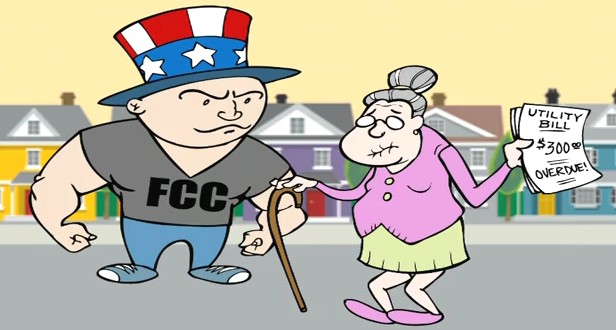
Americans for Prosperity's claim that grandma will face a $300 broadband bill will only become reality if Internet providers get away with Internet Overcharging schemes that would triple the price you pay for broadband service.

Americans for Prosperity, the group that harassed residents of Salisbury, North Carolina last year with push polls and recorded phone messages opposing municipal broadband, is renewing its effort to sign up the tea party crowd to oppose Net Neutrality reforms.

Ostensibly representing those favoring “less government,” AFP is actually a corporate front group founded by oil billionaire David Koch but also backed by telecom interests.  The group shills for large phone and cable companies to keep them deregulated, and opposes consumer reforms.  The group’s spokesman on Net Neutrality is Phil Kerpen — a regular on Fox News — appearing on Glenn Beck’s program to nod in agreement to wild claims that Net Neutrality is Maoist.

Now the group has unveiled a new advertisement opposing Net Neutrality and is spending $1.4 million dollars in its first ad buy.  The 30-second ad targets legislators with wild claims about Net Neutrality that don’t pass even the most rudimentary truth tests.

Comparing Net Neutrality with Washington-directed bailouts of banks and the auto industry, the group claims Washington wants to “spend billions to take over the Internet.”  Apparently the Internet is available for purchase on eBay.

In reality, the only group with the deep pockets is this debate is America’s telecommunications companies, who are among the biggest spenders for lobbyists, astroturf campaigns that claim to represent consumer interests, and writing big campaign contribution checks to state and federal elected legislators.

Establishing Net Neutrality protections doesn’t cost billions.  Fighting against establishing Net Neutrality might.

In fact, the biggest expense the Federal Communications Commission faces in its efforts to adopt Net Neutrality reforms will come from legal expenses brought about by continuous provider lawsuits.

[flv width=”480″ height=”380″]http://www.phillipdampier.com/video/Americans for Prosperity Dont Regulate the Internet Ad 5-2010.flv[/flv]

Americans for Prosperity’s anti-Net Neutrality advertisement claims Washington is spending “billions” to “take over the Internet.”  (30 seconds)

An amateurish animated video accompanying the ad on AFP’s YouTube channel extends the lies into the ionosphere:

  • The video claims the government is preparing to take over the Internet, which is false.
  • It implies the majority of Americans oppose Net Neutrality, also false.
  • The video suggests that businesses will be prohibited from purchasing faster broadband, because under Net Neutrality, everyone will share the exact same broadband speed, both of which are totally false.
  • Grandma, who “only uses the Internet to check e-mail,” will be prohibited from buying cheaper access under Net Neutrality.  More deception.

The video ends with a bleeped expletive.  Real professional.

[flv width=”641″ height=”380″]http://www.phillipdampier.com/video/Americans for Prosperity Animated Anti Net Neutrality Video 5-2010.flv[/flv]

Americans for Prosperity’s animated anti-Net Neutrality video makes wild claims that don’t come close to being h0nest with the viewer. [Warning: Loud Video — Turn Down Volume Before Playing] (1 minute)

Let’s Get Real.

FACT: If anyone is trying to “take over the Internet,” it’s a handful of corporate providers who won’t agree to common sense regulations that guarantee they will not block or impede web traffic.  If they have no intention of engaging in bad behavior, why spend millions of dollars to fight the regulations?

FACT: Americans favor Net Neutrality protections that guarantee net freedom and keep providers from further increasing your broadband bill by monetizing every aspect of the Internet.

FACT: Americans buy broadband based on speed tiers.  Net Neutrality does nothing to change this model.  Any business seeking faster service can continue to acquire it, if they can find a provider to sell it to them.  What Net Neutrality prohibits are Internet Service Providers artificially slowing down your website traffic unless and until you agree to protection payments to take the speed throttles off.

FACT: Most providers sell “Lite” broadband service to those seeking cheaper access or who only need the Internet for basic web browsing or e-mail access.  Some communities even offer basic Wi-Fi access to the Internet for free, and the Obama Administration is proposing to modify the Universal Service Fund to help economically disadvantaged Americans obtain basic web access at a more affordable price.

FACT: The only way a broadband bill is going to achieve the $300 price tag found in this video is if providers are permitted to run roughshod over their customers with Internet Overcharging schemes.  Some earlier proposed broadband “pricing experiments” would effectively triple the price for broadband service Americans pay, but that has nothing to do with Washington.  That can be laid directly at the feet of the same broadband providers who are writing enormous checks to astroturfers like Americans for Prosperity to hoodwink Americans into supporting things directly opposed to their best interests.

Don’t be Americans for Prosperity’s sucker.

Happy Cinco-De-Facto Banning of Municipal Broadband in North Carolina: Sen. Hoyle’s Absurd Proposal

Senator Hoyle's legislation lays the foundation for cable and phone companies to spend hundreds of thousands of subscriber dollars to mail smear campaign pieces like this one from Comcast.

(This piece is written by Jay Ovittore and Phillip Dampier.)

The good news is that all the pushback on an all-out-moratorium on municipal broadband was successful and Senator David Hoyle (D-Gaston) withdrew the idea.  The bad news is he had an even worse idea to replace it.

Hoyle Wednesday unveiled a new draft bill that hopelessly ties up municipal broadband projects into knots of red tape that, if passed into law, will bury municipal broadband projects in North Carolina indefinitely.

Hoyle sprung his telecom-industry-friendly legislation on the public after getting plenty of input and encouragement from the state’s cable and phone companies who already knew what was in it because they helped craft it.

For a retiring state senator who doesn’t have to worry about the next election, what better parting gift can you give to your friends in the cable and phone industry than a bill that preserves the comfortable duopoly they’ve  enjoyed for years.

Hoyle and those supporting the legislation will argue their bill doesn’t ban municipal broadband — it simply places conditions on such projects before they can go forward.  But what are those conditions?

Section One of the draft bill requires local governments to get funding for “external communications services” (ie. municipal broadband) by way of a General Obligation Bond (a GO Bond).  In North Carolina, that requires a taxpayer-funded referendum to be held for public input at the next election.

On the surface, getting public approval for municipal broadband isn’t a bad idea — no local government official expecting to win re-election would ever proceed on such projects without voter support.  But this requirement also gives plenty of advance notice to incumbent providers that a new player could be invading their turf.

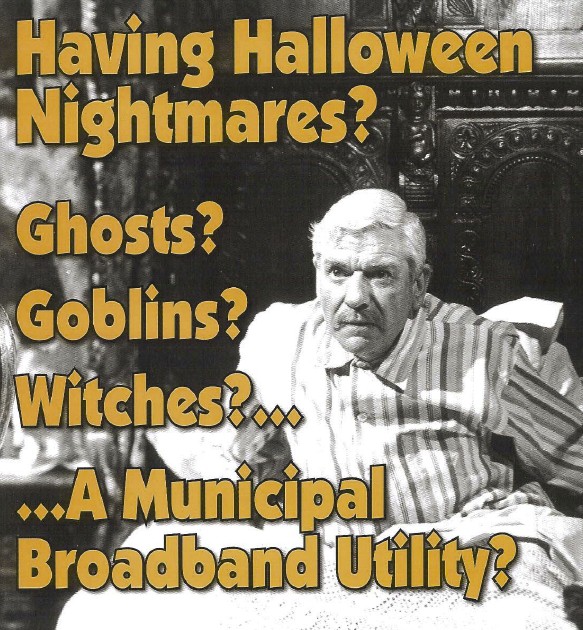
We know what that means.  A well-funded opposition campaign to demagogue the project.  Local cable companies can insert an unlimited number of free ads during every advertising break to slam the proposal.  Phone companies can release a blizzard of opposition mailers to convince consumers it’s as scary as Halloween — all tricks and no treats.

How can a local city or county government respond to the misinformation barrage?  They can’t.  Public officials can’t spend taxpayer dollars to promote such projects or refute industry propaganda.  They can’t even financially assist a citizen-run campaign.

That’s a fight with ground rules only Don King could love.

In the end, that leaves ordinary citizens of North Carolina facing down a multi-billion dollar statewide consortium of telecommunications interests hellbent on preserving and protecting the status qu0.

The earlier-discussed moratorium was a brick wall against municipal broadband.  Hoyle’s bill is the Great Wall of China with the logos of AT&T, Time Warner Cable, and CenturyLink plastered all over it.

But wait, there’s more.  To deal with municipal broadband projects that got an initial green light to dare to interfere with the phone and cable industries’ grand business plans, another provision provides a near endless supply additional referendums to get rid of the projects.  Hoyle’s bill actually demands more votes should existing systems need:

  • refinancing to reduce the interest rate or restructure existing debt;
  • to make repairs to the system’s “fixtures;” and/or
  • to upgrade the system to meet subscribers’ needs.

Ponder the insanity:

  • The legislation could be interpreted to demand a public referendum if your service goes out.  Can you wait until the next election to get back your cable service?
  • If a municipal broadband fiber cable falls in your backyard, does it make a sound?  It won’t, but you will when you learn that cable might not be reattached to the pole until the whole town holds a referendum about it;
  • Would you be upset if your local municipal provider could refinance its debt at a much lower interest rate, letting them cut their prices, but they can’t before the next election?
  • While cable and phone companies refuse to upgrade their service to levels that would have made such municipal alternatives unnecessary, they also want to make certain the one provider that did meet your needs can’t upgrade… without a public vote.

These systems are not constructed with public tax dollars, but Senator Hoyle wants every citizen in a community, subscriber or not, to ponder the future of a local municipal broadband provider.  It’s like giving AT&T veto power over Time Warner Cable’s channel lineup.  Guess who has to pay for these constant referendums?  Taxpayers.  So while Senator Hoyle complains municipal broadband costs the state tax revenue, his legislation guarantees increased government spending on pointless referendums.  That’s logic only a politician working for the interests of big cable can appreciate.

For the cable and phone companies, and their good friends in the North Carolina legislature, this is their idea of a level playing field.  In reality it’s about as level as a downhill ski run.

Let’s extend that “fairness” out to incumbent cable and phone companies and consider whether you got a vote on:

  • Whether or not the cable and phone companies got to put their wires on phone poles plunked down in front of your house;
  • Whether or not you wanted either company to dig up your yard to bury their wiring;
  • Whether you wanted that giant metal refrigerator-sized metal box installed on your street, in your yard, or on the phone pole you see from your window every day;
  • Whether or not you want the cable company to repair Mrs. Jenkins’ problems with HBO up the street whenever it rains or replace the cable the squirrels chewed up;
  • What channels and services you want to pay for, which ones you do not, and at what price you need to pay your local phone or cable company.
  • What cable or phone company gets to provide service in your community.

Apparently the fairness concept only applies to potential new competitors, not the existing providers.

Let’s also consider the cable television industry didn’t just magically bloom into a multi-billion dollar business without government help.  In the early days of cable television, investors were assured that they were financing a monopoly provider, guaranteed through a franchise agreement process that gave newly built cable companies exclusivity to help repay construction costs.  Franchise wars broke out between 1978 and 1984 as competing companies promised the moon with state-of-the-art two-way cable systems with the capacity to offer 70 or more channels.  The players then included Time’s American Television and Communications Corporation, Warner’s Amex, and Telecommunications, Inc. (TCI).  ATC and Amex would later evolve into Time Warner Cable and TCI became AT&T Cable before being sold to Comcast.  Communities seeking cable television for their residents would later learn a lot of these promises made were promises broken – reneged on by large cable companies with few, if any consequences.

During the Reagan Administration, then-FCC Chairman Mark Fowler bestowed additional deregulation benefits on the cable industry.  The Museum of Broadcast Communications explains:

The Cable Communications Policy Act of 1984 addressed the two issues that still hindered cable television’s growth and profitability: rate regulation and the relative uncertainty surrounding franchise renewals. Largely the result of extensive negotiation and compromise between the cable industry’s national organization, the National Cable Television Association, and the League of Cities representing municipalities franchising cable systems, the act provided substantial comfort to the cable industry’s future.

Its major provisions created a standard procedure for renewing franchises that gave operators relatively certain renewal, and it deregulated rates so that operators could charge what they wanted for different service tiers as long as there was “effective competition” to the service. This was defined as the presence of three or more over-the-air signals, a very easy standard that over 90% of all cable markets could meet. The act also allowed cities to receive up to 5% of the operator’s revenues in an annual franchise fee and made some minor concessions in mandating “leased access” channels to be available to groups desiring to “speak” via cable television.

Additional reforms guaranteed pole attachment rights to the cable industry so they could wire and service their network unencumbered by utility company interference or high pole attachment fees.  Cable consolidation allowed formerly mom and pop cable systems to become part of a cable industry where just a handful of cable companies provide service to the majority of cable households.  Countless millions are spent each year by the industry to lobby state and federal governments to keep the party going without regulatory interference, suggesting competiti0n alone is the only regulation required.

Except when a new competitor enters the market, of course.  Fearing competition from municipal providers who will force cable and phone companies to charge reasonable rates and upgrade service, the best possible solution is to find a way to ban such projects.

Forcing regular referendums and the complexities and expenses associated with them guarantees no community in North Carolina would ever bother with the onerous requirements to launch municipal broadband projects.

That’s not just Jay and I saying that.  What Hoyle has proposed hardly breaks new ground.  It’s the same dog and pony show the industry has brought to other states to stop competition and keep prices high and service slow.

So let’s learn from the painful experiences of others:

First lobbying for legislation requiring referendums and then winning it, SBC (later AT&T) and Comcast used the opportunity to spend more than $300,000 of their subscribers’ money to launch a major misinformation campaign with misleading and inaccurate mailers that successfully fought off a proposition to deliver better and cheaper service through a municipal broadband project in Batavia, Geneva, and St. Charles, Illinois.  Fiber for Our Future documented the whole sordid affair from start to finish as a lesson to others confronting industry-backed referendum requirements.

[flv]http://www.phillipdampier.com/video/unproven.flv[/flv]

Want a preview of the distortion and misinformation-campaign cable and phone providers will bring to stop municipal broadband?  Watch this SBC (today AT&T) executive tell city officials in Illinois that fiber is “unproven,” that the phone company’s DSL speeds are comparable to Comcast Cable, and that consumers don’t need the 3Mbps speed the company was delivering back in 2004 when this video was taken.  “What are you going to do with 20 megabits.  I mean, it’s like having an Indy race car and you don’t have the race track to drive it on.”  (3 minutes)

Longmont, Colorado spent years suffering with bad broadband service from Comcast and Qwest and sought a better alternative with a municipally-run provider.  But then the cable and phone giants spent $200,000 to put a stop to that.  While local subscribers may have preferred that $200,000 be used to reduce their rates, for Comcast and Qwest it was an investment in maintaining future pricing only duopolies can achieve, all while delivering “good enough for you” broadband service to Longmont residents.  In 2006, the Baller Herbst Law Firm collected information on industry-backed barriers to municipal broadband, and the list went on for nine pages.  Many of them sound eerily familiar to what Hoyle proposes (after cable and phone companies whispered time tested, industry proven ideas into his ear).

The city of North St. Paul, Minnesota has advice for states like North Carolina after their own experience with a coordinated industry-backed smear campaign against municipal broadband enabled by legislation similar to what Hoyle proposes:

What should be of interest to all communities was the organized opposition.  It appears that the incumbent providers, industry associations and politically conservative think tanks teamed up to promote negative news stories, do polling and opposition phone calls, provide transportation for identified “no” voters and create web sites.

While we heard some advocates lamenting this high priced anti-municipal fiber effort, this response is something that community leaders must expect and be prepared for.  A strong community education and mobilization effort must be a part of any municipal telecommunications initiative.  A coalition of business owners and residents must be created and maintained that can counter the expected efforts of the incumbent providers.  The benefits of the community-owned network should be documented and promoted so that an overwhelming majority of voters will choose to vote yes.  We hope that, one way or the other, North St. Paul gets the “More, Better Broadband” that the MN Broadband Coalition supports.

Of course, when local communities are banned from spending a nickel on advocacy for their projects, it effectively hands a restraining order to broadband advocates who can’t even get on the playing field, level or otherwise.

Outraged yet?

It will only get worse if Hoyle’s bill ever becomes law.  Residents in communities like Salisbury endured a sampling of the kind of negative campaign this industry will launch wherever municipal broadband competition threatens to appear.  In 2009, residents were hassled with push-polling phone calls from industry-backed astroturf groups claiming to represent ordinary citizens, but were actually little more than sock puppets for big telecom.  Your mailbox will be filled with blizzards of misleading mailers that current cable and phone customers pay for.  If they need more money, they can always raise your rates to cover the difference.  In the end, with the help of elected officials who don’t care about North Carolina consumers, existing municipal projects can bleed themselves dry (later to be used by the industry as “failed examples” to claim such projects are too risky to try) and proposed ones will never see a spade plunged into the soil to bury the first strand of fiber optic cable.

But it’s not all bad news.  It doesn’t have to happen this way.  You can tell your state representative you are watching them like a hawk on this issue.  Any “yes” vote for legislation like that proposed by Senator Hoyle is a no vote for them at the next election.  Let them know you are well aware of the game plan here — it has been tried in other states with similar legislation that is little more than protectionism for big telecom. Tell your elected officials you already have the power to choose whether or not you want these projects simply by voting for or against the elected officials that propose them.  While the concept of a referendum sounds fair on the surface, it’s not when you consider the past experiences of other communities who faced well-funded opposition campaigns, helpless to correct the record or fairly argue their position on the matter.  Providers know that, which is why they advocate this type of legislation in the first place.  It effectively stops competition, stops better service, and stops North Carolina residents from enjoying lower priced cable, phone, and broadband service.

There are a few stand-up representatives of the people of North Carolina who do deserve our gratitude and thanks today.

Rep. Paul Luebke, (D-Durham County) (who co-chairs the Revenue Law Study Committee) [email protected] 919-733-7663 College Teacher

Rep. Jennifer Weiss, (D-Wake County) [email protected] 919-715-3010 Lawyer-Mom

They both will likely face fierce opposition from the incumbent providers and their fellow legislators. Please take the time to thank them for standing with consumers today and for trying to protect the future of North Carolina and its economy.

Stop the Cap! will have video of today’s remarks by both legislators soon.  We hope to follow with a complete video record of today’s events surrounding the anti-competition legislation proposed by Senator Hoyle.  It will serve as a testament to just how much work we have to do to remove legislators who have stopped representing the public interest, and renew our support for those who stand with consumers.

Meanwhile, check out these two delightful pieces paid for by the cable and phone industry, sent to homes where municipal broadband projects faced a referendum in 2003 and 2004.  More than a dozen different mailers were sent to every home in the communities of Batavia, Geneva, and St. Charles, Illinois from phone and cable companies.  Now imagine the repercussions when not one of those communities could respond with their own mailers correcting the record and giving their side of the argument.  There is a reason why special interests spend enormous sums of money to protect their turf, and the battle is over before it even begins when those interests demand the other side not have the opportunity to respond in kind.

What smears do providers in North Carolina have in store for you?

… Continue Reading

Liberals Promise Universal Broadband Across Rural Canada – Join Today’s Online Town Hall at 3:30pm EDT

Phillip Dampier May 5, 2010 Broadband Speed, Canada, Data Caps, Editorial & Site News, Net Neutrality, Public Policy & Gov't, Rural Broadband Comments Off on Liberals Promise Universal Broadband Across Rural Canada – Join Today’s Online Town Hall at 3:30pm EDT

(The Liberal Party is sponsoring an online town hall meeting this afternoon at 3:30PM EDT on the issue of expanding broadband in rural Canada.  Why not join in and demand that Michael Ignatieff commit to reforming the Canadian Radio-television and Telecommunications Commission, which has landed Canada in a real broadband mess filled with Net Neutrality violations and Internet Overcharging schemes like usage caps and consumption billing.  The CRTC has been so submissive to Canadian telecom, they might as well be their trade association.

Tell him rural broadband expansion doesn’t do much good if the existing providers, which got Canada into this mess, are still in charge of running it.  Real broadband reform requires a government committed to universal broadband that works for Canadians and doesn’t simply profit from them.  Demand Net Neutrality commitments from the Liberal Party and an end to overcharging schemes.  Universal broadband doesn’t mean much to Canada if Canadians can’t use it without fear of overlimit fees and enormous bills at the end of the month. — Phillip Dampier)

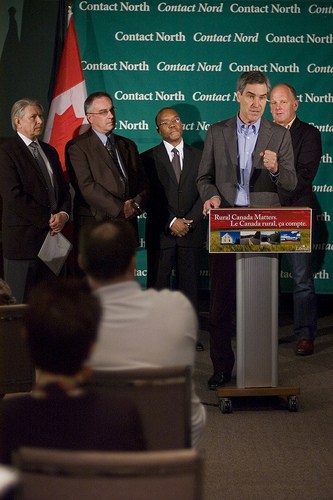
Ignatieff announces the Liberals' rural broadband plan at Contact North in Thunder Bay, Ont.

The Liberal Party of Canada has promised rural Canadians they will not be left behind the digital online revolution, unveiling a promise Tuesday to deliver universal broadband access to all Canadians within three years of taking office.

Michael Ignatieff, Liberal leader made the commitment as part of a series of planks the party introduced under its “Rural Canada Matters” platform to attract support from rural Canadians, who tend to vote Conservative.

“Too many rural communities can’t get access to essential services, because we don’t have the digital infrastructure to deliver them,” said Ignatieff. “That’s why I’m committing a future Liberal government to 100 percent high-speed Internet for every rural, remote and Northern community in our country.”

According to Ignatieff, using proceeds from a 2011 wireless spectrum auction, a Liberal government would invest to achieve an interim target of 100 percent high-speed Internet connectivity of at least 1.5 Mbps. A Liberal government would also seek to set a more ambitious goal for 2017, Canada’s 150th anniversary as a country.

The Liberals blasted the incumbent Conservatives for breaking their promise to deliver rural broadband to Canadians.

In 2006, Canada’s Telecommunications Review Panel recommended the federal government achieve 100% high-speed Internet connectivity by 2010. This goal was not achieved under the Conservative government.  According to the CRTC, in 2009 close to 800,000 Canadian households still did could not access high-speed Internet – or 20% of all rural Canadians. At the turn of the century, Canada ranked second in the world in Internet connectivity, but has now fallen to tenth place.

Ignatieff announced the plan in Thunder Bay, Ontario at an Internet access center run by Contact North.  He characterized the current state of broadband in Canada as threatening the country’s economic competitiveness and quality of life for rural residents.

“While railways and highways were the essential infrastructure of the 20th century, fiber optic lines, satellites and wireless towers, are the digital infrastructure needed to connect our communities and strengthen our economy in the 21st century,” said Liberal Rural Caucus Chair Mark Eyking, “In all regions of Canada, families and businesses depend on access to the Internet and mobile phone coverage.”

New Democratic Party (NDP) MP Bruce Hyer (Thunder Bay-Superior North) praised the Liberal plan.

The Liberal Party is trying to capture an increased share of traditional Conservative Party supporters with a rural-focused agenda

“Obviously, country-wide broadband is a good idea,” Hyer told The Chronicle-Journal newspaper in Thunder Bay. “And there should be virtually no community of any size in Canada, and nowhere along the Trans-Canada, for sure, that we don‘t have high-quality mobile phone access and service. The United States has those things, and we should have them, too.”

But NDP MP John Rafferty (Thunder Bay-Rainy River) told the newspaper he’s heard it all before.

“Liberals have been talking about rural broadband access for a decade now,” he said. “The interesting thing is that he says rural Canada matters. But clearly it hasn’t mattered to Liberals for a long time, or else we would’ve had broadband.  They had a chance to do this. What they’re doing is regurgitating old promises.”

Rafferty said the Liberals first brought it up in 2001, and said then it would cost $4 billion.

“I’m not sure where he comes up with ($500 million).”

Another concern for the Liberal Party plan is the fact it relies entirely on private providers to deliver the service, something they have refused to provide many rural Canadians thus far.  In effect, the government would transfer $500 million dollars earned from large telecommunications companies buying additional spectrum and then hand it all back to those same companies to construct slow speed broadband services they can then profit from.

While many Canadian officials blame Canada’s large rural expanse for the digital divide, others blame Canada’s broadband providers who have engaged in usage-limiting schemes, increased prices, and throttled the speeds of certain broadband services.

Country

Universal Service Target

Target date

US 4 Mbps 2020
UK 2 Mbps 2012
Canada (Liberal Proposal) 1.5 Mbps within 3 years of being elected
South Korea 1 Mbps Currently available
Finland 1 Mbps Currently available
Ireland 1 Mbps 2010
Germany 1 Mbps 2010
France 0.5 Mbps 2010

Search This Site:

Contributions:

Recent Comments:

Your Account:

Stop the Cap!