Home » Broadband Speed » Recent Articles:

Frontier Gets FCC Approval for Its Verizon Takeover; You Get 5GB Usage Allowances, 3Mbps DSL and No Fiber

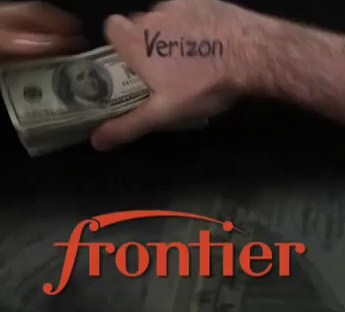
Take the money and run

The Federal Communications Commission’s approval of Frontier’s takeover of 4.8 million Verizon landline customers in 14 states comes a year after the company announced the deal.  Frontier joins three other independent phone companies — FairPoint Communications, Windstream Communications, and CenturyLink zealously trying to grow their companies with additional mergers and acquisitions to avoid being swallowed up themselves.

What is common among all four companies is they rely heavily on dividend payouts to keep their stock price as high as possible.  That was a formula for disaster for FairPoint, the first of the four to end up in bankruptcy after a similar deal with Verizon in northern New England caused the company to falter.  Service and billing deteriorated, customers fled, and promises for better broadband were broken.  Now Frontier is following in FairPoint’s footsteps with more than 4.8 million new customers Frontier hopes they can swallow.

The FCC’s statement approving the merger reads like a press release for all involved, and delighted FCC Chairman Genachowski, who called these meager requirements “robust”:

Coming one week after the final state approval for the transaction, the FCC’s Order holds the applicants, Verizon and Frontier, to enforceable voluntary commitments, including:

  • Extend faster broadband to more Americans: Frontier will significantly increase broadband deployment for the lines involved in this transaction, only 62 percent of which are broadband-capable today. Specifically, Frontier will deploy broadband with actual speeds of at least 3 Mbps downstream to at least 85 percent of transferred lines by the end of 2013, and actual speeds of at least 4 Mbps downstream to at least 85 percent of the transferred lines by the end of 2015, with all new broadband deployment offering actual speeds of at least 1 Mbps upstream.

Frontier's Fast One: 3 Mbps DSL Service with a 5GB Monthly Usage Allowance

Frontier’s broadband commitment gives the company a full five years to meet the bare minimum speed considered to constitute broadband in the National Broadband Plan.  One hopes Frontier doesn’t break into a sweat offering a piddly 3 Mbps service to homes using yesterday’s DSL service until then.  While Verizon’s rural castoffs get stuck eventually with 4 Mbps DSL, many of the company’s remaining customers are enjoying 50Mbps service over an all fiber network.  The FCC is accepting an urban-rural divide for broadband which will benefit the phone companies while leaving rural customers in the dirt.

  • Deploy fiber to libraries, hospitals, and other anchor institutions: Frontier will launch an anchor institution initiative to deploy fiber to libraries, hospitals, and government buildings, particularly in unserved and underserved communities.

Fiber for these locations sure, but no fiber for you or I.  Frontier, like most other telecom companies, loves to promote the benefits of fiber without actually deploying it to homes.

  • Promote competition: Frontier and Verizon have made a series of commitments to protect wholesale customers, including honoring all obligations under Verizon’s current wholesale arrangements that are in effect at closing.

Since wholesale customers often depend on the same network other customers do, if a company doesn’t deliver robust broadband into a state like West Virginia, there isn’t a robust service to sell to those wholesalers.

  • Improve data quality and collection: Frontier will make available to the Commission data on its broadband deployment progress at an unprecedented level of detail to enable effective monitoring of Frontier’s compliance with its commitments.

The Commission concluded that the commitments that applicants have offered, coupled with monitoring and enforcement by the Commission, will minimize the risks of harm and ensure that this transaction is in the public interest.

Phillip "Living on the Frontier" Dampier

Considering how weakly the FCC is committing itself to protecting rural customers from being dumped into the broadband backwater Frontier has on offer (complete with the 5GB monthly usage allowance), does collecting statistics help when things go sour?  Regulators collected statistics in New England when FairPoint failed, but that didn’t get service levels back until Maine, New Hampshire, and Vermont threatened to toss FairPoint out.  Now the company is in bankruptcy and regulators are negotiating which of the promises FairPoint made can be let go ‘for the sake of the company.’

That’s why it’s so ironic to read editorials that proclaim the FCC is on some sort of power grab when they seek to restore what meager authority they exercised over broadband before a DC Court effectively excluded broadband oversight from their portfolio.

It will be a good day when federal agencies like the FCC start worrying first and foremost about consumers instead of how to make a parade of overpriced mergers and acquisitions succeed for the companies involved.

[flv width=”480″ height=”380″]http://www.phillipdampier.com/video/WANE Ft Wayne Verizon hanging up on local landlines 5-24-10.flv[/flv]

WANE-TV in Fort Wayne warns viewers their landline company is about to change asVerizon vacates the area by July 1st.  (1 minute)

[flv width=”480″ height=”380″]http://www.phillipdampier.com/video/CWA Verizon Dont Take the Money and Run in WV.flv[/flv]

Too late.  The Communications Workers of America ran this ad spot asking the West Virginia governor to intervene and stop the sale.  (1 minute)

AT&T Tries to Solve Wireless Congestion in NYC By Giving Away Free Wi-Fi

Phillip Dampier May 26, 2010 AT&T, Broadband Speed, Consumer News Comments Off on AT&T Tries to Solve Wireless Congestion in NYC By Giving Away Free Wi-Fi

AT&T is having trouble meeting the wireless needs of its customers in major cities like New York and San Francisco, so it is experimenting with free Wi-Fi connections in particularly crowded parts of its service area.

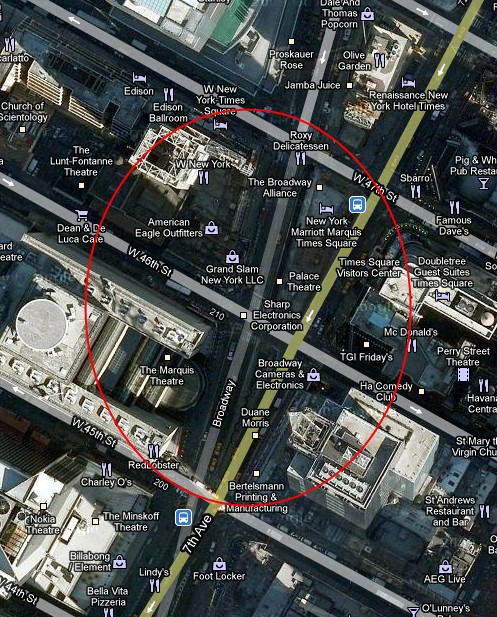
AT&T’s Wi-Fi “hotzone” launched Tuesday in Times Square.  The service has been installed near 7th Avenue between 45th and 47th street, and is designed for outdoor users.  Any AT&T customer can connect to the service with any Wi-Fi capable device.

AT&T has been promoting free use of its indoor Wi-Fi connections for customers for well over a year because it helps reduce demand on its 3G mobile broadband network.  Developing outdoor hotzones in densely populated cities like New York could offload considerably more traffic from congested 3G cell sites.

The company hopes that free Wi-Fi will prove more attractive to customers than 3G because it can deliver faster speed connections and won’t suffer from slowdowns that have become all too common on the company’s 3G network.

If the experiment proves successful, AT&T will consider expanding it to other cities where the company faces congestion issues.

AT&T's Hotzone in Times Square covers a narrow outdoor area bordering W. 45th Street and W. 47th Street near 7th Avenue.

Verizon FiOS Availability Increasingly Important in Real Estate Listings and Renter Guides

Phillip Dampier May 19, 2010 Broadband Speed, Competition, Verizon, Video 3 Comments

Real estate listings increasingly are promoting Verizon FiOS availability to would be buyers and renters

Real estate listings that prominently mention Verizon FiOS availability?

It’s true.  The much-coveted fiber-to-the-home service from Verizon has increasingly become important in residential home sales and rentals, according to realtors.  With the housing market still a shadow of its former self, just having broadband access is no longer good enough for many homebuyers and renters.  They want assurances that they can obtain fiber optic service, particularly as Verizon ceases expansion of its fiber deployments for the time being.

Despite claims from some providers that the type of broadband doesn’t really matter, real estate agents, such as those on www.hpw.com/, beg to differ.  The only thing worse than slow broadband is no broadband.  Those homes without broadband access of any kind can be a dead weight in an agent’s portfolio.  Practically nobody wants a home stuck with dial-up.  It’s like buying a home without electricity.

Just closing a sale on property that can only obtain slow speed DSL service or is served by a lackluster cable operator can also be a nuisance if a better provider is available nearby.

Some real estate listings have even begun providing Verizon FiOS certification guaranteeing would-be buyers of renters that FiOS service is ready and available. Look at this listing of Myrtle Beach sc homes for sale to find your next investment property.

None of this escaped Verizon’s attention, of course.  The company has used demand for FiOS in its advertising and communications strategies, and even has a rewards program for real estate professionals who convince buyers they are missing out if they aren’t Verizon FiOS customers.

Verizon claims up to 65 percent of home buyers say fiber optic broadband, including Internet connectivity, TV and phone service is an important and growing part of their home buying decision.

[flv width=”480″ height=”380″]http://www.phillipdampier.com/video/Verizon FiOS Real Estate.flv[/flv]

Verizon produced this video about how important their FiOS product is becoming to home buyers and renters.  (2 minutes)

[flv]http://www.phillipdampier.com/video/Verizon Agent Rewards Program benefits Real Estate with FIOS.flv[/flv]

Verizon has an Agent Rewards Program that rewards real estate professionals with $100 gift cards for signing up home buyers and renters for Verizon service.  (1 minute)

Time Warner Cable Discovers “Wideband” Broadband Is Exciting Despite Pooh-Poohing It Earlier

Time Warner Cable's DOCSIS 3 service is marketed as "wideband"

Time Warner Cable has made its DOCSIS 3 wideband broadband service its star at the 2010 Cable Show in Los Angeles.  Demonstrating up to 290Mbps service, company officials are suddenly excited about the prospect of delivering 21st century broadband speeds just one year after foot-dragging their way through upgrade plans for their cable systems nationwide.

Time Warner Cable has been among the slowest to deliver channel-bonded broadband service to its residential customers.  Currently marketed mostly in areas where Time Warner faces competition from Verizon FiOS or AT&T U-verse, DOCSIS 3 upgrades deliver faster speed tiers to its customers and reduce congestion.  At the top end, Time Warner residential customers can purchase 50/5Mbps service for just under $100 a month.  Because of its premium price tag, the company hasn’t had too many takers.  As of the fourth quarter of last year, just 2,000 customers signed up.  But the trends are clear — if the price comes down, adoption rates will increase.

For business customers, the price isn’t cheap either.  In Cincinnati, for example, Time Warner business customers face $350 a month for 50/5Mbps service.  Contrast that with Comcast in San Francisco, which charges businesses $189 a month for the same thing.

If Time Warner Cable is as enthusiastic about wideband as it suggested during this year’s Cable Show, it should be firing up its upgrade plans to deliver the service to all of its customers and attempt some new marketing that brings service at a more aggressive price.

In New York, Time Warner Cable’s DOCSIS 3 upgrades have so far skipped cities like Rochester, which faces only token competition from Frontier Communications’ DSL service.

[flv width=”480″ height=”380″]http://www.phillipdampier.com/video/TWC 2010 Cable Show – Chief Marketing Officer Sam Howe.flv[/flv]

Time Warner Cable employees and chief marketing officer Sam Howe fall all over themselves, ecstatic with Time Warner Cable’s wideband broadband service, in this company-produced video taken at the 2010 Cable Show in Los Angeles.  (4 minutes)

Time Warner Cable Demonstrates 290Mbps Broadband; Company Also Plans to Upsell Customers ‘Homesuite’ in Charlotte, N.C.

Phillip Dampier May 13, 2010 Broadband Speed, Consumer News 6 Comments

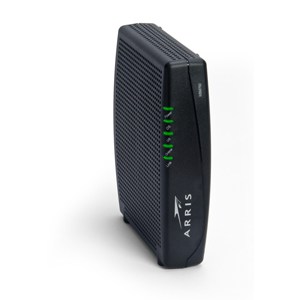
Arris WBM760 DOCSIS 3 Cable Modem

Time Warner Cable is demonstrating 290Mbps downstream coupled with 90Mbps upstream broadband in its booth at the 2010 Cable Show in Los Angeles.  A Time Warner Cable insider told CED magazine it was the first public showing of the company’s ability to provide faster service outside of a lab environment.

The new high speeds are achieved using DOCSIS 3 technology which can bond multiple “channels” on a cable system together to create additional bandwidth.

The demonstration relies on an Arris CMTS and cable modems manufactured by both Arris and Motorola, which are connected to Time Warner’s Los Angeles cable headend.

CED notes Time Warner Cable has plenty of room for broadband speed growth.

The company is achieving the speeds using 8 x 4 channel bondingClick here!. With TWC’s top tier rated at 50/5 Mbps, the demo shows speed increases of greater than fivefold on the downstream and 18-fold on the upstream.

The TWC engineer compared the MSO’s achievement with the 300 Mbps that Bell Labs demonstrated on DSL recently.

“What they’ve got is something in the lab that goes 10 feet, and what we’re showing is live from our headend 22 miles away. We can compete (using) DOCSIS,” he observed.

Such developments are all part of a larger company plan to develop and market additional services the nation’s second largest cable operator can upsell to its customers.  For now, 290Mbps service is more theoretical than practical at Time Warner Cable’s likely pricing.  But it illustrates cable remains technologically ahead of what most phone companies can deliver over non-fiber-to-the-home networks.

MediaPost’s MediaDailyNews reports Time Warner Cable is about to begin market testing a new super-deluxe package that moves beyond the “Triple Play” packages common in the cable industry today.  Targeting wealthy, premium cable customers, Time Warner’s new “Homesuite” service would include all the bells and whistles:

  • Multiple DVRs for several rooms in the house, with can eventually be connected together to let you start a recorded show in one room and finish it in another;
  • A full range of premium channels at a bundled discount price;
  • Faster DOCSIS-3 broadband with free Wi-Fi in and outside the home;
  • Enhanced digital phone service, perhaps with more calling features;
  • Concierge-like customer service, which could allow Homesuite customers to jump to the front of the queue for everything from service installation, repair and customer service.

Other options might include access to Time Warner’s wireless mobile broadband (rebranded Clearwire service), extended hours for service calls, discounts on pay per view, more deluxe set top boxes, and in some areas, even home security systems.

For Chief Operating Officer Landel Hobbs, the idea of selling $100 a month Triple Play package promotions just isn’t good enough anymore.  Time Warner Cable, MediaPost speculates, is now looking at $250 a month as a potential target price for Homesuite clients.

Time Warner Cable customers in Charlotte, North Carolina will be the first guinea pigs for super premium cable.  Are there enough customers around in Charlotte to pony up $250 a month for service?

TWC has conducted a customer “segmentation” study allowing it to identify opportunities for up-selling. “Our analysis indicates that certain of our large and profitable customer segments continue to hold substantial untapped opportunity,” Hobbs said earlier this year.

TWC says in a recent government filing that it’s likely to continue to lose video subscribers, but is expecting to make up for it by persuading customers to take DVR service, premium channels and other add-ons.

Charlotte is a key market for TWC — a Time Warner Cable Arena is located in the city center. After launching there, “Homesuite” would presumably then roll out in other TWC principal areas, which include Ohio, New York, Southern California and Texas. The working “Homesuite” moniker could be altered.

Search This Site:

Contributions:

Recent Comments:

Your Account:

Stop the Cap!