Home » Broadband Speed » Recent Articles:

Australia’s Prime Minister: ‘We Will Not Allow Anything to Block Our National Broadband Network’

Australia’s current Labor government has refused to compromise on its goal of delivering super-fast broadband service to nearly every Australian, declaring they will get the job done no matter what it takes.

“This government is determined to build a national broadband network and will not let anything get in its way,” declared Prime Minister Kevin Rudd.

Rudd was responding to critics from opposition political parties and some private providers who had been trying to throw up roadblocks to stop the government effort, which many private providers felt ceded too much control to the government.

Rudd’s plans to construct the network were bolstered with the release of a new study showing the construction and operating costs to be lower than previously thought.

Courtesy: Wikipedia

Stephen Conroy

Lindsay Tanner, Australia’s Finance Minister, told colleagues, “The government would get its investment back and also, over the course of the investment, earn a modest return.”

Stephen Conroy, Communications Minister, promised wholesale pricing for the unlimited fiber-based service would range between $17.50-26.30US per month.  Retail pricing for entry-level ADSL broadband service from Telstra currently runs $35US per month, with a 2 GB monthly usage allowance.

Conroy previously threatened Telstra that if it didn’t want to help build the national network at a reasonable price, the government would do it themselves.

Tony Smith, opposition Shadow Communications Minister called Rudd’s insistence on a national fiber network reckless, irresponsible, and risky.

But for Australian consumers long subjected to expensive monthly prices for heavily usage limited service, 100Mbps service — or even slower, unlimited service — represents a major improvement.

[flv width=”512″ height=”308″]http://www.phillipdampier.com/video/Network 10 Aus Cheap Broadband 6-21-10.flv[/flv]

The Ten Network in Australia ran this report on the current Australian government’s unwillingness to compromise away its goal for a national fiber network.  (2 minutes)

[flv width=”512″ height=”308″]http://www.phillipdampier.com/video/Nine Australia National Broadband Plan Study 5-6-10.flv[/flv]

Channel Nine reports on the release of the broadband study showing Australia would save money building their own national broadband network instead of letting Telstra build it.  (1 minute)

Australia: 90 Percent of Our Residents Will Have 100Mbps, Fiber to the Home Service Within 8 Years

Phillip Dampier June 21, 2010 Broadband Speed, Community Networks, Competition, Data Caps, Public Policy & Gov't, Rural Broadband, Telstra, Video Comments Off on Australia: 90 Percent of Our Residents Will Have 100Mbps, Fiber to the Home Service Within 8 Years

Australia is set to leapfrog over the United States and Canada, declaring its intent to deliver fiber broadband service to the vast majority of its citizens within eight years.  The country embarked on a National Broadband Plan more than a year before the United States, declaring the current state of usage-limited, slow, expensive, and incomplete broadband coverage to be unacceptable.

Australia discarded an earlier plan to work with private providers to build the network when government officials faced opposition from private providers who did not want to lose control of the broadband market.  In a surprising decision last September, Prime Minister Kevin Rudd announced the government would commence construction of a fiber to the home network itself, excluding private providers from participation.

NBN Company, a government-owned entity, will construct the $43 billion network over eight years, delivering 100Mbps speeds on a fiber network.  The infrastructure will be designed for an easy upgrade to 1 Gigabit service as bandwidth demand intensifies.

A separate deal concluded today with Telstra, Australia’s largest telecommunications company, will retire the nation’s copper wire landline network and cable systems, to be replaced by NBN fiber.

Up to 37,000 jobs will be created to build the network across the country, supplemented with wireless broadband for Australia’s most rural areas.

But some are complaining the network is too extravagant and expensive, adding their displeasure with the Rudd government’s strong-arming of Telstra to give up its network.

Opposition finance spokesman Andrew Robb said taxpayers would be on the hook for the project.

“It’ll come with a multi-billion dollar taxpayer debt that will have to be paid off over decades,” Robb said, adding if elected, the opposition promises to scrap the plan.

[flv width=”424″ height=”260″]http://www.phillipdampier.com/video/Nine Network New National Broadband Plan 4-6-09.flv[/flv]

Prime Minister Kevin Rudd originally introduced his nationwide fiber network proposal in April 2009.  Channel Nine provides this roundup of the original announcement, media reaction, and a few insults from the opposition.  Just a day after the plan was introduced, Communications Minister Stephen Conroy warned Telstra to “back off,” referring to the company’s immediate lobbying effort to block the proposal.  (11 minutes)

Australian Government Buys Telstra’s Copper Wire Landline Network to Scrap It

Phillip Dampier June 21, 2010 Broadband Speed, Community Networks, Competition, Data Caps, Public Policy & Gov't, Rural Broadband, Telstra, Video Comments Off on Australian Government Buys Telstra’s Copper Wire Landline Network to Scrap It

Prime Minister Rudd announcing the deal between Telstra and the federal government.

Australia has taken the first step towards 100Mbps unlimited broadband service this weekend as an agreement was reached to decommission the country’s copper wire phone network, replacing it with fiber connections to 90 percent of Australian homes.

After months of heated negotiations between Telstra and the federal government, Telstra CEO David Thodey this morning joined Prime Minister Kevin Rudd at the podium to announce the $11 billion deal.  Telstra will agree to scrap its copper-wire phone system and make way for the federal government’s new fiber network.

Rudd claimed the deal would benefit everyone because it would permanently retire an obsolete network with easily-upgradable fiber, connected right to the home.  Under Rudd’s previously announced National Broadband Plan, the government would finance the construction of the fiber network and lease access to any provider, including Telstra, at wholesale pricing.

In addition to an $11 billion offer, Telstra is expected to keep the estimated $580 million the company could earn from recycling more than 70 million kilometers of copper phone wiring no longer needed.  Another $1 billion will be earned from real estate sales.  At least 3,000 telephone exchange offices are expected to be declared redundant after switching to the fiber network, bringing Telstra plenty of additional earnings as those properties are sold off.

“I can’t stress enough just how complex this certain negotiation has been, because we’ve had to look at commercial issues, what the future of the business would be, what the structure of the industry would be, but we have got to this position and we are pleased to have done so, because it does give us clarity, and that’s what this company needs,” Thodey said. “Firstly we’ve got to grow our share of the market, we’ve got to simplify this business to take the unnecessary complexity [out], and we are going to continue now to build and invest in building new products and services to work in an NBN world.”

The agreement gives NBN Company, the government-owned entity building the fiber network, access to Telstra’s outdoor facilities to house the fiber network, saving the government billions in construction costs.  Telstra has also agreed to purchase wholesale access to the new network and will also decommission its coaxial cable-based systems, moving customers to the new fiber facilities as built.

Telstra will continue to operate its wireless mobile network and satellite TV business independent of the government broadband project.  For Telstra, in return for giving up control of broadband, the company is also freed from its universal phone service obligations which required it to provide service to any Australian that asked.

Telstra shareholders liked what they saw as the stock soared in value earlier this morning, but Thodey urged some caution.

“We believe that this is an important milestone towards getting [the deal done], but I want to stress it’s only a milestone, because it’s a non-binding financial heads of agreement that sets us on a road to get to a definitive agreement over the next period,” Thodey said.

[flv width=”512″ height=”308″]http://www.phillipdampier.com/video/Network 10 Aus Broadband Deal 6-21-10.flv[/flv]

Network 10 covered the deal between Telstra and the federal government in its weekend news report.  (4 minutes)

Ontario County, NY: We Need Fiber So Badly, We Just Did It Ourselves

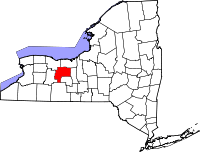
Ontario County, N.Y.

Ontario County, just south and east of Rochester, N.Y., is unleashing the power of fiber optics after private providers turned their noses up at the rapidly-growing Finger Lakes region.

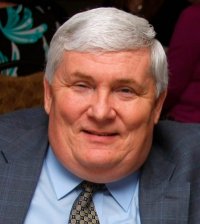
“We just said we need this so badly, we just did it ourselves,” says Ed Hemminger, president and CEO of Axcess Ontario, a non-profit corporation created by the county government to run the $7.5 million dollar project.  Hemminger appeared on this afternoon’s edition of CNBC’s Power Lunch.

The 180-mile fiber optic network now two-thirds complete is expected to be finished by year’s end.  Hospitals and schools are already leasing capacity on the fiber ring.

Axcess Ontario doesn’t actually provide broadband service to businesses and consumers itself.  Instead it leases capacity to all-comers, inviting them to use the fiber ring to enhance their broadband infrastructure.  The company doesn’t provide residential service, for example, but it could enhance another provider’s ability to deliver service.  Right now, the county is contemplating a wireless Internet service for consumers, if they can find a provider.  Frontier Communications could be a likely contender, considering it already provides a Wi-Fi service in downtown Rochester and in portions of suburban towns like Brighton, Pittsford, and Greece.

Hemminger

Hemminger

Ontario County is one of the bright spots in western and central New York’s difficult economy.  Both residential and business growth continues, despite the recession, particularly in communities like Canandaigua, Victor and Geneva.  Having a state-of-the-art fiber ring enhances the area’s ability to attract new businesses and jobs to the Finger Lakes region, often better known for tourism.  At least that is the plan.

“Honestly every company is an Internet company because they all have to use the Internet,” Hemminger claims.

Having the county build the network was the only prospect for getting it done.

“We can have a Return on Investment of 25 years, while the private sector has to recoup its costs in three to four years,” Hemminger says.

Thanks to Stop the Cap! reader Jeff for sending word.

[flv]http://www.phillipdampier.com/video/CNBC Making Broadband Accessible 6-10.10.flv[/flv]

Ed Hemminger discusses the Axcess Ontario fiber ring project in Ontario County, N.Y., on today’s edition of Power Lunch on CNBC.  (2 minutes)

Here’s an Internet Provider That Thinks Anything Less Than 100Mbps for Every American Isn’t Good Enough

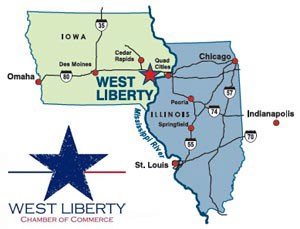
West Liberty, Iowa is home of Liberty Communications

One of the side effects of insatiable telecom industry consolidation is that hard-working, honest, and consumer-friendly providers are swept up by corporate machinery that ends up providing Americans with the least amount of service for the highest possible price.  Remarkably, there are still some top-shelf independent providers out there that actually stand with their customers, fighting to bring better broadband service to everyone in their service areas.

A letter to the editor in the West Liberty Index caught my eye.  It chastised the Federal Communications Commission for its plans to treat rural Americans as second class broadband citizens with speed goals 25 times slower than those enjoyed by their urban cousins.  The FCC, the writer wrote, was simply not going far enough for consumers.  What was so remarkable about the letter?  It was signed by an Internet Service Provider — Jerry Melick, manager of Liberty Communications.

What would happen if the federal government decided that city roads, bridges and infrastructure should be better-constructed and more efficient than the roads in rural America? What about if the policy-makers determined that urban consumers should be able to get where they are going and get what they need faster than rural consumers? A new government plan intends to make that true of our nation’s information superhighway — the Internet. And, while it is not the highway coming into town, as rural consumers, we should still be very concerned.

[…]

The FCC’s plan will make rural Americans second class citizens in the new broadband world, because it establishes a speed goal for rural areas that is 25 times slower than for urban areas. Shouldn’t rural residents have access to the same broadband services as our larger towns and cities? Despite the construction of our state of the art Fusion network, we still face the challenge of how to bring broadband to our rural customers living outside of the communities of West Branch and West Liberty. Without a National Broadband Plan that supports further investment in rural areas, this will be difficult if not impossible to accomplish.

Melick supports broadband reform efforts at the FCC and changing the Universal Service Fund to provide assistance to companies like his, serving rural eastern Iowa, to build out its fiber to the home Fusion network to nearly every resident in its service area.  That’s a refreshing change of pace from the usual rhetoric from AT&T, Frontier, Verizon, and others.

Liberty Communications began service as the independent West Liberty Telephone Company in 1899.  It delivered telephone service for more than 100 years until January 2008, when the company announced it was going to construct its own fiber to the home network to provide television, telephone, and broadband service to its customers.  The Fusion network would expand later that year to start construction in nearby West Branch, the birthplace of Herbert Hoover, the nation’s 31st president.  By April 2009 the fiber network offered a true triple play package of services to customers in both cities. Fusion broadband customers can buy up to 20/2 Mbps service from Liberty.  For the rest of its service area, Liberty still relies on DSL service providing up to 3 Mbps, but believes fiber is the future for all of its customers.

The only question remaining is when forward-thinking policies at the FCC will be enacted to help that goal?

Search This Site:

Contributions:

Recent Comments:

Your Account:

Stop the Cap!