More dollar-a-holler advocacy for AT&T in the pages of CNET. AT&T brings the money, lobbyists ride their former credentials to deliver exactly the "facts" AT&T wants to read.
CNET last week shamefully handed over column space to a barely-disclosed AT&T lobbyist trotting out the latest unfounded, anti-consumer nonsense: tiered data plans help bring broadband to the poor.
It’s all part of AT&T’s Re-education campaign to sucker convince Americans that paying more for less service is a good thing:
New analysis shows that as Internet providers ramp up their investments to accommodate the surge in bandwidth demand, the old, one-price-for-everybody model would slow our progress toward universal adoption, especially by lower-income Americans.
The first reaction of many Internet users to this news may well be disbelief. How can it be that a pricing approach that has worked so well for so many years can suddenly become obsolete and even counterproductive? The answer is that technological advances have changed what many of us do online, which, in turn, has changed the economics.
A techno-ecosystem once dominated by e-mail and text now is increasingly characterized by high-definition video that claims up to 1,000 times as much network capacity and bandwidth as simple text. The way we currently pay for the infrastructure required to keep the network humming also will have to change.
The only humming we hear is AT&T’s dollar bill-counting machines.
When at first you don’t succeed, try, try again. Robert J. Shapiro and his co-author Kevin Hassett’s latest work, “A New Analysis of Broadband Adoption Rates By Minority Households,” is simply a rehash — spoiled leftover bologna — of their last bought-and-paid-for-study we analyzed last fall. Both reports are tailor-made to appeal to the minority-interest groups that are part of AT&T’s Rainbow Coalition of Cash — groups that engage in dollar-a-holler advocacy of AT&T’s agenda while quietly depositing their substantial contribution checks.
The report assumes quite a lot:
That broadband service adoption rates in minority communities are too low because heavy users are artificially keeping broadband prices too high;
That without tiered data plans, AT&T can never afford to expand broadband service;
That unlimited broadband tiers can never co-exist with tiered plans — it’s one-size-fits-all under today’s bad pricing model;
That a grand exaflood is coming to swamp broadband users of all kinds, and without tiered pricing to finance upgrades, we could all drown.
For the second time, Shapiro and Hassett try to stick the bill for upgrades on so-called “heavy users,” who they suggest should pay 80 percent of the upgrade costs through higher priced broadband service. They also want content producers to cough up — the “they can’t use my pipes for free”-argument AT&T loves.
How will customers react to paying huge surcharges on their broadband bills? According to the report’s authors, heavy users won’t mind because they are “price-insensitive.”
Ask Time Warner Cable customers in New York, Texas, and North Carolina if they minded the prospect of paying $150 a month for broadband service they used to pay $50 a month to receive. How about Frontier’s customers in Mound, Minnesota asked to pony up $250 a month for up to 3Mbps DSL service because they exceeded Frontier’s 5GB monthly usage allowance?
The report has several other glaring fact-gaps:
Tiered service plans are already available industry-wide, based on broadband speed, not usage. Low income customers can obtain cheaper broadband today, if companies decide to advertise it;
The wounds from high broadband pricing are industry self-inflicted. They charge $40 or more for a service their financial reports suggest costs less than $10 a month to provide;
Providers can achieve universal broadband first by extending existing networks to rural America, upgrading them to fiber as the economy of scale from urban and suburban upgrades forces prices down;
The authors strenuously avoid reviewing providers’ financial reports which show enormous profits even as costs continue their rapid decline;
Many of the footnotes used to back their arguments turn out to quote self-interested parties like service providers, equipment manufacturers, and trade associations.
None of this is surprising or new in bought-and-paid-for-reports commissioned by companies to cheerlead their corporate agenda. The last thing AT&T wants to read is a recitation of facts that disprove their arguments.
In essence, Shapiro and Hassett are arguing (with a straight face) that if providers are allowed to charge some consumers dramatically higher prices for broadband service, it will somehow convince them to upgrade their networks -and- trickle down lower prices for economically-challenged consumers.
Maybe if we let BP drill more oil wells in the Gulf, the extra profits they earn will somehow lead to better safety records for drilling and lower gas prices. After all, with those record-busting profits earned over the past three years, the safety record for the industry is better than ever and gas is sold at fire sale prices, benefiting economically disadvantaged Americans, right?
If you or I argued this theory, we’d be drug tested. For corporate lobbyists, it’s just another day at the office.
Here’s just how silly this really is: You just discovered your hard drive is nearly full. You’ve gone shopping for an upgrade, planning to spend around $100 for a new drive. Just a few years ago, you spent around that much for a 120GB model. Today, that same $99 would today buy you a 1.5 terabyte drive, unless you bought it from AT&T. They want $1,500.
Newegg's price: $99.95 -- AT&T's price: $1,500
You: “Why is this drive so expensive?”
AT&T: “Over 90 percent of our customers never need a drive bigger than 120 gigabytes. Developing a 1.5 terabyte drive costs plenty, and we feel that because you are a heavy user, you should bear the brunt of the development and manufacturing costs of all hard drives.”
You: “Sure, but this same 1.5TB drive is available in Korea for $99 dollars. You want $1,500. Why is there such a price difference and when does your price come down?”
AT&T: “Poor people in Korea and America can’t afford even a 60 gigabyte drive. We are trying to make smaller drives more affordable so in turn you should pay a higher price. This isn’t about when AT&T will lower our price, it’s about when you will see our grand charitable vision and lower your selfish expectation of a lower price.”
You: “Wow, a corporation with socially-conscious pricing to benefit the poor? So you are telling me that when I spend $1,500 on this hard drive, it is going to subsidize the cost of their 60 gigabyte drive, right?”
AT&T: “No, not exactly. See, if we didn’t charge you $1,500, we’d have to raise the price on their 60 gigabyte drive and that’s not fair because they don’t need to store as much as you do.”
You: “But wait, your ‘subsidized’ 60GB drive costs three times more than what Koreans spend for a drive at least three times larger.”
AT&T: “That’s because the standard of living is different there. Besides, why do you want to make the poor pay for your hard drive?”
You: “You aren’t making any sense.”
AT&T: “But we are about to make a whole lot of dollars!”
Dumping unlimited usage pricing only sets the profit expectations-bar higher for the broadband industry on Wall Street, regardless of what the true costs are to provide the service. Wall Street never argues that excess profits should be spent on network upgrades and price subsidies to the poor — they want those profits paid to shareholders instead.
When the telecom industry is paying for your study, real facts never matter. If you want them to do future business with your lobbying firm, the only acceptable conclusion is the one AT&T wants you to reach.
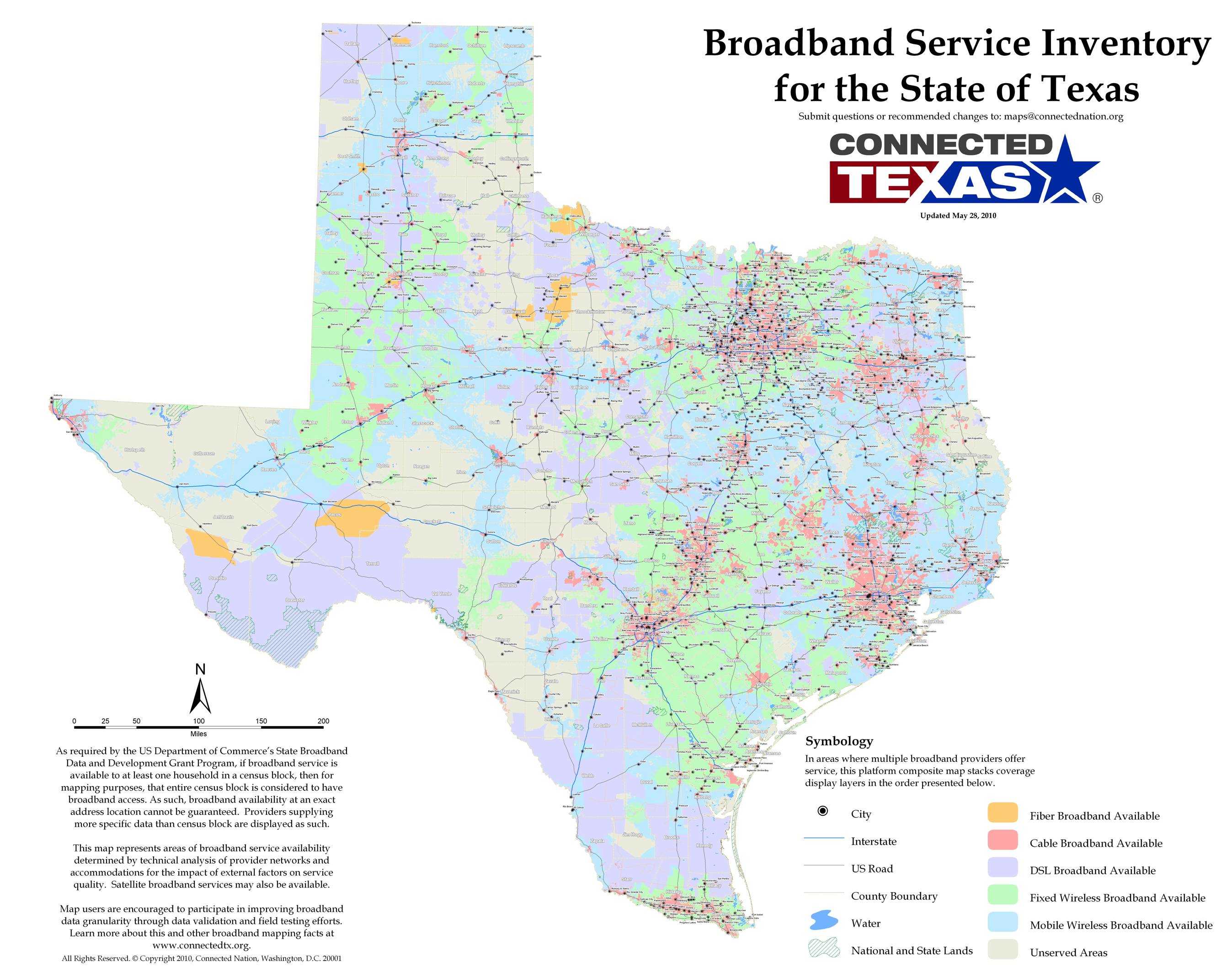
Less than a day after the Texas Department of Agriculture unveiled its statewide broadband map, an opposition candidate running for the office of Agriculture Commissioner dismissed it as a re-election scheme that will never benefit rural Texas.
Hank Gilbert, the Democratic agriculture commissioner candidate, criticized the incumbent commissioner’s efforts as a cheap stunt that took four years to deliver and wasted taxpayer money.
“This is yet another stupid, sleazy, ‘look-at-me’ political trick designed to cover up the fact that he’s one of the best at wasting tax money in the history of the state,” Gilbert said. “That map will do nothing for people without broadband access. I’m sure people on landline modems will be grateful to Todd—after the 45 minutes it takes them to actually view the map to determine, sure enough, that their area isn’t served by broadband,” Gilbert continued.
Gilbert is referring to a joint broadband mapping project by the Texas Department of Agriculture and telecom industry front group Connected Nation, which is stacked to the rafters with telecom industry executives with a vested interest in making sure those maps reflect the industry’s interests.
Current commissioner Todd Staples released the map with great fanfare, claiming 97 percent of Texas already had access to broadband service, with just three percent, representing 250,000 Texans without. Those numbers were debatable, considering Connected Nation was involved. In earlier mapping efforts, the group claimed ubiquitous broadband was already available over large sections of several communities, even though it turned out many of those homes could not qualify to receive the DSL service the group said was available.
Gilbert put a less fine point on it:
Texas Broadband Map (click to enlarge)
“Aside from the fact that he considers the federal stimulus dollars for broadband an excuse to gain further name recognition, what has Todd Staples really done to increase broadband connectivity in Texas,” Gilbert asked. He also questioned why TDA officials have said publicly, in the weeks prior to the map’s unveiling, that they didn’t know what areas of Texas were not served by broadband or high-speed internet access.
“It is a sad day when the agency and commissioner in charge of making sure rural areas get broadband don’t know which areas are underserved. It’s even more sad that the TDA had to depend on a public-private partnership with a non-profit agency to figure it out. I don’t think it will come as a surprise to anyone that telecom companies have far more granular information on existing service areas,” Gilbert said.
“Based on the information available on the website Staples is touting, anyone with a pulse, vocal chords, and the ability to dial the keys on a telephone could have collected this information from providers. I don’t see why it has taken Todd Staples nearly four years to do this,” Gilbert said.
Gilbert is apparently new to the broadband availability debate. Telecom companies treat specifics about their broadband service areas and speeds as proprietary business information and will not disclose it to the government or any other third party, claiming it needs to protect the information for competitive reasons. Earlier efforts to collect this information in other states met with stonewalling from providers. Even the federal government has been unable to gather street-level statistics on broadband service from some providers.
But Gilbert has a point that a map project, especially with an industry front group in the mix, does not actually bring broadband to anyone. Too often, such maps are used to block would-be competitors from getting federal broadband grant money, with nearby providers claiming the maps show the funding would help a community already served by broadband, even if it was not. They also help paint a helpful picture for an industry seeking funding for middle-mile projects that divert broadband stimulus funding to help incumbent providers enhance their networks at the public expense. In short, Texas cable and phone companies get to argue the stimulus program is a waste of money (unless they are recipients) because Texas doesn’t have a broadband problem.
Cue the Texas Cable Association:
“The map shows that less than 1 percent of all Texans cannot access some form of broadband, whether, wired, wireless or mobile. Yet – without this information – the federal government awarded more than $200 million in grants and loans to projects in Texas. Some of these projects propose to duplicate service in an area already served by multiple broadband providers.
“In addition, the federal government set a deadline for second-round funding applications that forced the Texas Department of Agriculture to again make recommendations without the benefit of the mapping data.
“As the federal government considers these new applications, the Texas Cable Association urges it to make its decisions based on the new Texas broadband availability map.
“Taxpayer dollars – in the form of government grants – should not be used to duplicate services or to provide free capital that allows grant winners to gain market advantage over private companies that have invested millions of dollars of their own money to make broadband available.”
The state cable lobby even has a 30 second ad running, thanks to the help of the mother-of-all-astroturf groups, Broadband for America — a front group for big cable and phone companies.
[flv]http://www.phillipdampier.com/video/Texas Cable Association Broadband Ad.flv[/flv]
The Texas Cable Association has this not-too-subtle ad promoting private investment in broadband, suggesting Texas telecoms are helping, not hurting consumers and businesses. (30 seconds)
The Staples campaign responded to Gilbert’s accusations Texas-style — by accusing their opponent of being a crook.
Staples’ campaign manager Cody McGregor said:
“Our opponent has a criminal conviction for theft, unpaid taxes, current tax liens, and allegedly accepted a bribe for $150,000. I hope all Texans will gain access to the Internet and have the ability to view www.guiltyguiltygilbert.com and get the facts about our opponent and his campaign’s trouble with telling the truth.”
Staples’ website is way over the top, accusing Gilbert of being a “villainous Obama Democrat” who is guilty of not wearing his seatbelt and being stupid.
Todd Staples owns stock in at least two telecom companies, AT&T and Fairpoint Communications, the latter of which is probably not helping his portfolio too much considering it declared bankruptcy.
Read Gilbert’s “fact sheet” on Todd Staples’ broadband mapping project below the jump.
And you thought your state’s campaign ads were too negative. The Staples campaign goes back to the old west to drive home a message about their opponent. (1 minute)
Oklahoma residents — your state government needs you… to test your broadband speeds.
Mapping the state’s broadband access will require the participation of all levels of state, county, and local government as well as Oklahoma citizens. A new website makes it easy for any Oklahoman to contribute some results of their own.
All Oklahomans are invited to test their Internet connection speed at the broadband mapping website. Visitors can then select their location (work, home, or other), street address, zip code, and what Internet provider they utilize. All the data collected will be consolidated onto a map of Oklahoma depicting what areas of the state are served, underserved, and unserved by broadband.
The Oklahoma Broadband Mapping Initiative is being conducted under the direction of the Secretary of State and a partnership of several state agencies.
Verizon Wireless is contemplating the end of flat rate, unlimited data plans as it introduces fourth generation data networks this year.
“We will probably need to change the design of our pricing where it will not be totally unlimited, flat rate,” John Killian, chief financial officer of Verizon Communications Inc., the wireless unit’s parent, said in an interview at Bloomberg’s headquarters in New York.
Verizon expects “explosions in data traffic” as the company introduces customers to its 4G network, potentially ten times faster than older mobile broadband technology. Verizon Wireless, already capturing enormous sums of revenue from consumers forced into mandatory, expensive data plans when they upgrade to smartphones, will soon discover some serious limits on those plans.
The irony is, Verizon’s 4G upgrade will bring wireless broadband speeds to consumers they realistically cannot use for much more than web browsing, e-mail, and low-bandwidth apps. Video downloads will burn through data limits imposed at the level AT&T introduced for its customers earlier this month.
Killian
Wall Street wants consumers re-educated to believe broadband can never be unlimited and must be treated as a precious, limited resource.
“The more bandwidth that you make available, the faster it will be consumed,” said Craig Moffett, analyst at Sanford C. Bernstein & Co. in New York. “From Verizon’s perspective, the last thing you want is for another generation of consumers to be conditioned to the idea that data is always going to be uncapped.”
Moffett’s clients hope that is true because usage limits will control costs and make customers think twice about using their data features on their phones. Reduced demand equals increased revenue, just what Wall Street ordered.
Verizon Wireless has already set the stage for that increased revenue with mandatory add-on plans that boost customer bills, especially for those buying smartphones. Although just 17 percent of Americans own smartphones today, Verizon predicts 70-80 percent of customers will upgrade to smartphones in the next few years. That guarantees an “upgraded” bill as well.
Estimates about current average data usage from smartphone customers ranges from 200-600 megabytes per month, but that was before the arrival of video-friendly 4G network technology and the newest generation of phones optimized for video, which can easily consume ten times as much.
Verizon recognizes the “video threat,” and press reports suggest the limits will only be imposed on the 4G network. Current generation 3G networks make viewing video tedious, a natural barrier for customers planning to “use too much.”
Verizon’s widely anticipated limits, almost certainly to be equivalent to AT&T’s with respect to allowances and pricing, may dampen enthusiasm for the iPhone on Verizon’s network. Any existing AT&T customer is grandfathered into unlimited data plans for their smartphones. If those customers leave AT&T, they will be forced to take a usage-capped data plan from Verizon with no looking back. AT&T won’t provide unlimited plans for customers returning to their fold.
Telstra is Australia's largest telecommunications company. (Photo: Telstra)
It’s not as if the Australian government didn’t warn private broadband providers, notably Telstra. For the past several years, Australians have endured expensive, slow, heavily usage-limited broadband service that has put the country well behind many other Commonwealth nations. Australian Communications Minister Stephen Conroy finally warned the nation’s largest telecommunications provider if it didn’t move forward on upgrades and improved service, the government would be forced to step in to protect the national interest.
Instead of improving service, Telstra spent years stonewalling the government and the Australian public, while banking high profits for broadband service. That’s a familiar story for North Americans, stuck with companies like Bell, Rogers, AT&T, Comcast and Verizon — all of whom seek ultimate control over what kind of service you receive, what you pay for it, and what websites you can and, perhaps down the road, cannot visit without paying a surcharge.
Australia is closing the chapter on this story with a happier outcome for its 22 million citizens. Perhaps the United States and Canada could learn a thing or two from the folks down under.
Bringing U.S. Oligopoly-Style Management to Australian Broadband: The Sol Trujillo Years — 2005 to 2009
Telstra, a former government monopoly comparable to the American Bell System, was privatized in the late 1990s. Telstra looked to the United States for a chief executive that had experience navigating that transition. They found Sol Trujillo working his way up the management ladder at AT&T, finally culminating in chairmanship of former Baby Bell Qwest Communications. Would Trujillo like to take on the challenge of managing Australia’s largest phone company? Trujillo signed on with as Telstra’s CEO in 2005 promising to modernize the business and to bring American-style innovation to the South Pacific.
Instead, Trujillo established an American-style rapacious oligopoly.
[flv width=”424″ height=”260″]http://www.phillipdampier.com/video/Nine Australia Trujillo War on Unions.flv[/flv]
Channel Nine in Australia reported on Telstra’s sudden interest in union-busting after Sol Trujillo arrived in 2005. (1 minute)
Sol Trujillo
In his first year at the company, Trujillo started an all-out war to get rid of Telstra’s organized labor, slashing 10,000 jobs to “save the company money” all while boosting his own salary. What started as $3 million in compensation in 2005 would rise to more than $11 million dollars just four years later, even as the value of Telstra declined by more than $25 billion on his watch.
Trujillo alienated his employees and officials in the Australian government. Then-Prime Minister John Howard attacked Trujillo’s salary boost as abusive.
“I’m not complaining about the salary I get but I do think the average Australian, who gets paid a lot less than I do … regards that sort of salary as being absolutely unreasonable,” Mr Howard said on Southern Cross radio. “And it doesn’t help the capitalist system, which I believe in very passionately, that some people appear to abuse it.”
Trujillo’s salary was 38 times greater than the highest official in Australia’s government.
The average Australian retiree gets by on $219AUS a week.
Trujillo had to make due with more than $211,000 a week.
[flv width=”424″ height=”260″]http://www.phillipdampier.com/video/Nine Australia Telstra Salary Hike.flv[/flv]
Channel Nine ran this report on the controversy over Sol Trujillo’s compensation package. That old meme about having to pay high salaries to attract quality talent would have been more convincing had Trujillo’s policies not caused a $25 billion reduction in Telstra’s value. (2 minutes)
Customers weren’t exactly endeared to spending more of their money on Telstra products and services. Telstra had already embarked on cost controls for network upgrades, leveraged its monopoly power in many parts of the country with high rates for usage-restricted service, and bungled a critical application to participate in Australia’s National Broadband Network.
Australia’s National Broadband Plan, a roadmap for broadband improvements, set pre-conditions to involve small and medium-sized businesses in network construction. Trujillo balked, demanding that Telstra — and only Telstra — should have the right to determine what kind of network should be built in the country. More importantly, unless they exclusively ran it, the company would do everything in its power to block or destroy it.
Internet Overcharging schemes limit enjoyment of broadband usage across Australia. Telstra provides a usage meter estimator that includes all of the useless measurements for e-mail, images, and web browsing. But throw in some movie watching and the gas gauge really starts to spike.
The Sydney Morning Herald business reporter Ian Verrender was stunned:
Telstra has employed a three-step strategy to muscle out any competition.
It can be neatly condensed into three words: Bluster, Belligerence and Obfuscation. We [just] saw it again in spades.
Telstra has been excluded from one of the most ambitious infrastructure projects announced by a Federal Government in decades: the construction of a national broadband network.
Could it really be that Telstra’s board and management were so incompetent that they could not get past stage one in a tender process of this magnitude?
After all, there were only four main criteria that had to be met. The first was the proposal had to be lodged in English. The second and third had equally low hurdles. Metric measurements – not the old inches, feet and miles – were required and the bid had to be signed. Nothing too difficult there.
But the fourth criterion appeared to stump Telstra. It didn’t include any plan for the inclusion of small business. And so the Communications Minister, Stephen Conroy, was obliged to exclude Telstra, an announcement that shook 12 per cent from the value of the country’s biggest telecommunications company.
This was no accident on Telstra’s part. It knew it was lodging a non-conforming proposal. Why, you ask?
The answer is simple. Telstra does not want a national broadband network, particularly one that involves anyone else. That includes taxpayers.
And if one has to be built, Telstra will do everything in its power to delay or kill the process. Yesterday marked stage one in a protracted war, ultimately designed to defeat one of Prime Minister Kevin Rudd’s key election promises.
Trujillo claimed yesterday that Telstra had been unfairly excluded from the process on a technicality. That’s just rubbish.
In recent months, the company, its chairman, Don McGauchie, and Trujillo repeatedly threatened to walk away from the tender process, and lodged the proposal only a few hours before the deadline.
Trujillo’s rhetoric yesterday was laced with the usual mixture of bravado and threats. He compared Australia to North Korea or Cuba. He declared only Telstra was capable of building the type of network required by the Government.
But two lines stand out. First this: “Customers make the choice of who they do business with; regulators and governments and others do not.” And then: “We reserve our rights regarding future action.”
The message is clear. Telstra will launch legal action at every opportunity – and even when there aren’t opportunities.
That time-honored American practice of simply suing your way through any legislative or regulatory roadblocks threatened to come to Australia.
The exclusion of Telstra from such a revolutionary broadband project didn’t sit well with the board or shareholders, and directly led to Trujillo’s ouster in 2009. By then, he had alienated customers, the government, and just about everyone else. Perhaps the government would allow a second look at a Telstra broadband application if it was submitted by someone other than Sol Trujillo? It couldn’t hurt to find out.
[flv width=”424″ height=”260″]http://www.phillipdampier.com/video/Nine Australia Telstra Trujillo Quits 2-26-09.flv[/flv]
Channel Nine covers the ousting of Sol Trujillo, wondering what sort of golden parachute he’d receive on the way out the door. (3 minutes)
Just weeks after leaving, Trujillo decided to settle scores with Australia, telling reporters that he thought the country was backwards and racist.
[flv width=”424″ height=”260″]http://www.phillipdampier.com/video/Nine Australia Trujillo Calls Australia Racist 3-09.flv[/flv]
Payback time. Trujillo threw a hissyfit in a BBC interview calling Australia’s lack of laissez-faire regulatory policies backwards, and treatment towards him racist. (Channel Nine – 1 minute)
The Post-Trujillo Era: More Arrogance and Ruthlessness, But a Communications Minister Outmaneuvers the Telecom Giant — 2009 to Present Day
Telstra spent the summer of 2009 attempting to heal the Trujillo-caused wounds with conciliatory statements in the Australian media. Telstra’s new chief executive, David Thodey, admitted the company’s customer service record needed improvement. He distanced himself from some of the more caustic comments from the former CEO, and claimed the company was on-track to be a major participant in improving Australia’s broadband experience.
Conroy
But as the months progressed, Australia’s Communications Minister, Stephen Conroy ultimately concluded he was getting the lip service treatment that Telstra had delivered Australians for years. Conroy, already suspicious of the company’s control-minded tendencies, quietly began bending the ear of Prime Minister Kevin Rudd. Conroy had watched Telstra’s steadfast refusal to work constructively towards a National Broadband Network (NBN). By last summer, the company was making proposals for underwhelming broadband expansion. Fiber optic broadband was unnecessary and expensive, they said. Besides, the service Telstra was providing was already good enough.
Australians didn’t agree. Part of the platform that brought the Rudd government to power was the promise of better broadband service in Australia. Waiting for Telstra to provide it was a futile exercise.
Conroy told Rudd the government should not be setting its broadband policy agenda based on what worked most conveniently for private providers. If they won’t move, then let’s get them out of the way, Conroy suggested. Rudd, working for the interests of the Australian people — not just a handful of telecom companies seeking riches with substandard service at monopoly prices, agreed.
After reviewing the proposals submitted to design and construct 21st century broadband service for Australia, Rudd dismissed them all, calling them inadequate. The government, he announced, would go it alone and build the network itself — delivering a fiber to the home network for 90 percent of Australians on an open network available to any provider that wanted to rent access at wholesale rates.
More importantly, Conroy was not going to allow Telstra to continually block progress on the NBN. Conroy was not some supine minister willing to compromise away the goal of super-fast affordable broadband. His critics called him Machiavellian, slashing and burning anything that stood in his way. But Conroy was steadfast — corporations would never be allowed to dictate broadband terms to the government. He warned Telstra to cooperate or face the consequences.
Telstra continued to stall and stonewall, and last September, the Rudd government delivered what it promised — a forced break-up of Telstra. The company was given a choice — either sell back its copper wire landline network to the government or divest itself of satellite TV service Foxtel and lose access to any additional wireless mobile frequencies for Telstra’s cellular service.
The equivalent in the United States would be to declare fiber to the home to be in the national interest, and if AT&T and Verizon didn’t deliver it to nearly every home in their service areas, the government would move in and do it themselves, taking back ownership of the AT&T and Verizon’s infrastructure along the way.
[flv width=”512″ height=”308″]http://www.phillipdampier.com/video/Network 10 Aus Telstra Break-Up 9-15-09.flv[/flv]
Network Ten covered the announced break up of Telstra by the federal government. (2 minutes)
Channel Nine ran several reports on the announced breakup of Telstra, including an interview with the opposition. (6 minutes)
Australia Declares Broadband a Utility Service that Private Providers Cannot Control
Monday marked a day in history for Telstra, agreeing to sell back its copper wire landline business (for which it will receive $11 billion in compensation). In return, Telstra is assured wholesale access to the new fiber broadband network, and can market products and services on it. It cannot, however, serve as a gatekeeper to keep competitors out nor maintain virtual monopoly service, especially for less suburban and rural customers.
Some telecom analysts believe the deal is actually good news for Telstra, if they’d see beyond their control tendencies. After all, they say, Telstra gets to rid itself of a legacy copper-wire landline network that is expensive to maintain and serves a dwindling number of consumers, many who have switched to wireless. They also get to develop and market new high bandwidth applications on a network they are no longer responsible for financing.
It’s a win for the government as well who gets a single, national fiber network built in the public interest, which makes it far easier to recoup the billions in costs to build it. They’ll even likely make a profit suitable to defray the costs of subsidizing wireless broadband service for Australia’s rural residents, to be served with at least 12Mbps connections. No cost-recovery fees on customer bills, no usage limitations that restrict innovation, and broadband that serves everyone, not just a handful of corporations that seek to monetize every aspect of it.
Conroy wouldn’t think much of America’s National Broadband Plan, which relies near-exclusively on private providers voluntarily doing the right thing. Conroy stopped putting blind faith in Australia’s large telecommunications companies. The Obama Administration hasn’t.
We’ve seen millions spent lobbying to permit a handful of providers to control broadband service on their terms. Few will provide fiber to the home service and many are content leaving rural Americans with dial-up service. With dreams of Internet Overcharging schemes to manipulate usage to maximize profits even higher, things could get much worse. What’s right for AT&T isn’t right for us.
For Australia, who has lived under such monopolistic broadband regimes for over a decade, a National Broadband Network without arbitrary usage limits and available to all — rural and urban — is the promised land. It will leapfrog Australia well ahead of the United States and Canada, with far faster speeds and better prices, all because a government stood up to a corporate provider that preferred to overpay its executives instead of getting the job done right.
Australia had a reality check — broadband is a utility service necessary for every citizen who wants it. Just as electrification and universal phone service became ubiquitous in the last century, broadband will also join those services in the years ahead as commonplace in nearly every home.
If only the strength and conviction that is fueling Australia’s broadband future could also be found in the United States, where too often what is urgently needed today gets frittered away into “maybe we can have it someday” compromises with big telecom and their lobbyists. That isn’t good enough.
ABC National Radio interviewed telecom analysts about the implications of today’s deal with Telstra to retire Australia’s copper wire phone network (June 21, 2010) (4 minutes, 17 seconds)
You must remain on this page to hear the clip, or you can download the clip and listen later.
Be Sure to Read Part One: Astroturf Overload — Broadband for America = One Giant Industry Front Group for an important introduction to what this super-sized industry front group is all about. Members of Broadband for America Red: A company or group actively engaging in anti-consumer lobbying, opposes Net Neutrality, supports Internet Overcharging, belongs to […]
Astroturf: One of the underhanded tactics increasingly being used by telecom companies is “Astroturf lobbying” – creating front groups that try to mimic true grassroots, but that are all about corporate money, not citizen power. Astroturf lobbying is hardly a new approach. Senator Lloyd Bentsen is credited with coining the term in the 1980s to […]
Hong Kong remains bullish on broadband. Despite the economic downturn, City Telecom continues to invest millions in constructing one of Hong Kong’s largest fiber optic broadband networks, providing fiber to the home connections to residents. City Telecom’s HK Broadband service relies on an all-fiber optic network, and has been dubbed “the Verizon FiOS of Hong […]
BendBroadband, a small provider serving central Oregon, breathlessly announced the imminent launch of new higher speed broadband service for its customers after completing an upgrade to DOCSIS 3. Along with the launch announcement came a new logo of a sprinting dog the company attaches its new tagline to: “We’re the local dog. We better be […]
Stop the Cap! reader Rick has been educating me about some of the new-found aggression by Shaw Communications, one of western Canada’s largest telecommunications companies, in expanding its business reach across Canada. Woe to those who get in the way. Novus Entertainment is already familiar with this story. As Stop the Cap! reported previously, Shaw […]
The Canadian Radio-television Telecommunications Commission, the Canadian equivalent of the Federal Communications Commission in Washington, may be forced to consider American broadband policy before defining Net Neutrality and its role in Canadian broadband, according to an article published today in The Globe & Mail. [FCC Chairman Julius Genachowski’s] proposal – to codify and enforce some […]
In March 2000, two cable magnates sat down for the cable industry equivalent of My Dinner With Andre. Fine wine, beautiful table linens, an exquisite meal, and a Monopoly board with pieces swapped back and forth representing hundreds of thousands of Canadian consumers. Ted Rogers and Jim Shaw drew a line on the western Ontario […]
Just like FairPoint Communications, the Towering Inferno of phone companies haunting New England, Frontier Communications is making a whole lot of promises to state regulators and consumers, if they’ll only support the deal to transfer ownership of phone service from Verizon to them. This time, Frontier is issuing a self-serving press release touting their investment […]
I see it took all of five minutes for George Ou and his friends at Digital Society to be swayed by the tunnel vision myopia of last week’s latest effort to justify Internet Overcharging schemes. Until recently, I’ve always rationalized my distain for smaller usage caps by ignoring the fact that I’m being subsidized by […]
In 2007, we took our first major trip away from western New York in 20 years and spent two weeks an hour away from Calgary, Alberta. After two weeks in Kananaskis Country, Banff, Calgary, and other spots all over southern Alberta, we came away with the Good, the Bad, and the Ugly: The Good Alberta […]
A federal appeals court in Washington has struck down, for a second time, a rulemaking by the Federal Communications Commission to limit the size of the nation’s largest cable operators to 30% of the nation’s pay television marketplace, calling the rule “arbitrary and capricious.” The 30% rule, designed to keep no single company from controlling […]
Less than half of Americans surveyed by PC Magazine report they are very satisfied with the broadband speed delivered by their Internet service provider. PC Magazine released a comprehensive study this month on speed, provider satisfaction, and consumer opinions about the state of broadband in their community. The publisher sampled more than 17,000 participants, checking […]


 Subscribe