Home » Broadband Speed » Recent Articles:

AT&T Caps and Now Throttles Many of Its Wireless Broadband Customers to 100kbps Uploads

Phillip Dampier July 6, 2010 AT&T, Broadband Speed, Data Caps, Wireless Broadband 7 Comments

The classic one-two punch of Internet Overcharging is to limit your broadband usage -and- throttle speeds downwards.  AT&T wireless customers in several major cities across the United States are experiencing that for themselves over the long holiday weekend, reporting upload speeds have been throttled down to 100kbps or less (one-tenth of the speed most customers enjoyed as late as last week).

Speedtest.net has shown AT&T network throttling in many parts of Baltimore, Boston, Cincinnati, Cleveland, Columbus, Denver, Des Moines, Detroit, Fairfax, Houston, Kansas City, Las Vegas, New York, Orlando, Phoenix, St. Paul,  Salt Lake City, and Washington, D.C.

The speeds are so noticeably slow, it has become a national story as irate customers find their wireless broadband service first usage capped at just 2GB per month, and now upload speed throttled to the point of unusability.  AT&T promised a statement explaining the issue, but one has not yet been forthcoming.  Some speculated the throttles were designed to reduce congestion on AT&T’s network over the holiday, while others suspect a technical fault.

Reducing your wireless speed reduces the impact on AT&T’s backhaul network, which in turn reduces congestion and the number of dropped wireless calls.

The introduction of speed throttles for “heavy users” is a favorite in countries where overcharging schemes predominate.  Most permit a preset amount of traffic to pass at normal speeds, but once customers exceed an arbitrary allowance, a temporary speed throttle gets applied to dramatically reduce speeds and discourage further use.  Some limit customers to a selected amount of traffic per day, others per month.  Once the window expires, the throttle is automatically removed.

While there is no indication AT&T is applying such a throttle at this point, the company has strongly opposed efforts to ban such schemes.  AT&T has a history of antagonizing its wireless customers with poor network performance, and has been judged the least favorite provider by Consumer Reports.

Republicans Tell Rural Caswell County, NC They Don’t Deserve Better Broadband

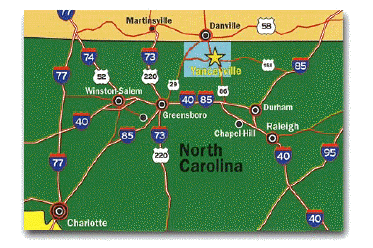
Although not too far from Winston-Salem and Greensboro, Caswell County has a population of just over 23,000 people

In a painful display of callous disregard for the broadband needs of rural North Carolina, where half the state’s population lives, nine Republicans and two Democrats on the House Public Utilities committee voted down a bill to deliver service to 60 percent of Caswell County that currently goes without.

HB2067, introduced by Rep. Bill Faison (D-Orange/Caswell) would have allowed the rural county to provide broadband service to unserved residents and businesses.  What Rep. Faison did manage to put in HB2067 was initiative towards 21st Century technology.  The bill would have authorized Caswell County to install better technology, both up and down, where Centurylink offers slow DSL as the only option.  In introducing the bill, Faison explained that recent broadband data showed only 40 percent of Caswell County had access to broadband.

Already suffering from the exodus of textile jobs that used to provide an economic base for the area, the failure to obtain broadband has proven disastrous to the work of the county’s 21st Century Group, trying to restore Caswell County’s economy with a higher-tech future.  Six years of work was blocked by CenturyLink — the local phone company and 11 legislators, who told residents they don’t deserve anything better than they already have (which is often nothing.)

Without HB2067, Caswell County cannot even apply for federal stimulus broadband grant funds because the state law doesn’t provide specific authority to deliver the service.  Faison’s bill would correct that oversight and encourage public/private partnerships to get busy bringing broadband to the region.

CenturyLink and its top lobbyist Steve Brewer would hear none of it — Goliath was afraid that David would install better technology and force Centurylink to upgrade or hit the road.

Brewer was given more than half the available time for discussion about the proposed bill to fill the ears of committee members with half-truths.

CenturyLink, Brewer claimed, was more than willing to work with the county to provide the kind of speed its business park needed, yet failed to mention its long history of refusing to expand service to unserved areas.  Brewer’s claim that 70 percent of Caswell County is served by CenturyLink doesn’t mean the company offers broadband to all of those customers.  His further claim that 90 percent of those areas include equipment that is “DSL capable” also doesn’t mean those areas are providing the service today, just that they could… someday.  Many factors can disqualify a potential customer from getting DSL service, especially in rural areas where line quality is not always the best.
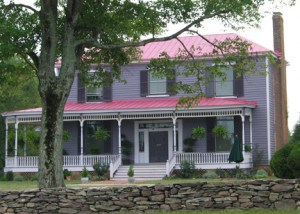
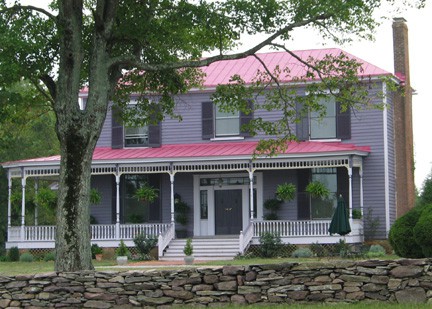
Bartlett Yancey House Restaurant and Gallery, a famous landmark in Caswell County.

Faison sought to explore exactly what Brewer defined as “broadband” service.  Brewer claimed DSL service offered anywhere from “1.5 to 6Mbps,” admitting speeds decline with distance and is untenable more than three miles from the telephone company switch facility.

Of course, Caswell County’s large rural expanse puts many of the unserved beyond the maximum distance DSL can work without additional equipment.  Many rural areas that can get DSL are typically offered between 768kbps-3Mbps service.  Caswell County is so rural, it met the Rural Utility Service’s (RUS) classic definition of an underserved community.  That allowed the county to technically qualify for first round federal broadband grant funding.

Unfortunately, legislators are not always as informed as they need to be to recognize statements riddled with loopholes and asterisks.

For instance, Rep. Daniel McComas (R-New Hanover) asked whether he could get high speed Internet over a phone line.  Although Brewer answered yes, what qualifies as “high speed” was left unanswered, as was exactly how many Caswell County residents requested DSL service, only to be refused by CenturyLink.  Yes, you can get DSL broadband over a phone line — but that doesn’t mean you will in Caswell County.

“The only definition of high speed Internet in North Carolina is from a statute from 10 years ago,” Faison noted. “You would have to admit that what was high speed Internet 10 years ago is not high speed Internet today.”

Just as the call for a vote was made, Brewer delivered an uninvited closing argument — probably unnecessary since no consumers were invited to speak on the issue.  If you don’t have broadband in Caswell County, 11 legislators on that committee weren’t interested in hearing from you anyway.

Brewer said the bill was completely unnecessary, because “federal broadband grants were no longer available,” and besides, it was unfair competition for the county to deliver broadband service better than what CenturyLink provides.  Of course, broadband grants -are- still available from the RUS, and few on the committee probably understood the irony of a phone company demanding that Caswell County not be allowed to deliver quality broadband service CenturyLink refuses to provide.
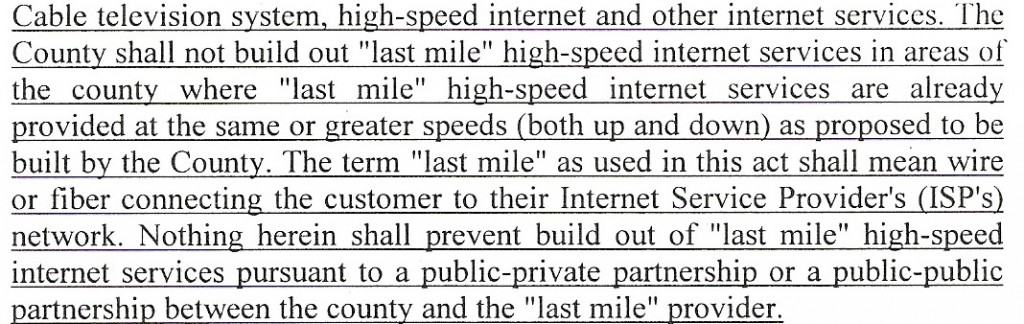
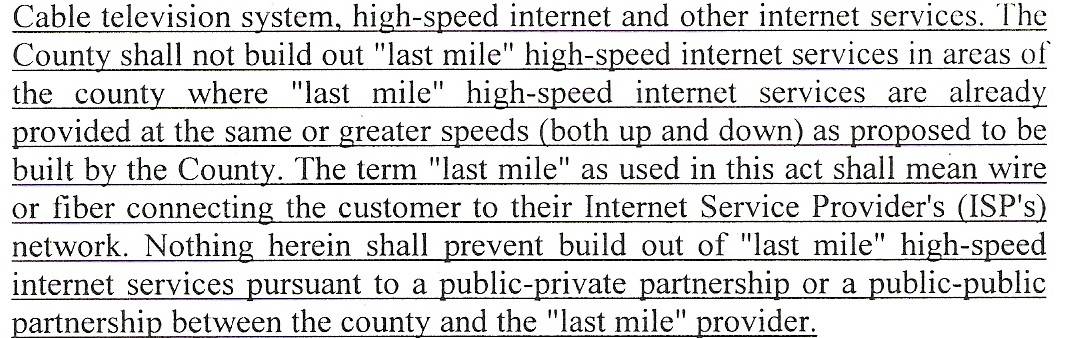
The substitute Committee bill would have protected CenturyLink from their fears of "unfair" competition by not allowing the county to build out broadband service where CenturyLink already provides it if it was not better service, but the company remained adamantly opposed to the county providing broadband service even in areas where they refuse to deliver it themselves for fear they would have to offer real broadband to Caswell County.

CenturyLink also claimed the county would have ‘secret insider information’ about CenturyLink’s every move through the permit process.  The glacial pace of the phone company’s broadband expansion is hardly a secret to the residents who live there.  Besides, permits are not required for the phone company to work in their own right-of-way.  Unlike cities who control the rights of way in their corporate limits, the state owns and controls the rights of way going through the unincorporated parts of the County.  Brewer’s comments were intended to scare legislators, not inform them.  It was a flat out lie.

The vote illustrates the disconnect many in the state legislature have about broadband.  Most of those in favor of the of the bill were Democrats mostly from rural sections of the state.  Two of the “no” votes came from Democrats in urban Mecklenburg County, which includes the city of Charlotte.  Representatives Beverly Earle and Becky Carney already have several choices for broadband service where they live.  Shame on them for condemning their rural neighbors in the north to a broadband backwater.

Mecklenburg County legislators were sure in a big hurry a few years back to do the bidding of AT&T, opening the doors to their kind of competition with statewide video franchising.  U-verse, which is available in parts of Charlotte, was supposed to put a stop the relentless rate increases and deliver competition.  So far, they’ve managed to sign up around 13,000 residents out of a potential 4 million plus in North Carolina, and the rate hikes just keep on coming.

The Republicans on the committee voted lock-step against the bill, even those from rural regions of the state.  Most of them are grateful recipients of big telecom money or are not running for re-election.  None of them can be bothered to ponder better broadband for their constituents unless it comes from a company cutting them a campaign contribution check.

When the vote was over, AT&T’s lobbyist Herb Crenshaw warmly shook McComas’ hand and congratulated him for a job well done. AT&T’s next check to McComas’ campaign fund will likely be bigger than the $500 he collected during the first quarter of this year.

The hit job on the broadband needs of rural Caswell County was complete.

The Members of the House Public Utilities Committee Voting Against Better Broadband for Caswell County & The Reasons Why
…and these amounts are just from the 1st quarter of 2010!

Rep. Harold J. Brubaker (R-Randolph) — Big Bucks Brubaker ran to the bank with $4,000 from AT&T, $4,000 from CenturyLink, $2,000 from Time Warner Cable, and $2,000 from Verizon.

Rep. Hugh Blackwell (R-Burke) — Blackwell accepted $500 from AT&T and $250 from Time Warner Cable.

Rep. Becky Carney (D–Mecklenburg) — AT&T and Time Warner Cable both cut checks for $500 each for Ms. Carney.

Rep. Beverly Earle (D-Mecklenburg) — She’s nice at half the price, with a grateful CenturyLink cutting a check for $250.

Rep. W. Robert Grady (R-Onslow) — Zippo.  He’s not running for re-election.

Rep. Jim Gulley (R-Mecklenburg) — Nada.  He’s not running again either.

Rep. Julia Howard (R–Davie/Iredell) — She gets around.  AT&T found her $500, CenturyLink provided a cool $2,000, and Time Warner Cable did even better with $2,500.

Rep. Linda Johnson (R-Cabarrus) — A double mint.  AT&T $500, Time Warner Cable $500.

Rep. Daniel McComas (R-New Hanover) — AT&T gave him $500, Time Warner Cable doubled that with $1,000.

Rep. Tim Moore (R-Cleveland) — Walking around money — AT&T $500, Time Warner Cable $500.

Rep. Wil Neumann (R-Gaston) — AT&T $500, but thanks to this year’s hefty rate hike, Time Warner Cable could afford $1,000 for Mr. Neumann.

Representatives Who Supported Rural North Carolina’s Need for Better Broadband, Voting For HB2067

Rep. Bill Faison (D-Orange, Caswell)

Rep. Kelly Alexander, Jr. (D–Mecklenburg)

Rep. Angela Bryant (D–Nash, Halifax)

Rep. Pricey Harrison (D-Guilford)

Rep. Marvin Lucas (D-Cumberland)

Rep. Nelson Cole (D-Rockingham)

Totals for 2010 (so far) for Telecom Contributions in the North Carolina General Assembly

AT&T $72,740

CenturyLink $51,750

Time Warner Cable $20,450

Verizon $10,500

(All figures are from the North Carolina State Board of Elections website, from candidates filings.)


[Updated] Clearwire Launches 4G Service in Rochester & Syracuse, Road Runner Mobile Also Forthcoming

[The article was updated at 10:30am to include promotional and coverage information not available when the article was published late last night]

Clearwire today announced the launch of its 4G mobile broadband service for businesses and consumers in Rochester and Syracuse, New York.  Designed to deliver the Internet at speeds four times faster than 3G, CLEAR is priced comparably to many wireless broadband plans, but has no usage caps.

Pricing from their website offers customers stay-at-home and mobile service plans (or both).  Customers choosing month-to-month service have to buy the equipment up front, starting at $70 and pay a $35 activation fee.  Those who commit to a two-year service contract can lease the equipment for $4-6 a month and skip start-up fees.  Packages start at $40 a month for 6/1Mbps service.  At $55 a month, they take the speed limit off, providing occasional bursts of wireless speed up to 10Mbps.  Another $15 on top of that buys you nationwide 3G roaming.  Sales tax is not included.  Customers get a 14 day trial period to evaluate the service and can cancel within that window with no obligation, although our Jay Ovittore reports they’ll drag you through the cancellation process.

At $40 for unlimited use, CLEAR’s 4G service beats Cricket, which charges the same price for 3G speeds, but limits consumption to 5GB per month before they start throttling your speed to dial-up.  Other mobile broadband services typically charge up to $60 for 5GB of usage at 3G speeds.  Ironically, while 4G service from Clearwire is unlimited, the slower 3G speed service is not — there is a usage limit of 5GB per month on the 3G network, and then overlimit fees of five cents per megabyte kick in.

A statement from the company released early this morning talks up the fact CLEAR does not burden their 4G customers with Internet Overcharging schemes like other wireless broadband providers.

“Our residents now have a fast Internet connection that’s as mobile as they are,” said Jerry Brown, regional general manager for CLEAR. “And we’re thrilled to offer affordable rate plans with no limits on the amount of data customers use. No caps on usage, no penalties – our customers just use the Web as much as they want wherever they go – it’s that simple.”

Clearwire's coverage area in Rochester & Syracuse

In Rochester, CLEAR covers approximately 560 square miles and more than 600,000 people with service extending as far north as Lake Ontario, as far south as Canandaigua and Geneva (Ontario County), as far west as Spencerport, and as far east as Webster.

In Syracuse, CLEAR covers nearly 230 square miles and more than 265,000 people with service extending as far north as Brewerton, as far south as Nedrow, Auburn, and Cortland; as far west as Village Green, and as far east as Fayetteville and Manlius.

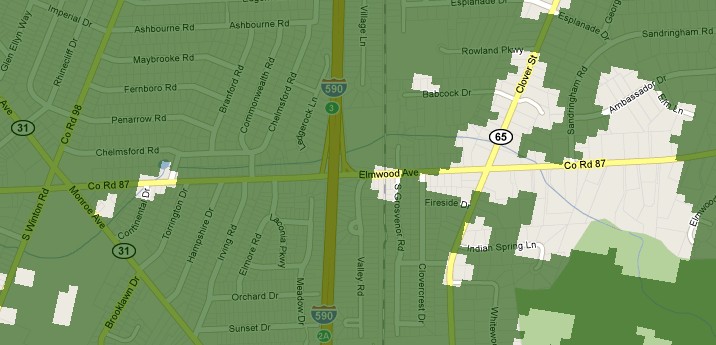
However, the company’s 4G coverage area is spotty in many areas in both cities.  Verifying coverage from their website is essential before considering CLEAR.  Anecdotal reports from some of our readers and others suggest 4G service from Clearwire is not nearly as robust as 3G service from some other providers, and dead zones and slow speeds have caused some to cancel service.  Here’s an example of their coverage in my part of the town of Brighton, just southeast of Rochester:

Clearwire's coverage of the 12 Corners/Elmwood Avenue area of Brighton, N.Y.

Some minor gaps in coverage are apparent near Commonwealth Drive, and if you were getting gas at the 12 Corners Mobil station or visiting Citizens Bank behind it, you’d be out of luck, but otherwise coverage looks fairly good to the west of Interstate 590.  However, a very strange gap pops up between Valley Road and South Grosvenor Road, also impacting a few apartment buildings at Elmwood Court Apartments, 3100 Elmwood Avenue.  That’s odd because although that part of Elmwood slopes slightly downwards, it’s still much higher than the homes on Valley Road or the apartments further back in the complex.  A major service gap opens up on Elmwood at Clovercrest Drive and extends into the very tony neighborhoods around Ambassador Drive and Clover Street.  But the country club set will do fine browsing away on the golf course at the Rochester Country Club further east.

In short, service can vary dramatically street by street, block by block, from nothing at all to full speed ahead.  Be sure to check your area before you commit to keeping the service, much less sign a two year contract for it.

For the rest of Rochester, if you live in the city or an inner-ring suburb, coverage is generally available.  Those further out in towns like Henrietta, North Chili, southern Pittsford, Honeoye Falls, Avon, Scottsville, Churchville, Brockport, Penfield and Perinton face significant gaps or no coverage at all.  Things improve dramatically in Ontario County in towns like Farmington and Victor and the cities of Canandaigua and Geneva.

For the greater Syracuse area, coverage pops up in Auburn and then disappears eastward until reaching Camillus.  Generally, coverage in Syracuse is not nearly as dense as in Rochester, with large gaps opening between suburbs and the city itself.  Mattydale is solidly covered, for instance, while Minoa isn’t.

Now that CLEAR has launched 4G service in Rochester and Syracuse, Road Runner Mobile, which is simply CLEAR rebranded as a Time Warner Cable service (they partly own Clearwire) will also soon be on the way.  Pricing in other Time Warner Cable cities wasn’t much different than from Clearwire direct, and some cable plans really push service contracts, which you really do not want on a service this new.  Do not commit to one unless you are satisfied with the service where you plan on using it.

Clearwire’s 4G Network in 2010

CLEAR 4G service is currently available in 44 markets across the United States, including: Syracuse and Rochester, N.Y.; Atlanta and Milledgeville, Ga.; Baltimore, Md.; Boise, Idaho; Chicago, Ill.; Las Vegas, Nev.; St. Louis and Kansas City, Mo.; Philadelphia, Harrisburg, Reading, Lancaster and York, Pa.; Charlotte, Raleigh, and Greensboro, NC; Honolulu and Maui, Hawaii; Seattle, Tri-Cities, Yakima and Bellingham, Wash.; Salem, Portland and Eugene, Ore.; Merced and Visalia; Calif.; Dallas/Ft. Worth, Houston, San Antonio, Austin, Abilene, Amarillo, Corpus Christi, Killeen/Temple, Lubbock, Midland/Odessa, Waco and Wichita Falls, Texas; central Washington, D.C.; Richmond, Va.; and Salt Lake City, Utah.

In the summer of 2010, CLEAR 4G will launch in Tampa, Orlando and Daytona, Fla.; Nashville, Tenn.; Modesto and Stockton, Calif.; Wilmington, Del.; and Grand Rapids, Mich. By the end of 2010, CLEAR 4G will also be available in major metropolitan areas such as New York City, Los Angeles, the San Francisco Bay Area, Boston, Denver, Minneapolis, Miami, Cincinnati, Cleveland and Pittsburgh.

You can read a company-provided tutorial about the service below the jump.

… Continue Reading

Seoul: The World’s Most Wired City

Phillip Dampier June 30, 2010 Broadband Speed, Public Policy & Gov't, Video 2 Comments

Seoul, the capital city of the Republic of Korea

Seoul, the capital of the Republic of Korea, is the world’s most wired city with some 95 percent of residents enthusiastic users of the world’s fastest broadband networks.

While Americans cope with a broadband duopoly that holds us back, the 100Mbps world of broadband has already arrived in Korea, at prices a fraction of what Americans pay for service — with no limits.

A full 95 percent of households in South Korea have broadband internet access – the highest in the world. Singapore is second to South Korea, with broadband connection in 88 percent of homes. The U.S. ranks 20th, with broadband connection in 60 percent of homes.

Although densely populated cities in Korea, where residents live in multi-dwelling units, makes wiring fiber optic broadband easy, that’s not the only reason why South Korea is so far ahead of the United States.

Koreans consider broadband an essential part of life, a representation of their sense of freedom, as well as a tool to help Korea’s development in a global economy.

[flv width=”640″ height=”380″]http://www.phillipdampier.com/video/ABC News Seoul The World’s Most Wired City 6-25-10.mp4[/flv]

ABC’s ‘Good Morning America’ visited Seoul to learn how the world’s most wired city has been transformed by universal, inexpensive, super-fast broadband.  (5 minutes)

[flv width=”640″ height=”380″]http://www.phillipdampier.com/video/ABC News Why So Wired South Korea 6-25-10.mp4[/flv]

ABC’s Juju Chang sat down for an interview with Yongmann Park, chairman of Doosan Corporation, one of Korea’s successful business conglomerates.  (2 minutes)

Lies, Damned Lies, and Broadband Numbers: Life is Good, Say Broadband Providers; Consumers Disagree

Mehlman

A telecom industry front group acknowledged today American broadband in the last decade has not won any awards for speed or price, but if you just give the industry ten more years of deregulation, there will be more competition than ever to change that.

For the Internet Innovation Alliance’s Bruce Mehlman, the cable and phone companies have done a fine job bringing broadband to Americans, especially considering the industry is only ten years old.  If you leave things the way they are today, the next decade will bring even more competition from phone and cable companies, he promises.

But consumer groups wonder exactly how a duopoly will ever deliver world class service in the next ten years when it has spent the last ten hiking prices on slow speed broadband and now wants to limit or throttle usage.

This afternoon, National Public Radio’s All Things Considered tried to referee the broadband debate, pondering whether America is a world leader in broadband or has just fallen behind Estonia.  Reporter Joel Rose was perplexed to find two widely diverging attitudes about broadband, each with their set of numbers to prove their case.

On one side, consumers and public interest groups like Consumers Union and Free Press who believe deregulation and industry consolidation has created a stagnant broadband duopoly that only innovates how it can get away with charging even higher prices.

On the other, the phone and cable companies, the groups they finance, and their friends on Capitol Hill who believe there isn’t a broadband problem in the United States to begin with and government oversight would ruin a good thing.

Compared with other nations, the United States has continued to see its standing fall in broadband rankings measuring speed, price, adoption rates, and quality.  When East European countries and former Soviet Republics now routinely deliver better broadband service than America’s cable and telephone companies, that story writes itself. Embarrassed industry defenders prefer to confine discussion of America’s broadband success story inside the U.S. borders, discounting comparisons with other countries around the world.

For Rep. Joe “I Apologize to BP” Barton (R-Texas), it’s even more simple than that.  Even questioning the free market is downright silly.

“As everybody knows, if it’s not broke, don’t fix it,” Barton said at a March congressional hearing to discuss broadband matters. “And y’all are trying to fix something that in most cases isn’t broke. Ninety-five percent of America has broadband.”

Industry-financed astroturf and sock puppet groups readily agree, and dismiss industry critics.

Bruce Mehlman, co-chair of the industry-supported Internet Innovation Alliance, which opposes more regulation, acknowledges that the story of broadband in the U.S. is a classic glass-half-full, glass-half-empty predicament. Still, he says he thinks broadband adoption in the U.S. is going pretty well considering broadband has only been available for 10 years.

“For the optimist, you’d say within a decade we’ve seen greater broadband deployment than you saw for cell phones, than for cable TV, than for personal computers,” Mehlman says. “It’s one of the great technology success stories in history.”

Mehlman says Americans don’t need more government intervention to make broadband faster and cheaper. “We haven’t yet and that’s in the first decade,” he says. “In the second decade, the marketplace is only going to be that much more competitive.”

Kelsey

The problems go further than that, however.

Derek Turner, research director for the public interest group Free Press, told NPR broadband rankings tell an important story. “For the providers to try to say that there’s no problem, it’s merely just a smoke screen,” he says.

Providers would prefer to measure their performance against each other instead of comparing themselves with foreign providers now routinely providing better, faster, and cheaper service than what American consumers can find.  They have to, if only because of those pesky international rankings illustrating a wired United States in decline.

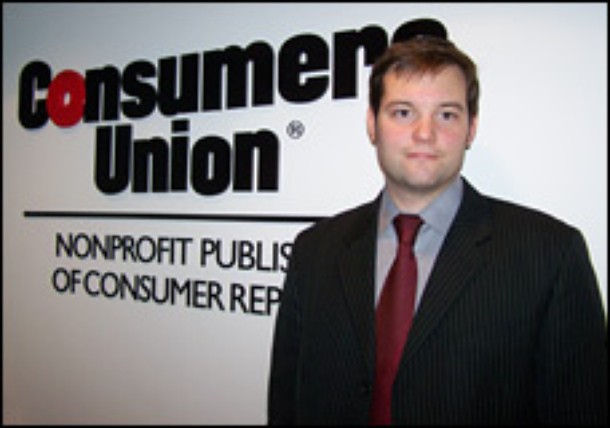
Joel Kelsey at Consumers Union tells NPR there is an even bigger question here — what role broadband plays in our lives.

Because 96 percent of Americans can only get broadband from a duopoly — the phone or cable company, the only people truly singing the praises of today’s broadband marketplace are the providers themselves and their shareholders.  Consumers see a bigger problem — high prices, and particularly for rural consumers, slow speeds.

“If you talk to [the] industry,” Kelsey says, “they think of broadband as a private commercial service akin to pay TV or cable TV.”

On the other hand, Kelsey says, “There’s a lot of folks who think it is an essential input into this nation’s economy — an essential infrastructure question.”

National Public Radio reporter Joel Rose dived into the battle over broadband numbers between consumer groups and industry representatives. Is America’s broadband glass half-full or half-empty? (June 28, 2010) (4 minutes)
You must remain on this page to hear the clip, or you can download the clip and listen later.

Search This Site:

Contributions:

Recent Comments:

Your Account:

Stop the Cap!