Home » Broadband Speed » Recent Articles:

MIT Study Funded By ISPs Discovers Slow Broadband Speeds Are Your Fault

Image courtesy: cobalt123

Your Friendly Internet traffic cops Time Warner Cable and Comcast paid for research that suggests those Internet speed slowdowns are your fault (or at least not theirs).

A study from MIT suggests that broadband speed test results that show “real world” broadband speeds far below what your provider promises are actually better than you think, and if they’re not — it’s not your provider’s fault.  The paper, Understanding Broadband Speed Measurements, finds slow Internet speeds are often your problem, because you run too many applications on your computer, visit inaccurate speed measurement sites, use a wireless router, or have run into an Internet traffic jam outside of the control of your ISP.

The research comes courtesy of MIT’s Internet Traffic Analysis Study (MITAS) project, financially backed by some of North America’s largest cable and phone companies — Clearwire, Comcast, Liberty Global (Dr. John Malone, CEO), and Time Warner Cable in the United States, Rogers Communications and Telus in Canada.  Those providers also deliver much of the broadband speed data MITAS relies on as part of its research.  Additional assistance came from MIT’s Communications Futures Program which counts among its members Cisco, an equipment manufacturer and promoter of the “zettabyte” theory of broadband traffic overload and cable giant Comcast.

The study was commissioned to consider whether broadband speed is a suitable metric to determine whether an ISP provides good or bad service to its customers and if speed testing websites accurately depict actual broadband speeds.  Because Congress and the Federal Communications Commission have set minimum speed goals and have expressed concerns about providers actually delivering the speeds they promise, the issue of broadband speed is among the top priorities of the FCC’s National Broadband Plan.

“If you are doing measurements, and you want to look at data to support whatever your policy position is, these are the things that you need to be careful of,” Steve Bauer, technical lead on the MIT Analysis Study (MITAS) told TG Daily. “For me, the point of the paper is to improve the understanding of the data that’s informing those processes.”

Bauer’s 39 page study indicts nearly everyone except service providers for underwhelming broadband speeds:

While a principal motivation for many in looking at speed measurements is to assess whether a broadband access ISP is meeting its commitment to provide an advertised data service (e.g. “up to 20 megabits per second”), we conclude that most of the popular speed data sources fail to provide sufficiently accurate data for this purpose. In many cases, the reason a user measures a data rate below the advertised rate is due to bottlenecks on the user-side, at the destination server, or elsewhere in the network (beyond the access ISP’s control). A particularly common non-ISP bottleneck is the receive window (rwnd) advertised by the user’s transport protocol (TCP).

In the NDT dataset we examine later in this paper, 38% of the tests never made use of all the available network capacity.

Other non-ISP bottlenecks also exist that constrain the data rate well below the rate supported by broadband access connections. Local bottlenecks often arise in home wireless networks. The maximum rate of an 802.11b WiFi router (still a very common wireless router) is 11mbps. If wireless signal quality is an issue, the 802.11b router will drop back to 5.5mbps, 2mbps, and then 1 mbps. Newer wireless routers (e.g. 802.11g/n) have higher maximum speeds (e.g. 54 mbps) but will similarly adapt the link speed to improve the signal quality.

End-users also can self-congest when other applications or family members share the broadband connection. Their measured speed will be diminished as the number of competing flows increase.

Image Courtesy: lynacThe study also criticizes the FCC for relying on raw speed data that does not take into account the level of service being chosen by a broadband customer, claiming many service providers actually deliver higher speed service than their “lite” plans advertise.

In short, it’s everyone else’s fault (including yours) for those Internet speed slowdowns.

Ultimately, the report’s conclusion can be summed up in three words: change the subject.  It’s not slow broadband speeds that are the problem — it’s the lack of understanding about what you can accomplish with the speeds you do get from your ISP:

In the next few years, as the average speed of broadband increases, and the markets become more sophisticated, we expect that attention may shift towards a more nuanced characterization of what matters for evaluating the quality of broadband services. Issues such as availability (reliability) and latencies to popular content and services may become more important in how services are advertised and measured. We welcome such a more nuanced view and believe it is important even in so far as one’s principal focus is on broadband speeds.

One thing the paper does effectively deliver at top speed are industry talking points, particularly the one that says less regulation is better (underlining ours):

Our hope is that progress may be made via a market-mediated process that engages users, academics, the technical standards community, ISPs, and policymakers in an open debate; one that will not require strong regulatory mandates. Market efficiency and competition will be best served if there is more and better understood data available on broadband speeds and other performance metrics of merit (e.g., pricing, availability, and other technical characteristics).

These kinds of research reports are often tainted by the industry money that pays for them.  Researchers and universities routinely deliver industry-pleasing, sober-sounding studies in return for considerable financial contributions, grants, and other forms of underwriting.  This report lacks full disclosure about who is helping to pay for it — North America’s largest cable operators, who also deliver much of the data MITAS relies on for their research.

Ask yourself how much longer these companies would be writing checks to MIT had they delivered a report implicating them in false advertising of speeds they do not deliver or for relying on inadequate upstream providers to handle their Internet traffic?  The report pulls any and all punches delivered to the companies who finance it — a clear sign of bought-and-paid-for research in action.


Google Launches ‘Google Fiber for Communities’ Website to Advocate for Fiber Broadband

Phillip Dampier July 13, 2010 Broadband Speed, Community Networks, Competition, Editorial & Site News, Google Fiber & Wireless, Public Policy & Gov't, Video Comments Off on Google Launches ‘Google Fiber for Communities’ Website to Advocate for Fiber Broadband

Google today launched a new website which could become a major advocacy center to promote fiber broadband service across America.

Google Fiber for Communities opened with a thank you message for the enormous number of submissions it received for its experimental 1Gbps fiber broadband network.  Google expects to announce the winning application(s) for its experimental  network sometime this year.

But in the meantime, Google also acknowledges what big telecom companies keep trying to downplay and dismiss — “people across the country are hungry for better and faster broadband access.”  That is… better and faster service than their current provider is willing to supply.

The new website provides hints as to its greater purpose:

  1. The name itself.  Notice “communities” is plural.
  2. The site intends to mobilize for fiber networks across the country, starting with lobbying for pending federal legislation that would require installation of fiber conduit as part of federal transportation projects.
  3. The site’s links heavily promotes municipal broadband advocates and organizations, including the National Association of Counties, the National Association of Telecommunications Officers and Advisors, the Fiber to the Home Council, the Baller Herbst Community Broadband Page, the Broadband Properties Municipal Fiber Portal, and Muni Networks.  Outside of the Fiber to the Home Council, which has some big telecom company members and isn’t above advocating for their interests, the rest of the list suggests Google advocates that communities do for themselves what their local phone and cable companies won’t do — deliver world class broadband service at non-duopoly prices.

Stop the Cap! shares many of these goals with Google, as we are strong advocates for community fiber-based broadband, and believe additional competition is highly needed in America’s broadband marketplace to break up an anti-consumer duopoly that delivers slow broadband service (or none at all) at the highest prices companies can get away with.  Thanks to Stop the Cap! reader Jerry here in Rochester for sending word.

<

p style=”text-align: center;”>

Democrats Want More Ambitious Broadband Plan, Call 4/1Mbps Speed Target ‘Second Class’

Senate Appropriations Chairman Daniel K. Inouye - CQ

Inouye

Three senior Democrats on the Senate Commerce Committee have characterized the Federal Communication Commission’s national broadband expansion plans as inadequate — firmly rooting America as second class citizens in a global broadband market.

In three separate letters to FCC Chairman Julius Genachowski, the senators criticized the chairman’s plan for broadband targets set too low, both in vision and in speed.

Genachowski’s plan calls for Americans to have universal access to at least 4/1Mbps service no later than 2020, a goal Genachowski described as “an aggressive target.”

But in a letter obtained by CQ, Senator Daniel Inouye (D-Hawaii) noted that such speed goals were set low in comparison to other countries, many of which are on target to achieve 100Mbps broadband well before 2020.

“What is the FCC’s rationale for a vision that appears to be firmly rooted in the second tier of countries?” Inouye wrote.

Begich CQ

Begich

Senator Mark Begich (D-Alaska) wanted to know how Genachowski settled for 4Mbps download speed, noting that seemed to him to be too modest.

In fact, speed goals in the National Broadband Plan were a major point of contention in the National Broadband Plan, with lobbyists from AT&T and Verizon pushing hard for the lowest possible speed goals.  That is because they are the largest traditional landline providers saddled with aging copper wire networks which provide broadband to most rural Americans through DSL.  Most Americans living outside of major population centers rely on phone company-delivered DSL service typically speed rated at 768kbps-3Mbps.  Because DSL service is distance sensitive, a speed target of just 4Mbps requires a considerably lower investment than a target of 20Mbps or higher.  It is likely 100Mbps service, outlined as a goal for at least 100 million Americans, will first be achieved through fiber and cable networks in large cities, and not from phone company DSL service.

The difficulty for rural Americans to achieve a fair shake in broadband was highlighted by Senator Byron Dorgan (D-North Dakota).  He cited his state’s poor ranking — 42nd in broadband speed, as evidence Americans in rural states suffer with considerably lower quality broadband service.  The FCC’s National Broadband Plan, Dorgan fears, may only recreate the digital divide, only with different levels of speeds.

Senator Byron Dorgan D-North Dakota - CQ

Dorgan

If 100 million Americans can access broadband services at 100Mbps, a rural speed target of 4Mbps will make new, high bandwidth-dependent Internet services just as off-limits to rural America as basic broadband is today in many areas.

Genachowski promised to review broadband speed targets every four years, making adjustments when necessary to be certain rural Americans receive broadband service comparable to urban areas.

But with the wide disparity in speed goals for urban and rural America, that may be impossible in the short term, especially as telecom industry lobbyists continue to pressure Congress for less regulation and no government mandates.

You Win! Consumers Fighting Back Help Kill Municipal Broadband Ban in North Carolina

Rep. James Boles Jr. of Moore County seen yawning as the North Carolina Legislature worked long hours to close the session for the year. (Photo: Charlotte Observer photographer Corey Lowenstein)

A bill to temporarily ban municipal broadband projects in North Carolina went down in flames early Saturday after a marathon 19-hour closing session of the legislature allowed a handful of pro-consumer legislators to finally corner and kill the bill.  But that victory would not have come without a coordinated effort by consumers and communities across the state vociferously objecting to legislation designed to protect the duopoly of phone and cable service offered by Time Warner Cable, AT&T, and CenturyLink.

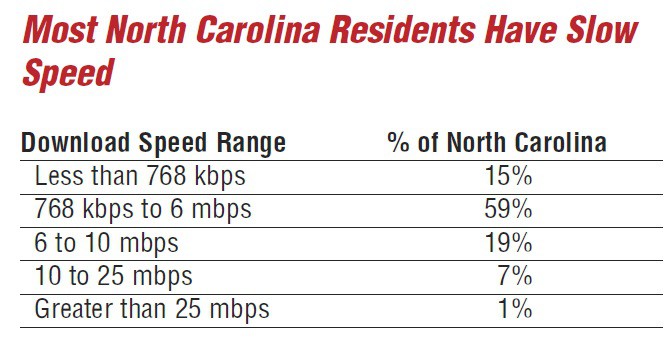
This was the fourth attempt by big telecom companies to get state legislators to do their bidding.  It’s almost as if they want to work harder to stop competitors from delivering service than they work at delivering it themselves.  North Carolina is ranked 41st out of 50 states in broadband adoption. Significant areas of the state are not served by any broadband provider, and broadband speeds experienced by customers in North Carolina are among the slowest in the country.

This year’s battle was among the most difficult because its biggest backer, retiring Senator David Hoyle (D-Gaston), was considered a heavyweight in the legislature, serving in the North Carolina Senate for 18 years.

The drama that would eventually wind its way to the bill’s demise began late Friday evening in an overnight session of the state legislature.

Catharine Rice from the SouthEast Association of Telecommunications Officers and Advisors (SEATOA) is our tour guide through the winding, treacherous waters of a North Carolina legislature in its final hours of the session for the year:

Saturday morning, July 11, at 5 a.m., the NC House of Representatives killed Senator Hoyle’s (D-Gaston) attempt  to force a moratorium on municipalities seeking to provide their communities broadband service. This was the industry’s 3rd (actually 4th) attempt to stop municipalities from providing superior broadband infrastructure to the communities.

Rep. Luebke

The bill died on Saturday after a one-two punch. First, the House Ways & Means Committee had refused to hear S1209 since June 8, under the hands of Committee Chair-Rep. Faison (D-Orange, Caswell), when it crossed from the Senate to the House. Then late Friday evening, the House itself added an amendment to its Study Authorization Bill (SB900) permitting, but not requiring, the Revenue Laws Study Committee to study the laws and circumstances surrounding municipalities providing broadband service to their communities, but dropping all other terms of S1209, mainly  the moratorium. The Senate concurred with House bill 900 unanimously later in the evening (9:49pm) and it was enrolled for review and signature by the Governor. (See Sections 7.5 (a) and (b) here)

Ten minutes later, Sen. Clodfelter introduced H455, a bill whose effect would have changed the approach of the House’s version of the municipal bbnd study. With H455, Senator Clodfelter gutted a House kidney awareness bill, and poured into it the “study” portion of S1209 (Hoyle’s Anti-Muni broadband bill), changing the House version by setting a date certain when the study (and recommended legislation) would have to be completed (March 2011), and increasing the number of seats on the subcommittee from 12 to 14, adding assigned seats for telephone coops and the NC County. The House version did not mandate a study, but made it optional, did not specifically authorize the committee to recommend legislation, and set the seats for the subcommittee at 12, naming 8 with an additional four unassigned seats. Clodfelter’s H455 contained two other sections, one addressing a fluke in sales tax refunds for MI-Connection, the Mooresville-Davidson muni broadband system.

Around 2:45 Saturday morning, on Rep. Paul Luebke’s (D-Durham) motion, the House denied concurrence with the Senate on H455 (96 to deny, 1 to allow). At 3:45 a.m., the House approved a Senate/House conference committee report for the purpose of keeping only one section of H455, (effectively deleting H455′s changes to the House study version of S1209). H455 (here) now provides a state sales tax refund status for Davidson and Mooresville’s MI-CONNECTION system, status the two towns would have if individually providing cable service, but from which they were disqualified by having  joined together to provide broadband cable  service.  On a vote of 91 to 6, the House approved the Senate/House conference report. At 4:55 a.m. the Senate concurred with that report and it was enrolled for the Governor’s attention.

Source: SpeedMatters/CWA

Bottom line, the effort to place a moratorium on consideration for new municipal broadband projects in the state is dead for 2010.  The next opportunity big telecom has for another anti-consumer bill is in January 2011.  At least the North Carolina legislature passed some additional ethics and government reform measures that will give consumers even more tools to fight the next battle:

  • It toughens penalties for illegal campaign donations above $10,000.  As we’ve seen repeatedly, big campaign contributions can make all the difference when legislators throw their constituents’ interests under the bus.  Big phone and cable interests are among the most generous contributors, making it easy to find one or more members willing to carry their legislative agenda forward;
  • Requires board and commission members to account for campaign fundraising activities for elected officials who appointed them.  A case of mutual back-scratching, powerful legislators can often find places for their special interest friends and supporters to serve on state commissions and boards.
  • Expands personnel information that must be released to the public about state employees.  We saw the implications of conflicts of interest in the legislature this past session when one member contemplating municipal broadband bans also happened to be one of Time Warner Cable’s engineering contractors.  More information, this time about past work by state employees, prevents these kinds of conflicts from staying secret.

Please thank Reps. Faison and Luebke for their hard work to stop the broadband moratorium.  It’s unfortunate Rep. Faison’s efforts to bring better broadband to Caswell County, part of his district, were unsuccessful.  But at least Caswell County leaders won’t face a broadband moratorium should they wish to renew their efforts to provide broadband service where CenturyLink will not.

[flv width=”640″ height=”500″]http://www.phillipdampier.com/video/WBTV Charlotte Salisbury A Wired Community 5-2010.flv[/flv]

Why we fight.  Communities like Salisbury, N.C., can now move forward on their own municipal broadband projects.  Back in May, WBTV-TV in Charlotte highlighted Fibrant, the community’s answer to bad service from incumbent providers.  (4 minutes)

AT&T Blames Technical Fault for Slow Uploads Affecting Under “Two Percent” of Customers

We have received a copy of AT&T’s statement in response to yesterday’s report about slowed upload speeds impacting customers in several cities around the United States:

AT&T and Alcatel-Lucent jointly identified a software defect — triggered under certain conditions – that impacted uplink performance for Laptop Connect and smartphone customers using 3G HSUPA-capable wireless devices in markets with Alcatel-Lucent equipment. This impacts less than two percent of our wireless customer base. While Alcatel-Lucent develops the appropriate software fix, we are providing normal 3G uplink speeds and consistent performance for affected customers with HSUPA-capable devices.

That two percent figure seems low considering the sheer number of reports received, but it’s not unprecedented.  Equipment and software glitches can create major slowdowns and outages.  While the problem is being fixed, affected customers are falling back to older and slower upload protocols.  AT&T didn’t apologize for the slowed upload speed, nor provide an estimate for when repairs would be complete.  As of the time of writing (3pm ET), problems are still being noted by some customers.

Customers annoyed by the glitch might be able to obtain some credit for the reduced level of service by contacting AT&T customer service and asking for it.

Search This Site:

Contributions:

Recent Comments:

Your Account:

Stop the Cap!