Home » Broadband Speed » Recent Articles:

NY Gets Broadband Mapping Grant: $6.3 Million Is a Lot of Scratch for a Map

New York State has won $6.3 million in federal stimulus grant money to draw a map of broadband availability in the state.  That’s a lot of money to draw a map.

Hopefully it will deliver a better result than the map that’s already online: inaccurate, slow to load, incomplete, and doesn’t play well with some browsers.

The NY State Office of Cyber Security is responsible for administering the project, which is an improvement over provider-infested (Well)-Connected Nation that draws maps for some other states.  The one developed for Texas was so bad, it became fodder in an election campaign to ridicule the man who approved it.

Theoretically, people can enter a street address and see a list of broadband providers who offer service in their neighborhoods, including the types of service and advertised service speeds.  But most of the data is voluntarily provided by the service providers themselves, and we know they have no reason to exaggerate, right?

Here at Stop the Cap! HQ, we decided to give the map a test run to see what it claimed was available here in the town of Brighton, a suburb just southeast of the city of Rochester, N.Y.:

NY State Broadband Availability Map for Zip Code 14618 - Brighton, N.Y. (click to enlarge)

Just to assist readers, the orange color represents fiber access, the blue represents cable broadband, and the pink-salmon represents DSL.  The results are actually an overlay of various service providers.  Time Warner Cable service is available throughout the 14618 zip code and the pockets of fiber are targeting business parks and medical offices.  These results appear generally accurate.  What is missing is an accurate depiction of DSL service.  That may be because Frontier Communications, the local telephone company, is not listed as a participant in the mapping project.  While DSL performs dreadfully in a number of areas in this zip code, it is generally available for most residents.

The results for wireless providers were a real hoot (speed results are for downstream and upstream speeds, respectively):

AT&T Mobility Mobile 1.5 mbps – 3 mbps 768 kbps – 1.5 mbps
Leap Wireless International Mobile 768 kbps – 1.5 mbps 768 kbps – 1.5 mbps
Sprint Nextel Mobile 768 kbps – 1.5 mbps 200 kbps -768 kbps
Verizon Wireless Mobile not reported not reported

(Note to AT&T: In your dreams.)

Only one of these results represent actual speeds seen from wireless broadband providers in this neighborhood, and we’ve tested most of them.  Sprint Nextel can manage 768kbps connections on its 3G network, and even faster speeds on its 4G network.  AT&T’s claimed 1.5-3Mbps is laughable.  Leap Wireless (a/k/a Cricket) delivers an average of 500-600kbps, with occasional bursts of 700kbps in this area.  Verizon typically has the best coverage but there is no data to compare.

The mapping folks have a lot of work to do to map actual wireless speeds around the state, not simply take the word of providers about the speeds they deliver.  New Yorkers can take a speed test and presumably help create that database.  The link is available at the top right of this story.

Ostensibly the map will allow the state to identify areas where high-speed Internet access is lacking so those gaps in coverage can be addressed. Gov. David Paterson has made a priority of extending affordable high-speed Internet access to all New Yorkers.  How a state with a budget deficit that approached $9.2 billion this summer can map its way towards that may require another grant.

Thanks to Stop the Cap! reader Paul for letting us know.

Ultimately Overpriced: Videotron’s 120Mbps Service Usage Limited With Overlimit Fees That Don’t Quit

Videotron last week unveiled 120/20Mbps broadband service loaded down with tricks and traps that will cost many Canadians far more than the $149.95CDN monthly asking price.

Québec’s largest cable operator introduced Ultimate Speed Internet 120 for “users who want to experience the fastest Internet access in Québec.”  But with a download limit of just 170GB per month combined with an upload limit of a paltry 30GB per month, what many Internet enthusiasts are also likely to experience is a huge bill.

Videotron is rolling out a high-speed Internet access service that will give residents of the Québec City area the fastest speeds in Canada. As of tomorrow, Ultimate Speed Internet 120 will support download speeds of 120 mbps and upload speeds of 20 mbps, a first for Québec City.

Ultimate Speed Internet 120 pushes back the frontier for intensive Internet users,” said Robert Dépatie, President & CEO of Videotron. “Today, we are launching the high-speed Internet service of the future. With the pace at which users’ needs are changing, we are not so far from the day when 120 mbps will be a must-have convenience.”

Astonishing capacity
As of tomorrow, Ultimate Speed Internet 120 will be available in nearly 80% of the greater Québec City area, or to nearly 310,000 households and businesses. The service will be accessible throughout the Québec City area by December 31, 2010 and will then be gradually rolled out to other parts of Videotron’s service area.

Astonishing Overcharging

Yanette is going to the bank to withdraw more funds to pay her exorbitant Videotron broadband bill.

Unlike many other Internet Overcharging plans from Canada’s usage cap-happy providers, Videotron’s highest-speed plans don’t limit the amount of overlimit fees customers will be exposed to once their allowance is exhausted.  In little more than three hours of usage at near-maximum speeds, overlimit fees of $1.50CDN per gigabyte kick in until your usage allows resets the following month.  That’s more than $50 an hour in overlimit fees if running the service near top speeds.

Videotron’s press release says those limits are “well in excess of the current needs of heavy bandwidth users.”

Even worse, Videotron targets its highest speed broadband plan for “traffic management,” which throttles upload speeds dramatically for customers who “have uploaded a statistically significant amount of data,” which is never defined:

Every 15 minutes, a system checks the usage rate for each upload channel (each upload channel typically serves a few dozen modems). If the usage rate has reached a threshold beyond which congestion is imminent, the system identifies the USI 120 modems on that channel that have uploaded a statistically significant amount of data. Uploading from these modems is then momentarily given lower priority. Depending on the severity and duration of the congestion, uploading speed may be slowed for these modems.  […]The above measures are applicable at all times.

That assures customers of a less-than-blazing-fast broadband experience they have paid top dollar to receive.  In effect, this means Videotron’s customers who pay three times the regular price for a concierge-like-broadband-experience are pushed to the back of the line if they actually use it.

A Videotron customer on Broadband Reports wrote, “It’s like driving a jet-car in an alley. You can probably start the engine, but don’t open the gas too much!”

Another customer from Montreal noted it takes no time at all for customers to blow through those kinds of limits:

This is merely a political play to be able to advertise as “the fastest ISP in Quebec/Canada”. Obviously such ridiculous caps are nowhere near the needs of someone who would pay $150 for that kind of speed, but they don’t mind saying things like “well in excess of the current needs of heavy bandwidth users” because 90% of the population, even the journalists themselves, have no idea what gigabytes are in the first place.

Considering most recent games released on Steam/D2D can be over 20GB, one HD episode is 1.3GB to stream each, 170GB is very little.

The cable operator will also throw some small bones to their existing customers effective Oct. 13:

  • Customers with Videotron’s standard High Speed Internet service ($42.95CDN – 7.5Mbps/720kbps) will get a 10 gigabyte usage allowance increase — to 40GB of usage per month.  The overlimit fee remains a stunning $4.50 per gigabyte, up to a maximum of $50 per month;
  • Upstream speeds on Ultimate Speed Internet 50 service ($81.95CDN – 50/1Mbps) will be doubled from 1Mbps to 2Mbps with no price increase.  Considering that plan limits consumption to 125GB per month, the faster speeds mean unlimited overlimit fees of $1.50 per month will add up even faster.

Delivering high speed broadband at premium prices with usage limits and speed throttles is a business plan disaster.  Customers willing to pay the highest prices for fast broadband don’t seek those Cadillac plans to browse web pages.  They want to leverage the fastest possible speeds to make high bandwidth applications work better and faster.  In a business environment, those faster speeds save time, which saves money.  But broadband providers who engage in Internet Overcharging schemes that limit use and charge confiscatory overlimit fees destroy demand for their own products, because few customers are willing to pay the premium prices these plans charge -and- expose themselves to overlimit fees if they happen to exceed an arbitrary usage limit.

Further south in the United States, Americans are still rejecting overpriced DOCSIS 3-premium speed broadband plans, and they come with no usage caps.  Time Warner Cable’s DOCSIS 3 expansion delivers a premium price on the resulting faster speed tiers, and the company managed to sign up fewer than 2,000 customers as of January.

Now imagine a plan that commanded a premium price -and- slapped a limit on usage.

As they say in Québec: c’est ridicule!

AT&T Sticks Texas Students With Lousy Wi-Fi Service They’re Forced to Pay to Receive

Phillip Dampier September 22, 2010 AT&T, Broadband Speed, Wireless Broadband 1 Comment

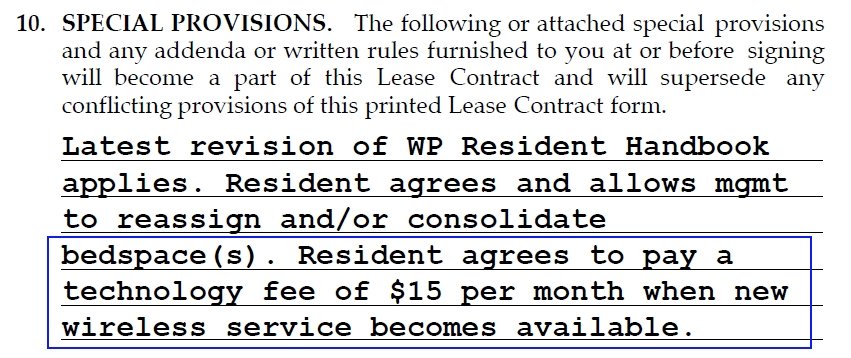
University of Texas students living in a Richardson on-campus apartment complex are stuck paying a mandatory $15 monthly “technology fee” for AT&T-provided Wi-Fi service that works so poorly, many residents are signing up with other providers and paying twice for Internet access.

Residents of Waterview Park have complained about Wi-Fi access inside the complex for some time, but they were never forced to pay for it until May, when the complex’s governing board notified residents that the mandatory fee would be imposed once AT&T took over the service.

Although AT&T doesn’t bill for, or collect the fee, they do provide the service, and students have complained loudly about its weak signals and poor performance.

The Mercury, the university newspaper, ran a story this weak outlining the complaints:

A sample lease agreement obtained from Waterview shows the mandatory technology fee of $15/month.

Computer science junior Kenny Rodriguez said the problems stem from the use of hotspot Wi-Fi as residential internet for students. Hotspot Wi-Fi generally broadcasts an internet signal from a fixed location that becomes weaker the further you move away from it.

“When I was living in building 29, my roommates and I could only pick up a signal by standing in one corner of the living room,” junior Michael Stettler said.

Stettler and his roommates moved to building 31 and are now able to pick up a signal in two of their bedrooms, albeit a slow one.

Rodriguez, who lives in building 8, can only pick up a signal in his living room and sometimes can’t even log on to use it.

“Frequently, the access points are broadcasting but aren’t routing traffic anywhere,” Rodriguez said.

Once a student finds a place in his apartments where a signal can be received, the speed of the connection becomes a problem because the more students who share the available bandwidth the slower the speed becomes.

“It was decently fast at the beginning of this school year, then when everyone came back for fall it crawled to like a tenth or a fifth of a MB per second,” Stettler said.

Waterview’s management has been forced to issue refunds of up to $30 to affected students for poor or non-existent service, but the complex won’t waive the ongoing monthly fee, despite the fact the service can’t deliver much more than 1Mbps on a good day.

Several residents opted to sign up with other providers instead, paying $30 a month or more for service they can actually use.  Stettler and his three roommates decided it was worth it and signed up with Time Warner Cable for 15Mbps service.

The student newspaper took note of another bulletin issued by Waterview management issued August 31 that claimed every resident would have reliable internet within the next 7-14 days or else a non-specific contingency plan would be implemented.

“Nobody has actually stated what will happen if AT&’T doesn’t make their service reliable,” Rodriguez told the paper.” They’ve just vaguely implied that something will happen.”

Twenty-two days later, students report no verifiable improvements have been made in the reliability of the network or the service.

New Study Reveals Why Your Broadband Bill Is Still High: Lack of Competition in a Broadband Duopoly

What is the last technology product you purchased that never declined in price after you bought it?  If you answered your broadband service, a new study proves you right.

Since there are no public data on what has happened to broadband prices over the last decade, Shane Greenstein, a professor of management and strategy at the Kellogg School of Management, and his co-author Ryan McDevitt, an assistant professor of economics and management at the University of Rochester and a graduate of Northwestern University, analyzed the contracts of 1,500 DSL and cable service providers from 2004 to 2009.

The results every broadband user already knows.

At best, prices have declined only slightly — typically between 3-10 percent, partly from a “quality adjustment” the authors included to account for gradually increased broadband speeds when measuring prices.

Greenstein blames a broadband duopoly for the stagnation in broadband pricing.

Greenstein

“So if you were in such a market as a supplier, why would you initiate a price war?” Greenstein asks. With no new entries on the market, suppliers can compete by slowly increasing quality but keeping prices the same. According to Greenstein, quality is where providers channel their competitive urges.

Meanwhile, once companies have installed the lines, their costs are far below prices. “At that point, it becomes pure profit,” Greenstein says. A company might spend around $100 per year to “maintain and service” the connection, but people are paying nearly that amount every other month. Greenstein says that it is not surprising that prices were high during the buildout phase in the early and mid-2000s, since the firms were trying to recover their costs. “However, we are approaching the end of the first buildout, so competitive pressures should have led to price drops by now, if there are any. Like many observers, I expected to see prices drop by now, and I am surprised they have not.”

The authors also confirm Stop the Cap!‘s long-standing contention that providers are enjoying dramatically reduced costs to deliver broadband to customers, yet are not spending some of those profits on important network upgrades.  That could lead to a broadband bottleneck, Greenstein contends, especially with the growth of online video.  We argue it is a recipe for Internet Overcharging — triggering increased pricing to “pay for upgrades” while limiting usage of broadband service, despite the mountain of profits available today to cope with usage growth.

McDevitt

Greenstein and McDevitt pored over 1,500 broadband contracts over several years, tracking pricing, service bundling, and speed improvements.  Pricing, adjusted for speed improvements, was generally flat.  Because the cable industry has delivered most of the speed growth Americans enjoy, the “quality adjustment” the authors used credited most of the modest price declines to the cable industry, especially for customers moving to bundled packages of services.  The authors found DSL and its providers almost completely stagnant — both in pricing and speed.

The most surprising discovery, Greenstein says, is that national decisions are being made without the type of data that he created in the consumer price index. “As an observer of communications policy in the U.S., I find it shocking sometimes how often government makes decisions by the seat of their pants,” he says. Without real data and statistics, decisions are based solely on who has better arguments—in essence, a debate. A better consumer price index will help produce better decisions for the future of the Internet and its users.

It may also serve as an effective challenge to telecommunications industry lobbyists who engineer their own statistics and claims about the performance of the nation’s phone and cable companies.

Thanks to Stop the Cap! readers Bones and Michael for sending along the story.

Australian ISP Says National Broadband Network’s 1Gbps Speeds Are “Crap”; Old People Don’t Care So Why Do It?

John Linton, CEO Exetel

Australia’s planned National Broadband Network (NBN) delivering the country access to broadband speeds up to 1Gbps face many of the same criticisms American municipal providers hear when incumbent commercial providers face imminent competition from fiber broadband.

But nobody can top the venomous spray of Exetel’s CEO John Linton, who called the entire concept of public broadband for the public good “a load of crap” and those behind it a mix of ‘thugs,’ ‘pretenders,’ and generally incompetent and stupid.

Linton’s Internet Service Provider delivers broadband to most of its customers over Telstra landlines, using DSL.  But the company has grudgingly agreed to participate in the NBN project, even while still despising it to the core.

Exetel’s pricing on NBN’s fiber network charges for speed and usage.  Much like cable broadband, Exetel delivers much faster downstream speeds (up t0 100Mbps), with upload speeds maxing out at 8Mbps. The higher the speed, the higher the monthly access fee.  Users receive no usage allowance, paying fees per gigabyte for all of their usage.  Exetel still reserves the right to throttle customer speeds for certain online applications, and “traffic shape” users based on their usage.

In Tasmania, Exetel has introduced a 25/2Mbps broadband plan with no usage allowance — but no monthly access fee either — charging a flat $2 per gigabyte of usage.

Exetel Fiber Pricing In Tasmania

Plan Speed Down Speed Up Monthly Access Download Charges Upload Charges Contract Length Usage Allowance
A 25 mbps 2 mbps $0.00 $2.00 per GB Nil 12 Months None
B 50 mbps 4 mbps $25.00 $1.00 per GB Nil 12 Months None
C 100 mbps 8 mbps $50.00 $0.75 per GB Nil 12 Months None

Linton spews most of his angry commentary on his personal blog, which he closed to non-Exetel customers unless they made a $20AUS contribution to the company’s endangered wildlife protection programs.  But he rarely pulls punches in public either.

Is this Australia's broadband future?

A sampler:

With wireless broadband waiting in the wings, those excited by NBN’s 1Gbps speeds are “unthinking and just plain stupid, pretty much along the same lines as the stone age cargo cult dwellers in the jungles of New Guinea are excited about the next ‘goods drop’ from the strange colored bird.”

Australia’s aging population, “who don’t play computer games or get a surrogate sex life from pornography” have zero interest in getting terabyte broadband speeds, making the whole endeavor a giant waste of money.

“The number of people who want 100Mbps are almost none today and aren’t going to be very many in five years time.   Probably 40-50% of people today will never want to use a piece of fiber […] and they’re certainly not gamers playing, or those other things.  They’re the other half of Australia that has a life rather than a half life.”

On the results of the recent election and the decision to move forward with the NBN: “God help us all.”

On Communications Minister Stephen Conroy (Australia’s version of FCC Chairman Julius Genachowski): “He was his usual mixture of bewilderment, ignorance and barely concealed thuggery, but I was amused at his reference to Exetel (not by name).” Linton wrote on his blog. “While I’m grateful for the ‘free plug’ I thought it was an obvious example of “straw clutching” if it wasn’t based on appallingly bad briefing, which I would doubt, because for him to have been aware of any actual pricing would have required some sort of briefing,” added Linton.

On NBN co-chief Mike Quigley, who will help manage NBN service: “Is [Mike Quigley] god? Can he reverse 100 years of telecommunications going one way and say, ‘Oh, I’m Mike Quigley, and I haven’t worked here in 30 years, I know nothing about running major networks, but someone has paid me $2 million a year so I can pretend I can’.  The only one who can do it is Telstra. It would do it cheaper than a bloody government.”

Linton blames all of the talk about a publicly-owned broadband network for the decrepit state of Australia’s commercial broadband market, claiming it dried up private investment in new ADSL products: “The situation as I see it is that the suppliers — Telstra, Optus, AAPT — are not really investing in anything new, especially when you’re referring to ADSL type broadband products. The current suppliers are holding on to the margins they have at the moment, and if anything they will seek to increase them rather than reduce them,” says Linton.

Since nearly every broadband user in Australia knows Linton hates fiber broadband, what technology does he believe represents Australia’s future?

Or this?

3G wireless.

“Most people that I know, including me, put a much higher priority on mobility than they do on speed,” he told ZDNet. “The average person needs a 100Mbps internet connection about as much as they need to have their arms amputated.”

While mobility is important, his critics charge, there is no way 3G wireless can deliver Australia its broadband future.  Service is not ubiquitous across the country, speeds are far below even what DSL offers, streaming multimedia is challenging at best, and the usage fees and limits that accompany wireless service plans in the south Pacific would create an even greater divide between those who can afford wireless broadband, and those who cannot.

A report released yesterday by the Bureau of Statistics shows Australians are downloading more data than ever before, increasing more than 50 percent in the second quarter compared to the same period last year. The amount of data downloaded every three months is now 11 times higher than March 2005 and 126 times higher than March 2002.

Australia’s National Broadband Network is open to all Internet Service providers that wish to participate, reselling their broadband plans using NBN’s infrastructure.

Search This Site:

Contributions:

Recent Comments:

Your Account:

Stop the Cap!