Home » Broadband Speed » Recent Articles:

Cisco Releases New Broadband Rankings: U.S. and Canada Not In The Top-10, Qatar Is

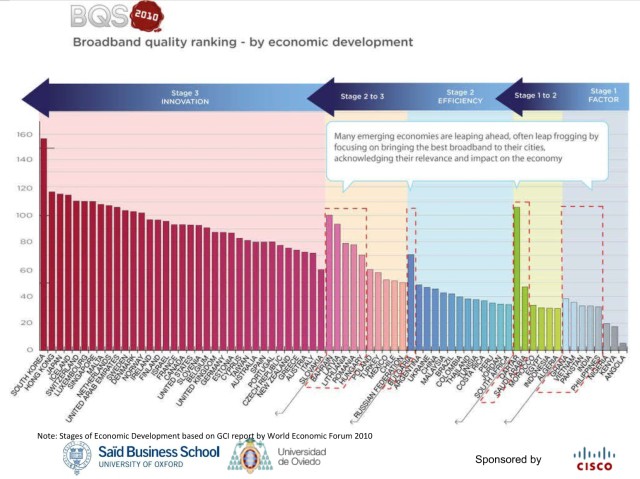
Cisco has released the results of the third annual study from the Saïd Business School at Oxford University, which looks at broadband quality in 72 countries and 239 cities around the world.  The results are an embarrassment to much of North America’s broadband.

Using data from 40 million real-life broadband quality tests conducted in May-June of 2010 on the Internet speed testing site, Speedtest.net, the researchers were able to generally evaluate broadband conditions in the 72 countries which generated enough tests to provide useful results.

Although these kinds of studies often end up indirectly promoting Cisco’s own products (which they’d argue go hand-in-hand with broadband improvement), the findings highlight the very real problem that most aggressive broadband development is taking place outside of North America.  Here at home, reduced investment and foot-dragging has kept growth in check, even as prices continue to rise.

Based on the findings, the countries with the most sophisticated and advanced broadband networks are:

Broadband leadership table (top 10):Ranking Broadband Leadership 2010
1 South Korea
2 Hong Kong
3 Japan
4 Iceland
5 Switzerland. Luxembourg, Singapore (tie)
6 Malta
7 Netherlands
8 United Arab Emirates, Qatar (tie)
9 Sweden
10 Denmark

While the United States and Canada both languish in 15th place, broadband in South Korea has gone from excellent to outstanding as it continues aggressive, almost revolutionary improvements in service and speed:

  • South Korea tops the broadband leadership ranking for the second year in a row;
  • Broadband quality in South Korea is ranked the highest and has set a new benchmark for the world;
  • Average download throughput is 33.5 Mbps, an increase of 55% from 2009, average upload throughput is 17 Mbps, an increase of 430%, and average latency is 47ms, an improvement of 35% vs. 2009 figure;
  • South Korea has achieved 100% broadband penetration.
Cisco’s study found North America is in peril of falling even further behind because providers are trying to incrementally upgrade inferior, obsolete copper-wire phone networks on the cheap instead of replacing them.

As long as providers in the United States and Canada maintain a Dollar Store-mentality towards broadband improvement, both countries will increasingly fall further and further behind countries many Americans couldn’t find on a map.

Developing economies, especially in eastern Europe, are poised to leapfrog over North America and potentially become new powerhouses in the digital global economy of the future.  Among the nations on the verge of blowing past the United States and Canada: Lithuania, Latvia, Bulgaria, Romania, the Czech Republic and Hungary.
Welcome to the 500GB Broadband Economy

Cisco’s study also includes some important findings about data consumption that expose North American broadband providers who support Internet Overcharging schemes as direct threats to our economic future in a knowledge economy:

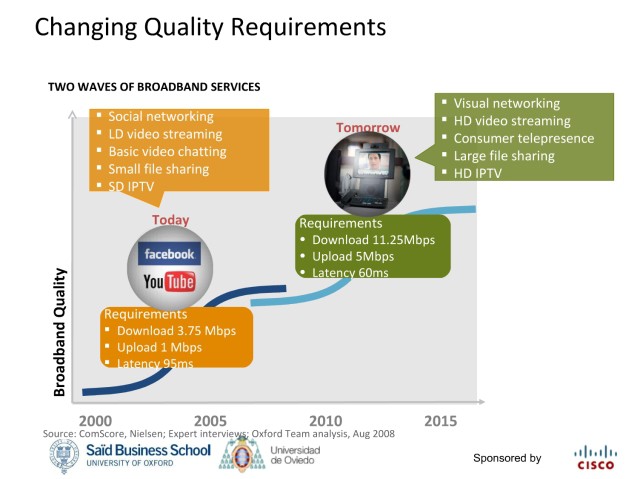
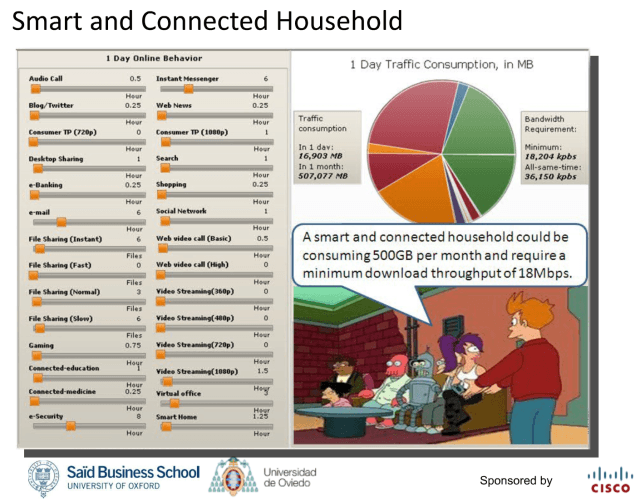
The study assessed the average consumption of different household segments and found major differences between basic-digital homes and smart and connected homes:

  • Basic digital homes which mainly use the web for simple-quality requirement applications such as web browsing, instant messaging and social networking, consume about 20 GB per month;
  • Smart and connected households, who would use the web for high definition video communication, high definition entertainment, tele-education or telemedicine, home security and others, can easily consume 500 GB per month and require an assured bandwidth of 18 Mbps.

Under these terms, Canada’s digital economy is already destined to fail because virtually every provider in the country limits broadband consumption to levels far below that required by “smart and connected households.”  In the United States, some providers have suggested as little as 5GB would represent “enough usage” under residential broadband accounts.  The nation’s largest cable company, Comcast, limits consumption to half the amount required.  Those advocating unlimited broadband or far higher limits are accused of being “bandwidth hogs” or pirates by many of these providers and their dollar-a-holler friends.

World leaders in broadband have some things in common: availability of inexpensive, unlimited broadband delivering fiber-fast speeds.  Those falling behind or at the bottom are raising broadband prices, putting limits on consumption and delivering slow broadband speeds that would draw laughter in countries as diverse as Japan, Sweden, and the United Arab Emirates.

Shaw’s “Fastest Internet in Canada” Doesn’t Mean Much If Usage is Limited

Phillip Dampier October 25, 2010 Broadband Speed, Canada, Data Caps, Editorial & Site News, Shaw 29 Comments

Shaw Communications is preparing to introduce a formal Internet Overcharging scheme for its customers across western and central Canada.  Although the company has maintained “soft caps” that have generally been unenforced, that is about to change.

An Edmonton reader of Broadband Reports first noticed the appearance of a new formal Internet Data Usage Policies section on Shaw’s website.  Some customers also received access to a usage meter that was roundly criticized for being inaccurate.

She's blown away by her high broadband bill.

In short, Shaw Cable plans a “three strikes and then you pay” approach to usage limit enforcement.  After a customer exceeding plan limits receives three warnings from the company, excess usage charges will start to appear on customer bills.

A participant on Broadband Reports inferring he’s a Shaw employee admits the company’s usage meter was so inaccurate, it has been pulled.  So has much of the information on Shaw’s website, which now provides a more general “stay-tuned” announcement:

Thank you for your interest in Shaw’s Internet Data Usage policies. Please stay tuned as we develop information specific to your area on this topic.

Shaw currently sells four levels of service in most areas (“Nitro” is available in limited areas with DOCSIS 3 upgraded service), sold by both speed and data transfer limits:

High-Speed
Warp†*
High-Speed
Extreme*
High-Speed
Internet
High-Speed
Lite
Maximum download speed 50 Mbps 15 Mbps 7.5 Mbps 1 Mbps
Maximum upload speed 3 Mbps 1 Mbps 512 Kbps 256 Kbps
Dynamic IP addresses 2 2 2 1
Price (in Canadian dollars) $107/month $57/month $47/month $35/month
Data transfer limit 250 GB/month 125 GB/month 75
GB/month
13 GB/month

*Service availability may vary by market. Docsis modem required.
Limited areas that are not DOCSIS 3.0 ready will receive 25 Mbps download and 2 Mbps upload.

In contrast, most Americans pay lower prices for equivalent levels of service, with no data transfer limits.

Shaw customers will soon see usage graphs on their monthly bills and face the prospect of paying overlimit fees once they exhaust their usage warnings.  While Shaw works to implement its broadband overcharging scheme, it is also making hay out of its new 1Gbps fiber-based broadband trials in British Columbia (primarily to stay competitive with its nemesis — competitor Novus Entertainment) and Alberta:

This service launched in select Vancouver neighbourhoods in June – and Pinebrook, a suburb west of Calgary, will be the latest area to try out the 1 Gigabit Internet service FREE for six months!

Our test neighbourhoods have the advantage of “future proofing” as they receive the best technology has to offer with Fibre-to-the-Premises (FTTP) and will be able to support new, cutting-edge Internet applications that will require faster download speeds – compliments of Shaw.

At the end of the six month trial, customers will still be able to retain their existing services without any change in features or function.

This is a great opportunity for our customers and we are thrilled to be the first provider in Canada to offer this incredible service.

Of course, most of the applications that require faster broadband speeds also consume plenty of data, and when Shaw formally introduces the fiber service, limits on its use are likely to come along for the ride.

World Wide Wait: DSL = (D)ead, (S)low and (L)ousy — the Dial-Up of the 2010s, Says Analyst

Telephone companies will lose up to half of their broadband market share if they insist on sticking with DSL technology to deliver Internet access, according to a new report from Credit Suisse analyst Stefan Anninger.

Anninger predicts DSL will increasingly be seen as the “dial-up” service of the 2010s, as demand for more broadband speed moves beyond what most phone companies are willing or able to provide.  Credit Suisse’s analysis says DSL accounts sold in the United States top out at an average speed of just 4Mbps, while consumers are increasingly seeking out service at speeds of at least 7Mbps.  The higher speeds are necessary to support high quality online video and the ability for multiple users in a household to share a connection without encountering speed slowdowns.

A lack of investment by landline providers to keep up with cable broadband speeds will prove costly to phone companies, according to Anninger. He believes a growing number of Americans understand cable and fiber-based broadband deliver the highest speeds, and consumers are increasingly dropping DSL for cable and fiber competitors.  Any investments now may be a case of “too little, too late,” especially if they only incrementally improve DSL speeds.

Anninger says providers may be able to offer up to 18Mbps in five years by deploying ADSL 2+ or VDSL technology, but by that time cable operators will be providing speeds up to 200Mbps, and many municipal providers will have gigabit speeds available.

The impact on phone company broadband market share will prove bleak for phone companies in all but the most rural areas, Anninger predicts.  He says by 2015, cable companies will have secured 56 percent of the market (up by 2 percent from today), phone companies will drop from 30 percent to just 15 percent, Verizon FiOS, AT&T U-verse, and wireless broadband will each control around 7 percent of the market, with the remainder split among municipal fiber, satellite, and other technologies.

Anninger is also pessimistic about wireless broadband being a wired broadband replacement in the next five years.

A Credit Suisse online survey of 1,000 consumers in August found that less than half would consider going wireless only.  The reasons?  It’s too slow, too expensive and most plans have Internet Overcharging schemes like usage caps and speed throttles.

Although cable companies are on track to be the big winners in broadband market share, still have one giant hurdle to overcome — a lousy image.  Just 36 percent of cable customers say they are “very satisfied” with their local provider.  More than 60% of FiOS and U-verse’s broadband customers said they are “very satisfied” with the services these advanced telephone company networks provide.  Consumer Reports has regularly awarded top honors to Verizon FiOS for the last several years.

Independent phone companies and smaller cable operators routinely score at the bottom, typically because they are relying on outdated technology to supply service.

This makes the marketplace ripe for disaffected consumers to jump to an alternative provider.  Unfortunately, as most Americans face a duopoly of the cable company they hate and the phone company that doesn’t deliver the services they want, there is no place for them to go.

Anninger also predicts the risk of broadband reform by reclassifying broadband under Title II at the Federal Communications Commission is now “minimal.”  That suggests Net Neutrality enforcement at the FCC is not a priority.  The Credit Suisse analyst says if action hasn’t been taken by winter or spring of next year, it’s a safe bet the Commission will never re-assert its authority.

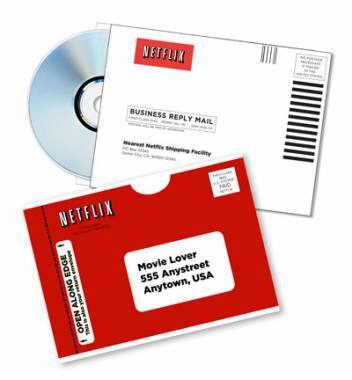
Netflix Finally Wakes Up to Net Neutrality, Internet Overcharging Threat

"DVD's are so five years ago!"

Netflix, which has seen its Canadian streaming-only video service welcomed with usage cap reductions by Rogers Cable, has finally started to wake up to the threat its online video business model is one speed throttle or usage cap away from oblivion.

As the video rental company now contemplates launching a streaming-only version of its service in the United States, it has now firmly waded into the Net Neutrality debate.  In a filing earlier this month, Netflix impressed upon the Federal Communications Commission the importance of prohibiting providers from establishing blockades to keep its competing video service from threatening cable-TV revenue:

“The Commission must assure that specialized services do not, in effect, transform the public Internet into a private network in which access is not open but is controlled by the network operator, and innovative Internet-based enterprises are permitted effective access to their consumers only if the enterprises pay network operators unreasonable fees or are otherwise seen by such network operators as not threatening a competitive venture.”

Netflix online video packs a real wallop, as Americans embraces the service as a suitable and cheaper replacement for premium cable movie channels.

Sandvine, which pitches “network management” products to the broadband industry, reported Netflix now represents more than 20 percent of all downstream broadband traffic in the United States during peak usage times between 8-10pm.

The company’s financial results seem to affirm its growing impact as an online video entertainment player.  The Washington Post reports in the third quarter, Netflix saw a 52 percent gain in subscribers to 16.9 million. Revenue increased 31 percent to $553 million. But most interesting: 66 percent of subscribers watched more than 15 minutes of streaming video compared with 41 percent during the same period last year. The company predicted Wednesday that in the fourth quarter, a majority of Netflix subscribers would watch more content streamed from the Web on Netflix than on DVD.

That prompted CEO Reed Hastings to say Netflix should now be considered a streaming company that also offers DVD-by-mail service.

If providers launch Internet Overcharging schemes that limit broadband usage or throttle their competitors to barely usable speeds, that growth could come to an end quicker than the introduction of the next “unfair usage policy.”

Sandvine’s research confirmed something else.  As broadband speeds increase, so does usage.  In Asia where broadband speeds are dramatically higher than in the United States, Sandvine found median monthly data consumption is close to 12 gigabytes per household compared to 4 gigabytes in North America.  And Asians stay very close to their broadband connections, using them on average for almost 5.5 hours per day, compared to just three hours for North Americans.

When one considers the majority of broadband users are only starting to discover online video, those numbers are headed upwards… fast.

GCI Spokesman Openly Lies to Media About Internet Overcharges – We Have the Bills

GCI delivers unlimited downloads of customers' money.

GCI spokesman David Morris either does not know what his own company does to abuse its customers or he openly lied about it in statements to the media:

GCI said it hasn’t yet charged anyone fees for exceeding the data limits (some customers dispute this), but the company began contacting its heaviest data users this summer to move them to new, limited plans. The company is also upgrading Internet speed for its customers this year at no extra cost.

GCI said it hasn’t decided when to enforce the data limits on everyone else. The crackdown might not happen until next year, according to Morris.

Apparently Morris is living in a time warp, because “next year” is this year.

After our article earlier this morning, Stop the Cap! started receiving e-mail from angry GCI customers with bills showing outrageous overlimit fees running into the hundreds of dollars GCI claims they are not charging.

Our reader Steve in Alaska sums it up:

“GCI is a bad actor that abuses its customers with bait and switch broadband, baiting customers with expensive unlimited bundled plans and then switching them to limited plans with unjustified fees,” he writes. “A legal investigation exploring whether this company is violating consumer protection laws is required, especially after misrepresenting the nature of these overcharges in the Alaskan media through its spokesman.”

GCI is apparently iterating the credit card industry’s tricks and traps.

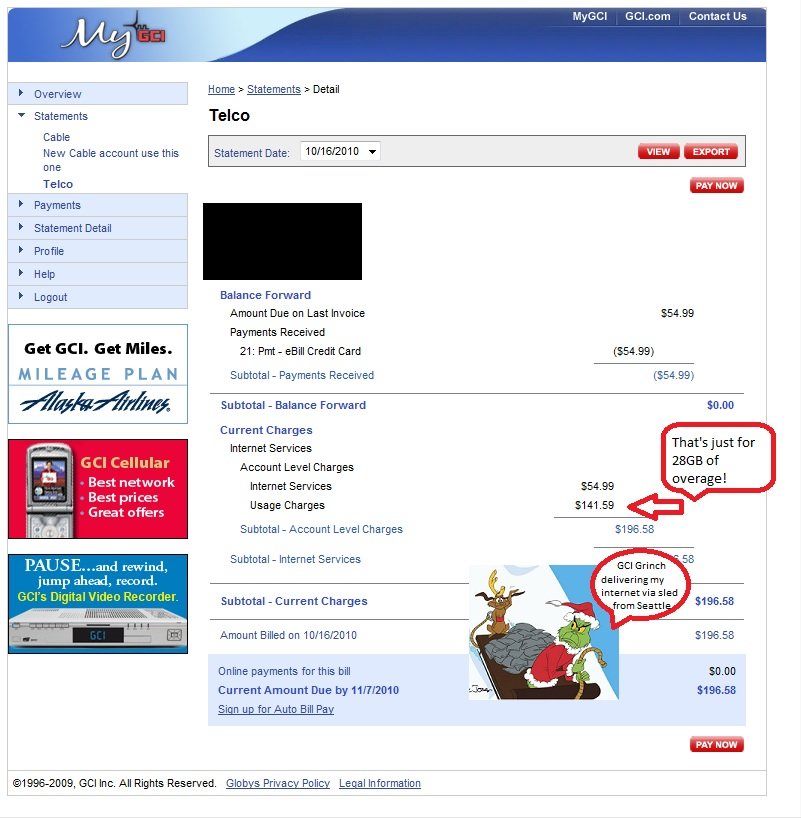
Our reader Scott’s latest broadband bill shows just how abusive GCI pricing can get:

GCI: the Grinch That Stole the Internet (click to enlarge)

Scott was floored by GCI’s Festival of Overcharging, which turned a $55 a month bill for broadband into nearly $200.  It exemplifies everything we’ve warned about over the past two years with these pricing schemes:

Well it finally happened, I got hit with GCI internet bill shock, $196.58 total for my 8Mbps plan with 25GB usage.

My usage prior to this has always been around 15-20GB/mo according to them — just the usual web surfing/e-mail with a little online gaming over the weekends (Eve Online) but not much.

Something ratcheted up my usage to nearly twice that (I did buy one game off Steam for digital delivery), which still would have been perfectly reasonable given the $75.00/mo plan I chose — that’s double what most people pay for unlimited in the lower 48 states. I only moved to this plan because their $135/mo bundle plan wasn’t affordable due to the required overpriced digital phone + taxes.

I tried calling their customer service and just got the company line about how expensive it was to provide their service, and I must have an open Wi-Fi router or “downloaded” too many YouTube videos, iTunes, or other content. He also stressed five or six times lots of customers go over their limits thanks to Netflix streaming and you really can’t use it with GCI Internet service.

To date I’ve never gotten a straight story from them on how this is managed, or from their marketing material which never mentioned overage until recently, or their reps that used to say you’d get a phone call to warn you if you went over their limits. The rep I spoke to most recently claims you’re supposed to call them daily or every other day – or login to a special portal online to monitor usage.

Either way this company has no sense of customer service, nor does it operate in the interest of Alaskan consumers that are cut off from the lower 48 and need reliable and affordable Internet services.

Stop the Cap! recommends making a copy of David Morris’ comments and notifying GCI you are not paying their overage fees because they are “obviously in error,” at least according to the company’s own spokesman.  Then get on the line with the State of Alaska’s Consumer Protection Unit and the Better Business Bureau and demand your overlimit fees be credited or refunded.  We’ve even got the complaint form started for you.  GCI values its A+ Better Business Bureau rating, so chances are very good they’ll take care of you to satisfactorily close the complaint.

GCI’s claims that with Internet usage limits, the company can deliver its customers faster speeds.  But Stop the Cap! argues those speeds are ultimately useless when GCI allows you to use as little as 3 percent of your service before those overlimit fees kick in.

A Broadband Reports reader ran the numbers before speed upgrades made them even worse:

Yes, GCI is overcharging customers and they have been on their unbundled tiers for a very long time. Now GCI wants to overcharge the rest by setting limits on ultimate package tiers that previously were labeled as “unlimited downloads”. I thought I’d post the more revealing information about how GCI is ripping off residential customers.As an academic argument let’s compare what data transfer is possible vs. what GCI now expects customers to use on its [formerly] “unlimited downloads” tiers.

1 Mbit = 1,000,000 bits

1,000,000 bps * 60 = 60,000,000 bpm
60,000,000 bpm * 60 = 3,600,000,000 bph
3,600,000,000 bph * 24 = 86,400,000,000 bpd

Now that we have a baseline measure of the total data transfer possible from a 1Mbps line PER DAY, let’s convert bits to bytes and gigabytes.

8 bits = 1 byte
86,400,000,000 bits / 8 bits = 10,800,000,000 bytes

Now let’s convert this to gigabytes

1,000,000,000 bytes = 1GB
10,800,000,000 bytes / 1,000,000,000 bytes = 10.8 GB

This means that 10.8GB of data transfer is possible with a 1Mbps connection operating 24/7 PER DAY.
NOTE: This figure doesn’t take into account network overhead or other loss.

Ultimate package speed tiers.

(Total Throughput possible PER DAY)
4Mbps = 10.8 * 4 = 43.2 GB
8Mbps = 10.8 * 8 = 86.4 GB
10Mbps = 10.8 * 10 = 108.0 GB
12Mbps = 10.8 * 12 = 129.6 GB

(Total Throughput possible PER MONTH)
Assume 30 days = 1 month

4Mbps = 43.2 * 30 = 1296 GB = 1.296 TB
8Mbps = 86.4 * 30 = 2592 GB = 2.592 TB
10Mbps = 108.0 * 30 = 3240 GB = 3.240 TB
12Mbps = 129.6 * 30 = 3888 GB = 3.888 TB

Now this is what GCI expects its customers to use.
4Mbps = 40 GB
8Mbps = 60 GB
10Mbps = 80 GB
12Mbps = 100 GB

GCI expected utilization factor (actual/possible usage)
40 / 1296 = 0.0308 = 3.08 %
60 / 2592 = 0.0231 = 2.31 %
80 / 3240 = 0.0246 = 2.46 %
100 / 3888 = 0.0257 = 2.57 %

It should be no surprise that as technology continues to develop, the true costs of broadband have continued to fall.

Given the true cost of bandwidth today, GCI’s forced bundling, and the price it’s asking this is pathetic.

Some might choose to ignore it or want to be a water carrier for GCI and similar ISPs, but advertising a service and expecting less than 3% usage is overbilling. It’s overcharging and also manipulative because the general population doesn’t understand it and can be easily duped into believing whatever they’re told to believe by an ISP.

Search This Site:

Contributions:

Recent Comments:

Your Account:

Stop the Cap!