Home » Broadband Speed » Recent Articles:

Clearwire in Big Trouble: Laying Off 15% of Staff, Unhappy Customers Fleeing, Money Running Out

A Facebook group has been established to oppose Clear's Internet Overcharging schemes

The clock may be running out on Clearwire, America’s “4G-WiMax” wireless broadband provider controlled by Sprint, with close investment ties to Comcast and Time Warner Cable, who both resell Clear wireless broadband under their own brands.

At issue is money — the lack of it, and the wireless company’s cash on hand has grown so perilously low, Clearwire was forced to admit to its investors it may not survive beyond the first half of next year:

Based on our current projections, we do not expect our available cash and short-term investments as of September 30, 2010 to be sufficient to cover our estimated liquidity needs for the next 12 months. We also do not expect our operations to generate positive cash flows during the next 12 months. Without additional financing sources, we forecast that our cash and short-term investments would be depleted as early as the middle of 2011.

The Securities and Exchange Commission rules governing public companies represent a public relations nightmare for anyone trying to put a positive spin on bad news, and Sprint chief Dan Hesse desperately tried to make lemonade out of the financial lemon Clearwire increasingly represents for the wireless company.

“If you get to the point where you don’t have 12 months of cash in the till, even if you’ve got negotiations going on, or what have you, you have to, from an accounting perspective, say you have a going-concern issue,” Hesse said. “That doesn’t mean that Sprint and other partners won’t continue to fund Clearwire.”

With Sprint’s 54 percent stake in Clearwire defining the entity as a subsidiary of Sprint, its demise could risk Sprint’s own financial well-being, something Sprint plans to address in 2011, potentially ending its majority stake in the company.

For Hesse and his cable partners, Clearwire’s financial problems are being spun as a result of the venture’s success.  The company says it cannot afford the rapid expansion it has undertaken to expand its WiMax network into additional cities across the country, and faces serious financial challenges from the subsidies consumers demand when buying smartphones.

Hesse particularly complains about the latest whiz-bang smartphones consumers demand, many costing upwards of $600.  Consumers in the United States don’t pay full retail price.  In return for two year contracts carrying steep cancellation penalties, carriers cut the price of most high end phones to $200 or less.

“Subsidies are going through the roof in our industry,” Hesse said. Nearly 40 percent of Sprint customers use the company’s 4G network, and that number is rising.

Revenues are up 114 percent from a year earlier to US$147 million. But Clearwire’s losses for the last quarter alone amounted to $139 million, or $0.58 per share.

As a result, Clearwire slashed 15 percent of its staff, laying off nearly 600 employees and has indefinitely suspended its expansion plans to bring the network to additional cities.  Clearwire will also shutter many of its planned retail outlets — some already built — and delay the introduction of its own branded smartphone.

But even that may not be enough.

Although Clearwire’s growth has been double the level anticipated, achieving a net gain of 1.23 million subscribers in the third quarter — reaching 2.84 million total subscribers, not all of those customers are sticking around once they begin using the service.

Complaints about the company’s poorly disclosed speed throttling continue to be a regular topic on Clear’s support forums.  At least 1,000 complaints have been logged on Clear’s own support forums and elsewhere online about the speed traps.  A Facebook group opposing the schemes has also been established.

Stop the Cap! filed a formal complaint with the New York Attorney General’s office accusing the company of false and misleading advertising and fraud for claiming customers would enjoy “blazing fast speeds” with no limits or speed throttling, despite the fact company officials later admitted they were throttling customers deemed to be “using the service excessively.”  Dozens of additional complaints from Clearwire customers have been filed with state Attorneys General across the country, as well as with the Federal Trade Commission in Washington.

Just how much is too much has never been made clear by the company, but many users report the speed throttle reduces speeds to 250kbps, often for hours at a time.
Clearwire told Electronista:

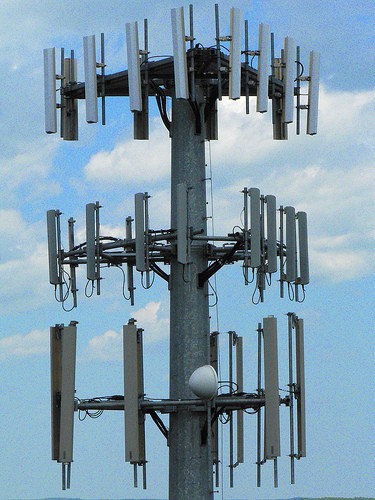
Throtting is based on the current utilization for each cell tower, and many low-use towers do not throttle speeds at all. For high-use towers, throttling occurs during peak-use times.

A customer’s maximum speed is based on the number of gigabytes of data transferred in the past seven days and the download speeds for the past 15 minutes. Speeds are recalculated every 15 minutes, at which point a throttled customer will be bumped up to a higher speed. Rather than implementing one speed for throttling, the calculations will move customers between 48 different speed brackets.

The worst offenders using peer-to-peer software on Clearwire’s network may face repeated throttling.

Clearwire’s network management speed throttles come despite claims made last March by Chief Commercial Officer Mike Sievert, who said the average subscriber was consuming around 7GB of usage per month and this posed no problem for the provider, which owns up to 150 MHz of wireless spectrum in some markets.

Clearwire advertises a faster Internet experience for their 4G service, but many report they receive speeds far slower, even if they have engaged in very little usage.

Many consumers are also unknowingly finding themselves back on Clear’s network even though they signed up with a third party provider.  Clear resells access to its network under a variety of different brands not limited to Sprint, Road Runner Mobile, Comcast Internet2Go, and Best Buy Mobile/Wireless.

[flv width=”640″ height=”380″]http://www.phillipdampier.com/video/Clear Speed Woes 11-10-10.flv[/flv]

This Clearwire customer visits a Clear hotspot location and discovers even on a Wi-Fi network, Clear’s speeds don’t match their advertising claims.  Then, he discovers just how sneaky Clearwire gets in disclosing important information about the company’s wireless speeds customers might want to know before signing up.  (5 minutes)

Gullible Media Buys Into More ‘Internet Brownout’ Nonsense

Phillip Dampier November 9, 2010 Astroturf, Broadband "Shortage", Broadband Speed, Online Video, Video Comments Off on Gullible Media Buys Into More ‘Internet Brownout’ Nonsense

Netflix accounts for 20 percent of all broadband activity in the United States during prime time evening hours.  As expected, “Internet experts” that are really little more than paid lobbyists for the broadband industry have started to feed the media scare stories about the great Internet traffic crisis soon to befall the Internet.

Just a few years ago, it was peer-to-peer traffic responsible for Internet “brownouts,” but now Netflix offers an even better, more convenient scapegoat — especially for the broadband providers that compete with it.

Fortune magazine provides a handy dandy needle to pop the balloon of BS from the broadband industry bully boys:

Just for fun, try to guess the year in which the following warnings about the Internet’s impending meltdown were issued:

No. 1: “Over the coming six to 12 months, computer users around the planet are likely to experience the Internet equivalent of the Great Blackout, or at least frequent brownouts, as our information infrastructure staggers and struggles under the heavy onslaught of new users and new demands.”

No. 2: “Internet access infrastructure, specifically in North America, will likely cease to be adequate for supporting demand within the next three to five years.”

No. 3: “Will Netflix Destroy the Internet?  American broadband capacity might not be able to keep up.”

The answers: 1997, 2007 and this week—and that’s just a small sampling from the past 20 years. Such predictions of the Internet’s breakdown are always premised on  the arrival of a scary new device or application that will send lots of digital bits over the Net.  Back in 1995, when Internet sage Bob Metcalfe tried to explain why he foresaw “the Internet’s catastrophic collapse,” he cited a wave of new “Internet appliances,” in particular the dangerous Sony Playstation, which for the first time had Internet access!

[…]What the chicken littles often miss are the clever ways in which Netflix movies and other content get delivered.  Like most major companies that move lots of Internet traffic, Netflix contracts with companies whose job it is to deliver lots of bits, fast and cheap.  Netflix relies mainly on industry giant Akamai, which runs 77,000 servers with big hard drives that it has placed in every nook and cranny of the Internet.  When a college student downloads “Dexter Season 1” from Netflix there’s a good chance the show is already stored on campus on an Akamai box.

“That video is growing rapidly and going to be huge is true,”  says Akamai co-founder Tom Leighton. “But there’s tons of capacity out at the edges of the network….plenty of capacity in the last mile to your house.”  That capacity, he says, combined with smart delivery of Netflix content from nearby servers, means the Internet can handle Netflix just fine.  If all that traffic had to travel closer to the center of the Internet then many larger peering points would be overwhelmed, Leighton adds. (There’s reason to trust Leighton’s numbers on both counts: he’s also a professor of applied mathematics at MIT.)

[flv width=”640″ height=”380″]http://www.phillipdampier.com/video/KOCO Oklahoma City Netflix Crashing The Internet 11-4-10.flv[/flv]

Check out KOCO-TV Oklahoma City’s “Internet Panic” story, delivering the broadband industry’s talking points about Internet traffic jams in just 30 seconds.  (1 minute)

Virgin Media to Game Developers: It’s All Your Fault You Assumed We Weren’t Going to Throttle You

Virgin Media broadband customers in the United Kingdom who spend free time playing the highly addictive World of Warcraft (WoW) suffered some serious withdrawal episodes after game developers, who may know how to create games like 벳엔드, released a major software patch (v4.0.1).

Just after installation, customers noticed their game play started slowing to a crawl, resulting in game performance worthy of a Noob popping Xanax.  With online ‘street cred’ at risk on the multiplayer game environment, WoW players rushed to Virgin’s support forums inquiring about the sudden slow lane performance:

Ever since this patch I have experienced very high latency (around 2-4k ms) whilst being in combat in 25-man raids. This latency causes me to disconnect from the game after around 10 seconds of very lagged out combat. Outside of raids I seem to yo-yo up and down. I have been as low as 70ms and as high as 1kms.

I have tried everything I can think of game related. I have ensured all the correct ports are opened via port forwarding on my router.  I have tried running the game in its default state with all add-ons removed. I have done virus scans, disabled my firewall and I am running out of options. No one else in-game seems to have the same problems as I do. Admittedly, a couple of them are Virgin Media customers too and have no problems but I cannot think what else it could be.

Now stuck in the slow lane on Virgin Broadband

Virgin Media customers and staff initially seemed at a loss about what could cause just WoW traffic to become very un-WoW.  Virgin’s terms of service includes a virtual paddle to spank customers who “excessively utilize” their broadband connections, and the patch itself — amounting to at least 7GB with accompanying updates — was worthy enough to put some customers in the time-out corner.  But even as company support officials were asking impacted customers to do the problem-solving sleuthing for them, a growing number of customers suspected the provider’s “intelligent network traffic shaping” technology was the real culprit.

Traffic shaping is a term Americans are just getting acquainted with.  It’s essentially a virtual traffic cop that can identify different types of online traffic and assign different levels of priority for different applications.  The broadband industry claims traffic shaping is a net plus for broadband consumers because it forces traffic gorgers like peer to peer file sharing to the back of the line, making room for more predictable performance of Internet phone calls, video, and other time-critical Internet applications. Virgin even markets its broadband service as enhancing online game play by giving the highest possible priority to game-related traffic. Join betpro today for access to a wide range of sports betting options and exciting casino games!

But when traffic shaping goes bad, it can create a nightmare for broadband customers who find roadblocks that ruin their online experience.

Virgin initially denied it was responsible for traffic shaping WoW to the point of unusability. Eventually, Virgin admitted it -was- responsible for the game traffic throttles, but passed the blame to WoW’s game developers, Blizzard Entertainment.  At one point Virgin suggested the company might want to recall the latest patch, just to get the game to work again on Virgin’s broadband network.  When that didn’t fly, company officials eventually released a statement taking responsibility, but telling customers it will be weeks before their “traffic management supplier” can create a workaround:

Since the latest World of Warcraft update we have seen that the type of packets used by Blizzard to deliver the on-line gaming has changed significantly.  This means that Virgin Media’s National (ADSL) traffic management system is unable to recognise the packets as gaming traffic and assumes that they are peer to peer traffic.  Due to this the traffic management system does not place the packets within the gaming queue which has the highest priority and lowest latency within the VM network, instead they fall into the peer to peer class which gets a low level of priority within our network and by default a higher level of latency.

We are working to try and rectify this as soon as we can with our traffic management supplier however it will take us a few weeks to upgrade the traffic manage solution so that is can recognise the new traffic class and correctly classify it as gaming.  Unfortunately due to the nature of most traffic management solutions we can not manually move these packets into the gaming queue as the solution can not work out which ones to move.

We appreciate that some customers will have noticed a similar issue with the previous World of Warcraft update.  The reason behind this is because gaming companies are not prepared to share the updates with Virgin Media or traffic management suppliers prior to its release and so the first time we see the new packets is when people start to use the new updates.  We are trying to change this view point of the gaming companies however at present they are un-willing to work with us.

We apologise for the affect that this has on your gaming experience and we will update you when we have a confirmed fix date for this.

By that time, many WoW enthusiasts will have probably fled Virgin for another provider.

Our reader James, who alerted us to this story, notes it takes a special kind of nerve for a broadband provider running speed traps to blame software developers for the problem.

“So, wait — Virgin is blaming the game developers because their code runs on the assumption that all traffic is treated equally and because they don’t verify their updates with the ISP before pushing them out to consumers?” James incredulously asks.

Virgin could always discontinue their faulty un-intelligent network traffic shaping scheme until a solution can be found, but that hasn’t happened.  It could interfere with “preferred content partnerships” — clients who pay to avoid the speed traps and throttles and always get special treatment.

Paying customers?  They can wait two or three weeks.

A Blizzard representative said Virgin’s buck (or is it pound?)-passing was inexcusable because the game producer -has- made efforts to reach out to ISPs in the past:

“In our defense, most of our previous attempts to work with ISPs have been shut down by the ISP management. I’m going to avoid naming actual ISP names for obvious legal reasons. We’re not the ISP’s actual customer so they rarely care what we have to say.”

And that is a perfect real-world example of what happens when Net Neutrality is not the law of the land.  Providers claim their traffic management schemes benefit their customers, but in reality they are only responsive to the “preferred content partners” that pay them to be responsive.

If Americans want to enjoy a similar level of service from their Internet Service Providers, just oppose Net Neutrality, sit back and wait… and wait… and wait.

Fibrant Blows Past Time Warner Cable: 200/200Mbps Planned, 50/50 Already Available

Fibrant ruins Time Warner Cable's Speed Party by delivering faster service at a lower price, without the cable company's rate increase notice sitting in Charlotte-area mailboxes.

Residents of Salisbury, N.C. are going to get some of the state’s fastest broadband speeds as the community-owned broadband provider prepares to introduce 200/200Mbps service, leaving Time Warner Cable’s Road Runner service behind in the dust.

Time Warner Cable enjoyed a few moments in the spotlight last week announcing free speed upgrades for the Charlotte region, which includes Salisbury.  But Fibrant’s fiber to the home network is well-equipped to turn Time Warner’s temporary speed advantage on its head.

Last week, the cable operator promoted the introduction of its new maximum speed 50/5Mbps Road Runner Wideband service, which carries a monthly price of $99.95.

But Salisbury city officials were unimpressed, claiming Fibrant already offers 50/50Mbps service — they just haven’t advertised it.

Assistant City Manager Doug Paris said Fibrant’s top available speed is 10 times faster than the cable giant’s when uploading.

“We’re cheaper, and we’re faster,” Paris told the Salisbury Post.  Fibrant sells the 50Mbps service for $85 a month, about 15 dollars less than Time Warner Cable’s slower Wideband service.

City officials also weren’t surprised that Time Warner announced faster Internet speeds the day after Fibrant launched.

“We’ve seen this in every other city that has invested in fiber optics,” he said. “They are trying to match our speeds, but they can’t.”

The Salisbury Post needs a few cans for its message boards, filled with anonymous lunacy.

Time Warner Cable claimed its new speeds were not in response to Fibrant but were part of a service upgrade for the entire Charlotte area, a claim every cable company makes in response to new competition on their doorstep.

Fibrant’s upstream streams are dramatically better than those offered by Time Warner Cable, which uses an inferior network architecture not currently capable of delivering the same upstream and downstream speeds to consumers.  Cable broadband networks are constructed with the assumption most users will download far more than they upload, so the networks emphasize downstream speeds.  Time Warner Cable has dramatically increased those download speeds, but has been forced so far to limit uploads to just 5Mbps.

Fiber to the home networks like Fibrant do not suffer those limitations, and the city plans to exploit that in their marketing.

Fibrant has the capacity to provide up to 1 gigabit per second upload and download, Paris said. Forthcoming are plans offering 100/100 and 200/200Mbps service, with prices yet to be determined.

Fibrant continues to have a waiting list of several hundred area residents waiting for service, but you wouldn’t know it from the raucous anonymous postings on the Post’s website.  Virtually all of the anonymous comments about Fibrant have been negative and wildly uninformed, to the point of hilarity.  From a Korean War veteran talking about eating blueberries and living life in the Windstream DSL slow lane (and loving it) to comments proclaiming fiber optics as woefully slower than WiMax, the Internet trolls have managed to prove why an increasing number of newspapers have learned to adopt “real names-only” posting policies or have just turned the comment section off altogether.

For those fans of  Time Warner Cable, the price of that love is about to go up.

Time Warner is mailing notices to Charlotte area customers announcing broadband rate hikes for some customers this December.  Time Warner customers who bundle their services or are on price protection promotions will be exempted from the rate increases… for now.

West Virginia Engages in Major Broadband Battle as Frontier Service Problems Keep Coming Up Nationwide

Phillip Dampier November 4, 2010 Broadband Speed, Community Networks, Competition, Editorial & Site News, Frontier, Public Policy & Gov't, Rural Broadband, Video, Wireless Broadband Comments Off on West Virginia Engages in Major Broadband Battle as Frontier Service Problems Keep Coming Up Nationwide

Frontier Communications is continuing to suffer service outages and problems across many of their respective service areas.  Some of the most serious continue in West Virginia, especially in the northern panhandle region where emergency response agencies continue to complain about sub-standard service from the phone company that took over Verizon phone lines this past summer.

Hancock County officials report their T1 line that connects emergency dispatchers with the county’s dispatch radio system was out of service again early Wednesday evening.  This Frontier-owned and maintained circuit has suffered repeated outages over the past year, and the latest outage comes after company officials promised to inspect the 12,000 foot line inch-by-inch.  Once again, the county’s emergency agency is relying on help from nearby counties and a backup radio system to communicate with at least some of the area’s police and fire departments.

Outages of 911 service are not just limited to West Virginia.  Illinois Valley (Oregon) Fire District Chief Harry Rich was forced to rely on amateur radio operators and extra staffing in county firehouses to cope with a 911 system failure caused by Frontier service problems in late September.  Rich called a public meeting in late October with Cave Junction Mayor Don Moore, Josephine County Sheriff Gil Gilbertson and Josephine County Commissioner Dave Toler to discuss the implications of Frontier’s outage and what steps the region needs to take to mitigate future outages.

In Greencastle, Indiana a Frontier phone outage disrupted service for DePauw University and the Putnam County Hospital Oct. 20.  In Meshoppen, Pennsylvania an outage caused by a downtown fire on Oct. 24 left 1,200 homes in the community without telephone service for most of the day.  Frontier has also suffered periodic copper wire thefts, particularly in the Appalachian region where illicit sales of copper can bring quick cash for those addicted to drugs.  In Eastern Kanawha County, West Virginia, some 100 customers lost service for at least a day after thieves yanked phone cables right off the poles.

Sandman

In Minster, Ohio village officials have hired a law firm to sue Frontier Communications over a wiring dispute.  Village officials accuse Frontier of being intransigent over the removal of telephone lines from poles to bury them underground.  Village Solicitor Jim Hearn told the local newspaper utility companies should be responsible for the costs of installing underground wiring.

In Wenatchee, a community in north-central Washington state, Frontier’s general manager is going all out to try and assuage customers Frontier will provide better service than Verizon.  Steve Sandman went as far as to hand out his direct number to the local media, inviting residents with service problems to call.  It’s (509) 662-9242.

Sandman promises other changes for his customers, according to The Wenatchee World:

Sandman said all Frontier technicians will be fully trained in the installation of phones, internet and TV. No more modems sent through the mail for the customer to install by themselves, he said.

“We’ll be there on the premises for complete installation,” he said. “And, if the customer needs it, we’ll provide some fundamental training on how to turn on the computer, hook up to the internet and get started using online services. Or give advice on how to use the TV remote.”

But all of these issues pale in comparison to the all-out battle forming in the state of West Virginia over broadband stimulus money awarded to help Frontier extend fiber broadband service to local government and community institutions.  One of their biggest competitors, Citynet, has launched a well-coordinated attack on what it calls “a flawed plan that does nothing to provide faster Internet speeds or lower the majority of Internet costs for West Virginians.”

Frontier will spend $40 million of federal broadband stimulus money on a network that will deliver fiber-fast speeds only to government, educational, and health care institutions.

Martin

James Martin II, president and CEO of Citynet argues Frontier is building a state of the art fiber network very few West Virginians will ever get to use, from which it will profit handsomely delivering service to government entities with which it already has contracts.  For the rest of West Virginian homes and businesses, Frontier will deliver outdated DSL service delivering an average of 3Mbps service at a time when adjacent states are enjoying service 2-4 times faster.

Citynet argues funding would be better spent on a middle mile, open fiber backbone available for use by all-comers.  Martin notes West Virginia is one of the few states in the northeast and mid-Atlantic region almost completely bypassed by the core Internet backbone.  The only exception is a fiber link connecting Pittsburgh with Columbus, Ohio, which briefly traverses the northern panhandle of West Virginia.  Citynet’s perspective is that West Virginia cannot improve its poor broadband standing — 48th in the nation, unless it has appropriate infrastructure to tap into for service.

As an example, Martin points to the community of Philippi, served by fiber to the home cable TV and broadband service.  The community’s fiber network is capable of Lamborghini speeds between homes within Philippi. But the community can only afford a single 45 megabit DS-3 connection to the outside world, provided by Citynet for just under $8,000 a month.  That line is shared among every broadband customer in Philippi trying to get out onto the Internet. The result is that Philippi residents can only buy a broadband account with speeds up to 2Mbps for $60 a month on that all-fiber network. That’s equivalent to being forced to drive that Lamborghini on a dirt road.

Martin says if the broadband stimulus money was spent on constructing a statewide open fiber backbone, they could sell the community a 1Gbps pipeline for around $3,000 a month.

Philippi's fiber optic broadband is not so fast, thanks to a bottleneck between the community and the rest of the Internet

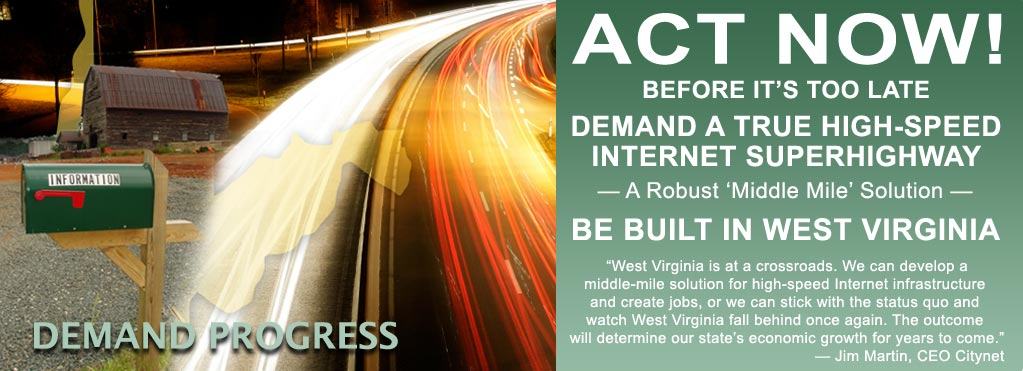
“West Virginia is at a crossroads,” Martin said in a prepared statement. “We can build a ‘middle-mile’ solution for high-speed Internet infrastructure and create jobs, or we can stick with the status quo and watch West Virginia fall behind once again. The outcome will determine our state’s economic growth for years to come.”

The state, according to Martin, is reneging on its promise to build a broadband network that will deliver improved service to institutional users as well as at least 700,000 homes and 110,000 business in the state.

Instead, the project would only serve 1,000 “points of interest,” he said. The state’s plan would limit Internet speeds and make broadband service unaffordable, Martin argues.

“If the state were to build a true middle-mile solution, then businesses and residential Internet customers would see a significant reduction in price, as well as an increase in quality, capacity and speed,” Martin said. “Regretfully, the state chose to support a plan that relies on outdated telephone lines and a monopoly.”

Of course, Citynet does have a vested interest in the outcome of the project.  As a provider specializing in selling bulk broadband lines, they would be a prime beneficiary of a government-backed middle-mile broadband network.  Citynet’s argument that funding should be spent primarily on that network ignores the reality few new entrants are likely to enter West Virginia’s rural broadband market, with or without the benefit of a robust broadband backbone.  One of the biggest flaws of broadband stimulus spending is that much of the money will never directly provide “last mile” access to individual consumers and businesses that want broadband service where none is available.

Citynet needs to acknowledge much of West Virginia’s broadband is going to come from the phone company or a local municipality that elects to build its own network.  While cable companies deliver service in larger cities and suburban areas, large swaths of the state will never be wired for cable.  In fact, West Virginia is poorly covered even by wireless companies who see little benefit building extensive cell tower networks in the notoriously mountainous areas of the state that serve few residents.  The only existing rural telecommunications infrastructure universally available is copper telephone wires.  Like it or not, Frontier Communications will be the biggest provider of broadband in rural West Virginia.  A fiber backbone network alone delivers minor benefits to those residents who either cannot connect at any broadband speed, or are stuck with Frontier’s current 1-3Mbps DSL service.

Still, Citynet’s campaign is a useful reminder that too many broadband stimulus projects direct most of their money to networks ordinary consumers and businesses will never access.  And so long as local governments, schools, and hospitals “get theirs,” they have little interest in fighting to share those networks with consumers and for-profit businesses.

Citynet produced two radio ads criticizing West Virginia’s allocation of broadband stimulus money, and Jim Martin appeared on a local radio show to explain to West Virginia why this issue matters. (Ads from 11/2010 — Interview with Jim Martin: September 16, 2010) (18 minutes)
You must remain on this page to hear the clip, or you can download the clip and listen later.

<

p style=”text-align: center;”>

Ultimately, Verizon may get the last word, even after they abandoned the state’s landline customers.  Charleston, the state capital, has been selected as one of the early communities to receive Verizon Wireless’ new 4G LTE wireless broadband network, according to WTRF-TV:

Verizon subscribers in Charleston with devices that are 4G compatible will see changes within the next six to seven weeks. The whole city is expected to be covered by the network by mid-2011, according to company officials. From there, it will be expanded to cover Huntington, Parkersburg, Wheeling, Weirton, Beckley, Clarksburg, Morgantown, Fairmont and Martinsburg by 2013.

The company also plans to expand coverage along the entire Interstate 79 corridor from Charleston to Clarksburg.

The decision to include Charleston among the 39 metropolitan areas where Verizon would deploy its 4G network left many analysts of the industry scratching their heads, although they noted in online posts that Rockefeller chairs the Senate committee that regulates the telecommunications industry.

Should West Virginians find Verizon Wireless a suitable replacement for their landlines, Frontier may have bought themselves a pig in the poke.

[flv width=”640″ height=”500″]http://www.phillipdampier.com/video/West Virginia Frontier 11-4-10.flv[/flv]

WTOV-TV covers the emergency services outage in northwestern West Virginia in two reports, WBOY-TV covers the Citynet-Frontier controversy, and WTRF-TV covers the arrival of Verizon’s LTE upgrade, starting with Charleston.  (7 minutes)

Search This Site:

Contributions:

Recent Comments:

Your Account:

Stop the Cap!