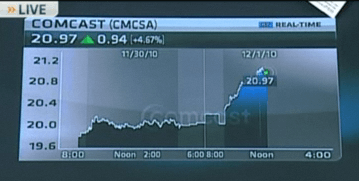
When the FCC delivers for Big Telecom's agenda, stocks soar. Comcast shares exploded on news the company could largely do as it pleases with its broadband service. (CNBC)
Comcast’s stock price soared today as Wall Street was cheered by news America’s largest cable operator would likely face little regulatory restraint from consumer protection policies designed to keep broadband providers from meddling with Internet traffic. But investors were also excited by the green light signaled by Federal Communications Commission chairman Julius Genachowski that launching Internet Overcharging schemes like “usage-based” billing, speed throttles and hard usage caps on broadband consumers was also acceptable marketplace behavior.
Craig Moffett, a Wall Street analyst with Sanford Bernstein said Genachowski’s remarks left the marketplace with little doubt it can get away with price increases and new limits on broadband consumption.
“The FCC here is expressly acknowledging the need to ration broadband, and that’s a really big deal,” said Moffett, appearing on CNBC this afternoon. “I think you are going to start to see usage-based pricing plans from the broadband providers pretty quickly.”
Moffett also acknowledged his firm’s own research showing consumers despise such pricing schemes and admits the impact on America’s broadband landscape is likely to include a dramatic shift in how customers use their Internet accounts.
“When customers think they are going to be charged when they click on that link and watch a movie, they are going to be inclined to watch fewer movies,” Moffett said. “You can’t expect linear progression of online video because there are going to be feedback loops like usage-based pricing that are going to limit usage.”
Moffett says cable operators are benefiting from Chairman Genachowski’s new approach because it opens the door to repricing wired broadband accounts to limit broadband consumption. Since most analysts guessed regulators would allow usage-based pricing to remain on wireless broadband, the unexpected green light for similar rationing plans on cable broadband, DSL, and other wired services was welcome news, at least for providers and Wall Street.
Consumers that don’t deliver a resounding negative response to elected officials, the FCC, and the White House better start thinking twice about clicking that YouTube video, because that few minutes could cost plenty if providers slap higher prices and limits on broadband service in the coming year.
[flv]http://www.phillipdampier.com/video/CNBC The Fight for Your Right to Surf the Web 12-1-10.flv[/flv]
A Wall Street telecom analyst predicts the end of unlimited home broadband accounts is going to come quickly, now that the FCC has capitulated on Net Neutrality policies. (3 minutes)
If you have nearly $200 a month burning a hole in your pocket that you’d be willing to give Time Warner Cable for a cable-TV, phone and broadband package, have we got a deal for you.
Time Warner Cable is completing a test of its Cadillac cable plan for ultra-premium customers in Charlotte, N.C. Dubbed “Signature Home,” the plan targets the cable company’s biggest spenders with a deluxe package of cable television, phone, Road Runner Wideband high speed Internet, two premium whole-home DVR units, and a wireless home network. Customers in Charlotte paid $179.95 a month for the service during the test. One of the conclusions apparently reached — Time Warner was not charging enough. As the service goes national, its price will increase by $10 a month for some, $20 for others, topping out just a nickel shy of $200 a month before taxes and fees.
For that price, customers get just about everything Time Warner Cable offers, except premium movie channels:
Personal Customer Service Team, 24/7
Convenient priority reservations
No-fee installation and customization of up to 13 devices, including TVs, computers, gaming and mobile phones
Specially trained Personal Solutions Advisors (PSA) available by phone and online chat
Digital Cable
Whole House DVR includes two networked
HD DVR set-top boxes
Storage for up to 150 hours of HD programming
or 400 hours of Standard Definition programming
Record up to 4 HD shows on 2 DVRs at once
Remote DVR Manager web-based application
to program your DVR via PC, Macintosh or any smartphone using the WAP2.0 protocol
Look Back® – Travel back three days in time
on your TV menu and non-recorded TV shows*
Start Over® – Restart non-recorded TV shows from the beginning*
Digital package with over 180 channels,
including HD and On Demand
Wideband Internet
Features the next generation Internet with the fastest speed available—up to 50 Mbps downloads and 5 Mbps uploads
Enables simultaneous downloading and uploading of photos and songs in seconds, movies in minutes
Family members can game, watch a movie and surf on various devices, all at the same time
Wireless home network with DOCSIS 3.0 modem with 802.11n wireless router included
Create up to 30 email addresses
Free Internet Security Suite, including Parental Controls and anti-virus software
Digital Home Phone
Home voicemail to email
Caller ID on PC and TV (requires AOL Instant Messenger)
Call forwarding
Two distinctive ring patterns—one for friends and family and one for everyone else
Unlimited nationwide calling, including Canada and Puerto Rico
Arris Touchstone® Telephony Modem
TM602G/TW-4
VoiceZone™ to screen and track calls and
check voicemail from any PC or Macintosh
Time Warner Cable expects to unveil the service in other areas of the country in a matter of weeks.
CEO Glenn Britt told Bloomberg News the targeted packages of services are designed to retain different classes of customers.
“If this were a BMW this would be the 750 IL, with all the whiz-bang things,” said Britt. “It’s our package with everything we have to offer and a different service experience all wrapped up in one.”
[flv width=”640″ height=”380″]http://www.phillipdampier.com/video/Signature Home Time Warner Cable East.flv[/flv]
Time Warner Cable produced a brief promotional video for Charlotte customers explaining the benefits of its new Signature Home service. (2 minutes)
A new report proves what Stop the Cap! has advocated for more than two years now — communities seeking the fastest, most-modern, and most aggressively priced broadband can get all of that and more… if they do it themselves.
The concept of community self-reliance for broadband has been dismissed and derided for years among small government conservatives and corporately-backed dollar-a-holler groups who claim government can’t manage anything, but when it comes to broadband in the state of North Carolina, the evidence is in and it is irrefutable — Tar Heel state residents are getting the most bang for their broadband buck from well-managed and smartly-run community-owned broadband networks.
Christopher Mitchell from the New Rules Project — part of the Institute for Local Self-Reliance, gathered evidence from North Carolina’s different broadband providers and found the best broadband services come from local communities who decided to build their own fiber networks. instead of relying on a handful of cable and phone companies who have kept the state lower in broadband rankings than it deserves.
North Carolina is undergoing a transition from a manufacturing and agricultural-based economy that used to employ hundreds of thousands of workers in textile, tobacco, and furniture manufacturing businesses. In the last quarter-century, the state has lost one in five jobs to Asian outsourcing and America kicking the tobacco habit. Its future depends on meeting the challenges of transitioning to a new digital economy, and major cities like Charlotte, Raleigh, and Greensboro have risen as well-recognized leaders in engineering, biotech, and finance.
But for rural and suburban North Carolina, success has been hindered by a lack of necessary infrastructure — particularly broadband for small businesses and entrepreneurs. It becomes impossible to attract high tech jobs to areas that are forced to rely entirely on low speed DSL service, if that is even available.
In communities like Wilson and Salisbury, long frustrated by area providers not delivering needed services, a decision was reached to build their own broadband infrastructure — modern fiber to the home networks worthy of the 21st century.
Mitchell’s report charts the benefits available to every resident, as communities with state-of-the-art fiber networks consistently deliver the most robust service at the lowest prices, all without risk to local taxpayers. Better still, when the network construction costs are paid back to bondholders, future profits generated by the community-owned systems will be plowed back into local communities to reduce tax burdens and keep service state-of-the-art.
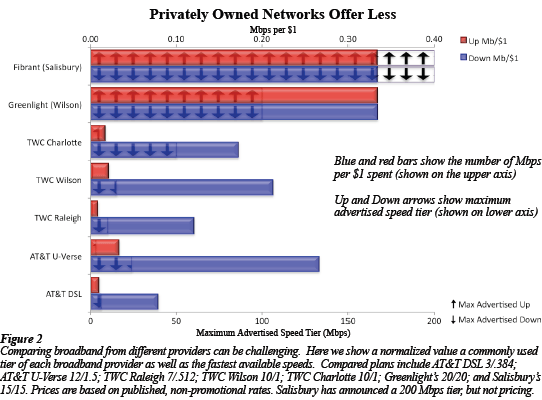
“Comparing the tiers of residential service from Wilson or Salisbury against the providers in the Raleigh area shows that the communities have invested in a network that offers far faster speeds for less money than any of the private providers,” Mitchell concludes. “Whether communities in North Carolina are competing against other states or internationally for jobs and quality of life, they are smart to consider investing in a community fiber network.”
Mitchell’s report arrives just a few weeks after voters handed North Carolina’s General Assembly to GOP control for the first time in more than a century. Both cable and phone companies in the state modestly suggest that is good news for their legislative agenda, which is an understatement equal in proportion to the historic handover of control of both the House (67-52) and the Senate (31-19). The top items on the agenda of incoming members is a checklist of conservative activist favorites, including a war on unions, mandatory ID cards for voting, opting the state out of recently enacted health care reform, an eminent domain constitutional amendment, sweeping deregulation reform to favor business interests, and redistricting to “restore fairness” in future elections.
The state’s big cable and phone companies are convinced with a list like that, they can come along for the legislative ride and get their agenda passed as “pro-business reform.” That means a much larger fight in 2011 for the inevitable return of corporate protection legislation banning exactly the kinds of municipal networks that are delivering North Carolina better, faster, and cheaper broadband.
Don’t want blazing fast fiber optic broadband speeds? Unhappy with fiber optic quality video and want to go back to putting a satellite dish on your roof? If the answer to either question is “yes,” Frontier Communications has good news for you.
The phone company, which assumed control of a handful of communities formerly served by Verizon’s fiber-to-the-home FiOS network, has announced it will begin marketing DSL and satellite TV services to its fiber customers.
Frontier CEO Maggie Wilderotter told investors on a third quarter results conference call that FiOS broadband could be too expensive.
Wilderotter noted Verizon would not allow customers in a FiOS neighborhood to buy DSL service, which leaves budget-minded customers behind.
“Now, FiOS starts at like 50Mbps and it’s very expensive. It’s like $50 a month for a customer. So they left a whole host of customers behind from an affordability perspective who didn’t need that kind of capability on broadband.” Wilderotter explained. “We have just over the last 30 to 60 days opened up DSL in all of the FiOS markets to give the customer choice. So the customer can choose whether they want FiOS broadband or they want high-speed Internet service, typically, and in those markets we’re offering around 6 to 7Mbps.”
Time Warner Cable occasionally runs promotions helping customers break free from Frontier's multi-year service contracts.
Of course, Frontier FiOS starts at 15Mbps — not 50, and that costs $50 a month for standalone service. For $99, ($89 in Verizon FiOS areas), customers can get broadband, cable TV and unlimited phone service. Frontier’s “Turbo” DSL service is priced at $40 a month for up to 7.1Mbps service.
Wilderotter also noted their FiOS customers can also choose to skip fiber video and go with DirecTV.
“We think that customers should be able to choose what kind of video they want,” she said. “We have aggressive offers in the market for both DirecTV and for FiOS video, but in our vernacular, what we care about is keeping the customer, getting the customer to take more products and services from us and making sure the customer is happy with the choice.”
Wilderotter said Frontier is prepared to tolerate more congestion on its DSL circuits than Verizon permitted, which opens the door to potential traffic slow-downs down the road.
“We’ve opened up in many of these locations the opportunity to sell high-speed service up to 95% capacity on the equipment that we have out in the field. Verizon had set a parameter at 75%,” Wilderotter said.
The company continues to study whether Frontier FiOS is worth maintaining or expanding outside of the Verizon territories where it was originally constructed.
“We are still evaluating it from a financial perspective and a customer perspective, and from a cost perspective and a revenue perspective,” Wilderotter told investors. “In terms of what that does for us overall, what it does for churn, how much does it really cost to extend this capability in the markets that we’re in today — we think that analysis and evaluation will go on through the first quarter [of 2011] and then we’ll be able to make some [decisions] in terms of what we want to do with FiOS from an expansion perspective or a maintenance perspective.”
Frontier Communications CEO Maggie Wilderotter answered questions about broadband expansion and the impact of the fall elections on telecommunications policy in Washington. (11 minutes)
You must remain on this page to hear the clip, or you can download the clip and listen later.
<
p style=”text-align: center;”>
Frontier's largely rural service areas provide a captive audience for the company's DSL broadband service.
In the near term Frontier has several plans to get more aggressive in the marketplace to meet its target goal of losing only 8 percent of their customers per year — a goal that illustrates legacy phone companies are still on a trajectory towards fewer and fewer customers:
Don Shassian, executive vice president and chief financial officer of Frontier reports expansion of DSL remains a top priority for Frontier. The company is on track to deliver access to 300,000 additional homes by the end of the year. Verizon delivered access to 64 percent of Frontier’s acquired territories. Frontier wants to get that number up to 85 percent. But part of that target is not just expanding service to unserved areas. It’s also trying to win back customers lost to other providers through promotions and incentives.
Frontier plans to resume aggressive promotions in the coming weeks and months, including its “free Netbook” promotion, which provides a Netbook computer to new customers signing up for several packages of services, committing to remain with Frontier for at least two years.
Frontier intends to push “price protection agreements” on as many customers as possible. Their “Peace of Mind” program locks customers into multi-year contracts with stiff cancellation penalties. Wilderotter noted: “I think, as you know, in our legacy markets, 96% of all of our sales are on a price protection plan and we have close to 60% of our residential customers on a one-, two- or three-year price protection plans. That number is below 15% in the acquired markets. So we’re also driving for price protection plans with every sale that we’re doing in these new markets as well.” Such contracts dramatically discourage a customer from disconnecting Frontier, because fees for doing so can exceed $300 in some cases. Frontier has been heavily criticized by some customers and State Attorneys General for deceptive business practices regarding contracts.
Frontier continues to enjoy a lack of solid cable competition in its largely rural service areas. Shassian reports Comcast competes with Frontier in only about 32% of homes in some areas, Time Warner Cable in about 23%, and Charter below 15%. With reduced competition, Frontier often represents the only broadband option in town.
Frontier is also spending an increased amount of time coping with copper thefts, especially in West Virginia where the company is warning would-be thieves it will prosecute to the fullest extent of the law.
“Damage to our facilities can affect communications access in an emergency, increase company costs and consumer rates, and disrupt community phone and broadband connections,” said Lynne Monaco, Frontier’s Director of Security. “When network connections are severed by copper thieves, it endangers customers and emergency responders and poses significant risks of personal injury and property damage.”
Just last week, West Virginia state police solved another copper caper that disrupted service for some customers.
The Charleston Daily Mail reports:
Stephanie Burdette of Charleston was arrested in connection with a copper wire theft.
Trooper A.B. Ward from the South Charleston detachment went to the Fishers Branch area of Sissonville last Thursday afternoon when a Frontier worker discovered a section of the communications line missing. The worker found that 300-feet of the 400-pair line, valued at about $5,000, was missing, according to a complaint filed in Kanawha Magistrate Court.
A trooper who had worked on a similar investigation told Ward to check the home of Ervin “Tubby” Page, 49, where troopers had previously found evidence of wire burning. Ward went to Page’s home, described as a Goose Neck travel trailer parked next to the Guthrie Agricultural Center in Sissonville, and found three burn barrels about 50 feet in front of the trailer. One of them was on fire.
Page’s girlfriend Stephanie Marie Burdette, 25, of Cross Lanes, was at the scene when the trooper arrived. Ward spoke to her then checked out the barrels where he found aluminum wrap, which is used to cover the copper communications wiring, and pieces of copper cabling, the complaint said.
Frontier customers are encouraged to report any suspicious activity around telecommunications equipment and facilities by calling the company’s toll free security line 1-800-590-6605. Anyone witnessing a theft in progress should not confront the suspects but should immediately call 911 and then call Frontier. Vehicle and suspect descriptions are very useful. This is a community safety problem, and the cooperation of the public is critical.
Time Warner Cable customers in North Carolina are getting rate hike letters from the cable company that foreshadows what other Time Warner Cable customers around the country can expect in the coming months.
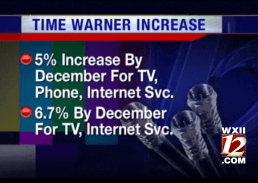
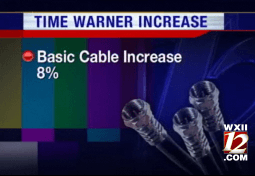
For residents in Charlotte and the Triad region, Time Warner is boosting prices for unbundled customers an average of six percent, which will impact customers not on promotional plans or who are not locked into a “price protection agreement.”
The rate increases particularly target standalone service customers. Those with the fewest services will pay the biggest increases. Those who subscribe to cable, phone, and broadband service from the company will suffer the least.
A Time Warner Cable spokesman claimed the company is just passing on the cost of programming.
WXII-TV in Greensboro reported that for many customers already struggling with their bills, they don’t want to hear anything about a price hike.
“I think it’s ridiculous at this time with the economy — it’s hard to make it as it is,” one customer told the station.
“I wish there was a better option out there, but it’s about the only thing you can get,” said another viewer.
Time Warner has been developing pricing models that increasingly push customers towards bundled packages of services. Standalone broadband service saw dramatic price increases in many areas in 2010, and the company’s most aggressive new customer promotions encourage customers to take all three of its services.
But broadband customers need not expose themselves to inflated broadband prices for standalone service. Most Time Warner Cable franchises offer Earthlink broadband at comparable speeds at prices as low as $29.95 per month for the first six months. When the promotion expires, customers can switch back to Road Runner at Time Warner’s promotional price.
Time Warner does face competition in some areas of North Carolina from AT&T U-verse, which offers attractive promotional pricing for new customers. But the phone company’s broadband speeds come up short after Time Warner boosted speeds across much of the state. The cable company now delivers Road Runner at speeds of up to 50/5Mbps. AT&T tops out at 24Mbps, and not in every area.
When a competitor can’t deliver the fastest speeds, they inevitably claim consumers don’t want or care about super-fast broadband.
“We are focused on offering the broadband speeds that our customers need, at a price that they can afford,” said AT&T spokeswoman Gretchen Schultz.
Greenlight promotes its local connection to Wilson residents
Some North Carolina consumers are watching AT&T’s slower speeds and Time Warner’s price hikes from the sidelines, because they are signed up with municipal competitors.
Residents in Wilson with Greenlight service from the city don’t have to sign a contract to get the best prices and obtain service run and maintained by Wilson-area employees. The provider has embarked on a campaign to remind residents that money spent on the city-owned provider stays in the city.
In Salisbury, Fibrant is making headway against incumbent Time Warner as it works through a waiting list for customers anxious to cut Time Warner’s cable for good. Fibrant customers are assured they’ll always get the fastest possible service in town on a network capable of delivering up to 1Gbps to businesses -and- residents.
MI-Connection, the rebuilt former Adelphia cable system now owned by a group of local municipalities is managing to keep up with Time Warner with its own top broadband speeds of 20/2Mbps. The system is comparable to a traditional cable operator and does not provide fiber to the home service. Its 15,000 customers in Mooresville, Cornelius and Davidson are likely to stay with the system, but it is vulnerable to Time Warner’s bragging rights made possible from DOCSIS 3 upgrades. Since Time Warner does not provide service in most of MI-Connection’s service area, city officials don’t face an exodus of departing customers.
But that could eventually change. Some MI-Connection customers have reported to Stop the Cap! they have begun to receive promotional literature from Time Warner Cable for the first time, and there are growing questions whether the cable company may plan to invade some of MI-Connection’s more affluent service areas. Cable companies generally refuse to compete with each other, but all bets are off when that cable company is owned by a local municipality.
For most North Carolina residents, AT&T will likely be the first wired competitor, with its U-verse system. To date, U-verse has drawn mixed reviews from North Carolina consumers. Many appreciate AT&T’s broadband network is currently less congested than Road Runner, and speeds promised are closer to reality on U-verse compared with Road Runner during the early evening. But some AT&T customers are not thrilled being nickle-and-dimed for HD channels Time Warner bundles with its digital cable service at no additional charge. And for households with a lot of users, AT&T can run short on bandwidth.
“We have five kids — three now teenagers, and between my husband’s Internet usage and me recording a whole bunch of shows to watch later, we have run into messages on U-verse telling us we are trying to do too much and certain TV sets won’t work until we reduce our usage,” writes Angela. “AT&T doesn’t tell you that you all share a preset amount of bandwidth which gets divided up and if you use it up, services stop working.”
Angela says when she called AT&T, the company gave her a $15 credit for her inconvenience, and the company claims it is working on ways to eliminate these limits in particularly active households. For now, the family is sticking with U-verse because the broadband works better in the evenings and she loves the DVR which records more shows at once than Time Warner offers. Their U-verse new customer promotional offer saves them $35 a month over Time Warner, at least until it expires.
“From reading about Fibrant and Greenlight on your site, my husband still wishes we lived in Salisbury or Wilson because nothing beats fiber, but at least what we have is better than what we used to have,” she adds.
Be Sure to Read Part One: Astroturf Overload — Broadband for America = One Giant Industry Front Group for an important introduction to what this super-sized industry front group is all about. Members of Broadband for America Red: A company or group actively engaging in anti-consumer lobbying, opposes Net Neutrality, supports Internet Overcharging, belongs to […]
Astroturf: One of the underhanded tactics increasingly being used by telecom companies is “Astroturf lobbying” – creating front groups that try to mimic true grassroots, but that are all about corporate money, not citizen power. Astroturf lobbying is hardly a new approach. Senator Lloyd Bentsen is credited with coining the term in the 1980s to […]
Hong Kong remains bullish on broadband. Despite the economic downturn, City Telecom continues to invest millions in constructing one of Hong Kong’s largest fiber optic broadband networks, providing fiber to the home connections to residents. City Telecom’s HK Broadband service relies on an all-fiber optic network, and has been dubbed “the Verizon FiOS of Hong […]
BendBroadband, a small provider serving central Oregon, breathlessly announced the imminent launch of new higher speed broadband service for its customers after completing an upgrade to DOCSIS 3. Along with the launch announcement came a new logo of a sprinting dog the company attaches its new tagline to: “We’re the local dog. We better be […]
Stop the Cap! reader Rick has been educating me about some of the new-found aggression by Shaw Communications, one of western Canada’s largest telecommunications companies, in expanding its business reach across Canada. Woe to those who get in the way. Novus Entertainment is already familiar with this story. As Stop the Cap! reported previously, Shaw […]
The Canadian Radio-television Telecommunications Commission, the Canadian equivalent of the Federal Communications Commission in Washington, may be forced to consider American broadband policy before defining Net Neutrality and its role in Canadian broadband, according to an article published today in The Globe & Mail. [FCC Chairman Julius Genachowski’s] proposal – to codify and enforce some […]
In March 2000, two cable magnates sat down for the cable industry equivalent of My Dinner With Andre. Fine wine, beautiful table linens, an exquisite meal, and a Monopoly board with pieces swapped back and forth representing hundreds of thousands of Canadian consumers. Ted Rogers and Jim Shaw drew a line on the western Ontario […]
Just like FairPoint Communications, the Towering Inferno of phone companies haunting New England, Frontier Communications is making a whole lot of promises to state regulators and consumers, if they’ll only support the deal to transfer ownership of phone service from Verizon to them. This time, Frontier is issuing a self-serving press release touting their investment […]
I see it took all of five minutes for George Ou and his friends at Digital Society to be swayed by the tunnel vision myopia of last week’s latest effort to justify Internet Overcharging schemes. Until recently, I’ve always rationalized my distain for smaller usage caps by ignoring the fact that I’m being subsidized by […]
In 2007, we took our first major trip away from western New York in 20 years and spent two weeks an hour away from Calgary, Alberta. After two weeks in Kananaskis Country, Banff, Calgary, and other spots all over southern Alberta, we came away with the Good, the Bad, and the Ugly: The Good Alberta […]
A federal appeals court in Washington has struck down, for a second time, a rulemaking by the Federal Communications Commission to limit the size of the nation’s largest cable operators to 30% of the nation’s pay television marketplace, calling the rule “arbitrary and capricious.” The 30% rule, designed to keep no single company from controlling […]
Less than half of Americans surveyed by PC Magazine report they are very satisfied with the broadband speed delivered by their Internet service provider. PC Magazine released a comprehensive study this month on speed, provider satisfaction, and consumer opinions about the state of broadband in their community. The publisher sampled more than 17,000 participants, checking […]


 Subscribe