Home » Broadband Speed » Recent Articles:

AT&T: Our 3G Network Can’t Take It Anymore, Adds Expanded Wi-Fi Hotzone in NYC’s Times Square

Just in time for New Year’s Eve, AT&T is pushing revelers off its 3G network onto a newly expanded Wi-Fi hotzone that encompasses Times Square.

It’s all part of AT&T’s plans to improve connectivity for smartphone customers enduring the company’s overburdened 3G network.  A year ago, it could take 10 minutes or more for an AT&T smartphone user in a crowd to bring up a single web page.  That’s because too many other AT&T customers were trying to do the same thing at the same time.

In Times Square, where an estimated one million people are expected to ring in the new year, it’s a safe bet more than 200,000 AT&T customers will try and upload photos and send New Year greetings to friends and family back home.  They’ll have a better chance of success using AT&T’s Wi-Fi.

[flv width=”640″ height=”500″]http://www.phillipdampier.com/video/ATT Expands Wi-Fi Hotzones Connections in United States 12-28-10.flv[/flv]

An AT&T social media representative introduces the new hotzone in Times Square.  (1 minute)

AT&T has been installing hotzones, accessible by their customers, in large gathering spots in cities like New York, Chicago, and San Francisco to address complaints from customers about network congestion.

“Our initial AT&T Wi-Fi hotzones have received great customer response and supported high data traffic,” says John Donovan, AT&T’s chief technology officer. “The pilot demonstrated the clear benefits of having fast and readily-available Wi-Fi options for our customers and our network, and so we have decided to deploy hotzones in more locations.”

AT&T’s outdoor hotzones typically deliver a signal across several city blocks and are intended for those on the go.  They join more than 20,000 indoor Wi-Fi hotspots already accessible to AT&T customers.

A strong Wi-Fi signal means reduced battery consumption and faster speeds.  And unlike AT&T’s 3G network, using Wi-Fi won’t eat into your monthly usage allowance, a major issue for those facing AT&T’s Internet Overcharging scheme on the wireless side, which delivers only 2GB of service per month before overlimit fees kick in.

But Wi-Fi alone cannot work miracles, and AT&T has no idea whether the hotzone in Times Square will have enough capacity to meet customer needs.  But the company is satisfied that it will certainly help, which is why it plans to continue installing the outdoor networks in other high volume areas.

Verizon Wireless already operates its own Wi-Fi network in Times Square for many of the same reasons.

[flv width=”640″ height=”380″]http://www.phillipdampier.com/video/ATT Wi-Fi.flv[/flv]

AT&T explains how to use their Wi-Fi network.  (5 minutes)
Cablevision, New Owner of Bresnan Cable, Promises Broadband Upgrades in Montana and Wyoming

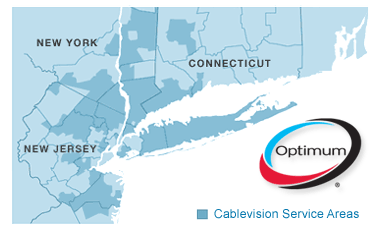
The cable company best known for serving suburban New York City has gone west with the purchase of Bresnan Communications

The new owner of Bresnan Communications is promising customers in Montana and Wyoming an end to anemic broadband service, but subscribers wonder who is going to pay for it.

Bethpage, N.Y.-based Cablevision is telling subscribers upgrades are on the way to bring faster broadband, better cable and phone service to 300,000 Mountain West customers formerly served by Bresnan.

John Bickham, president of Cable & Communications for Cablevision, told readers of the Billings Gazette improvements would arrive over the next year-and-a-half:

We’re going to start by increasing the number of high-definition channels we provide, with a goal of providing more than 100 free HD channels over the next 18 months. We will also be adding more movie choices and more free video-on-demand titles, including prime-time shows from leading broadcast networks.

High-speed Internet service in the towns we serve is going to get faster. Over the next 18 months, we will upgrade the speeds of our basic level of Internet service to up to 15 megabits per second, nearly double what they are today. And with our award-winning and top-rated phone service, we will be adding even more features, functions and value to the phone service available in these communities today, including access to an innovative Web site to manage account preferences, review calling records or check voice mail from any computer.

For many subscribers, the improvements cannot come soon enough.

One reader in Jackson Hole, Wyo., said Bresnan rarely provided broadband service at the advertised rates, noting their 8Mbps service really was closer to 3-4Mbps.

But residents in both Wyoming and Montana warn that if Cablevision plans to manage all of the spiffy upgrades with a rate increase, they’ll cancel.

“I’ll be watching my bill. If it goes up because of all these changes, I’ll drop you in a heartbeat,” wrote one Montana customer.

Will Providers Charge Consumers More Without Real Net Neutrality? ‘Uhhh…,’ Says Wall Street Analyst

Phillip Dampier December 23, 2010 AT&T, Broadband Speed, Consumer News, Editorial & Site News, Net Neutrality, Public Policy & Gov't, Video, Wireless Broadband Comments Off on Will Providers Charge Consumers More Without Real Net Neutrality? ‘Uhhh…,’ Says Wall Street Analyst

[flv width=”640″ height=”500″]http://www.phillipdampier.com/video/Bloomberg Oppenheimer Declares Net Neutrality A Victory for Consumers 12-21-10.flv[/flv]

Wall Street continues to consider Monday’s lukewarm Net Neutrality regulations to be a victory for AT&T and other providers.  Bloomberg News asked Tim Horan, an analyst at Oppenheimer & Co., whether the impact of Net Neutrality would be higher prices for consumers.  “Uhhh,” began the stumbling reply.  Watch as Oppenheimer tries to get back on board with provider-generated talking points, eventually declaring the almost non-existent protections “a victory for consumers.”  Do you think he really believes that?  (3 minutes)

Your Net Neutrality Primer: CNN’s Ali Velshi Breaks It All Down

[flv width=”640″ height=”380″]http://www.phillipdampier.com/video/CNN Net Neutrality Primer 12-21-10.flv[/flv]

For those who may not fully grasp Net Neutrality, CNN’s Ali Velshi delivered a primer that helps explain how Internet traffic moves, how providers want to manage that traffic, and the implications of not enforcing robust Net Neutrality.  Velshi’s explanation delivers both sides of the argument with only a few minor errors.  We’d remind him consumers already paid for the big pipe depicted in the video.  Consumers should not have to pay twice for the same thing.  Less useful is CNNMoney Staff Writer David Goldman, who got several points wrong, especially about wireless. (8 minutes)

Salisbury’s Fibrant Proposes Near-‘Turn-Key’ Headend Network for Community Fiber Projects

Phillip Dampier December 16, 2010 Broadband Speed, Community Networks, Competition, Fibrant, Public Policy & Gov't, Video, WOW! Comments Off on Salisbury’s Fibrant Proposes Near-‘Turn-Key’ Headend Network for Community Fiber Projects

Crowell

Fibrant, Salisbury, N.C., community-owned fiber to the home network, shares advice to other communities considering building their own self-reliant, locally-owned broadband networks: work together and outsource the headend.

Christopher Mitchell from Community Broadband Networks alerted us to a video from TelecomTV interviewing Michael Crowell, Fibrant’s Director of Broadband Services.  In it, Crowell shows off Fibrant’s GPON fiber network and explains what the city has learned from the experience of building its own network.

Ironically, a significant part of Fibrant’s network came cheap thanks to Windstream.  It seems what the residents of Salisbury won was also a loss for those living in Concord, N.C.

Crowell explains Concord was served by a small independent phone company — Concord Telephone.  They had decided to build their customers an advanced fiber to the home network similar to Fibrant, until the company was sold to Windstream.  Windstream has no interest in delivering world-class fiber broadband to Concord (or anywhere else), and left Concord with dismal DSL, selling the fiber network equipment to Salisbury dirt cheap — for around 10 cents on the dollar.

But not everything has come so easy to Fibrant, says Crowell.  One of the company’s largest expenses is its headend, which receives, monitors, and distributes the hundreds of video channels Fibrant customers receive.

“What we think would be a better model going forward is for the other cities and counties to do what is called an open access network.  They build and maintain the fiber but get other providers to provide the service,” Crowell said.

Crowell proposes allowing the state’s two largest municipal broadband projects — Wilson in the east and Salisbury in the central-west part of the state, handle the headend, as well as customer service calls and billing on behalf of other communities interested in building their own municipal fiber networks.  Both cities can deliver bulk feeds of video channels to different parts of the state and that saves other communities from spending money to hire employees to monitor redundant, expensive equipment.

That is more or less what is happening further south in Opelika, Ala., where work is underway constructing a fiber to the home network.  But in Opelika, city officials have decided to let cable overbuilder Knology run the network.

Knology’s network is already up and running in nearby Auburn, according to Royce Ard, general manager for Knology.  Ard told WRBL TV:

“We met our scheduled date for installing our first Auburn test customers and the test is progressing nicely. We will begin adding our first paying customers by the end of October,” Ard said. “Initially, our services will be available in a limited number of neighborhoods, but as we build out our network we will contact homeowners and let them know when services are available in their area.”

Knology projects being able to offer service to its first Opelika customers by the second quarter of 2011.

“Knology is very excited about entering the Opelika market,” Ard said. “The technology that we are deploying in the Auburn/Opelika markets will allow us to offer consumers a much better product than they have today. This, along with Knology’s commitment to customer service, will greatly improve the overall experience for consumers in Auburn and Opelika.”

[flv width=”512″ height=”308″]http://www.phillipdampier.com/video/Salisbury Discusses Motivation Behind Fibrant on TelecomTV 12-16-10.flv[/flv]

Fibrant’s Michael Crowell, interviewed by TelecomTV, walks viewers through Fibrant’s fiber network and discusses community-owned fiber networks.  (7 minutes)

Search This Site:

Contributions:

Recent Comments:

Your Account:

Stop the Cap!